Jump to content

Nickfromwales

Members
  • Posts

    30681
  • Joined

  • Last visited

  • Days Won

    310

Everything posted by Nickfromwales

  1. Apparently not the best for stratification. Iirc it was posted about on EB briefly.
  2. No wonder you extended ......I mean
  3. Sorry I can't recall, but have you lost all,of the roof space to the flying mice?
  4. From what my small brain can ascertain, those plates are as strong, if not stronger, than the actual points elsewhere in timber. I consider those to be continuous uninterrupted members. If they weren't then the joints would have to be manufactured to land on pad stones or steels / supporting walls wouldn't they ?
  5. I use Harris stuff where it matters. For obliteration with the Leyland stuff it really doesn't matter as that paint shouldn't be your final finish e.g. you should be sanding that back prior to applying 2 coats of a quality durable paint. The Leyland is most definitely NOT a durable paint btw, it's just a high opacity filler for obliterating new plaster to white / mag. It's on the final coats that you want to spend out on a decent roller unless it's just the size you're worried about for speedier coverage? In which case stick with a cheaper roller and just move your arms faster
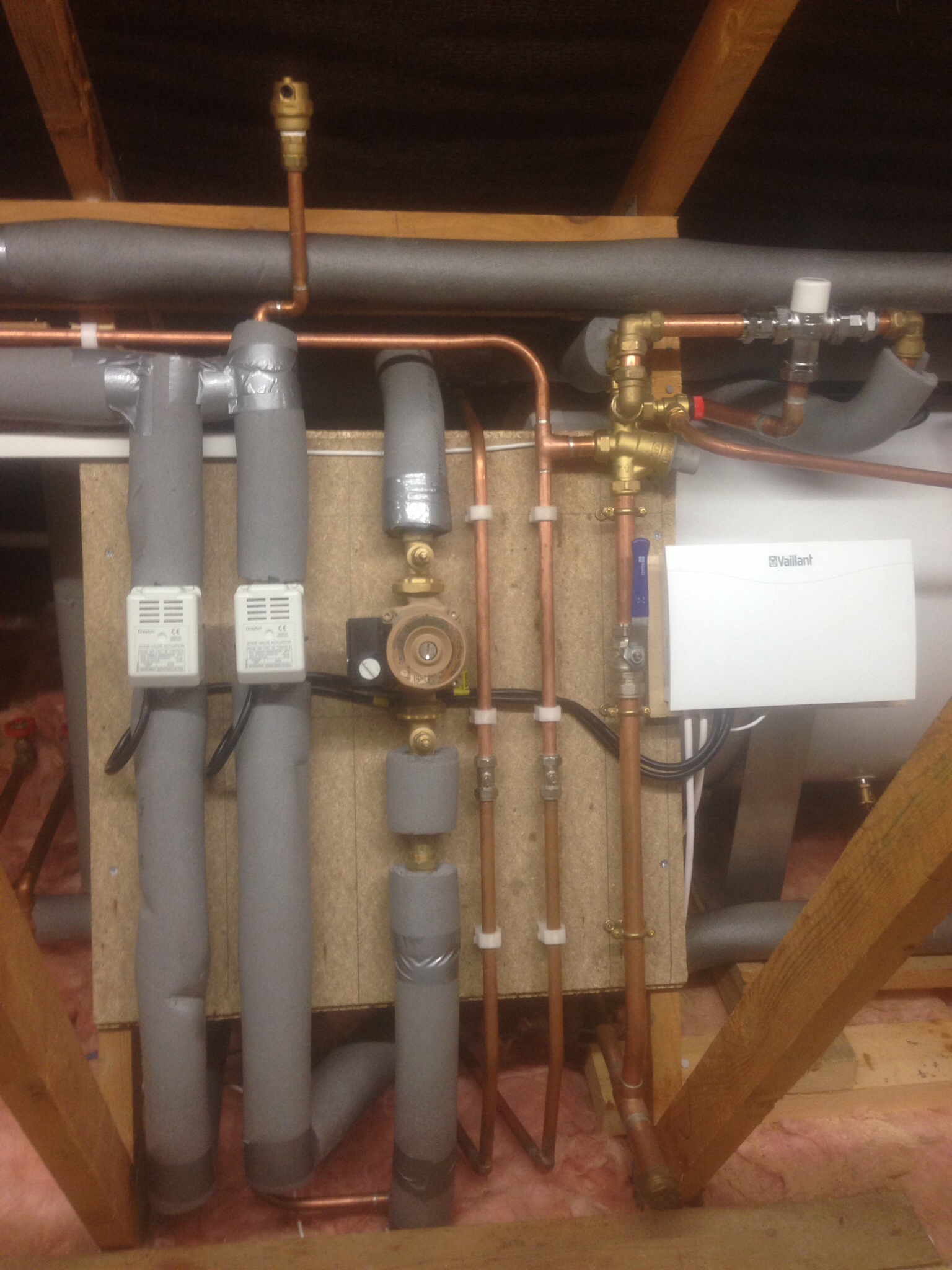
  6. Either by looping the pipe up behind or by fitting a bend and a male to female ( M&F ) bend back to back. This is mostly done on site to speed up a build, and is very typical of mass produced or commercial builds. Then the pipe goes behind the rad and into one of these angled rad unions.
  7. The trusses won't need replacing IMO. If they do, I'll be beyond shocked. At the worst they'll need an in-situ repair as suggested above. They'll be over engineered already, so will have a good bit of headroom in them. Please keep this updated though, as it's a good reference for anyone about to get trades in. Oh, and tell your sister not to start removing the sharp objects from the house quite yet
  8. Thanks Dave. that wasn't meant the wrong way and I know what you're saying. Off the record, about the truss thread, I would bet my left nad that there would never be any issue, ever, with those trusses. They're going to have been over engineered anyway and even though the manufacturers will want to cover their arses, I'd be beyond shocked if there was even a hint of a failure tbh. I've seen joists like that with 2"x4" cut outs and worse, yet they've been there for years without issue, and are still there as I type this. This is based on me seeing literally hundreds of these scenarios, not just from me making an assumption. Rules are there to be followed, of course, and any trade will be ( or should be ) aware of joist rules in their most basic form, so these guys should have checked first and drilled after. They've gone in the wrong way, and may have to face the consequences. The difference between them and me is I stop, assess, and engineer a solution rather than just crack on. If I think it needs the Feds involving, then in they come. What does shock me is the number of customers who will stop going ahead with a knock through etc when I say an SE will cost around £350 and the BCO sign off will be around the same ( when my price for a wall-down steel-in is around £1500 before professional fees ), and then when they find out they have to pay half that again for the sign off they say no thanks. I know then they'll go to someone who will just do the job regardless and they'll smile just the same for the job with no recourse. As with everything, there is wheat and there is chaff.
  9. Go to the manufacturers installation guide for your chosen gas burning appliance and it'll all be in there to the mm
  10. Ok. Just switched my iCloud picture sharing back on.....hadn't realised it was off. Bloody kids. the perspective makes it all look out of square but it's just because it was a close up. That's the way I pipe rads up. I'm not a fan of the bent irons in the valve with the pushfit going in tbh. Looks lazy to me These were rads I fitted on the last kitchen fit, either side of the wine servery so had to look good 18 bags of self leveller went in under that oak floor. 0-19mm over 3 metres.
  11. You wouldn't want to create high spots / points by going up behind each rad and then back down to the valve. That would, particularly with Microbore and its lower velocity, create air locks. I come up from underneath directly on the centre of the rad valve and have a small piece of pipe between the wall and the valve. I know this is a towel rad, but same principle. Same thing just 15mm and chrome. You can get 10mm white plastic covers and pull bends in the 10mm copper to make them look as neat as possible.
  12. I just can't stand having different light fittings in the same ceiling space. Why not change the discipline so you can have all matching, regardless of zone . ? for me it's almost always day / cool white. Makes a clean sharp bathroom bright and clean looking. Warm white has a far too yellow tint to it so isn't as nice imho. It can be nice if you've exclusively used natural tiles / themes but that limits their use-ability.
  13. I can tell you that I left that stronger than when I got there. I cut below the top plate and above the lower one in order to get the cylinder in. One timber got cut only. The new support timber was sistered over the original piece which I reinstated, and the additional support timber was thicker and wider that the truss section that I cut out btw. It was fixed above the top plate ( into the roof rafter ) and below the bottom plate ( into the ceiling joists ) so I'll sleep as soundly tonight as I did last night. PL a-plenty but not needed it in over a decade ( when I took the policy out first ). I have a strict rule, don't touch it unless you can make it the same, or better. I strive for the latter in everything I do.
  14. Ripping another f'kd bathroom out at the mo ( yes on a bank holiday, don't rub it in ) so I'll add to this later when I'm sipping a cold one
  15. 3 graded 4x2's on flat holding the stainless cradles. And yes, the upright was cut out entirely ( couple of inches short of the plates iirc ) and then the original piece fitted back in to fill the gap back up ( to stave off compression force) and a bigger timber screwed in to sister and reinforce. The idea is that the entire cylinder can be removed with a pair of adjustable spanners and a cordless drill in less than 30 mins. Work of art that one. The customer said it reminded him of a ship's boiler room . I did that so it didn't impede on the storage space in the attic, which I created by removing the original timber raft and multiple cold water storage tanks etc. I fitted 3 X 6' fluos and boarded the whole thing in weyroc plus cut out and oversized the original attic hatch to fit a Fakro ladder. Great pieces of kit. NOTE : Fyi if you put a boiler or cylinder up an attic and you ever require a manufacturer visit for inspection / repair / replacement etc then you MUST have a FIXED ladder, continuous and sufficient boarding of the floors to gain safe access and it must be lit. Anything less and they'll walk out the door. They WILL NOT go up a free standing step ladder.
  16. That filler looks quite bulky try this one as that's what I bought for my bath.
  17. Easy tiger. I really, really think you need a chill pill on the access issues. Once the bath is in you'll never see them again. How about putting isolation valves in the attic and just coming down and going direct? I do this for a living and personally dislike isolating valve on baths and showers as they tend to restrict the flow a bit plus I can't ever think where they would have been 1) necessary or 2) handy when it's just a 2 second job to knock the mains off and drain down. The overflow fillers do stick out a bit and your bath is quite pronounced there so maybe just go for the overflow there ( deep breath ) and find a way to connect to the water jet system so it backfills through them ( I'll get my tin hat ready ). Only problem will be washing goop out but if you tee into that somehow it might be quite cool. You'd need additional double check valves for protection against cross contamination but just a thought.
  18. Couldn't you still ditch the taps for a combined overflow filler? Hot and cold taps but no spout?
  19. Solar thermal water heating would be a waste of money IMO. Just a one trick pony, very inefficient for high temp recovery and a pita to look after. Spend every penny of that money on a small PV array, and add to it as time goes on ( if the budget doesn't allow for a full array now of course ). If you've got oil and Ufh, then the two aren't matched very well for starters, as the boiler is either going flat out or off and Ufh cannot consume the heat as quickly as the boiler produces it. The way to deal with that is to either use a small buffer tank on the feed to the Ufh, with the boiler pulsing high grade heat into that where it is temporarily stored, and then allow the Ufh to trickle feed off that, or you fit a TS. The TS will provide a means of regulating the heat from the boiler to the Ufh very well, as would the buffer option, with the difference being that the TS will also provide instant constant dhw. A TS will give very high flow rates and would be a better option for later down the line when you find that dhw demand goes up. An UVC will always be restricted in output by its size, but not so with a TS when served ( on demand ) by a high temp heat source ( such as an oil boiler ). Size wise, you'd probably need a 400ltr TS to manage with this size of property ( number of bathrooms vs occupants ) to ensure peak dhw production. The heating requirement is really neither here nor there btw. I'd look at putting the TS in store 1, and the Ufh manifolds etc in store 2. Expansion vessels can go in the attic out of the way, and that'll be around 70-80 litres for a system like this so quite significant. A pair of 35ltr vessels is easier to manage than one 70ltr, and the oil system boiler will have between 18 and 24 ltrs expansion internally so will take you to the required volume with a bit of headroom. Exact calcs for this sizing can ( and must ) be done later when you settle on a design. Have the manifolds for hot and cold water as close to the TS as possible like this. That's a 500ltr TS and a 300 ltr cold mains accumulator.
  20. Low energy means ideal candidate for an ashp. To that, couple up a large low temp pre- heat TS and then to a secondary instant heater such as a Sunamp. Without an accurate account of the additional needs of the occupants it's hard to specify, but it sounds like a few other 'tweaks' could be made to get the extra capacity. Need to find out if it's showering or bathing first though.
  21. Personally, I despise the IP65 spots in bathrooms. To avoid that requirement I'd go for 12v led lamps with one whopper, or multiples of smaller transformers and do a way with those horrible tunnel like fittings. They harbour all sorts of dirt dust and grot and have next to zero dispersion so give a very unsympathetic spot of light.
  22. An UVC has a coil that introduces heat, and the cylinder is full of the heated water that will flow out of your taps. A TS is full of central heating ( primary ) water, and has a coil to glean heat in order to produce dhw instantaneously.
  23. That's belt and braces, but IMO moot as the heat will remain captured above the fitting anyway. The 230v fittings get hot to the touch but when encapsulated in a fire rated spotlight are negligible at best.
  24. They run pretty cool compared to halogen, which run at ~200oC, so are not that problematic with wool insulation. Just push it up and away prior to fitting and job done.
  25. Plenty of room to go in the attic if you'd rather keep the cupboards for clothes / storage etc. That's the last horizontal UVC, but there's no HZ TS's
×
×
  • Create New...