

Nickfromwales
-
Posts
31382 -
Joined
-
Last visited
-
Days Won
346
Everything posted by Nickfromwales
-
Was it 'signed off' ?
-
Don't be TOO specific please. We hate it when that happens It was with respects to estimating the increased running costs ( losses ) vs time and then for us to recommend whether it's worth the extra effort and £ input.
-
How long do you really expect to live in the property ?
-
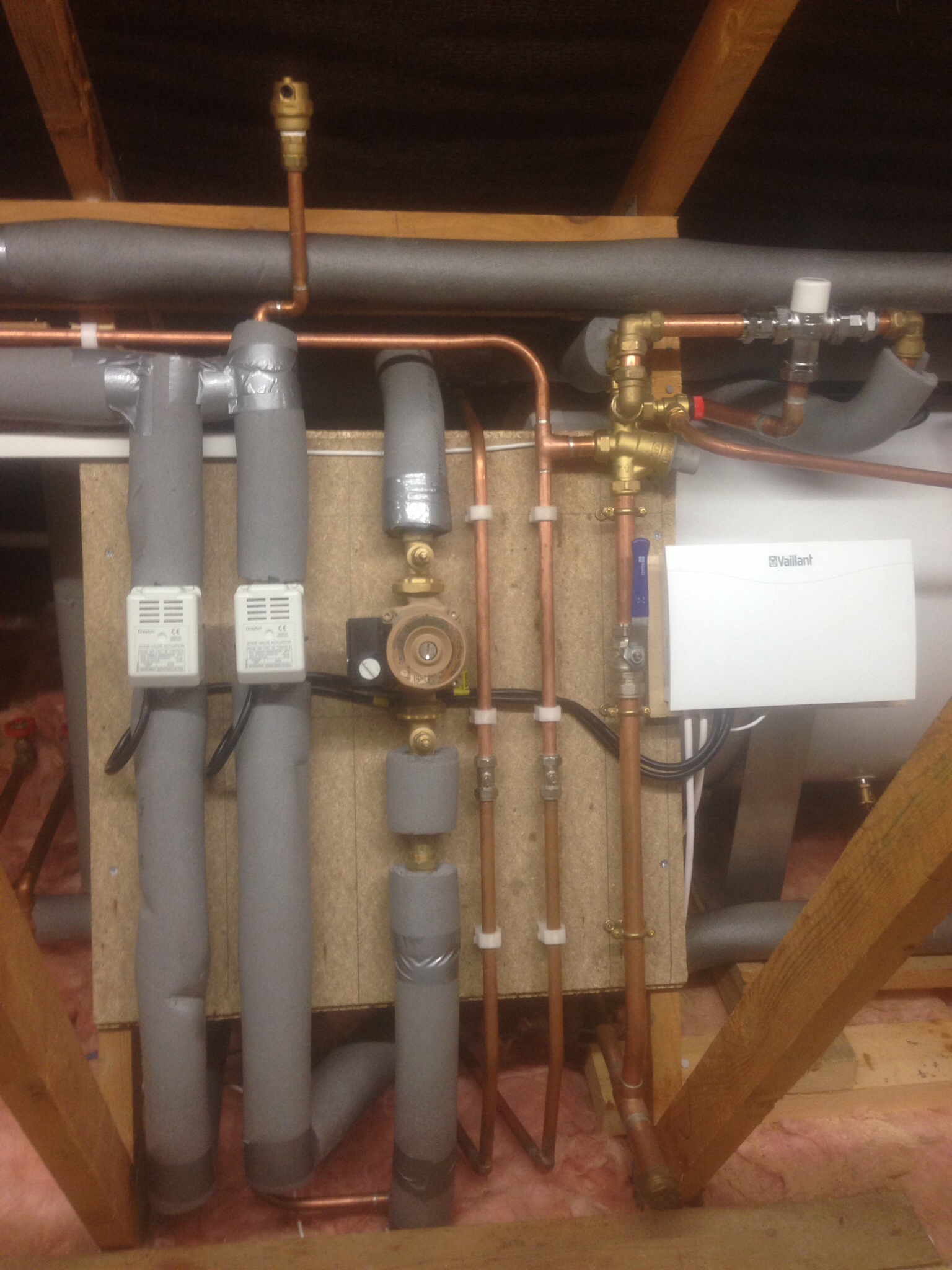
@Alphonsox Is your schematic detail exactly as per your system? As in, you have your manifold flow and return on the left and then another return off the right lower connection ? There shouldn't be a third connection in any instance other than fill / drain. What type of motorised valve is it ? A gyneric one? Also, is the UFH tmv teed in after the uvc ( buffer ) pump as per the drawing ? If so the additional pump velocity isn't doing you any favours here as the zone valve has both pumps fighting against it when it's trying to close. It should be teed off immediately from the buffer, or better still the uvc could have been ordered with a secondary ( HRC ) hot return tapping 2/3 of the way down the tank which would have stopped this issue completely. Can you confirm point 1 above to the letter please ! Ta. Another observation, your expansion vessel should be teed off the colder side of the buffer, eg where the return tapping is. At the moment you've got 2 pump isolation valves which could be closed inadvertently whilst the immersion is still on, say for the air rad to be serviced, plus I assume the air rad will also have localised isolation valves, so again the possibility of totally isolating the expansion from the buffer which is a big no-no in a sealed and pressurised system. Does the buffer / uvc have a Temp & PRV connected and terminated accordingly? I believe @dpmiller is referring to the motorised valve that is causing the issue, not manifold actuators. . Having a 5-wire 2-port ZV would stop this problem normally as they are designed so the pump only spins when the valve is fully open. General rule is :- thernostat opens / closes the ZV's. ZV controls the pump and heating appliance. micro switch ( across orange and grey wires ) turns the pump on, but only gets pressed closed when the actuator arm inside the ZV reaches 100% of it travel, eg to the fully open position. Similarly, whilst closing, at 99% open the micro switch breaks again ( and shuts the pump off ) whilst it continues slowly to the fully closed position. that micro switch usually controls call for heat ( demand ) for the heat source too, where practical.
-
It's dreaming that keeps the spring in my step tbh. I get to build wonderful things all the time...........just for someone else. ? Enjoy life, keep touch here, and come what may. As for lists, I can't even go to asda without one. If I do one of my kids doesn't eat ?
-

Bath Surround / Boxing In, and concealed pipework
Nickfromwales replied to Onoff's topic in Bathrooms, Ensuites & Wetrooms
In a word, yes. It has. -
Bath Surround / Boxing In, and concealed pipework
Nickfromwales replied to Onoff's topic in Bathrooms, Ensuites & Wetrooms
Bloody hell. I thought you were actually tiling then ? Some of the grout lines differ slightly, and your missus will go nuts when she sees that pool table ? -
I'd recommend watering down some flexible primer say 75/25% water/primer and applying it with a mop and bucket, literally saturating it to the point it's got puddles standing on the surface. Leave that soak in and dry. Then the primer gets mixed 50/50% and you apply that AS your tiling. I've done that on my current customers floors and mine are the only ones stuck to the original liquid screed. Other original tiles just lifted like a magic carpet.
-
Living and learning. ?
-
The downsides with the thinner screeds are the surface preparation prior to bonding anything down ( mechanical abrasion for laitence removal, a considerable amount of work in larger instances ), and then the lack of heat retention and regulation needs addressing and mitigating against, as the thinner screeds warm up quicker, but also cool down quicker too. That leads to over / under shoots in room temp versus what the room stats are being asked to maintain. That needs an Ufh flow temp nigh on linear to the heat loss of the dwelling, to maintain the offset, plus a degree or two on top for comfort. To achieve that need digital room stats with at most a 0.5oC hysteresis to control the heated slabs vs 2oC typical for rads, as rads change the air temp much, much quicker than Ufh does. I'm struggling with this at the moment with my current customer as one day I go there and it's roasting and another day it's chilly, due to the mechanical rotary room stats ( which are soon to be replaced to finally tame things ). If your stuck with the thin screed regardless, then it's down to floor coverings and cost. Liquid may be cheaper initially, but beware the prep work if you expect to tile over it afterwards as dry screed would be fit to lay on without any prep. @Lin, is there definitely no option of excavating the existing floors out and doing a much better job of insulating and using a thicker dry screed or concrete slab?
-
After the showroom it just goes south pretty damn quickly. If they gave the same attention to the production line, quality control, wrapping up and caring for of the items before transport, and had staff delivering the stuff who actually gave a shit, they would likely excel. They don't......so they do not.
-
I was only the fitter, but they still cost ME money. Delivery drivers REFUSED point blank to do the first drop ( requested so we weren't all sat arout scratching our arses ), but no chance. Told the stuff had to come off the wagon in perfect harmony, according to the order in which it was loaded onto it. Fair enough, can't argue with that methodology can you? ? Wagon turns up late afternoon and the kitchen was third deep so they basically threw most of the other two kitchens which were in the way out onto the street, then, whist tired and pissed off from this perfectly orchestrated ballet of bullshit, proceeded to bash and unsympathetically wrestle the kitchen I was fitting into the property. Then they slung the others back onto the wagon in no real order. Tidy. 5 damaged units 6 damaged doors ( as they're ready fitted to the damaged units ) Most decor end panels either wrong or damaged Oh, and they gave us two items from another customers order. They must have been right pissed off. I didn't notice until towards the end of the fit as we had to abandon it twice due to duff parts. Gloss white decor ends, the tower ones retail at £200+, are full gloss foil on 1 face / 4 sides and the other face is Matt White with open seems where the Matt meets the foil. Utter dogshit. Radius's on the 3 sides and square edged at the junction. They came damaged but I could have wiggled something if the bloody things were reversible. Nope, that would be too easy. ? Replacement decor panels arrived either damaged or a different colour white. Weeks and weeks ( 7 iirc ) passed before the manager got involved and told that they'd even stopped putting the wrappers and foam corners on the deliveries. He assured us the next one ( the 900x960 breakfast bar one ) would be delivered super fast, by a unicorn on a bed of cotton wool. It again arrived with no additional wrapping, other than the cardboard, and again smashed on one corner. As it was gloss one side only, again we had to charge for a wasted journey as we couldn't even flip it over, ( which at this stage the customer would have accepted ). To summarise. Wren. 1) Showrooms are stunning. If you go in there with cash, you'll leave with a kitchen without a doubt. 2) That's where the dream ends. 3) Big wait, and then a load of broken, uncared for stuff arrives which is unfit to install. 4) Fitters won't hang around so you lose your 1st choice fitters 5) New fitters get pissed off when replacement gear also is a load of ? so they leave too 6) Go to Magnet. Everything in the expensive and lovely showroom is available from the trade outlet in the building next door. £13k retail kitchen for change of £7k. Delivered with nothing damaged. Replacement parts turnaround much quicker. ( I dropped my chisel and it fell against a door, damaging it. I told the salesman what had happened and as he couldn't believe I hadn't spun some elaborate story and blamed them for it being damaged replaced it free of charge ). If I ever get asked to do a wren kitchen, it'll be with a huge disclaimer which I'll want signing before I start.
-
Hi @Lin. What's the current / intended heat source for the UFH?
-
? ?
-
Yup. Plus those on LPG still get to cook on gas . Lower consumption when on LPG is something to look into imo.
-
It's what we do
-
@Spangles FYI, to tag a member into a post ( their username goes blue ) type @ then the first couple of letters of their username and then choose them from the drop list The member then gets a notification that you've 'mentioned' then ?
-
Those beasts are dotted around all the living rooms / dining rooms in the house I'm currently working on. I must admit I'd much prefer a row of regular socket sized boxes where they'd be on regular display, but in the study / out of eyesight they would make life easier. It just depends on how much stuff originates where that will be, as in sound as well as data etc. For me, I've started to run everything back to one of the dead eave spaces in my boys attic room, data / cctv, Tv, ( DAB omitted as it's simply strong / good enough direct from the transmitter ), so I'll just be patching as cheaply as I can there and then dedicated 1g - 4g outlets remotely mounted where required. Oldest boys room is the next to hit, aka mission control . Can't wait for this bloody cast to come off my arm.
-
Jeez. You quickly forget the pics of your site covered in green and then the borehole baths etc. The SE's job is quite safe !
-
My 12v dewalts were amazing little drills. Masses of torque and just kept going and going.
-
Look on the bright side, that ain't gonna fall down any time soon ? Is that the concrete footing seen projecting out in front !
-
Conceptual and detail design software
Nickfromwales replied to LouiseSJPP's topic in New House & Self Build Design
Me too. I'm off the tools with a duff arm, post op, so need to change from installer to designer / installation supervisor pretty much overnight Ill be watching and listening, and then comes the learning. Plus, I also like cake. ? -
Vaillant ecotec 938 heating resume delay faultby 2 minutes
Nickfromwales replied to shab's topic in Boilers & Hot Water Tanks
Ps @shab. Have you fitted the Vaillant wireless room thermostat / controller, like the 470 ? With that you can time the actistore cycles so it doesn't operate overnight etc. -
Vaillant ecotec 938 heating resume delay faultby 2 minutes
Nickfromwales replied to shab's topic in Boilers & Hot Water Tanks
@shab Hi and welcome. FYI, I've deleted your other post as it's best to keep the subject separate and in one place, ( or things get messy and difficult to monitor ). As it's the heatstore it's a different beast to the combi. I'll check with Vaillant as to what the normal sequence of events are, but if it's the exact same 2 minutes or so EVERY time after domestic hot water ( DHW ) is drawn off, then it'll likely be the normal return to service sequence. Legionella purge ( purposely high heating ) of the hot storage tanks iirc is factory programmed to happen at 03:00 or 04:00 hrs so the 70+oC water is less likely to be drawn by the consumer, therefore reducing the risk of scalding. I'll update ASAP, but I wouldn't panic about it being a fault TBH unless the times / durations of these events differ each time. -
"Shitoff" is not a term we appreciate on this forum. "Jetwashmyarseuntilthecraphasgone" will be what we use from now on. The management.


