

Nickfromwales
-
Posts
31382 -
Joined
-
Last visited
-
Days Won
346
Everything posted by Nickfromwales
-

Adding radiators without hiding pipework
Nickfromwales replied to Tennentslager's topic in Other Heating Systems
They'll be 2-way IMO, but look on the body ( chrome bit ) for the bent arrow symbol. If the 22mm pipe is only getting warm for 5-6' after the boiler then it stinks of airlock. Is that with the rads nearest the boiler turned off on the TRV ? Turn rads 1,2,4&6 off on the TRV's and tell me what happens. -
Not necessarily 'wrong', but if you can live on the change that's left over, I d'oth my cap....and the world salutes you sir. ?
-
Adding radiators without hiding pipework
Nickfromwales replied to Tennentslager's topic in Other Heating Systems
First thing to clarify is if the TRVs have an arrow on the body, it should be double headed. That means the TRV is bi-directional, so the polarity of flow and return matters not one Jot. If they are used / old TRVs then yes, double check. Can you clarify ? ( not from the pub obviously ? ) -
Bath Surround / Boxing In, and concealed pipework
Nickfromwales replied to Onoff's topic in Bathrooms, Ensuites & Wetrooms
Jesus. If we're against you AND the better half, now could be a good time to shut BH. ? -
Adding radiators without hiding pipework
Nickfromwales replied to Tennentslager's topic in Other Heating Systems
I'll scratch my noggin. -
Cool. Sounds like there is a way of controlling the air rad and the primary pump as a couple. The UFH will simply draw what it wants when it wants, when the 2-port is open. The hammer may well stop just by removing the primary pump force ( by teeing the UFH below it ) so I guess I'd start there. The issue is cost for the plumbers time if it also requires the ZV moving as I suggested. A second visit may not be economical so maybe do both out of diligence whilst he's there and it's drained down. From my experience, of fitting regular ZV's in the flow not the return, the only hammer I've ever had issue with has been duff actuators 'bouncing' a couple of times as they close, which created a loud water hammer sound. I simply think it's a) the wrong valve b) in the wrong place c) and the UFH doesn't need the primary pump force as it's doubling the velocity and fighting the ZV.
-
Adding radiators without hiding pipework
Nickfromwales replied to Tennentslager's topic in Other Heating Systems
How far away from the boiler is roasting ? -
Adding radiators without hiding pipework
Nickfromwales replied to Tennentslager's topic in Other Heating Systems
Let's see how that goes then. -
Adding radiators without hiding pipework
Nickfromwales replied to Tennentslager's topic in Other Heating Systems
You trying the above now ? I'll stay "on the line" if so. -
Does the air rad blow into unheated spaces or the the mvhr? Sorry if you've answered elsewhere but theses a lot of folk on here now
-
Well there's how to control the primary pump then ? Does this need to be on often ? Is the UFH not 'cutting it'? Have you considered slightly raising the input temp to the UFH ? One degree can make a significant change.
-
Adding radiators without hiding pipework
Nickfromwales replied to Tennentslager's topic in Other Heating Systems
You on site now? -
Adding radiators without hiding pipework
Nickfromwales replied to Tennentslager's topic in Other Heating Systems
Got it. For some reason the pics weren't showing. Now they are I think it's down to balancing. Ok. Do the dopy checks first. Close all the wheelhead valves fully and count the number of turns from open to closed. Open the ones nearest the boiler to 30%, midway ones to 60% and furthest away to 100% open. Next. All trvs closed except the furthest away. Next. Switch it on and see if those rads heat up. If they / it does then leave for 5 mins to push any air out to the AAV's, then go to the next furthest away and open that trv. Repeat until all hot. Leave to run for 30 mins and bleed all rads again. Have you checked the aav above the pump ( inside the boiler ) is open / working? -
Adding radiators without hiding pipework
Nickfromwales replied to Tennentslager's topic in Other Heating Systems
Pipe or pipes ? -
Adding radiators without hiding pipework
Nickfromwales replied to Tennentslager's topic in Other Heating Systems
I need to see how the rads are piped. The pics are too far away and I can't see the detail. Do flow and return pass under each radiator? Eg left pipe off one 15mm and the right pipe off the other 15mm so flow AND return to each rad? -
Bath Surround / Boxing In, and concealed pipework
Nickfromwales replied to Onoff's topic in Bathrooms, Ensuites & Wetrooms
Yup. Good thing to remember, that things can be used for obscurity . -
Bath Surround / Boxing In, and concealed pipework
Nickfromwales replied to Onoff's topic in Bathrooms, Ensuites & Wetrooms
Yes. Nowt wrong with them. When it's grouted up you'll wonder what the fuss was about. . The cuts under the window will soon mellow too, but that's about as thin as you'll want. You cant really do anything about that as it'll screw you for the bath if you do, and that's not what I'd do. -
Bath Surround / Boxing In, and concealed pipework
Nickfromwales replied to Onoff's topic in Bathrooms, Ensuites & Wetrooms
Yup. ? -
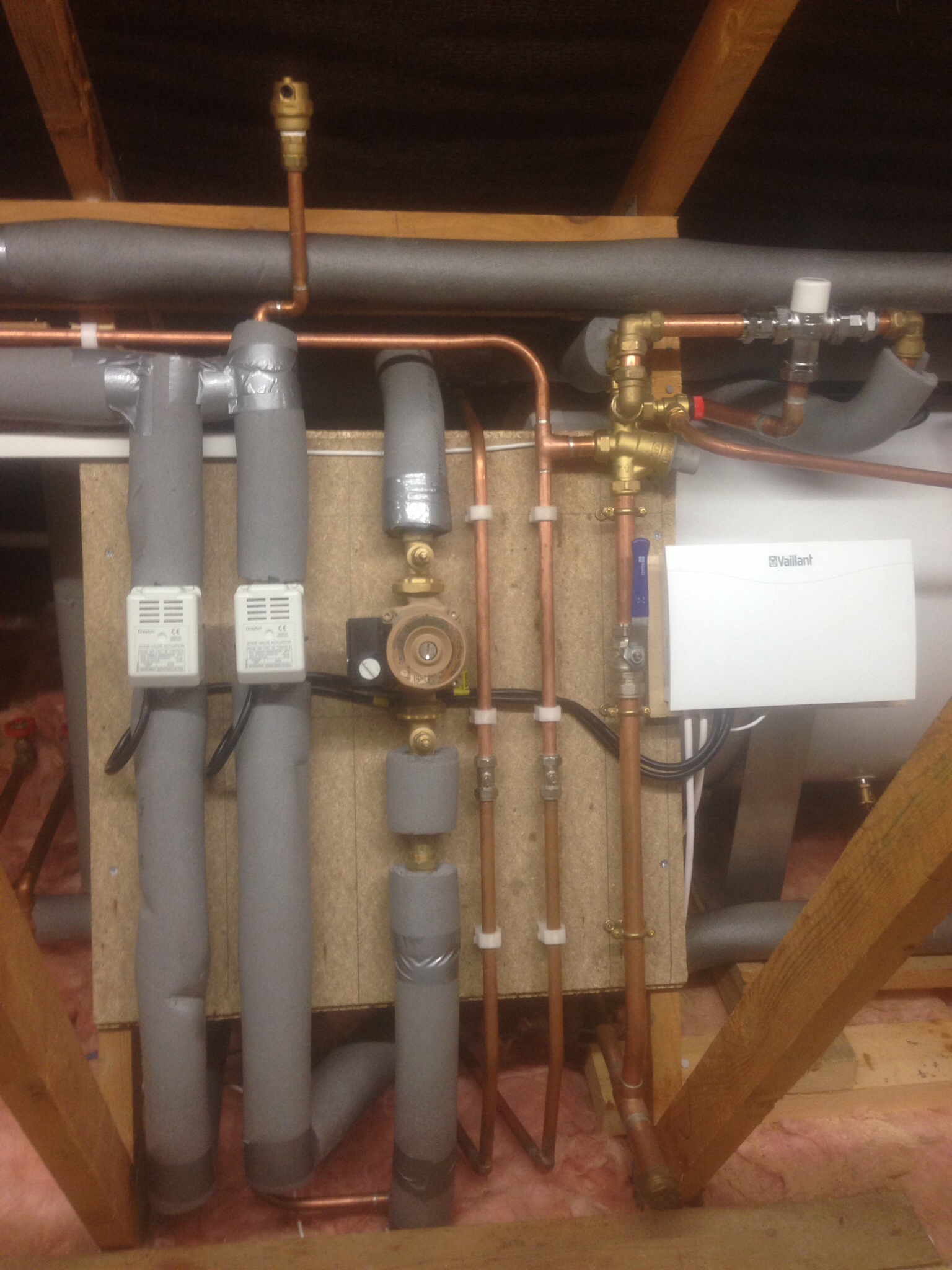
@Alphonsox Point conceded over the return coming off the third connection, just I've never seen that done. If Wunda do it that way then it's ok with me. Well you'd better go grab a stiff drink, because you've got one lol. Your repurposed UVC is filling the boots of a buffer / T/S, just its not designed to be there as your not using it for a 'mono-function' such as simply providing DHW. Jeremy's was an open pipe type instead of sealed like your cylinder, so suffered much higher losses. Where a purposefully chosen ( by design ) buffer / T/S would be better, would be where it had 2x tappings for the air rad flow and return, and then another 2 tappings for the UFH flow and return. As they're always at differing flow potentials, ( static for the air rad and dynamic for the UFH ), the two should never meet, let alone be teed together with a pump thrown in to further upset the balance. Changing the position of the UFH T will solve this as far as we can with this equipment. As for the constant circulation feature for the UFH loops, moving the UFH ZV as proposed, so it's correctly in the flow not the return, will still allow the UFH loops to circulate 24/7, just connect the room stat for heating to the ZV and connect the manifold pump to a timer, set accordingly ( timed / constant ). Pointless going to a 5-wire, but I'd drop the non generic wax ZV you have and instead fit a typical heating / DHW 2-port ZV ( like this ) which will open and close without the hammer. I still don't get the air rad. If it doesn't call for heat, why does it have a stat ? What does the stat do?
-
Nope. The pump for the air rad would cause cross circulation. UFH always needs isolating unless it's the only thing direct off the heat source, and thats only if it's an instant heater. A storage heater ( cylinder ) would still need a ZV to stop convection circulation occurring.
-
Relevant here too TBH, as it's down to costs / returns and why we arrive at such decisions here My point being that if they're only staying for 10 years and are in their 30's then let's face facts, they'll not want spend their budget on the next occupants. If it increases the value then it's game on though.
-
Bath Surround / Boxing In, and concealed pipework
Nickfromwales replied to Onoff's topic in Bathrooms, Ensuites & Wetrooms
I think a few slaps across the face may be in order. ? The fact is that nobody makes tiles to fit your bathroom. Get over it and you'll soon see that cuts are normal. On the window wall simply bring the two tiles in the centre together, then cut the mosaics out of the tiles. That'll give the illusion of continuity with the grout lines and give you bigger rips on the right hand side. You've just got too much going on in one room to be this particular, so compromise at least a little or you'll never get it tiled. Oh, and putting extra vertical strips of mosaic in instead of smaller cuts of tile will look ? I promise you. ?? -
If it's your money to spend then yes. Im certainly not going to future proof the house I'm in for the next occupier. I'll do a cost vs return analysis and spend what will cover me for my time in it, and not a penny more. We have a government that's supposed to be investing in our planets future, rather than well minded folk blowing what spare cash they have in this lifetime, to keep their children, and their children in a healthy world. I don't mind helping out, but it's not for my wallet to perpetuate it surely ?
-
Oh, and I'd relocate the UFH ZV to the flow pipe before the TMV.
-
Well 'technically' it's a buffer tank in this instance, but still a water heater over 15L so G3 does kick in. I think your plumber has chosen the easier route, rather than the correct one. Connecting the much higher operating pressure T&PRV wasn't really necessary TBH as the EV would likely fail before they got to operate, but obviously the primary ( additinal equipment ) 3bar PRV would operate to protect the lot anyhoo. Only bit about that I really don't like is where they've been connected into the system. Having isolation valves between the heat source and its means of protection is just not allowed, that's a very basic discipline TBH. That's up to you to live with, but at least the 3bar PRV should be at the heat source. ( You can leave the kit physically where it all is and just run a 15mm pipe between them should you decide to do so ). As long as you understand that the heater needs to be shut off in the event of the system being part or fully isolated for any reason, then it's your call. The UFH being teed off after the primary pump is a strange one, as surely that pump can operate for the air rad when the UFH is satisfied. Also, why is there no ZV to stop the air rad being heated when the UFH is calling ? Do they share a thermostat ? Having two heating circuits flowing at different potentials, trying to share a single pump isn't a good arrangement imo, and the UFH most definitely didn't need the primary pump. Only the air rad needed that and the pump could be on a low setting too then. To properly achieve the connection of 'mixed potential circuits' the cylinder should have been a TS / buffer not an uvc ( so each heating discipline could be connected via dedicated separate tappings ) but I doubt you want to change that now. ? I wouldn't fit a bypass, instead id move that tee, and change the ZV to a 5-wire, using the micro switch to turn the manifold pump on and off. I'd fit a second ZV prior to the primary ( then air rad only pump ) and that should see any and all problems put to bed as the big man intended. Fitting a bypass is a quick fix but I expect it'll have side effects / other consequences. ? The only downside I can see with the additinal return run off the manifolds is the possibility of it upsetting the balance between loops, by upsetting the potential of the flow and return feeding them.

