

Nickfromwales
-
Posts
31382 -
Joined
-
Last visited
-
Days Won
346
Everything posted by Nickfromwales
-
There are 2 types of 3-way valve. One is a mid-position and one is a diverter. This one, following the link from the part number, is a diverter so can actually only give fliw to one port or t'other For mixed / combined flow ( true Y plan where a single flow temp can serve the rads and the dhw cylinder simultaneously ) the mid-position valve is the kiddy.
-
I argued against the single lever SEQUENTIAL valves ( because they have no flow control ? only temp ). The one you linked has both, but I'd really endeavour to find a thermostatic one TBH. Id rethink this if I were you.
-
Take your time, it's not a race ? I / we put a lot into one post as I am posting between merchants visits / working etc ?
-
Oh and are the properties detached ? If so what's the distance between the two ?
-
@Cpd Ok. Some observations . Why bother with an ASHP at all ? If it's only running a couple rads upstairs you'll be far better off going all electric. If you do go for the ASHP I'd deffo be utilising it to provide 100% of the space heating and at the least preheat ( via a small buffer with DHW coil ) for the electric instants. That all takes room and capital, and I assume you want a reasonable cost vs return. This sounds increasingly complex and TBH just screams gas combi boiler very very loudly. Can't recall if you have mains gas or not ? Also, a room sealed stove is a nice feature but kind of mucks up your airtighthess for effective use of the mvhr. I'd go 'outside air fed' for that at the very least. For space hesting with a ASHP you'll need oversized radiators to run at the lower flow temp, you don't really want to exceed 40oC or you'll end up defrosting on grid electricity and a higher flow temp will drop the CoP so you'll also be burning more grid electricity to reinforce the ASHP operation. You may be happy with an instant wall-wart over sink water heater but renting a house with one ? It'll look less than appealing and the flow rates from them is pitiful on a good day ? Before i go on to make some suggestions can you clarify..... 1) gas yes/no ? 2) are you holding onto BOTH properties for the foreseeable future eg 15+ years? 3) can you get large radiators in downstairs?
-

MvHr in cottage refurbishment
Nickfromwales replied to Cpd's topic in Mechanical Ventilation with Heat Recovery (MVHR)
Combined with a smoke machine will soon identify where the bad air leaks are so they can be plugged. -
Why no ashp UVC ? Seems a no brainer, is it a space issue?
-
First off thet should be able to INDEPENDENTLY identify the issues here and resolve them with some sense. 1) heating flow temp is too low for the air rads 2) air rads temp is too high for the UFH loops to accept directiy 3) LLH shifts water not heat so cannot either rule or define these temps 4) simple solution is to fit a TMV and job done 5) you could refine this by fitting a small buffer but a bypass arrangement ( e.g. your LLH ) provides this anyhoo ? Are these the same installers who fitted a 2-port after the 3-port for giggles ?
-
That's 3 pints ?
-
????
-
Tossers. ?
-
Apart from the glitch with thectowel rads, as highlighted, I don't see a huge overhaul being required As Jeremy suggests, a probe / TRV thermostatic blending valve can be introduced at the manifold and that will regulate the floor loop flue temp nicely. Then you can run the ASHP heating temp just high enough to bring the air rads on by themselves. ( Modifying the rads is a step sideways not forward imo ). Tee off for the air rads after the LLH so your getting bigger flow ( and a better mix ) through it, and utilise the wasted 2-port ZV for control of the rads. Now can we go to the pub ?
-
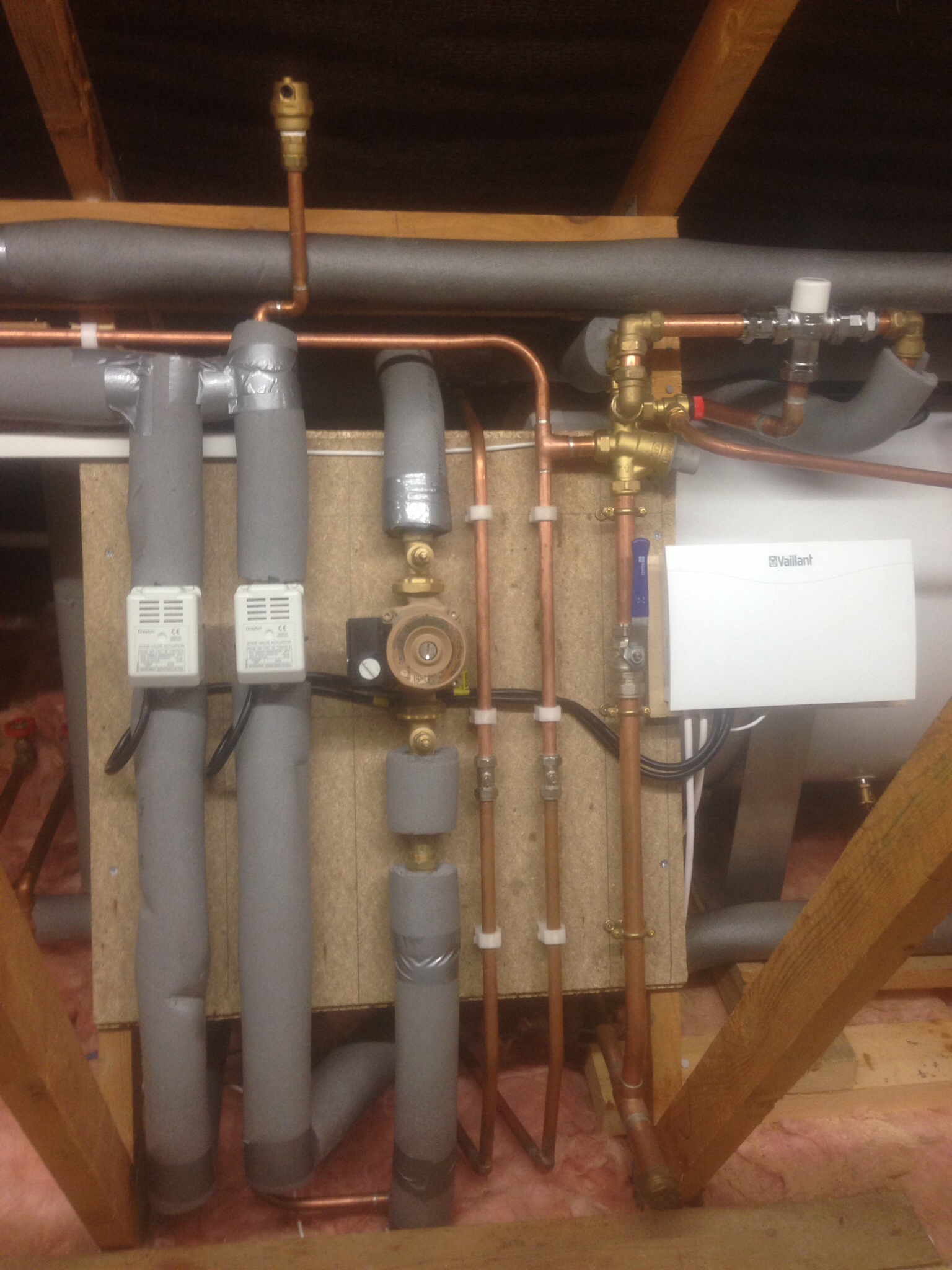
Tbh I'd rather them set like that. No need for a hot towel, just not a cold one. I was just about to ask if they were fortified with electric elements aka dual-fuel. ? That's a true diverter so absolutely no need whatsoever for the second valve They probably just saw that in the box and thought "must do something....let's just fit it and worry later" Actually, you could take the motorised head off and use it manually as a gate valve to choke the flow to the LLH , ( just an expensive gate valve ! ).
-
@NSS Can you post the model / part numbers of each of those ( silver metal boxed ) zone valves please?
-
A 2-port AFTER the 3-port valve Curioser and curioser. .
-
Adding a gate valve to the LLH flow ( before the LLH but AFTER where it tees off for the rad ) will allow you to balance the output from the ASHP and split it equally between the manifold air rad.
-
?? How does everything perform as it is now?
-
Enjoy ! Thats why the LLH is there then, so the UFH can circulate when the motorised valve isolates the UFH from the ASHP and directs flow to the cylinder at max temp. It'll also allow the two pumps to be running at different speeds so deffo for hydraulic separation and not much else. The answer to the original post has to be, that setting the UFH temp via the ASHP flow temp setting means there is no option or mechanism to allow the ASHP space heating temp to be increased without increasing the UFH flow temp . A very peculiar design, BUT, it works. Another qiestion....did the installer know the air rad was being fitted at the design stage or was it a bolt-on?
-
Not quite. The UFH can circulate from the low loss header ( spot on with that btw ) as it hydraulically separates the UFH from the ASHP. That allows each circuit to remain at 0 poreabtail and each can pass through the LLH without either pulling or pushing in any direction. Both 'can' therefore circulate independently, but there should REALLY be a 2-port zone valve in that arrangement which opens when the ASHP is called on for heat. That imo would offer a better heating characteristic / hysteresis as it would circulate the heated water rather than heat linear to the ASHP set temp ( and its hysteresis). I agree that the likelihood is that it's all running in unison, and it's very strange to see it configured this way, as @JSHarris has highlighted. @NSS, does the ASHP also provide DHW ?
-
Flooring underlay on top of concrete subfloor
Nickfromwales replied to mike2016's topic in Wood & Laminate Flooring
In conjunction with a thin ply I should have added. . 18mm plank with a proper tongue and groove is pretty robust. The laminates have nearly half the joint thickness removed so are terrible in comparison. -
Go for it as you'll have ( when I get around to posting it ) a big enough manifold anyhoo. Then one thing you MUST use is aluminium spreader plates. I'd leave the rockwool in TBH as I don't think you'll really notice the difference in the real world. Decking up... Spreader plates down... Pipe in... Deck back down... Drink beer. ? If you switch the OCD off ( easier said than done ) you can do this on a weekend start to finish. Set yourself a target to be done and just do it.
-
No, that's the beauty of it. It's got memory because of the aluminium layers, so doesn't come off the coil like an angry spring and tangle up like pert or speedfit does. Speedfit have finally cottened on to nobody sane wanting to buy / use their stupid springy unmanageable pipe so now have produced a range called 'lay flat' which is easier to work with ( 15mm though ). I still don't choose speedfit as I don't like the fittings, utter crap compared to Hepworth.
-
You could have bought @Onoff's home-made onefor £50 lol.
-
Flooring underlay on top of concrete subfloor
Nickfromwales replied to mike2016's topic in Wood & Laminate Flooring
You can use much thicker engineered flooring directiy over it, but it has to form a solid deck eg minimum of 18mm. Its about point pressure, and laminate relies on a solid subfloor as it needs to be fully supported. -
Try and keep up will you Were on about using pex for potable. Don't go taking a Kango to your slab quite yet.

