


le-cerveau
-
Posts
524 -
Joined
-
Last visited
Everything posted by le-cerveau
-

Hello from Devon and floor insulation question
le-cerveau replied to sam's topic in Introduce Yourself
3.. If you select (1) you are possibly over-specifying the system with the danger or overshoot and massive temperature swings unless you can control the system. WIth (3) if the house gets cold you will never heat it up in the depths of winter. You need more that (3), the question is how much more? Depends oh heat loss, heating eoutput, time you are prepared to wait..... -
Why only double glazing, are you not looking at triple? Fitting is the key, otherwise you are wasting money as all the heat you save with good windows runs through the edge and you get condensation issues. However my windows were almost twice this cost and I had more windows and doors and they were fitted for less so I suspect something is not quite right here as mine also included airtightness taping. On your windows with modern units (not standard British designs) you could get nice tilt and turn windows without all the bars (cold spots) for example you could have a single pane of glass for each face of the bay windows, same goes for a lot of the other windows, single pane or just one mullion on the 2m wide ones. Don't be limited by standard British windows, look at other options.
-
I suspect it is down to a simple install under G83 max 16A per phase on a domestic (single phase) gives 3.68kW, gives 16 panels for most standard panels. This ends up as two rows of 8 panels and as @SteamyTea says it is the most efficient install to put them portrait. To go beyond this requires more effort (normally) and in the past the installers were only interested in the simple installs. Doing it yourself then anything goes, I have 37 x 250w panels on my roof 9.2kW, however this is split across 3-phases so stays within G83 limits. My panels are portrait as it was the most efficient, 3 x rows of 9 on the SW face, staggered and 10 the SE hip, one row of 2 and one row of 8. These are on GSE in roof mounts.
-
I don't have specifics yet, should be installed 3 weeks time so will have more details then.
-
Balancing
le-cerveau replied to Woodgnome's topic in Mechanical Ventilation with Heat Recovery (MVHR)
If you add up all your readings and compare to what the unit says it is extracting, what is the difference? If everything to too high, just reduce the flow in the unit. Have you done any estimations of what the flows should be initially. -
You have mixed potable (drinking) with non-potable (not drinking) water! The way you have it the boiler heats the UVC via a coil (Primary water non-potable), what is in the UVC is potable and supplies you domestic outlets. The UFH system is non-potable so cannot be run directly off the UVC you need a buffer tank as @Nickfromwales diagram shows. Alternatively if you want to run one tank then it would need to be a Thermal STore (TS) type where you heat the TS directly from the water (TS contains primary water), you take a tapping for the UFH from the TS (usually middle) and use Coils/Heat Exchanger for Domestic Hot Water (DHW). These have their drawbacks (heat loss). As you have a boiler the simplest is to add a buffer and plumb the UFH (upsize boiler if required). If you want an ASHP, then again it needs a separate buffer (though you can potentially not have one) and you should consider DHW pre-heat to take advantage of the high COP of ASHP at 40oC, however you system will be infinitely more complex (for a normal plumber). If you want to run the ASHP overnight for E7 then you will definitely need a descent buffer, to store adequate heat for the day (and DHW pre-heat if you go that route).
-
@vfrdave I agree, I have Visio also and it just didn't work for me, I found it easier to just use Powerpoint.
-
It is not what it is designed for but most people can use it easily enough for drawing lines/curves and inserting pictures.
-
I just did mine on powerpoint. Put the appropriate cut out of the plans as a background (you need to be able to scale) and went from there. Some companies do have them but you then have to utilise all their parts which can be a pain of you are doing it non bog standard (as a lot on here are).
-
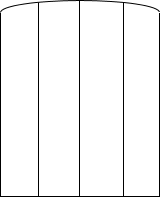
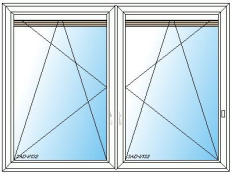
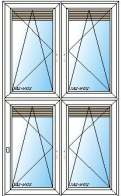
@gcm My largest window is 4.32m2 being 1.8m high and 2.4m wide split in the middle: This is tilt/turn with build in blinds and wasn't the limit of size they could do. I also have a 1.5m wide by 2.55m high quartered: Again each one is tilt/turn with blinds, this in halfway up the stairs. My smallest is 0.5m2, so the full range. For your problem child a see a few options: just straight panels as you say, you have to keep the area of glass with a certain limit to avoid engineered glass. Alternatively: quarter is, should be within limits with a top light, these quarters could be openable if required. Another option: curved top sections (non openable) and rectangular bottom ones (openable). The second one is probably easiest to manufacture, bottom one most practicable.


-
Hi, and welcome, I installed 45.5m2 of Internorm windows + 5 large doors or is your overall project 45m2? location was not such an issue we are in Cumbria but used ecohaus Internorm who are SW based, but it was a large install so travel was less of an issue. My tallest window was on 2.55m though. There are others here who have internorm/Rationell and others so ask you specific questions, we all have our preferences, I went with internorm as I wanted integrated blinds.
-
Design of drainage in to be built over mains manhole
le-cerveau replied to Jml's topic in Waste & Sewerage
Have you got an overall ground floor layout including drains the people can work on? -
The Ecostat S is circular, Ecostat E rounded edges and Ecostat Square well square. You need the 2 outlet one for 1 bath and 1 shower, the single outlet will only do a bath or shower only. If you have a separate shower cubicle the fit the selects in the shower.
-
Yes, they all need an ibox, that is the idea, you insert the ibox into the wall with all the pipework, finish, plaster/skin/whatever, and then after fit the front, and later if you want you can change front plate with minimal fuss. The important thing is to fit the ibox and the pipework correctly and later on decide on the front panel of choice.
-
Building Regs / Construction drawings - what is needed?
le-cerveau replied to Weebles's topic in Building Regulations
Unless you need this for Mortgage purposes, as you say it isn't worth the paper it is printed on. I originally took one out but canceled during construction as they were getting increasingly demanding, changes post the agreed plan as ICF is novel to them. As I have an Architect (AT but close enough) and he has professional indemnity insurance of over 2 million, he works on larger projects, my Mortgage company were happy with that professional indemnity insurance. Personally ask yourself is it worth it/ do I need it? -
One reason i selected the Ecostat E series for out bath fillers, they have variable flow and there is an option with 2 outlets, so one way to fill the bath the other way for the hand shower. We have no bath showers, rather separate shower stalls, so I just have the single outlet versions.
-
The highflow range is designed for those multijet systems, so overhead + side jets + hand shower all at the same time: You have the highflow, followed by 3 selector followed by the outlets, you can select 1, 2 or all 3 at the same time, thus necessitating high flow rates.
-
If you are looking for Passive Haus standards, Internorm and Rationel and popular here.
-
Plug point on edge of hood chimney safe?
le-cerveau replied to DundeeDancer's topic in Electrics - Kitchen & Bathroom
I originally planned all the isolators near the devices, meaning 13/14 DP isolators around the kitchen: 4 x Oven 2 x Hob 2 x Extractor 2 x Boiling Taps Fridge Freezer Dishwasher (scope for second slimline) Representation of the kitchen below. In the end I decided to put them all on one wall behind the hall door so out of the way but accessible: Picture below shows the bank of isolators (first fit), including Fire Alarm test point and a double socket below: These all run to unswitched outlets/connector plates for 3 of the ovens and hobs. Planning is everything, but either way that is an amateur job at best and not worthy of a "professional".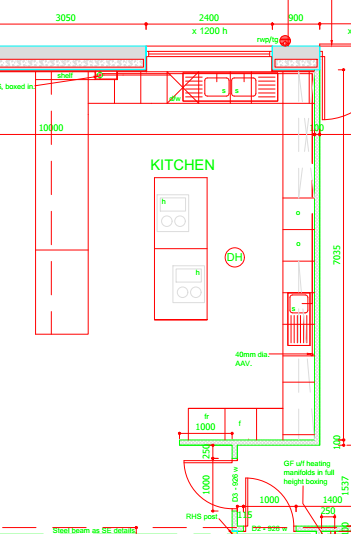
-
What are you going to put on top of the, potential, slab, TF/ICF/SIPS/block? this potentially changes the whole house structure. Do you have any diagrams/plans to share? What are your thermal targets? so many questions and options.
-
A passive slab, many here have them, will allow you to build up to the edge of the slab (just about). Our house is 250m2 on the ground floor and the slab is the same size with a little extension at the sides. I have attached the foundation layout to show this: 16-063-01B Foundation Layout.pdf Others here have used other manufacturers raft foundations but they all have the same principal. I chose mine as it is the same supplier for foundation and wall and they interlock.
-
@mike2016, you are talking about 2 different products, The normal SunAmp is charged by electricity (however produced), to charge by hot water (ASHP) you need a SunAmp Stack, which can't be directly charged by electricity. The stack is a variable size beast depending on your requirements and you could charge by direct electricity (wills type heater). To get the best out of an ASHP you need to keep the temp down to around 40C, I am doing this by having 2 different cells in my Stack, 6 cells with PCM34 and 6 standard cells PCM58. The PCM34 cells will be charged by my ASHP to around 40C, this will be utilised for UFH and DHW pre-heat, the PCM58 cells will be charged by a gas boiler, but you could use an ASHP in DHW mode (lower efficiency). Mine is a bespoke setup.
-
Hi @AndyT, we are fitting a SunAmp Stack, next month, with to different temperature cells PCM34 and PCM58. I have been told that it will be equipped with the new dual port cells. ANy insight would be appreciated. PM me if it is not for public discussion yet.
-
Mine was an oversimplification, but the results being that the outcome is not necessarily the best result but skewed (sometimes significantly) in favour of an interested party, rather than general improvement.
-
So basically, a good idea initiated by Politicians (fine), but then implemented by Politicians (not fine) who have no idea how to do it but need to ensure they don't impact their electoral base!

