


pdf27
-
Posts
387 -
Joined
-
Last visited
-
Days Won
1
Everything posted by pdf27
-
There are two issues here One thing that a lot of people with cellulose-insulated houses rave about is the "long" time constant of the house - 24 hours between the weather changing and them noticing on the inside. For this to provide meaningful heating at the end of winter, you need to extend the time constant out to ~150 days: in practice this means living in a cave deep underground. If you're just averaging out temperatures over the course of a year, you end up living in the average air temperature for the country - about 14°C where I am. Most people would find that unacceptably chilly, so you need to run with a lot of solar gain - enough to capture your entire heating requirements for the year, which risks overheating or demands a very big solar thermal system. The fundamental problem I have with it given the technology we currently have is that PV is so cheap. Right now we have virtual storage (any PV generated displaces gas from the grid, allowing it to be drawn back at 100% efficiency in winter), and in future we'll have something like Hydrogen at 50% round trip efficiency. Combined with a heat pump, you can capture more useful heat from a given roof area with PV, with far less complexity and it can do your hot water into the bargain. There is also the issue that it's very easy to turn electricity into heat but hard to go backwards - and the ability to store heat for 24-48 hours gives you 80% of the energy savings of being able to do it for 6 months.
-
What is the distance on the ground along that boundary between the two features? What does the deed say - does it have a measured map in it, for example saying that your land boundary is 51.3m long, on a bearing of 135° true from datum A, or does it relate to features on the ground. The green drawing is from the croft registry, taken from land registry data, correct? For something like this I wouldn't rely on it being absolutely accurate. They use OS data, and their published root mean square error in rural zones is <±2.8m (https://www.gov.uk/government/publications/land-registry-plans-the-basis-of-land-registry-applications/land-registry-plans-the-basis-of-land-registry-plans-practice-guide-40-supplement-1 : 99% confidence interval is <±5.8m). Given that the discrepancy between the map and your boundary is only 4m, the map by itself is insufficient to prove with certainty where your land ends - on the north side you've got it running along what is marked up as a fence/wall or something like that which gives you a good datum. However the south boundary is hanging in the air so you could potentially be anywhere from 2m inside the line to 10m over it based on the map alone.
-
Just to confirm - is the image above the one showing what you own, i.e. the one with the land registry? The maps are all inconsistent with each other. IF this is the correct map, then we have a good datum on the ground for where your land starts - the corner of the boundary with the other house marked (2). Note that the green area marked on the croft map is inconsistent with this because the corner does not match the boundary shown - the discrepancy is something like 10m scaling off the 51.3m length marked.
-

SAP fail mainly due to walls
pdf27 replied to WWilts's topic in Environmental Materials & Construction Methods
Just looked up the numbers for a very big (18kW) PV array (split SE/NW) - Midsummer Wholesale is quoting just under £10k for all the bits, of which £6500 is the solar stuff and £3500 is the GSE bits. That's for 95m2 of roof, so £37/m2. Switching to a rail-based system saves £1500, so the incremental cost of GSE over a conventional system is in the region of £15/m2 for a large installation, a bit more for a smaller system. -
Questions regarding my ground floor layout
pdf27 replied to Dan_the_man's topic in New House & Self Build Design
I think you're better off rotating it 90°.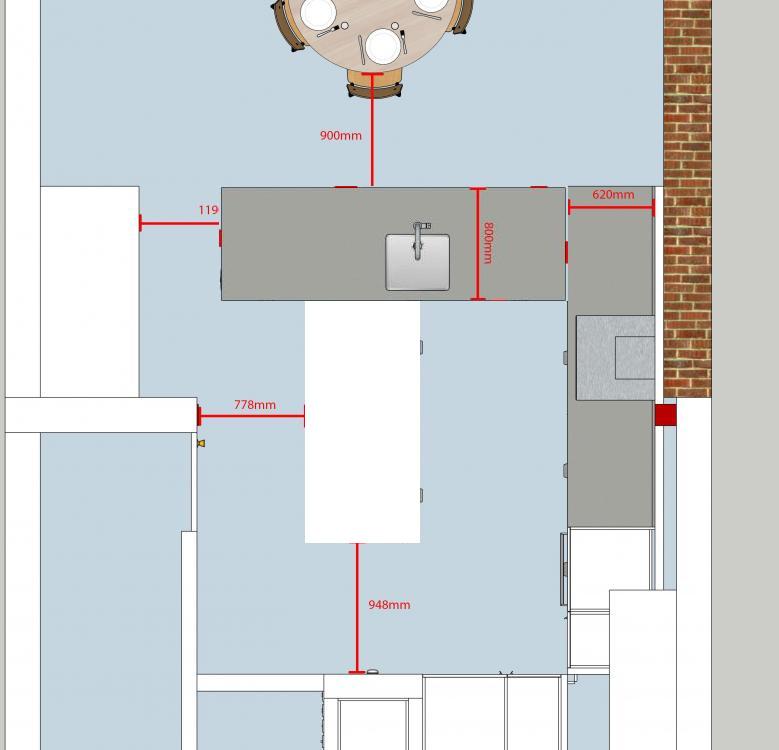
-
SAP fail mainly due to walls
pdf27 replied to WWilts's topic in Environmental Materials & Construction Methods
Not totally sure about that - with the GSE-type fittings any roof penetrations are inside the watertight layer, with conventional rack mounts they need to go through it. Ventilation isn't as good - so power is maybe 5% down - but it isn't totally non-existent and if you got for instance birds nesting under rack mount panels it might end up being quite close. Costing is about £40-50 for ~1.7 m2 of roof, depending on how much flashing you need. That's comparable to cheap tiles, more cost-effective than the nicer ones. I'm figuring that upgrades are pretty unlikely over the life of the system - there are a few 50 year old panels out there still producing electricity, and the cost of scaffolding, etc. is pretty significant. So an upgrade of any sort only makes sense if the roof needs re-tiling anyway, and there is nothing in the GSE-style panels which looks like it won't last 50 or so years by which point the whole roof will probably need re-doing. -
SAP fail mainly due to walls
pdf27 replied to WWilts's topic in Environmental Materials & Construction Methods
PV panel failing ≠ roof leaking - it's a sheet of glass with a doped surface, and how often does one of those spring a leak. If the panel fails and you can't get a replacement, just disconnect it and keep running with the rest of the string. -
There are times it might come close - we're looking to build a very well insulated house which would only need a small slinky done at the same time as the groundworks and would fit in the garden. I'm figuring a GSHP would be £2-3k more expensive but that it's worth it not to have a carbuncle facing onto the back garden - once I put a value on that the two about break even. Gas cost per kWh looks a bit high and electric per kWh looks low - worth going on one of the comparison sites and checking what the actual costs would be for you. I note that their quoted gas prices are a lot higher than you're paying, and their quoted electricity price a lot lower. It's more efficient for heating but less efficient for hot water - in summer the hot air gives a really nice boost to the COP for hot water. In a retrofit scenario you win significantly, less so for a new build where hot water is a bigger fraction of the total. At the moment there are significantly higher levies on domestic electricity than on gas, and there is a campaign going on to change that. If that happened total energy bills would presumably be about the same (assuming no change in the tax burden), but gas would become significantly more expensive and electricity quite a bit cheaper. I'm not holding my breath. At that price and heat consumption it's a borehole, and probably quite a deep one - rough rule of thumb for a slinky is 10m per kW. 17kW heat capacity is at least 170m of slinkies - so minimum of a space 50m x 25m which is a hell of a big back garden. With boreholes you're getting 25-50 W/m so for 17kW you're looking for ~300-500m of borehole which is probably two boreholes spaced apart from each other, which is where the £50k estimate is coming from (and why they hybrid system is so much cheaper). Agree with everyone else, GSHP doesn't make sense for me - even environmentally, let alone financially. You'd get a much bigger carbon saving spending the same amount of money on insulation than on a heat pump.
-
SAP fail mainly due to walls
pdf27 replied to WWilts's topic in Environmental Materials & Construction Methods
https://midsummerwholesale.co.uk/buy/roof-integrated-solar-pv - £33 exc VAT, before any discount. It **just** gets to £100 a panel if you are only fitting a single panel and using the GSE flashings all around - as soon as you put in a big block the cost comes right down. -
Heatle - An alternative to boiling water tap or kettle?
pdf27 replied to Donegalsd's topic in Kitchen & Household Appliances
Might be of interest if you're regularly trying to make drinks which need a particular temperature significantly below boiling - lets you just press a button rather than diluting/mixing. Pretty much all the other claims are greenwash though, and having to wash what is essentially your kettle (the stick) every time you make a drink sounds like a pain in the backside. -
You're only trying to stabilise temperature over a day or two however, rather than ~180 days, and have a heating system to support keeping the temperature stable. That's ~100x easier. I've been told £2000/m2 for something like Goldsmith Street - sounds a bit high, but given they will be small houses and can't reduce the number of kitchens, bathrooms, etc. and won't have any free labour provided it doesn't sound crazy.
-
Sorry, that wasn't clear. I was thinking about temperature stability - for a perfectly insulated box, you could potentially keep it at the same temperature over the course of a year, and that would match the average ambient temperature at the site. That's essentially what we see for modestly deep excavations - they match the ambient air temperature due to the large thermal mass (I know, I know) combined with the insulating effect of tens of metres of soil. Because the heating inputs are concentrated in 6 months of the year, so you'll get seasonal temperature swings at best. It's a follow-on from the zeroth law of thermodynamics: you need a temperature difference to drive a heat flow, so even if you have an infinitely large reservoir of heat around your living area the temperature in it will always be somewhere between the source and sink temperatures. When he dug the foundations it wasn't. His design had an uninsulated slab and relied on warming up the soil under the slab for a very large fraction of his heat storage (driven by surface area, and there is a lot greater thickness of soil under the slab than above the roof). That means ground conditions up to maybe 5m (judging by the apron size) below slab also have an impact, and we have no information about those. I could have sworn they mentioned connecting the wood stove up to them too right at the end of the show when they were giving a tour of the nearly-finished building.
-
Hot water and cooling looked like grid electricity - no sign of PV, and I suspect no budget left over for it. At best you'll average out the temperature over the year. In practice you'll always do quite a bit worse, probably depending if there is any groundwater flowing under the site. Outside is a bit marmite, but I quite like it. I'm too young to remember, but as I understand it their living temperatures are essentially the same as people lived in prior to central heating. From what we saw of their old house, it might well be that it's warmer than the conditions they presently live in. CO2 emissions are about 70kg/tonne for concrete. He had what, about 20 mixer trucks @ 30 tonnes each over the course of the build? ~42 000 kg of embedded CO2 in the concrete, equivalent to ~10 MWh of electricity from gas. Passivhaus heating requirement is 15 kWh/m2/year, assume from a COP 4 heat pump -> 4 kWh of electricity a year. Assume house is 300m2 since it looked fairly big -> 1.2 MWh of electricity for heating per year "saved", payback is 10 years. Not sure costing is a fair comparison - he seemed to really want something shaped like that, and I actually really quite like most aspects of the design (as opposed to the engineering). You might have got it a bit cheaper using some ICFs and a more conventional insulation scheme, but anything underground will always be expensive. Concur. It's also worth noting that he fitted underfloor heating pipes in the end (would have been cheaper to cast them into the slab), which I think it said were connected up to the wood stove. It's quite likely they're using wood stove and immersion for the hot water - if so total energy use would be lower over the course of a year if they replaced that with a heat pump for heating + hot water. Per m2 it probably is - it was a pretty big house. Then again, not many social housing landlords will get 3 acres of land in Buckinghamshire for free... There was no sign of a flue being fitted for the stove (big hole in the top of it where one would have gone, so I don't think they were going to use a back flue), and no sign of an outside chimney. Cutting a hole for one through the roof and getting it waterproof will be fun.
-
A guy I used to know now lives in Vietnam, teaching the locals English with a strong West Country accent. I really want to meet some of his pupils one day!
-
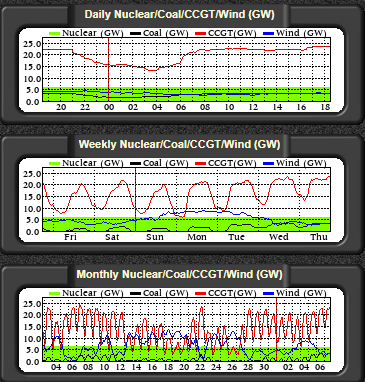
Things aren't quite so clear cut. If you're exporting to the grid, you are meaning that fuel isn't being burned as a result - importing means that additional fuel is being burned. 90% of the time the difference comes out in the wash - it's gas plant with a reasonably fixed efficiency which is being turned up and down, so using the electrons provided by your own PV doesn't make much of a difference. What does have an effect is if a particularly dirty fuel (i.e. coal) is on the grid - mostly in winter at the moment: Not the easiest graph to read, but it's pretty clear from the middle chart that coal is mostly on during the day. So that means at this time of year (when admittedly you won't get much from your solar) you're better off running it at night. Octopus agile pricing is actually a pretty good proxy for how clean energy is - burning fuel costs money, so if it's cheap it's probably green too. I'd just run it whenever need to in order to stay comfortable, and not worry about it.
-
Tesla or other-brand roofing tiles vs the classic panel-approach?
pdf27 replied to puntloos's topic in Photovoltaics (PV)
It's worth noting that the Tesla system is claiming to compete with US residential solar systems on price - but those are hideously expensive compared to the UK. The US also mostly uses asphalt shingles for roofing, which have a pretty short life so their comparisons often include the cost of replacing those several times. I tried to do the maths on it a while back, but it was horribly expensive compared to something like the GSE system with conventional panels. -
Agreed with Ferdinand, I think you're going to need legal advice here and I also suspect that you would probably spend more on legal fees than you would ever recover. Looks like you've got (2) covered but fail with (1) and (3). If the church were to pay you your costs they'd get (1) and (2) but not (3). You **might** be able to claim against the church, but that will depend on exactly what they told you and how - and getting legal with them might not be the most effective route. I think your best bet would be to talk to them and point out that your report saved them a lot of money, and ask them to share the cost of the emptying, inspection and report - that would with luck get you 2/3 of your costs back without having to get legal and upsetting everyone. It's probably also more than you'd end up with going down the legal route.
-
Heating design, calcs and process - ASHP/UFH
pdf27 replied to SuperJohnG's topic in Underfloor Heating
It's worth remembering that the rate of heat transfer is very strongly linked to the temperature difference between room and floor (the radiative component goes with the fourth power of temperature). If you can run the water relatively cool and still get enough heating on the cold side, you aren't likely to notice the additional heating on the warm side with a single zone. -
standing heat loss across cylinders/thermal stores
pdf27 replied to Jeremy's topic in Boilers & Hot Water Tanks
Another issue is applying the correct boiler efficiency - because a thermal store heats the water indirectly (you don't store the water you're using, but rather it's heated by a heat exchanger within the tank) then you typically need to store the water at a higher temperature. Since boiler efficiency is a function of flue gas temperature (itself a function of return temperature), running a cylinder hot will reduce the boiler efficiency even before you account for the increased losses of it being hotter. -
Build-Zone Warranty not recognised.
pdf27 replied to Silver Birch's topic in New House & Structural Warranties
This sounds seriously shady to me - as in, I wouldn't be confident that this buyer would ever get the mortgage they've applied for. Have they got a seriously good reason for applying for a mortgage from an Indian bank on a UK property? -
Sadly the evidence of the past year suggests that they won't get any better, they'll just borrow a vast amount of money and funnel as much as possible of it to their mates, irrespective of if they know anything about the subject in question.
-
The Bronze-Age population of the UK was at most 100,000 - and even that had a major impact on the environment. A handful of people living like that is OK, but too many of them would cause big problems for the rest of us.
-
"Not very eco-friendly" is really difficult to justify. If you look at something like Gridwatch, there is virtually no coal fired electricity left on the grid. That means any extra load on the grid is generated from gas at ~55% efficiency - so any heat pump with a COP of better than about 2 will be significantly cleaner than mains gas (i.e. it's cleaner to burn gas in a power station than at home). Drax is about 40% efficient, so if you're better than a COP of about 2.5 you're cleaner burning biomass for electricity and then using the electricity in a heat pump. A lot of people on here have noted that a professional/MCS install of a heat pump adds a LOT to the price - and certainly monobloc heat pumps aren't difficult at all to install. Work out the cost numbers for yourself rather than believing they're what a magazine article tells you they are. Electricity is always going to be more expensive than anything else per unit, but if you're already on the electricity grid then that isn't a true picture - paying for the extra on your bill is all you have to do in cost and time terms. Oil, biomass, etc. are somewhat more demanding, gas has an extra standing charge, etc.
-
Shouldn't do - the meters sum across the three phases and are supposed to be able to cope with export on some phases and import on others. You're never going to perfectly balance across all three phases anyway.
-
Assuming that the flow rate and heat capacity of the water is constant, then temperature difference is a pretty good proxy for heating power, and then multiplied by time gives energy. Essentially it sets the size of the lumps in which the heat pump delivers energy - the idea is probably to reduce short-cycling without affecting comfort too much, and changing the parameter allows you to vary whether you prioritise avoiding short-cycling (big number) or achieving a very stable temperature (small number). Basically you want the biggest number where you don't notice any issues with comfort.


