


pdf27
-
Posts
387 -
Joined
-
Last visited
-
Days Won
1
Everything posted by pdf27
-

Heating required
pdf27 replied to stubiff's topic in Mechanical Ventilation with Heat Recovery (MVHR)
It's part of the definition of the Passivhaus standard - the 10W/m2 comes directly from the amount of heating that can be provided by the MVHR system without the supply temperature exceeding 50°C, which is associated with burning dust smells. It makes some sense if you're only using resistance heat, but if you are then it absolutely needs to be a full-fat Passivhaus to ensure the heating actually works rather than an approximation using rules of thumb. https://www.paulheatrecovery.co.uk/heat-recovery-explained/feasibility-heating-via-air/ has a good explanation. On a maximum cold day with no solar gain it'll be on continuously at max power (i.e. 10W/m2: not very much), and will probably modulate by switching on and off as required when the heating load drops. Because you're heating the air directly you're unlikely to be able to make much use of something like Economy 7 however. -
Starting first Fix - Manifolds and pipe types etc
pdf27 replied to Conor's topic in General Plumbing
Digging further, looks like you're supposed to insulate them for 1m away from the cylinder if it's heated by a gas boiler: There isn't any equivalent guidance for heat pump systems - I would just insulate the 22mm pipe from the cylinder the the manifold since that pipe will be seeing far more frequent draw-offs so would probably benefit from it. https://assets.publishing.service.gov.uk/government/uploads/system/uploads/attachment_data/file/697525/DBSCG_secure.pdf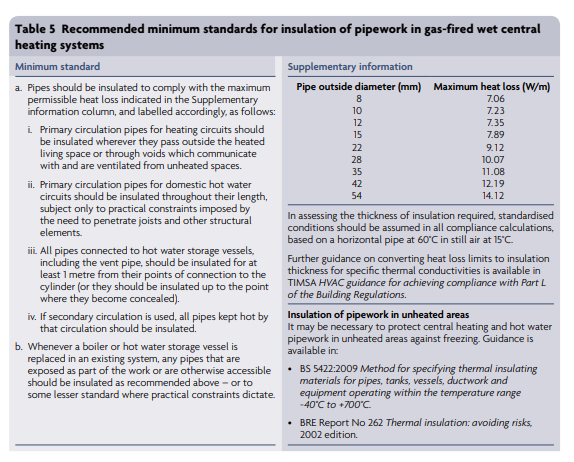
-
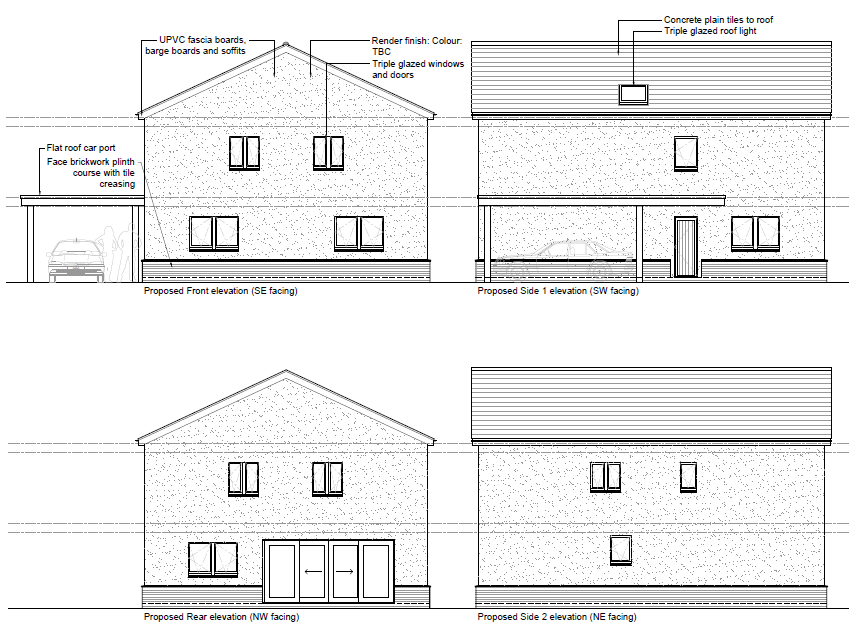
Not massively worried by the SW windows since they're ~5m from a blank wall on the house next door. I'm pretty sure that all the windows except for the ground floor at the back are massively undersized though, and that the current layout of them is fugly. I've asked for the sizes to be checked before it goes to the QS, the shape and alignment can wait for the time being but we would certainly want it to be revised before submitting for planning.
-
Starting first Fix - Manifolds and pipe types etc
pdf27 replied to Conor's topic in General Plumbing
The only bit I can find is: Note that primary pipes are those between the heat source (ASHP in your case) and the hot water cylinder - lagging these is a good idea anyway, as is keeping them as short as you can. Pipes from the hot water cylinder to the point of use are secondary ones. The reality is that unless you use the secondary pipes very frequently they will have cooled down before the next use no matter how well lagged they are. The one exception to this is if you are running a secondary return hot water system because the hot water cylinder is a long way from the point of use - if you are, then the pumped circuit absolutely needs to be well insulated since being shared across a large number of draw-off points means it will be running far more frequently and will be kept hot to minimise draw-off time.
-
Starting first Fix - Manifolds and pipe types etc
pdf27 replied to Conor's topic in General Plumbing
Is there any benefit to lagging pipes from cylinder to point of use? If it's 10mm the amount of energy lost in just letting it cool down should be pretty trivial unless you've got very long runs. The primary circuit from ASHP to UVC does definitely need lagging though. -
We're trying to. We've had a lot of time to think about this - we originally bought the place almost 4 years ago with the intention of doing a major refurbishment and loft conversion, but the more we looked at it the more we found was wrong and it's ended up being cheaper to knock down and rebuild. Unfortunately, that required a significantly larger budget and we didn't have that until recently. This particular practice seems to make very conservative assumptions about cost of ~£2500/m2 based on their previous projects, which seems to come from the fact that they primarily do Passivhaus and that tends to attract the sort of clients who tend to gold-plate everything. Given we've been pretty clear our budget is quite a bit below this, they're trying hard to keep things small and simple to control costs, and I suspect that if you strip out the gold plating they're maybe trying a little too hard to keep it compact. QS report (due in a couple of weeks) should give us a good understanding of whether that is the case.
-
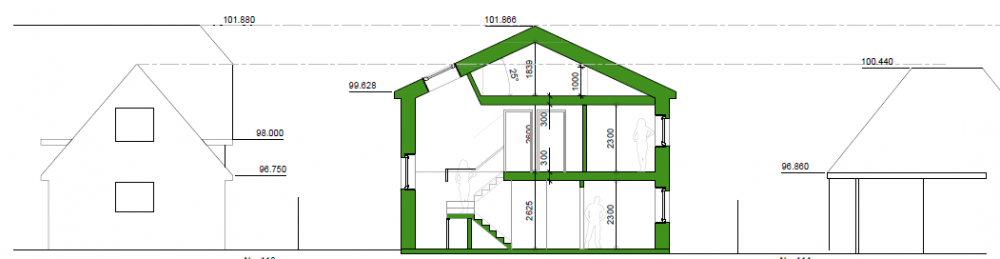
Pretty much matches our thinking, there are several details that should let us get a few hundred mm more height and 2400mm internally is definitely our next priority. The ground level at the front is ~200mm higher than at the back for instance, and the street scene is very varied so we really shouldn't have any issues getting a higher ridge line than the neighbours at planning (to the extent that the parish council recently had to employ a barrister to oppose the district council granting permission to a load more new builds outside the settlement boundary in direct contravention of the adopted neighbourhood plan). This particular practice did a very similar sized house in the next village over where they had a major issue with the council about ridge height, so I think they're a bit once-bitten. However there are a number of differences (for instance it's inside an AONB, we aren't) which I'm gradually getting through to them. I'm not too concerned at this stage - what we've got is acceptable, and is very representative for costing. Plan is to go for pre-application advice with a strong steer to push for an increased ridge height over next door by maybe 300mm, but we need to get the QS numbers back first and then revise the design accordingly if needed - we'd quite like to stretch it a bit front to back if budget allows, probably adding ~1m on the front and maybe a little on the back.
-
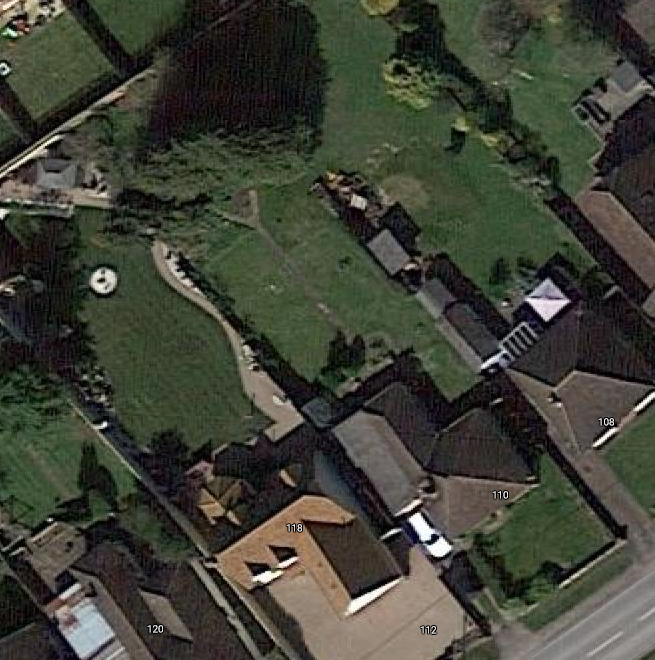
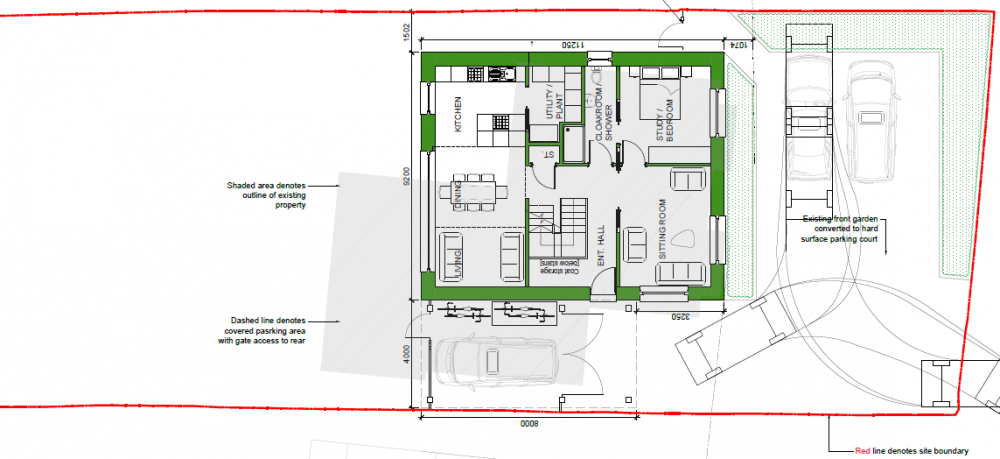
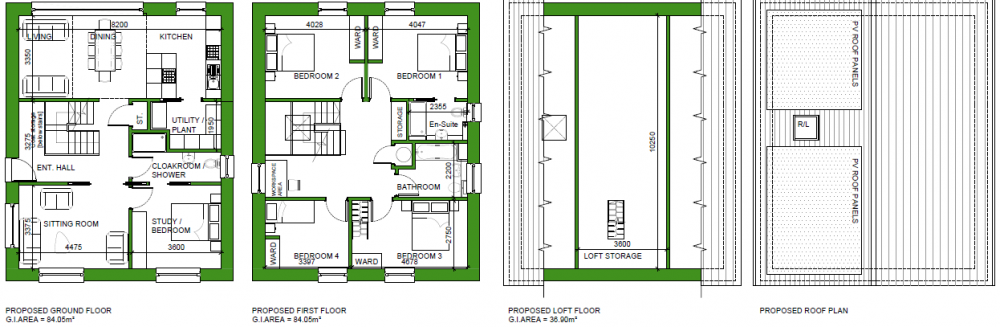
Sorry, forgot to include that. It's the house labelled "110" in the centre of the Google Earth snapshot. We're thinking about pushing the house back on the plot a bit so that the back wall is aligned with the current back wall, but that's something we'll discuss with the architect before we submit for planning - also planning to get them to push for an increased ridge height so we can go to 2400mm rooms and a more normal roof pitch. Due to COVID the guy doing the design hasn't actually been on site although someone else from the practice has - plan is to do so before we submit for planning to make sure we haven't missed anything. I **think** that because the ceiling height is so low and there are no windows the loft doesn't count as a habitable room and therefore there should be no impact on building regulations - we're still very early in the design process though so switching between stairs and a loft ladder has virtually no impact. We definitely want permanent stairs though - my wife in particular is a bit of a hoarder someone who doesn't like to waste anything and carrying crates of stuff up a ladder is enough of a pain they end up lying around the house for ages. The architect tried to just continue the current stairs up but there isn't enough headroom.
-
First set of plans back from the architects, we're fairly happy with the layout but I figured it would be a good idea to stick them on here for feedback from the buildhub hive-mind. Please ignore the fact that the outside is fugly at the moment - the current window positions are carried over from a previous iteration of the design which was a 1 1/2 storey version with very restricted headroom upstairs - that's being changed at the moment. It's off to the QS for initial costing at the moment before we start thinking about the details.
-
Pretty much. Essentially the limit comes from the load on the three phases not being balanced, which gives all sorts of issues all the way back through the system. Any 3-phase load or generator will automatically be pretty well balanced. There are other limits - for instance on how much you can put back into a system designed to deliver power - but the unbalanced load one is typically the one with the most impact on domestic supplies.
-
Who is the opposition from and what do they want to achieve? My wife isn't too fussed about how we heat it but really wants active summer cooling. Past that she doesn't really care how it's achieved.
-
Induction downdraft hobs requirements (Bora etc)
pdf27 replied to SuperJohnG's topic in Kitchen & Household Appliances
You really don't want grease in the MVHR heat exchanger. -
Can I just check my understanding of this is correct? The 19% reduction is saying that the SAP CO2 emissions must be at least 19% better than a building of the same shape and size built to building regulations minimum. The 28% reduction is in practice saying that you must have a big enough PV system to offset 28% of the CO2 emissions of your final building.
-
I think you're going to struggle here - if doubling the danger by the application is unacceptably dangerous, then it's probably unacceptably dangerous at the moment and they should be looking at prohibiting cars from the existing housing driving down there. If not, the increase isn't going to be statistically severe enough for them to deny the planning application, which is probably why the planners aren't objecting to it. At this level danger really increases in orders of magnitude (10x, 100x, 1000x) - so a 2x increase (arguably 4x since there would presumably be more pedestrians too) isn't big enough to register as a major reason. If you can come up with a way of ameliorating this, such as building a new pavement or having them provide pedestrian access to another road via their new development, then you might be able to try to get it added as a planning condition. I think you're really going to struggle to oppose the application itself though.
-
-
ASHP Installer sizing calculation - how do they do it?!
pdf27 replied to drcarrera's topic in Air Source Heat Pumps (ASHP)
7000W peak on a 300m2 floor area is ~23 W/m2. That's about twice the power consumption of most Passivhaus buildings, which suggests the model should be giving you something in the region of 30 kWh/m2/year, maybe 25 kWh/m2/year at a stretch. That's ~9000 kWh of heat per year - equivalent to about 900 litres of oil. You're using 3-4 times this amount, which suggests that your spreadsheet is seriously under-estimating your consumption. Based on that heat pump sizing in the region of 15 kW doesn't feel unreasonable. -
Car charging already mentioned - most of Europe uses 3-phase so I think we're highly likely to see the more powerful chargers being 3-phase only. VW are working on an interesting one which is DC-coupled to the car so will be able to do vehicle-to-grid quite easily. I think that's very interesting for people on something like Agile. More PV: 8.5 kW in GSE trays to fit our proposed roof is £5700 ex VAT from Midsummer Wholesale. The 4kW equivalent is £3400 and the fixed costs of fitting it should be very similar - plus we save an additional 24m2 of tiles - so while the value of electricity from a bigger PV system goes down as you consume less, the cost does too. That's an extra 4200 kWh/year for ~£1600 up front which is probably a bit better than the payback on a 4kW system. Not great as an investment, but if you're doing it I think it works better if you go big. Any machine tools. I'm an engineer and when I've mentioned I'd like to get 3-phase everybody immediately starts talking about how they'd love to have a lathe/mill/etc. in their shed but it needs 3-phase. Essentially anything with a cheap-ish electric motor in it benefits massively. I'm not sure that I'd pay very much to get any of these, but in my case we're going to have to disconnect the supply to allow for demolition and there is 3-phase at the end of my driveway so the marginal cost of upgrading should be comfortably worth it. The key point is that it doesn't add any new limitations beyond possibly the metering technology - the distribution network is all 3-phase, and normally you're just connected up to one of them.
-
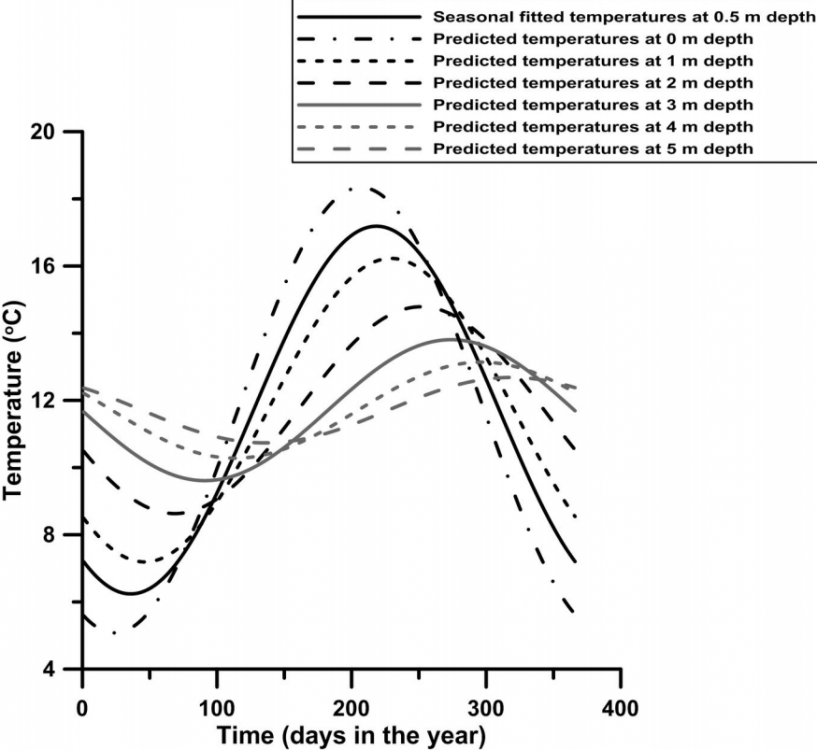
I think that's a little pessimistic. "Depth" is a pretty good proxy for distance from outside air here, so the rims of an unheated room will get that cold but the centre will be significantly warmer. Add in the impact of the losses and the fact that soil is a pretty poor thermal conductor with a lot of heat capacity, and I wouldn't be surprised to see 15°C at the centre of a room where the floor is at 30°C and the insulation is at or about building regs minimum. The floor losses approach is a good one though, and easy to do: essentially you're modelling the amount of insulation that is required to have a temperature difference of (UFH Flow Temperature) - (Room Temperature) across it for the design heat loss of the room. For an example, assume 80 W/m2 of heat required with the mean water temperature at 35°C. "Radiator" floor U-value is the building regulations minimum (0.22 W/m2.K) : assume the ground is at 5°C so that's 3.3 W/m2 lost we want to maintain with underfloor heating. Lambda value for PIR is 0.02 W/m.K. 3.3 W/m2 = (Lambda/thickness) x (35-20) 3.3 = 0.02 x (1/Thickness) x 15 Therefore you need an extra 90mm of PIR to keep heat losses the same comparing radiators to underfloor heating in this particular scenario. That's probably a significant overestimate - you gain from the insulation even when the heating isn't at full power - but should give some idea of the impact of running warm floors. If you keep the minimum building regulations value and accept higher losses, you're effectively doubling your losses to ground (+3.3 W/m2).
-
It isn't 30°C though, there's a very long time delay (several months unless you have a lot of groundwater flowing) between the air temperature and soil temperature under a slab. 150W is more realistic - essentially this is the same reason that GSHPs get higher COPs than ASHPs in winter. That level of insulation is still rubbish and will cost you a lot over the lifetime of the insulation, but it's important to get the numbers right. There are two issues here: Stopping working - they'll have a rated minimum temperature, for instance for Panasonic it's -20°C. Coldest temperature ever recorded in the UK is -27°C, so if you're in an exceptionally exposed location it may be an issue. For 99.9% of the population they'll never see anything that cold though. Tepid output is a sizing issue, not one inherent to the technology. **Some** ASHPs can produce higher outputs at higher temperatures, and if somebody hasn't read the manual correctly and installs one which can only provide the required 15kW at air temperatures above 10°C performance isn't going to be good enough. The only way that GSHP is going to be cheap is if someone installs a shared ground-loop system in front of your house. If that happens the only infrastructure you'll need is a couple of pipes from it to the heat pump location. If that doesn't happen, it'll stay seriously expensive unfortunately. A thermal store isn't likely to be a good match here unless you absolutely want to heat with wood (where it's required for safety reasons). Because of the way they work you need to store the heat in them significantly warmer than your hot water temperature needs to be, which in any case is the hottest water in the system. That really cripples the heat pump performance, you're much better off segregating your domestic hot water and space heating requirements as a result. Compost heating is a thing, but not practical on a domestic scale - you're looking at the best part of 100 tonnes of compost to provide a decent flow rate of hot water.
-
I think they're using different foams. Cygnum is PIR (0.022 W/m.K), the Flight Timber material is 0.025 W/m.K - 25/22 is 19.3 / 17 which matches the ratio of claimed U-values.
-
A bad fit of foam insulation **will** allow for some air to set up convection currents, meaning the as-built U-value will be a little bit lower than that on paper. I'd be very surprised if any CNC process gave you a significant benefit there however - unless they're measuring everything and adjusting on the fly the fits will be slightly shaky (because they need to ensure it will always fit then they'll have to ensure it has a clearance fit at the extremes of tolerance - so the nominal air gap might be surprisingly big). It'll only get worse if the timber shrinks slightly as it dries. If this is something you're really bothered by then go for either a process with the foam moulded in place so it is bonded to the timber (SIP) or use blown in insulation (fibreglass/beads/cellulose) which will take the shape of the cavity when blown in and should be more able to expand slightly if the timber frame shrinks as it dries.
-
Would you mind sharing who is on your list of people you'd use?
-
New build ph design now - add ph extension later
pdf27 replied to goatcarrot's topic in New House & Self Build Design
One thing that isn't clear here is the balance between "minimise spend now" and "minimise value of the finished product" which I'm guessing isn't something you get asked for very often! -
New build ph design now - add ph extension later
pdf27 replied to goatcarrot's topic in New House & Self Build Design
If you're doing Passivhaus, MBC & similar timber frame companies often use I-beams or posi-joists for everything at which point the additional cost of insulating at roof level with no internal beams can be very low. -
I think @jack has a slightly smaller version.




