
ProDave
-
Posts
30683 -
Joined
-
Last visited
-
Days Won
424
Everything posted by ProDave
-
If you have mains water at sea level, then it will have enough pressure to get part way up the hill. You would need to measure the pressure to see how far. This is sounding like a house I worked on years ago in Glen Urquahart. The mains water went as far as it could up the hill and emptied into an underground break tank. From there it was pumped up with a borehole pump up to the house. You can't suck from the water main so it has to go via a break tank. You just need to see first if the mains pressure will get it high enough to do the second lift in one go with one pump.
-
So you are proposing to collect / treat your water supply lower down the hill and them pump it up 140 metres? What it the height above sea level of the actual house, sounds quite high. How about pumping the raw water up in a 2 stage process with a tank half way and doing the treatment at the house?
-
Plumbing wise you can tee into this but you need to think about controls. You will need a 2 port motorised valve to turn on and off the boiler feed to the UFH manifold. Depending where else this flow and return goes, you may need additional motorised valves, or it may already have them, e.g one for hot water and one for heating, or a 3 port valve to do both. And then you need to integrate the controls for the UFH into what you have there, so when the UFH turns on, it opens it's valve and calls for heat from the boiler. I suspect the controls will be more than "link it across the heating switch"
-
Even a 10KW electric shower, we find the flow rate disappointing. If you appreciate a good shower it really needs to be a thermostatic mixer from a pressurised hot water system. Heating stored hot water with an ASHP you need to be careful of your water temperature. We heat ours only to 48 degrees C. You don't want to go a lot hotter than that with an ASHP. And because you are storing the hot water at a lower temperature than you would with a boiler, you will use more "hot" with less cold added. So we chose a 300 litre cylinder.
-

Designing gas central heating for DIY maintenance.
ProDave replied to epsilonGreedy's topic in General Plumbing
But you won't get that out of your tap at 100 litres per minute, it needs a pump or something. -
SWMBO delegates that task to HWMBO who then adapts a standard floor mop to go around a corner to achieve the required cleaning function.
-
I think it depends on just how well insulated your house is. I have my UFH on only in the daytime. There are 2 reasons, one is if there is any useful solar PV generation the heating can use that (which it can't if running at night) but secondly I like a silent house at night, and even the very low level hum of a quiet circulating pump is an annoyance to me, so it's off completely at night. In our house during the overnight off period the house temperature won't drop by more than about 1 degree, so any set back operation is pointless. That is really for old leaky houses to stop them getting too cold and then taking too long to heat up in the morning.
-
Designing gas central heating for DIY maintenance.
ProDave replied to epsilonGreedy's topic in General Plumbing
If the annual servicing cost is likely to be £250 or more, then on a low energy house that has got to be very close to the annual heating bill. It starts getting silly when the cost of servicing something doubles your cost of using it. So I would be designing out gas and using something like an air source heat pump. No annual service cost, no standing charge to pay for gas, and all that saving will likely pay for most of the electricity it uses. If you really like gas cooking then an LPG fired hop running from 47Kg cylinders. But on the subject of servicability. There are some makes of brass pump connector that have an isolator built in. Waste of time. When a pump in our old house failed so too had the isolators, so it was a partial drain down anyway to replace the pump and the connectors. Perhaps separate full bore in line isolators and a simple pump connector. Trying to fix a problem for a neighbour at the moment, the BEST thing you can do to aid maintenance is keep a clear and accurate diagram of how the system is piped, and WHERE the pipes go, with photographs of pipework before the floor or ceilings go down. And pass this file of information on if you sell the house. Then you won't be cutting random holes in the ceiling hoping to find the leaking pipe (don't assume the leaking pipe is above where it is dripping) Motorised valves. I would only fit Honeywell now. Too many of the "plastic" ones have common faults with microswitches. It is rare to have to change the valve body. The actuator head can be changed if it fails with no plumbing. -
No definitely a water leak. Turn off stopcock and after about 5 minutes the drip stops (there is wood fibre board up there acting like a sponge). Then turn the stopcock back on and after a few minute the drip starts again. Most pipe is copper, some soldered, some with pushfit connectors, but the runs under the floor seem to convert to a white plastic pipe, I have not determined the make yet.
-
They do seem less bothered in Scotland. Our plot was under the stamp duty threshold, and not second property tax. Even the council tax, they seem happy for us to pay band A for the caravan and seem in no hurry to value the not yet finished house.
-
Okay just back from there again. Since putting the system pressure up to 1 bar (it was about 0.5 bar) yesterday, everything has started working, radiators and UFH. The pressure vessel for the heating is fine, it's bladder is holding air and the blow off valves both work. I bled the radiators. There was no air, and the water that came out was clear, that blows the gummed up with crud theory out of the water. The leaks I have determined are from the hot or cold water. I checked the borehole system (in a shed) and that is sitting at just under 3 bar. I had thought the pressure switch might have failed and it was over pressurising. So the mystery to find and fix is 2 leaks that started on consecutive days. Too far apart to be just 1 leak and water tracking along a pipe. So apart from cutting holes in the ceilings to find and fix it, the question remains why have two pipes decided to leak?
-
Well there is a new twist. Just had a phone call, leak above the ceiling in a different place. So I am going back again. My bet is shot expansion vessel and non working blow off valve, over pressurising and causing random leaks. I will ask when it was last serviced
-
Probably not. Indeed many on here just have the whole house as one zone. I have 3 zones downstairs and they all pretty much turn on and off together, so there is not much benefit to be had. But on the other hand it is not hard or expensive to zone the house a bit.
-
The above will diagnose what is going on with the UFH. But what about the rads? Motorised valve open, all TRV's on max, seemingly no flow at all. Bleed all radiators for sure (didn't have my key with me today) but what, apart from sludge would stop all flow through the rads. Pipework is a mix of 22mm copper at the motorised valves, swapping to some variant of plastic pipe to manifolds somewhere, emerging at each rad as something like 10mm copper. Not seen a magnetic filter anywhere.
-
There are many places you can buy suitable maps. Just google "planning maps" On the other hand, I just photocopied the maps that came with the deeds when I bought the plot.
-
What DNO area do you come under? SSE normally fit meters with a built in isolator. But probably the easiest thing is install the mini CU AND your DP isolator before the meter comes, and the meter man should connect to that. Then you are free later to change it for a full size CU when you are ready.
-
"conventional wisdom" is that it is cars, particularly those with internal combustion engines that are killing the planet. But a simple fag packet calculation shows our previous house burned more litres of Kerosene in a year than my gas guzzler car consumes of petrol. Yet there is no big push to make old houses more energy efficient. Oh and road fuel is taxed to extreme, because it is bad, but house fuel is not.
-
Post a picture of what you have as that will influence what will work with it or not.
-
Flashing: some sympathetic advice please
ProDave replied to ToughButterCup's topic in General Self Build & DIY Discussion
Except the slot and wedge method will be mostly watertight before the final render. My method won't be. But this seems the normal method used up here. -
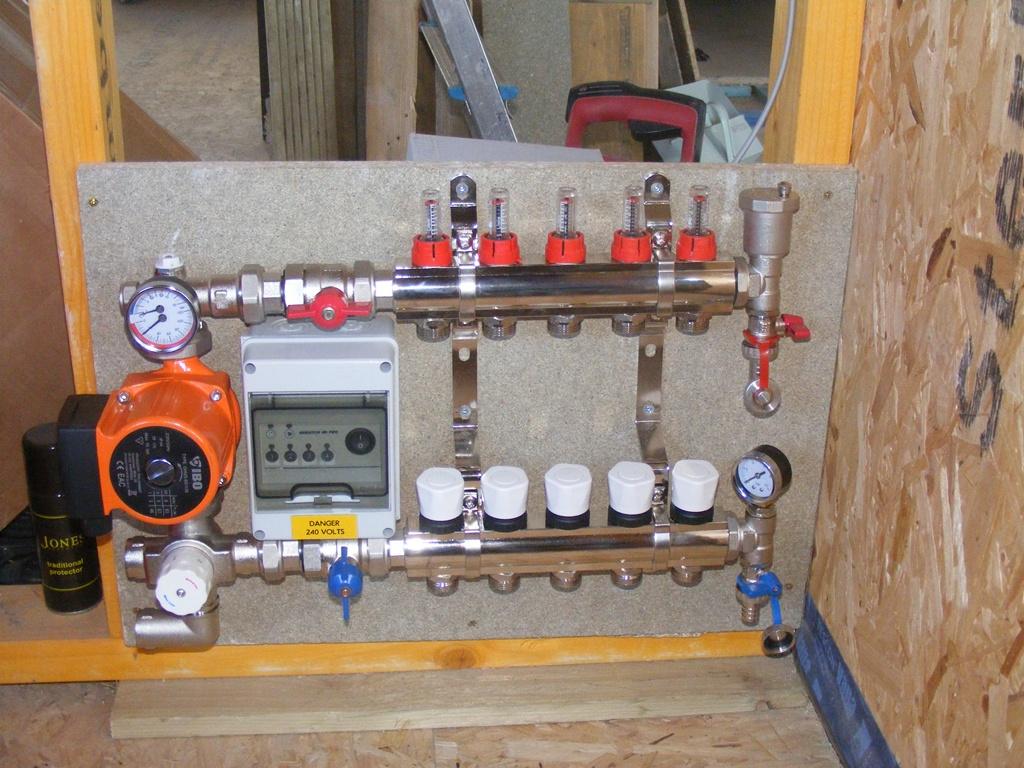
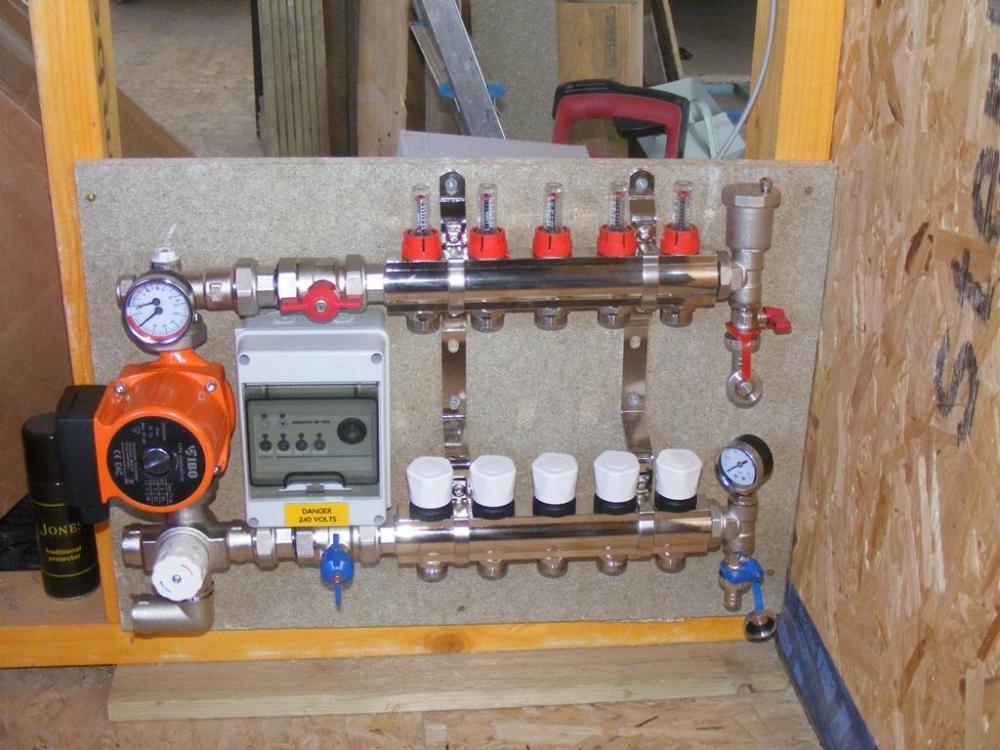
Can you post a picture? Do you even have actuators on the manifold yet? What do you want to achieve? That will determine what controller(s) I opted for the simplest system (I like simple) I have a simple and cheap manifold controller. Each room just has a room thermostat, and the whole thing is under the control of one conventional central heating programmer to determine when the heating is on and off. You can be more clever if you want to and have programmable thermostats so you can set different rooms at different temperatures at different times. Without a controller, what powers the UFH manifolds pump? This is the only picture I have to hand of mine, showing the bargain basement controller, but before I had attached and wired the individual actuators (in fact before I had connected any pipes!!!)
-
Flashing: some sympathetic advice please
ProDave replied to ToughButterCup's topic in General Self Build & DIY Discussion
We seem to do it different up here. You just fix the flashing to the wall, not in it (might be because I have wood fibre not brick so no easy groove) Then you fit a bell cast drip bead with a built in strip of mesh and render. The render goes down partly over your flashing, with the mesh to bond to, and terminates in the bell cast bead. It has not leaked yet. -
This is a neighbours heating system. I don't normally do "plumbing" for others, but I am too nice to say no. House built about 15 years ago, UFH downstairs, radiators upstairs, driven by an oil fired Aga. Initial problem some rooms not getting warm. But problem No 2 today that got me round there, water dripping through a ceiling. The dripping water problem is an odd one. Above and just to the side of the leak it a hatch with the pump and motorised valves. All dry there. so on owners instructions I cut a hatch in the ceiling. Just a single pipe runs across above there and that pipe is dry. By the time I mopped up, it is no longer dripping, so that one is "pending" So onto the heating. All motorised valves are opening, hot water is flowing to the HW tank, and UFH but the pipe to the radiators remains cold. All radiators have TRV's and all turned up to maximum. At the UFH manifold, HW is arriving at the manifold and the pump is running. All actuators seem to be opening, but very little water is flowing, each loop the flow pipe is warm but return pipe stone cold. Now onto the "clue" If you look in the sight glass of the flow meters on the manifold, you see nothing. It is completely brown, you cannot even see the "float". So my guess is the whole system is completely gummed up with rusty crud and needs a complete flush out. That is needed anyway even if it turns out there are other faults. The house in on borehole water, which (unusually for these parts) is very hard water as there is a seam of limestone running under here. Part 2: How do I flush it? UFH is easy, water hose to supply manifold, drain hose to return manifold, run water through each loop in turn until it runs clear. But how do you flush all the radiators? What's the usual procedure?
-
I wouldn't do it like that, you would be screwing into the end grain of the noggin / strap, which is never very good. @pocster way I think is stronger. Plus you don't need to cut the strap to the precise length.
-
What ya building.
ProDave replied to Russell griffiths's topic in General Self Build & DIY Discussion
I wired a "straw bale" house once. In reality it was a timber frame, based on a Larsen Truss with the bales between the inner and outer part of the Larsen Truss providing the insulation. My conclusion, you needed a lot thicker walls to get the same U value as something like Earthwool or Celulose, you needed a good autumn to get the straw in and baled all nice and dry, then a good barn to store the bales and keep them dry until they go into the house, and the only "benefit" was your smug feeling at "being green" -
I agree with the above. Give that list to an architect and he is just going to see the £££ signs for implementing all that detail. Assuming you have a plot already, I would start sketching house layouts yourself to try and get all the rooms and storage spaces you need with the separation you want, and then give that initial idea to the architect.