
ProDave
-
Posts
30862 -
Joined
-
Last visited
-
Days Won
427
Everything posted by ProDave
-
Re the position of inspection chambers. Get him to agree he will do what building control deem necessary. Get him to install ALL the chambers he thinks necessary, then BEFORE it is covered over get building control to inspect it. If they say they want more, he must fit more. I would still want more concrete over the top personally.
-
I used the Impey water guard kit which is a membrane you apply to the floor and seal all the joints and comes with the corner joints etc. It doubles as a decoupling mat for the tiles. I also used a matching Impey tray.
-
At least one door will have to be level access, so lay a thicker screed to raise the entire floor a bit, or grind down the threshold of at least one door.
-
The key to solar PV now is cheap. I self installed a 4kW PV system a few years ago for about £1500 and self usage should give payback in 6 years. 2kW should be easy to self use if you divert excess to hot water heating almost nothing will get exported. Self usage and the need for batteries only starts to become an issue above 4kW.
-
Looks like you got the local cowboy. Statt by getting a competent roofer to write a quick report on the bodge that has been done to show the first joker when you refuse to pay his bill.
- 16 replies
-
- 1
-

-
- leadwork
- poor practice
- (and 1 more)
-
Okay, a question for those on Octopus Go: The 4 hour 5p rate at niight, is that on GMT (like E7) or is that local time? i.e. would I have to change my programmer (which works on local time) between seasons (it is it on fixed GMT times)
-

Major Issues Octopus App
ProDave replied to canalsiderenovation's topic in Energy Efficient & Sustainable Design Concepts
Thanks @canalsiderenovation Have you tried using Octopus's on line portal? If so how does that work with Go? Is it much the same as with a standard tariff? -
Major Issues Octopus App
ProDave replied to canalsiderenovation's topic in Energy Efficient & Sustainable Design Concepts
I take it it is safe to assume nobody is installing SMETS1 meters any more? -
Major Issues Octopus App
ProDave replied to canalsiderenovation's topic in Energy Efficient & Sustainable Design Concepts
Thanks. -
Thanks. I have just posted in that thread to see how she is getting on. So if I switch to go I would save 1.67p per kWh on the "day" rate, so based on my annual usage would save £118 per year, plus another 0.99p per day in standing charge or £3.61 so lets call that a saving of £120pa plus whatever I would save by shifting ASHP load to the 4 cheap hours. Is that saving worth the potential problems that @canalsiderenovation had?
-
Major Issues Octopus App
ProDave replied to canalsiderenovation's topic in Energy Efficient & Sustainable Design Concepts
Resurecting this old thread. Are all your problems with Octopus Go sorted now? You mention an APP? I am considering Octopus GO but I am a dinosaur I DON'T want an app. I am happy to manage my account on a web browser on a proper computer. Is having an app on your phone to interface with it compulsory ow will old stuck in the mud people like me still be able to use the web interface? -
My remaining reservation is this cheap tariff is a "loss leader" to persuade me to get a smart meter (from which there is no going back) and won't last long before it creeps up to higher rates?
-
If it is rusty water, there might not be enough inhibitor. What pressure is the system charged to? Is your expansion vessel okay (plumber should have checked that) What make of manifold? Picture?
-
That post was a big "Whoa, hold on what's going on here" post. I am currently with Octopus and I am on their variable tariff (any fixed tariff currently on offer is higher) and currently paying 18.47p per kWh and 25.99p daily standing charge. So I looked up this Octopus go tariff and got the "quote for your area" that includes the distribution surcharges (high up here) It came back with 16.9p per kWh and 25p daily standing charge. So IF I switched to Octopus go, I would get a cheaper day rate, a lower standing charge, and the 5p rate for 4 hours at night (that I could use to heat the DHW by the ASHP and pre heat the house a bit for the day in winter) What am I missing? I have always avoided off peak tariffs because traditionally they come with a higher day rate, but if I can get a cheaper day rate as well it seems a no brainer. Only 2 issues. I would have to get a smart meter (ugh) and I would have to pretend to have an EV (we do have a hybrid) do they actually check you have an EV or not? Now I generally like Octopus because their customer service is pretty good and they are quite flexible with the control a user has over how they operate their account, BUT I feel VERY irked, that every time I have looked to see if they offer a cheaper tariff, they have NEVER mentioned Octopus go and how much I could save by switching to that.
-
I had that nightmare in a previous rental property. When we got vacant possession back and submitted meter readings they were all wrong. It took months to unravel. I had a meter reader out twice, and both times we agreed what the readings were but when they got submitted they were swapped, it's as of the computer algorithm's saw an "error" and automatically swapped them. When they finally agreed there was an error, they had to trace the last two tenants to "correct" their bills.
-
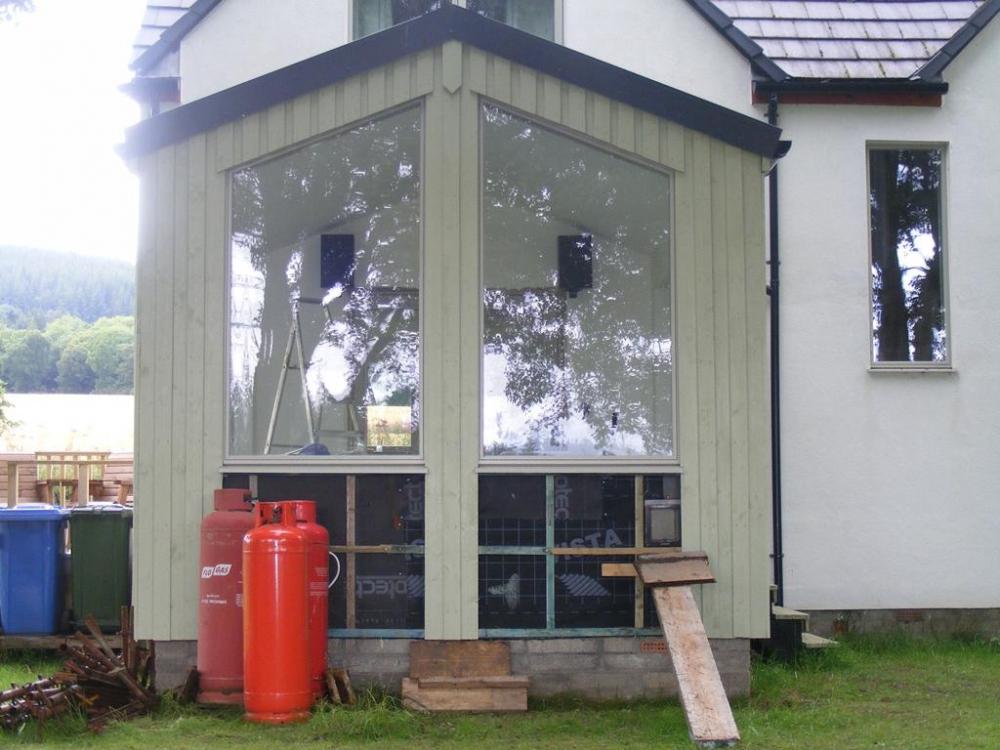
After what seems ages, I fitted the last upper boards today, painted them with their top coat of paint, and then dropped the rest of the scaffold from around the sun room. So now the other 2 sides are visible Just the bits under the windows to clad now, that are easier now the scaffold has gone.
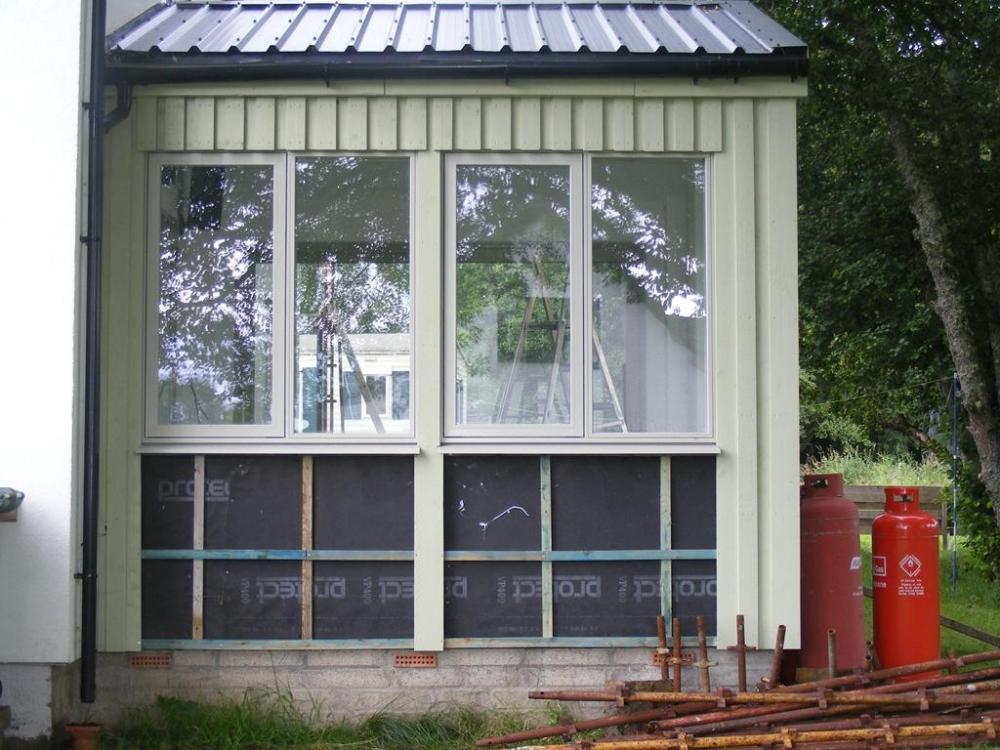
-
Heat Pumps & Hydrogen Powered Boilers Book
ProDave replied to Des Ingham's topic in Introduce Yourself
A good solution for future proofing houses built right now, would be mandate under floor heating is fitted, not radiators, so even if fitted with a gas boiler now, and upgrade to a heat pump would be a lot easier. -
Heat Pumps & Hydrogen Powered Boilers Book
ProDave replied to Des Ingham's topic in Introduce Yourself
Excellent summary of the situation Ian. So by 2035 any home not economically able to achieve an EPC C becomes a building plot? Whole estates of them could be demolished and rebuilt? The 21st Century "slum clearances"? It has certainly hardened my view that I would not personally buy a house now worse than EPC C unless it was very cheap with a clear way of upgrading it. -
Heat Pumps & Hydrogen Powered Boilers Book
ProDave replied to Des Ingham's topic in Introduce Yourself
The No 1 thing to create a "carbon neutral" home is insulation and air tightness to keep the energy requirements down. Then a low power heat pump will be all you need, and throw in some solar PV that will over the year generate more electricity than your house uses to run the heat pump, and you have a carbon neutral house. That is easy to do for a new build (but still a lot of new builds don't come anywhere close). The real problem, is what to do with the huge number of poorly insulated and draughty old houses? Just sticking a heat pump in won't solve the problem. I look forward to reading that chapter in your book. -
Code RED - the end maybe nigh!
ProDave replied to MikeSharp01's topic in Environmental Building Politics
Until we stop burning wood at Drax, I have no faith in anyone who is planning our "carbon neutral" generation. As for Nuclear, the present ones under construction or planning seem a bureaucratic, late, over cost money pit under the control of foreign countries. A GREAT embarrassment for a nation that pioneered nuclear power and one upon a time we could design and build our own. -
I was doing some work on a house being refurbished recently. The owner wanted to build up some ground to lay a raised patio. I saw all sorts of stuff going into the hole, including a load of the plasterboard that was ripped off. It would be interesting to see how that works out.
-
Code RED - the end maybe nigh!
ProDave replied to MikeSharp01's topic in Environmental Building Politics
My overwhelming thoughts are the sheer enormity of the task, and I don't believe we have a government capable and competent to make the changes needed. Housing stock. Just WHO, how and when are the UK's mostly poor houses going to get updated? Who is going to pay etc? Transport. I don't believe EV's are the answer unless electricity generation gets significantly greener and more of it, I just don't see that happening quick enough. And other nations that continue to burn coal in power stations, unless they stop the rest of us are p*****g in the wind. -
Which country are you in, may affect the answer.
-
New home insurance without build warranty
ProDave replied to magutosh's topic in New House & Structural Warranties
Warranty has nothing to do with it. We didn't bother as no intention of selling and it was several £K that could be better spent on building than a bit of paper that would have no value after 10 years. If you switch to normal insurance before sign off then perhaps they could try and wriggle out of a claim? but once signed as complete by building control there can be no issue. -
Scottish builders: extending a building warrant
ProDave replied to Stewpot's topic in General Self Build & DIY Discussion
If you extend the warrant you will stay on the old regs (I am still working to 2013 regs) It is ig you let it lapse and then re apply they could enforce you adopt anything new.