


Stones
-
Posts
3762 -
Joined
-
Last visited
-
Days Won
23
Everything posted by Stones
-

Changes to Short Term Lettings regulations in Scotland
Stones replied to Crofter's topic in Planning Permission
In your case, the local impacts - traffic, services etc would have been considered when you built it, as you went through the full process of getting PP. Probably going to be a case of wait and see what the Council does. -
Changes to Short Term Lettings regulations in Scotland
Stones replied to Crofter's topic in Planning Permission
@Crofter From SG website: The Control Area Regulations will allow planning authorities to designate all or part(s) of their area as a control area. Within such a designated area, the use of a dwellinghouse for secondary letting is always deemed to involve a material change of use and requires planning permission. Outside such areas, the current case-by-case consideration would continue to apply. The requirement to seek planning permission in a control area would not, of itself, imply any predisposition to refuse consent. However, as planning applications are required to be determined in accordance with local development plans, it would be open to individual planning authorities to consider the inclusion of policies relating to short-term lets in their relevant local plans. Whether or not the various adverse impacts that have been cited are material planning matters in respect of any individual application, and what weight to attach to them in considering the application, would continue to be assessed on a case-by-case basis within a control area. As a primary purpose of control areas is to help manage high concentrations of secondary letting, we are proposing that, in a manner similar to advertising hoardings, any planning permission which is granted would be valid for a default period of ten years (unless a longer or shorter period is set by the authority) but that local authorities should have the power to revoke planning permission after that time. Without such a mechanism, the granting of planning permission for use of residential property for secondary letting is a one-way ratchet, in which the number of properties which can be used for this purpose would only ever increase. My reading of that is that local authorities can if they wish, designate areas as a control area (similar I suppose to Conservation Areas in that there has to be justification), which then allow them to apply planning legislation, and in particular specific policies to control the number of lets. I suspect this is primarily aimed at certain city centre locations where residents (or those that are left) face misery on a daily basis as whole flats are let out to groups of people who consume copious amounts of alcohol and the fall out that follows. PP would normally specify the period of time it is valid, i.e. time from date of approval to commence development. The general principle in planning is one of 'use' rather than simply being - you could have a little cabin in your garden and use it for purposes incidental to the enjoyment of your dwelling with no PP req, but rent it out as holiday accommodation and it's use has changed. The cabin is the same, but the use is different and would require PP. Equally you could have planning granted and then decide not to implement it. Ultimately it will all depend on your local authority view on the planning side of these measures. They may be quite content with status quo and just implement the registration side. -
@ToughButterCup Really good to hear you're in! Hopefully won't be too long before we're down your way again as keen to see how much you've done since the boys tried to knock everything down with your minidigger.
-
2020 ends on a high note (surprisingly)
Stones replied to ProDave's topic in General Self Build & DIY Discussion
Good to hear it's progressed @ProDave, it's been interesting to see the transition over the course of my various visits. Looking forward to seeing the finished article (if and when we are 'allowed' out again). -
Certainly from the time I spent there, that was the case. In addition to the primary loop circulation pump that's needed, do you think a different arrangement at the manifold would be advised, (in my non plumbing mind, replacing the bottom T with an elbow so the pump is only taking flow in/through, and blank off the end of the manifold, so there is direct flow/line of sight)?
-
Thanks both.
-
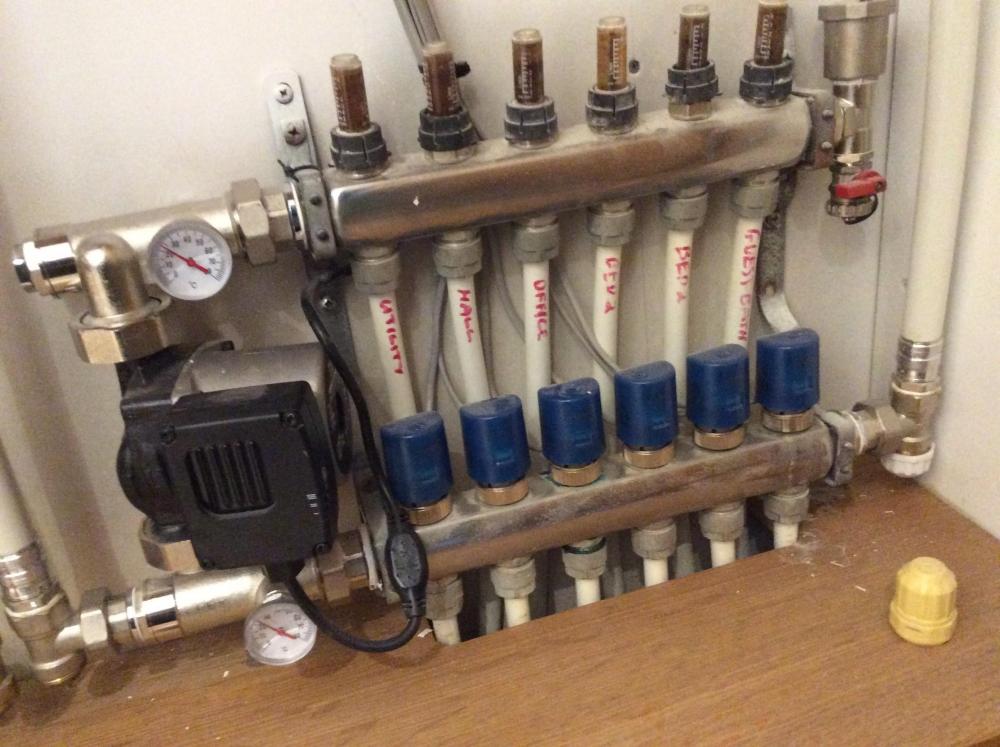
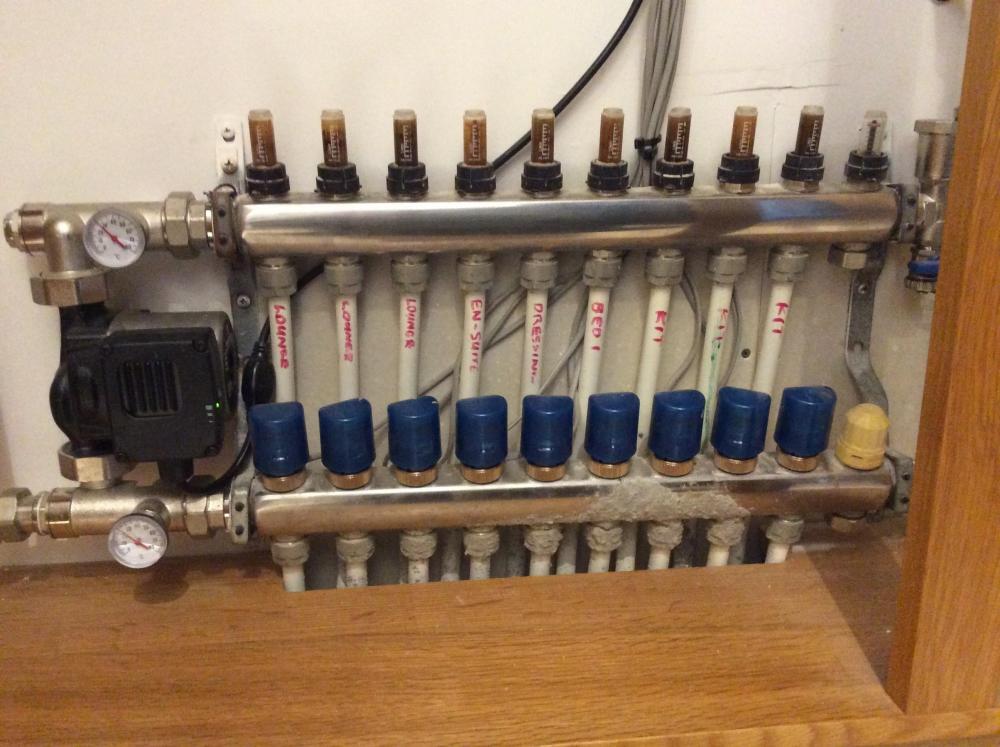
We have friends who built round about the same time as us, with 200mm SIP. They have a GSHP and UFH. Problem is they have never been able to get the house much warmer than 19C, but still have quite high energy bills. In an effort to get to the bottom of why they can't heat the house up, I spent a few hours there earlier this week. The GSHP is plumbed to a buffer tank. A circulation pump in the GSHP runs a very small loop between the heat pump and the buffer tank. There is then a 20m loop from buffer tank to the UFH manifold position. 2 manifolds, each with own circulation pump (as pictured). Every room has a thermostat and as you can see motorised actuators on the manifold. The GSHP registers the return temp (in this case 32C) and according to the manual, will produce a flow temp 5C higher (a default differential). First alarm bell was the circulation pump in the GSHP (circulating between heat pump and buffer) was red hot to touch - basically too hot to hold your hand on for any length of time. Second alarm bell was that the temperatures registered at the manifold were lower than the return temp measured at the heat pump - one of the manifolds, despite being active with the pump circulating, was registering 25C on both flow and return. Circulation pumps on the manifold both set to medium. So the GSHP seems to be doing its job and heating water, the buffer tank being at the target temp. However, the hot water from the buffer is not getting to the manifolds, and as a consequence, excess heat is being lost via the red hot circulation pump. The only way I could get more heat to the manifolds was to crank up the call for heat so both manifold circulation pumps were active, and switch them to their fastest setting. This seems to have created enough pull to get more of the hot flow through the 20m loop, and we managed to get the temp at flow temp at the manifold to 30C. The good news is this resulted after a few hours, with the house temp rising to 21C. The problem as I see it is that the buffer is in effect acting as a large low loss header, and that the circulation pumps at the manifold, whilst doing a grand job of circulating around the UFH loops, are not there to pump water around the 20m circuit between buffer and manifold / or the flow is being outbalanced by the manifold pump blending / recirculating too much. My various testing of variables and settings showed that both manifold circulation pumps need to be on and on the highest setting to get hot water delivered to the manifolds. Whilst this can be managed in the short term, our friends want a longer term solution. They have tried by getting plumbers out, but so far the fixes have been additional controllers or an additional expansion tank. Nobody has taken the time to actually see what is going on and test different variables. As I see it there are a couple of options - an additional circulation pump on the 20m loop from buffer tank to manifold. I can see that a different or adjusted pump arrangement at the manifolds to reduce or eliminate the circulation blending that must be going on may also be an option, although I'm not as convinced this would be as effective. Would appreciate any thoughts.
-
For everyone who has been asking, I gave Jeremy a call yesterday. The good news is he has recovered from his injury and having to take rather unpleasant medication alongside that. On the Buildhub front, Jeremy was undertaking a lot of the day to day background admin work of the forum prior to his injury. Having been away from it, he has been less inclined to get back involved and has various other interests which occupy his time. His missing blog is simply down to the EU domain being shut down. Unfortunately, that's where his back up was hosted as well so what's here on Buildhub is it, unless he can dig out a hard back up copy (which he thinks he has). That's all there is. Hopefully he will return at some point in the future.
- 165 replies
-
- 23
-

-

-
Really well, significantly reduced the noise to the point I'm generally not aware of it. This blog entry explains / shows what I did:
-
Should my Ecodan system sound like this?
Stones replied to Bozza's topic in Air Source Heat Pumps (ASHP)
We have this system. As @ProDave said, you can alter the speed settings on two of the pumps. Other option is to use the schedule function so that the unit doesn't operate overnight (or during the key hours when you are trying to get to sleep). There are advance setting where you can set the length of time the circulation pumps continue to circulate after the actual heating DHW production has ceased. -
Page 13 tells you how to access installer settings : https://www.daikin.co.uk/content/dam/document-library/declaration-of-conformity/heat/air-to-water-heat-pump-low-temperature/ehbh-cb/EHBH-CB_EHBX-CB_4PEN383118-1C_Installation manuals_English.pdf It will simply have defaulted to end user settings
-
@MarcelHoldinga Our house is ICF, and has an ASHP and UFH set in a 155 sqm slab. Our ASHP has 3 options in terms of control, weather compensation (where flow temp varies), heating curve control (where you can set the flow temp for any given outdoor temperature) or fixed flow temp (which is what you seem to have). I use the weather compensation setting and it works flawlessly, calls and gets heat when required, and keeps the house 24/7 to our desired set temp of 21C (21.5C in reality). Our flow temps rarely go above 30C, and more often than not sit in the mid 20's. More info on our system here: From everything you have said, the flow temp setting is too high. Our neighbour (another new house) had exactly this issue, 3-4C temp overshoot, and this was all down to the flow temp (offset) which had been set by the installer +9C above the heating curve, which effectively meant the flow temp was boosted 9C higher than required for the given outdoor ambient temp. We removed the offset and problem solved. As suggested by others, reduce the set flow temp down. If you are not convinced about reducing it in one go, do it in small steps, 2C every three or four days and see what the difference is. If you have the option of weather compensation control, you could try that instead.
-
@tanneja - hello. If you lay your ductwork within the earthwool layers (as per the 1st image) then you shouldn't have any problems - this is how ours is laid. If you have to clamber over multiple ducts to get to your unit, then I would suggest you think urgently about relocating your unit so it's easy to get to from / beside your loft hatch/access. If you can't do that, I would suggest a boarded walk / crawl way to get to the unit so you don't have to disturb the insulation / risk damaging a duct. The foil backed fibre insulation supplied is indeed intended to wrap the main intake and exhaust ducts. We initially had our unit in the cold loft, just next to loft access hatch. I housed the unit in a PIR shed to keep it 'warm', the front being removable to allow access for servicing. The condensate drain was connected. This still proved a bit of a hassle and earlier this year I relocated the unit into a cupboard within the heated envelope. This had been the original intended location so all my ductwork was geared to doing this in any case. Much easier now.
-
A very good summary of the benefits and how we use our system. I would add no condensation on windows etc in the house. As @Cpd says, we have MVHR here, without much if any shelter and winter wind speeds of 60mph plus in winter. Genuinely, not an issue, it just works away. I fitted the inlet and exhaust vents on the leeward side of the house. Occasionally you do hear the fans struggle when the wind gusts at extreme / is swirling multi direction, due I think to pressure differentials. Having rented a 15 year old house here while we built, that slight occasional imbalance was far better than the whistling and howling gales that would come through extractor fans and trickle vents! We have had MVHR in 5 houses now, the first back in 2003 when airtightness and good levels of insulation weren't really a consideration! The difference even then to the house before which had trickle vents and extractor fans was night and day and it's something I wouldn't go back to by choice.
-
Yes, 8.5kW monobloc with 300 litre cylinder. Generally, the packages offered with the 8.5kW came with a smaller cylinder, my feeling that these are primarily marketed at developers and installers as 'about right'. I simply specified what I wanted. Being brutal, a developer probably isn't interested in whether you have the right capacity cylinder for family use, they are concerned with what SAP says you should use, and cost. We have run with a 8.5kW and 300 litre cylinder for over 3 years without problem - have never run out of hot water (which I can't say in a previous house when we had a 200 litre cylinder). The only issue with a small ASHP and large cylinder is the reheat time is longer, but if you don't run out of water in the first place, that really isn't a factor.
-
@Square Feet - Impressive! - out of interest, what is the ceiling height?
-
The original Sunamp PV unit was IIRC intended to be used in conjunction with a Combi boiler, allowing households to benefit from PV diversion - one significant market that had been identified was social housing where PV rent-a-roof had been installed, and the thought that to meet fuel poverty targets, their would be an investment in anything which could help reduce tenant bills. I think it was @DamonHD who originally made us all aware of the product, and it just so happened to be the ideal solution to the overheating cupboard issue @Jeremy Harris had. A couple of other members decided to use the product, and it was certainly something I looked into as well, but I concluded that there was no benefit in me using the product due to my specific requirements. I went with a straightforward ASHP and UVC system and it suits our needs perfectly. It's very easy to get swept along in a tide of enthusiasm for a (new) product which has positive attributes, and initially, I was one of those individuals. Stepping back and honestly assessing your individual circumstances and requirements isn't easy sometimes, but probably the best advice I could give.
-
https://www.bbc.co.uk/news/uk-scotland-tayside-central-45286413 https://www.hutton.ac.uk/news/scotlands-first-vertical-indoor-farm-unveiled-hutton-dundee-site
-
We don't have the WiFi module or use the MELCloud service, and to be honest can't see a reason why you would ever want or need to. The system works perfectly without it, or indeed without integration into a home management / automation system. We run our house as a single zone, and it maintains the set indoor temperature without any issue. We have room thermostats in the bedrooms controlling actuators on the UFH manifold so we can turn off the heating in the bedrooms, but other than that, it just ticks along in the background. I use the Auto function which works on a weather compensation basis, only heating to the lowest flow temp required to maintain the set temperature (in our case it's very rare for flow temp to exceed 30C). No complicated setting up in terms of setting heating curves (although you can control by this option if you wish). Controller also allows you to programme on/off times to match cheap electricity rates etc. Master controller records details of energy use and production. I wouldn't waste any money trying to integrate with other control systems or cloud functionality as they simply are not needed.
-
Apologies for the delay. When I did speak to them, they said it was just one of those things that can happen. The cold loft location may have been a factor, but equally, it may not given my unit was housed in an insulated box.
-
Could be a win for you here - if the pipe carries effluent out of septic tanks to a watercourse, you could fit a larger treatment plant and take in that effluent flow in addition to your own requirements. You would then be saying to SEPA, if you let me discharge to watercourse (and thus avoid filter mound), I'll clean up the pollution currently being discharged...
-
No buffer tank, didn't see the need or point as we have UFH covering 150 sq m of slab, which is of course a huge buffer in of itself, and we've not had any issues with short cycling which was one of the main reasons why we might have fitted a buffer. Plumber fitted the cylinder and ASHP, but as per the blog entries, simple and quick for them to do. No specific contacts - just give them a ring. The package was circa £800 or so cheaper than the plumber quoted via the local merchant here.
-
@Andrew @JulianB Some additional reading for you both in respect of ASHP feeding UFH, and a 300 litre UVC using a preplumbed Mitsubishi Ecodan:
-
This is what I've used to clean algae off our render: https://www.mapei.com/gb/en/products-and-solutions/products/detail/silancolor-cleaner-plus Sprayed on with a small garden sprayer, gently agitated in with a paintbrush if quite heavily soiled, then leave. Two days later, all gone.
-
@DOIGAN That's what the unit was supplied with. In the end I opted to get some new spire clips (I called them chimney nuts above) and new machine screws with a Pozi2 head, and accept that I will end up replacing the spire clips as soon as they become loose.

