


Stones
-
Posts
3762 -
Joined
-
Last visited
-
Days Won
23
Everything posted by Stones
-

Do retrofit ASHPs need larger pipes to the rads?
Stones replied to Ferdinand's topic in Air Source Heat Pumps (ASHP)
We had a low temp radiator system running off a heat pump in our last house. Radiators were a lot bigger (surface area) compared to the size required for gas/oil system. Pipework was IIRC 22mm ring with 15mm feeding each radiator. Microbore would in my view need replacing. The customer feedback above is I think a little misleading - unhappy with heat - what exactly do they mean? Are they are trying to use a HP system like a gas boiler only coming on for a couple of hours in the morning/evening? Living with a low temp system is very different to a gas/oil rapid response system. -
@Sketching Do you have the heating set to a timer - as you would a gas or oil system, or are you letting the heating come on/off as it needs 24/7 ?
-
We haven't the budget for Internorm, what other brands are good?
Stones replied to CalvinHobbes's topic in Windows & Glazing
We have Rational windows and very happy with them. In for 5 years now and look as good as new. Around a year after they were installed, a couple of guys from the supplier visited as they were in our area and had a quick check of everything. The biggest issue they said they normally encountered was, as you say, lack of maintenance, especially the hardware/opening mechanisms etc. I've religiously made a point of twice a year cleaning and lubricating everything I can get to with a PTFE spray. -
Possible, yes. Our last house we had low temp radiator system running from a heat pump. There's nothing special about the radiators, other than they have to be a lot bigger compared to your usual gas or oil system. In our case they were roughly 4 times the size (surface area). Pipework feeding also needed to be 15 or 22 mm (sorry, can't remember which) - microbore simply would not work. Our system ran at a flow temp of 33C at 0C ambient, but that was a new, very well insulated house.
-
I see the government is proposing shifting green levies onto gas: https://www.ft.com/content/54b437ad-4683-434e-89aa-e26772092b31
-
It also wants to weaken it's neighbours, especially Ukraine, so rather than upgrading the existing pipeline through Ukraine and Poland and negotiating better payment deals, it has built a new pipeline it will control. All the new pipeline will do is divert supply from the old to the new.
-
Regardless of what the method of generation is, a 'fuel' source is needed - sun, wind, tides, current, water flow (and geography), gas, oil, coal, uranium etc. Where we cannot guarantee a continuous and uninterrupted supply, some form of storage is needed to help smooth out the peaks and troughs. What strikes me as odd in the push to switch over to more renewables is that there has not been a corresponding investment in storage capacity (or research into developing) of the electricity generated by solar and wind. @SteamyTea mentioned compressed air storage which I've read a couple of articles on, and on the face of it, could be one of several solutions. 'Green' Hydrogen is another, albeit round trip efficiency isn't great (though that may not really matter if the generated electricity is surplus/excess).
-
Sewage Treatment Plant - Written agreements with neighbours
Stones replied to LakesDylan's topic in Waste & Sewerage
None of that seems unreasonable. Our neighbours tank and soakaway lies on our land. When we purchased, provision was made covering access and reinstatement should any works be required. Straightforward for a solicitor to draft for you. Have you agreed to do it all via solicitors and who is picking up costs? -
Sewage Treatment Plant - Written agreements with neighbours
Stones replied to LakesDylan's topic in Waste & Sewerage
What a pleasant chap! -
From what I remember when I looked, it was less than slate, but a lot more than concrete tile. One of the installation details was it had to be laid on 18mm board and breather membrane. Also depends on the roof, the sq m price of the sheeting seems reasonable but the cost of flashings adds up.
-
A lot of truth in this I think. Also true that around 80% of journeys are short / local. An EV is ideal for this. Longer range I'm less convinced in the absence of fast charging (comparable to filling up with fuel). I can accept the argument that you stop and have a coffee while you charge. What the proponents seem to gloss over is the queue of others behind waiting to charge, which will happen when we have all switched to EV's. Easy solution is more charging points, but how many do you need to effectively replace fuel pumps given it takes longer to 'fuel' an EV? Given we can make carbon neutral synthetic fuels, I'm a little puzzled why Hybrids are not part of the future, as I'm positive synthetic fuels will be used in heavy goods vehicles and alike. The other thing that doesn't get much press is the lifecycle carbon emissions of an EV. I've read a few comparison studies and the carbon reductions all come from the decarbonisation of the energy used to make the batteries, and recycling them into another use thereafter. The gap at the moment is only a few %. If your battery production is powered by renewable energy then fine, but if the batteries come from China? Interestingly, the lifecycle carbon emissions of an EV with a longer range, i.e. more batteries, gets worse, which is why I assume they select EV's with a 100 mile odd range for their comparisons. Can't help but feel that once they have encouraged the switch, in years to come we'll all be labelled planet killers for buying an EV, much in the same way diesel is demonised today. Lastly, does anyone seriously think EV's will remain cheap to run? The govt will have a huge fuel duty hole in its finances to make up. Road pricing here we come!
-
No bagged cement to be had up here, apparently won't be any until well into July.
-
Exactly my experience at our old house. Hedgehogs worked flawlessly and kept all the gutters clear and free flowing. Didn't need to secure as the slate overhang ensured they stayed in place.
-
@Redoctober - yes looked at those, although not ideal for the specific application (which is a round semi sunken area) that prompted this thread. We have a second sitting area where it may well still be an option. How effective have you found it? Do you experience much in the way of vortice/eddy effect and how much flex / billow is there? How close to the sitting area have you fitted it?
-
Yes and no. It's certainly the case with a completely solid break that you get vortice and eddy. The porosity (thanks @A_L) slows / bleeds the speed down and prevents the vorticing and eddy effect. I watched this lecture on the subject, a bit drawn out but some useful info: The optimum for my location and application would seem to be a windbreak that has a porosity of 40-60%, so I'm going to go with the 110g/m2 mesh. I'll have enough to experiment and double up to see how much of a difference it makes. https://www.amazon.co.uk/Yuzet-Windbreak-Protection-Screening-Greenhouse/dp/B00BFE8Z6Q/ref=sr_1_1?adgrpid=106809795311&dchild=1&gclid=EAIaIQobChMI6baAqsqD8QIVQ4XVCh0DgwFUEAAYAiAAEgJO8PD_BwE&hvadid=447273382007&hvdev=c&hvlocint=9047003&hvlocphy=1007361&hvnetw=g&hvqmt=e&hvrand=6114048618325880839&hvtargid=kwd-791409383460&hydadcr=5972_1758595&keywords=yuzet+windbreak&qid=1623002196&sr=8-1 The heavier mesh I looked at was more a balcony privacy screen, perhaps more akin to the weave of a bulk bag, and having experiment with the latter, I need more bleed through of air given the supporting structure I will have.
-
Cannot find an answer to this so hoping someone might have the answer. I'm looking to create a short term windbreak around a patio area, until such time as the permanent planted windbreak has grown. I plan to use a windbreak mesh. Of course a wide variety available. The key question is am I better doubling up layers of a light 110g/m2 mesh or a single layer of 220g/m2? Which option is going to be better at reducing wind/provide the biggest reduction?
-
Concrete slab moulds and making your own slabs
Stones replied to Stones's topic in Landscaping, Decking & Patios
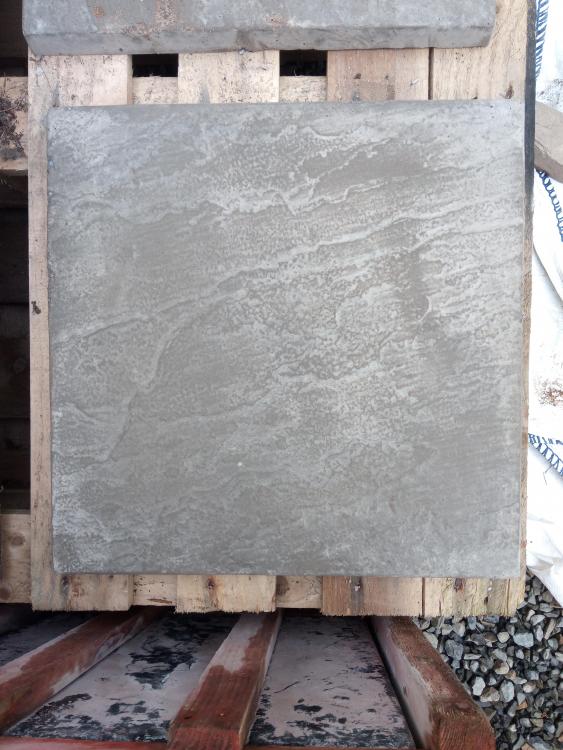
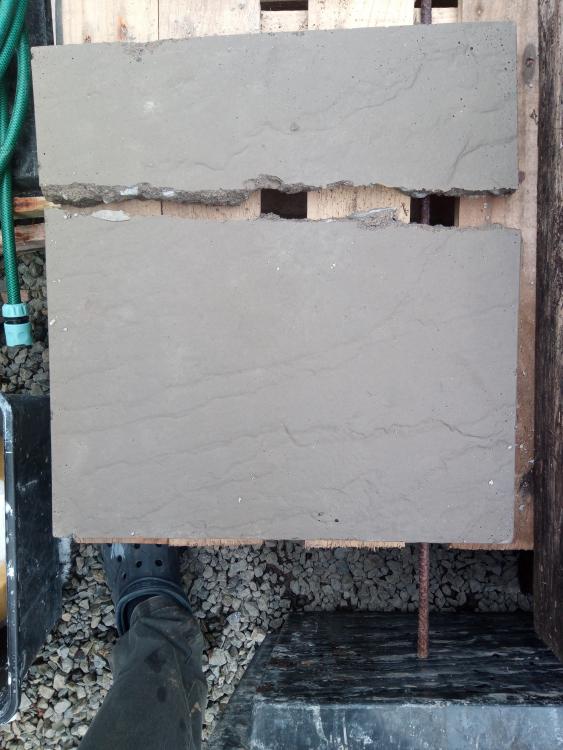
Trial slabs. Concrete 3:2:1 mix by hand in barrow. Slab 1, Veg oil used as release agent Clearly I didn't get it all fully mixed. Slab 2, veg oil used as release agent. Slab 3, silicone spray used as release agent. This slab was made with quarry dust as the aggregate, whereas 1 and 2 used Type 1 MOT. It was also a wetter mix which I think is why it broke. Lessons learned: Veg oil as release agent works, as does silicone spray. Concrete mix shouldn't be overly wet. 72 hours in mould to cure may be better than the 48 I gave them. Use a concrete mixer to ensure consistency of mix. I'm reasonably happy with first slabs cast. My neighbour is kindly lending me his mixer, and I'm hopefully getting a loan of a vibrating table to speed up production.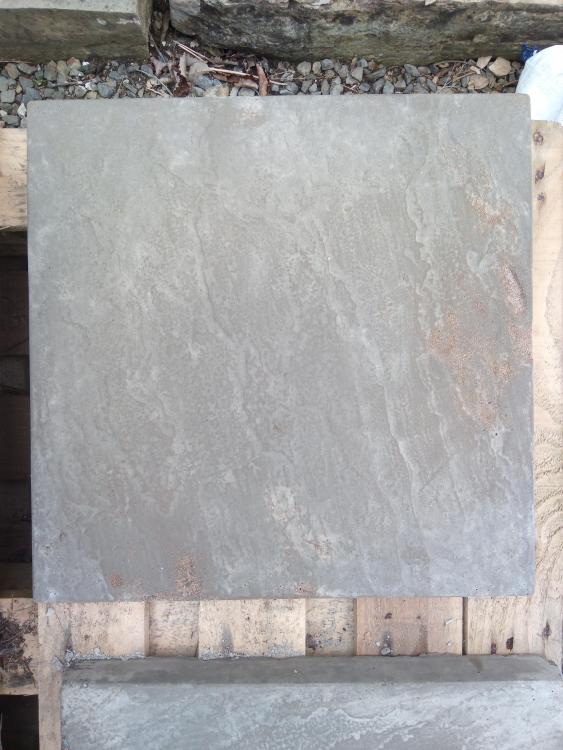
-
I have acquired a number of (plastic) concrete slab moulds (riven face) with the intention of casting my own slabs. I plan to trial different aggregate types (coarse gravel / quarry dust), and adding colourant to see what comes out best, using a basic 1:2:3 mix. I'm aware I will need to use a release agent of some sort in the moulds. I know vegetable oil has been suggested here before (rather than the significantly more expensive release agents you can buy). Anything else anyone would advise using?
-
The BuildHub forum was founded by the Forum Foundation Group (FFG) in 2016, following the closure of a large UK-based self-build forum. The forum has continued to grow significantly and we currently have over 8000 registered users, and that number continues to rise daily. To date, BuildHub has been managed on a private and voluntary basis by a small group of members known as the Forum Management Group (FMG). The FMG looks after BuildHub's day-to-day running, including hosting and maintaining the forum software, moderating member posts, and managing membership applications. The FMG was originally constituted as a Members Association for the purpose of forum governance and ownership. While this was the quickest and easiest way to get the forum up and running, it has the disadvantage of not having an associated legal entity. The absence of a legal entity means that many suppliers will not contract directly with Buildhub. The result is that BuildHub contracts and assets such as forum software licences, server space, and URL ownership remain in the names of FMG members, which places a large legal burden on those members, and also involves risk to BuildHub. To address this ongoing issue, the FMG recently approved motions to: Form a Private Company Limited by Guarantee; and On an agreed date, dissolve the Members Association known as the Forum Management Group, and transfer its assets, including ownership of the forum, to the new company. To this end, Buildhub Forum Management Limited has been formed as a not-for-profit company, limited by guarantee. The company will operate the BuildHub forum website, provide a limited liability structure to own and operate the forum, and ensure that the forum software licences, server space and URL ownership are no longer subject to a single point of failure or irrecoverable circumstances. The company directors are not remunerated, and the costs for operating the forum and its support will be kept to those essential to run and operate the service. The date of handover was 30th April 2021, and this is the formal notification that it has been completed. BuildHub has always operated on a strictly non-commercial basis and will continue to do so. Advertising is not allowed and members may not offer services to other members via the public forum. This policy will remain under the new structure. Similarly, BuildHub intends to continue with its periodic donation funding model. Day-to-day operations will continue to be run by volunteers giving freely of their time and expertise in much the same way as it is now. This group will be known as the Operational Management Committee (OMC). Information about how you can get involved in the running of the forum will be posted shortly. In practice, your experience of using the BuildHub forum should be unchanged. As chair, and on behalf of the members of the now-dissolved Forum Management Group, I would like to express my thanks for your support of BuildHub since its creation. We look forward to the continued growth and improvement of BuildHub under this new and long-term sustainable structure.
-
- 45
-

-

-
We have our Biopure pumped out every 2 years, by SW at a cost of £183. No issues at all and tanker driver seemed happy and said it all looked fine. Whether we drop to a 3 yearly empty when the kids depart, I'm not sure.
-
Hire a rotovator for the weekend, break it up. Roughly level and finish with topsoil.
-
A few round and about us, all owners pleased with them. Not sure I'm interested enough to justify the investment though. Aware of a few folk building their own, sourcing the components themselves either fish pen pipe, or if you have some shelter 63mm water pipe - could save you a fair bit I think. Have the name of the polycarbonate supplier (7m lengths) that they use if it helps.
-
-
I believe the report indicates that the climate committee has factored in 50C as the default running temp for heating with an ASHP. Those with an ASHP know that CoP at that temp is woeful, and would indeed cost householders a lot more in terms of electricity compared to gas price for the same level of kWh of delivered heat. That's a big ask / sell. Hydorgen is interesting. Commercially, due to the conversion % it has as far as I know never been economically viable, however the advent of excess electricity produced by renewables means that there is a resource that can be used to make it economic to produce, whilst at the same time maintaining current retail electricity prices (as I don't think for a minute that either government or the energy sector has any desire to see electricity prices fall as should happen in a true market when supply exceeds supply). Test project has been ongoing up here for a while: http://www.emec.org.uk/projects/hydrogen-projects/bighit/ Lots of possibilities, although the one question I have is where all the water will come from if we start producing Hydrogen on an industrial scale...
-
Heating, Hot water, ASHP, and Sunamp Design Needed
Stones replied to Triassic's topic in Other Heating Systems
Thanks Terry. Really interesting to see. We use a bit more and over the past 4 years it has ranged between 6500 and 7000 kWh for heating. We are achieving a CoP of 3.8 over the heating season, so an input energy requirement of between 1700 and 1842 kWh. At my current tariff of 13.44p/kWh I'm paying £228 and £247 per annum, to keep the house comfortably at 21.5C When I was deciding which route to go down I compared various different options and configurations and came to the following conclusion. If DHW and Heating requirement were sub 2500 kWh then direct electric resistive heating was the most cost effective. Between 2500 and 5000 kWh the balance started to shift to other solutions and over 5000 kWh then ASHP won out. Looking at your heating figures, and assuming you could get the same 3.8 CoP, would mean an input energy requirement of 1250 kWh per annum. Split 750/500 between night/day would cost you £147 per annum. Your in the realms of it making sense financially based on a ten year life of an ASHP (which is what I factored), but probably not enough for the hassle given you have a perfectly functional set up. Of course the real beauty of your set up is the simplicity of the willis heater and ease of repair. This brings us full circle back to what we concluded a few years ago when we discussed this, different ways to meet individual requirements (which of course vary but may be the biggest decision drivers) but ultimately, the overall cost balances out for a given energy requirement (for low/lowish energy requirements).


