Stones
-
Posts
3762 -
Joined
-
Last visited
-
Days Won
23
Everything posted by Stones
-

Where is the kWh price heading in 2022?
Stones replied to epsilonGreedy's topic in General Self Build & DIY Discussion
The amount of political haymaking at present is unbearable, and none of them seem willing to talk about demand reduction. What I think it would be useful to hear openly discussed: Removing VAT from domestic and business gas and electricity Increasing warms home discount - targeting help where most needed Energy reduction program in all public buildings - turn down the heating to 18 or 19C and encourage all businesses to follow - stress the green benefits of this approach. Pass an emergency law if need be and enforce. Really push messaging on turning down thermostats and wearing a jumper (and be willing to accept the political flak for saying it) Graduated pricing structure for electricity and gas to encourage demand reduction, the first 2000 is the cheapest, followed by the next 2000 and so on. Get all the fixed priced generators around the table and impress on them (especially those who receive or have received subsidy payments in the past) that they need to divert a significant % of the current excess profits back into supporting those needing help - if they decline, move to compel / impose emergency levy to boost warm homes discount. Urgently look into whether we can use some of the lower calorific value gas not currently extracted from the north sea -
Where is the kWh price heading in 2022?
Stones replied to epsilonGreedy's topic in General Self Build & DIY Discussion
It's quite interesting to see how vested interests are using this emergency (having been escalated from its previous crisis status). The Ch Exec of Scottish Power (seemingly supported by the bulk of the industry in the UK) , has proposed freezing prices and the govt loaning energy companies the excess required to buy energy at whatever the market price is over the next two years, with that money being paid back by bill payers over the next 20 years - basically the governments original £400 help proposal on steroids. What he neglects to mention is that it neatly takes the risk away for the industry in terms of non payment and potentially cutting people off, and will allow their generation arms to continue making money hand over fist where that generation is fixed cost. Easy to see that the government will be seduced by this approach, neatly kicks the can down the road and they can present it as keeping bills down, as a loan to industry rather than public debt and to keep the green transition alive. Telling people to use less, turn down the thermostat, wear a jumper etc simply is not a political option for the government, even though it is what's actually needed. -
Problems with how to finish reveal with aluclad windows
Stones replied to cbk's topic in Plastering & Rendering
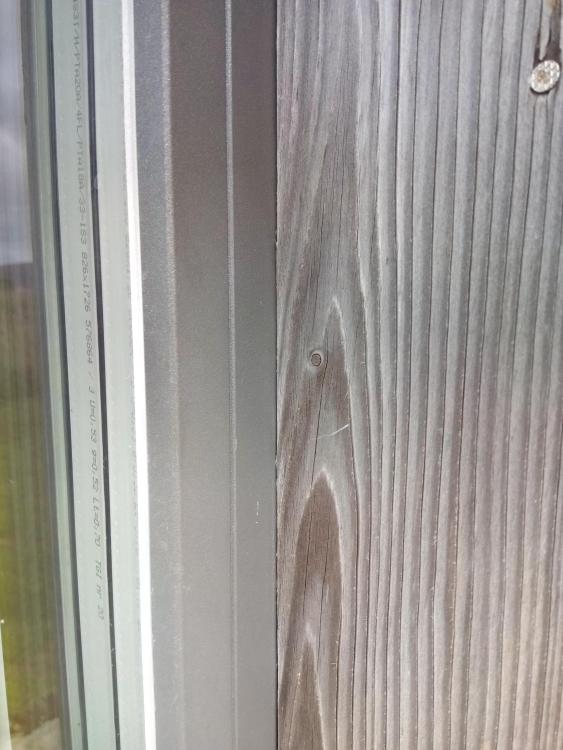
We have an ICF built house with Rational Auraplus aluclad windows. Windows weather sealed to structural timber frame in ICF wall, in our case using a sealant but could as easily have been compriband. Render reveals: Plastic stop bead hard up against alu cladding. Timber reveal: Timber hard up to alu cladding. This ensures drainage channels behind alu cladding are clear and any water drains away. Weatherseal hidden and protected from elements.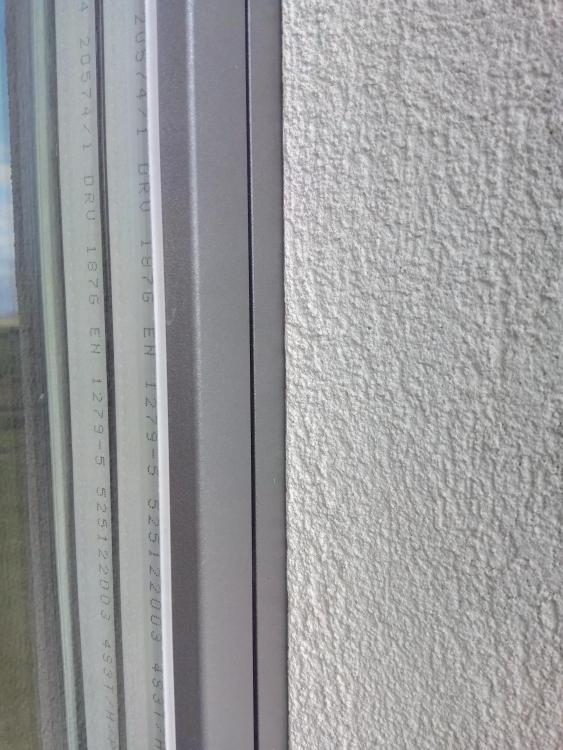
- 7 replies
-
- 1
-

-
- silicone render
- window reveal
- (and 1 more)
-
Between 380W - 600W consumed every 24 hours.
-
Mine is a PUHZ-W85VHA2-BS As per comments above, in summer the heating registers energy input, but no output. On the basis of those figures it seems to be using between 16W and 25W (380-600W per 24 hours), although how much of that is for the controller and how much for the heater I do not know.
-
I've been following this for a while as I have an 8.5 kW Ecodan, package cylinder and FTC5 controller. I've been over and over my energy use and meter readings and certainly cannot find any evidence to substantiate the circa 250W standby, at any time of year. Having just checked, my unit is a VHA model.
-
My system mounted to garage wall:
-
Garden fence 'adjacent' to footpath / road - Advice
Stones replied to ChrisOli's topic in Building Materials
@ChrisOli The 1 metre is for visibility for road users and pedestrians, i.e. road safety - think car emerging from driveway. Without seeing exactly what the situation is at your location we are really just guessing as ultimately, it will probably be a matter of fact or degree. I would suggest the fact you have a letter means there is no or little leeway given your location. You can do nothing and wait for them to take enforcement action - serve a notice requiring removal. You can appeal such a notice, albeit no guarantee your appeal would be upheld. If you failed to comply with any notice you would be guilty of an offence, and probably be offered the opportunity to pay a fixed penalty (£1500 if memory serves). The local authority would also be able to take direct action to remove the fence etc and you would be invoiced for the cost (and doubtless pursued in court for non payment if you didn't settle the invoice). I would always advise engaging with the enforcement officer to see if there is any leeway / clarify what you could do in your location. -
A further update to this, replaced the bearings with SKF as recommended. So far so good - a real difference, whisper quiet.
-
First year Heating Energy Use in Passive(I hope) House
Stones replied to Iceverge's topic in Boffin's Corner
@rh2205 Do you know the breakdown between DHW input energy and Heating? 50/50 ? Your figures seem quite remarkable, and from a bill paying point of view most welcome. I'm up in Orkney, and very similar to @ProDave in terms of input energy for heating, albeit we do not have a wood burner / secondary heating source. Not as cold here but as you would imagine, very windy, which in effect, drives as much heat loss as colder temperature does. Looking back at my energy usage, year to year there can be up to a 15% variation in the amount of heat energy required, with the total figure ranging between the calculated energy demand for average outdoor air temp and minimum outdoor air temp. We heat the house to 21.5C, with the ASHP coming on as required to maintain that temp. Within the house the impact of household gains are evident as occupation moves between different parts of the house +/-0.5C. The ventilation rates set in specific rooms also impact on the room temp by perhaps +/-0.5C We meet some passive house criteria, but certainly not all, and our house design, for want of a better description, two interlinked bungalows, means we have a lot more exterior wall standing up to the elements. We have 155m2 internal footprint with one upstairs attic room. We have additional areas of vaulted ceiling as well meaning our house volume is around 473m3, so roughly speaking the equivalent of a 200m2 standard sized room building. -
Quick update with what I hope is a useful tip. In the end I went for simple mechanical removal with a Stanley blade scraper. To reduce friction and prevent the blade digging into the shower tray, I used a little lightly diluted washing up liquid to wipe over the silicone and the blade. This worked brilliantly and let the blade glide on the shower tray and easily break the bond of the silicone for removal. First time I've tried it but worked a treat. Likewise having cleaned off the old silicone I used wet wipes to remove any final residue (when you see what they do to your hands I can't fathom why you would want to use them on a baby!), I did a final clean / degrease with meths before applying the new silicone, finished as suggested with profile tool.
-
Short update to this. The replacement bearings seem to have failed, as the fan has been getting noisier and noiser. This may simply be the fact the bearings were cheap and poor quality, but nonetheless annoying. I have therefore replaced them again but there doesn't seem to be much in the way of improvement (same batch of bearings). I really don't want to have to replace the fans themselves given the cost, but other than getting some different bearings there's not much I can do or think of doing. Given the cost of replacement fans, and the fact the other fan is now making a little noise, if new (better quality?) bearings don't work, I'd be as well replacing the whole unit given the cost of the controller/control board (also known to fail) runs to several hundreds as well. While nothing lasts forever, and I accept that bearings costing less than £1 fall into that category, its still frustrating. Having looked online, there are several suppliers from which I can buy the right size bearing. Can anyone suggest a quality bearing brand to go for (rather than the no name ones I've tried)?
-
One point to bear in mind, whenever a government spokesperson hails the amount of renewable heat energy being generated, he or she is referring to the notional total as derived from the kWh calculated through RHI and other like schemes. All good you see - takes us closer to net zero, so a win all round.
-
Don't know what you have planned for the oak, but do not burn it. They can be sold for surprisingly big money. Can put you in touch with a furniture maker here who would be very interested, including some of the smaller limbs.
-
5 years on and no issues for us.
-
They have performed as PVGIS suggested, lower output compared to mounting on the roof, but reasonable none the less. The array I have produces circa 20% less compared to being roof mounted at 45 degree pitch. Mine are fixed to the garage wall so no issues with wind (which can get quite brisk here!)
-
Where is the kWh price heading in 2022?
Stones replied to epsilonGreedy's topic in General Self Build & DIY Discussion
I believe suppliers are also permitted to apportion the cap between standing charge and unit price as they see fit, so there will be some minor variation there as well. -
Smart meters in Shetland?
Stones replied to cmorewood's topic in Networks, AV, Security & Automation
Not sure as it's not something I've looked into (not being especially keen on the idea). Got a couple of folk I can ask and will update if anyone of note to add. -
Its very difficult to detect the extract air movement by hand - and in comparison to supply where there is a positive flow it feels like there is very little movement. A very easy way to test that air is being pulled through is to hold a bit of tissue up flat to the extract vent - the extract air flow should pull the tissue up against the terminal and at least reassure you that it is extracting. You could also close all but one extract terminal and see the step change at the one remaining open one, again to show you the total volume of air being extracted.
-
Conventional extractor fans are designed to shift large volumes of air quickly. MVHR less so. I think this is probably more a case of your expectations rather than anything wrong with the MVHR unit itself. I take it the steam in bathroom clears, just takes longer than you thought?
-
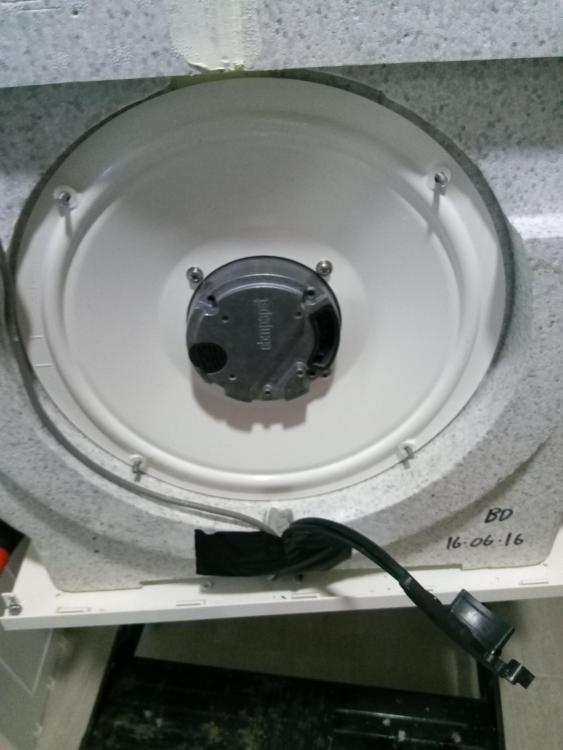
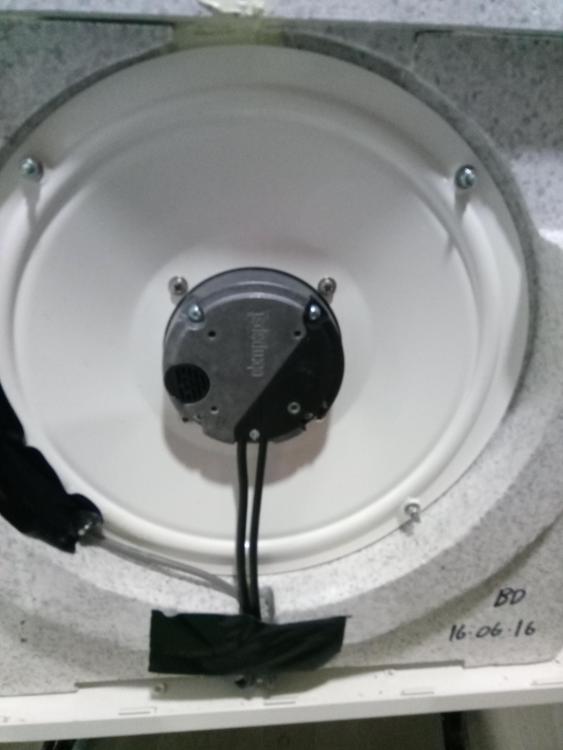
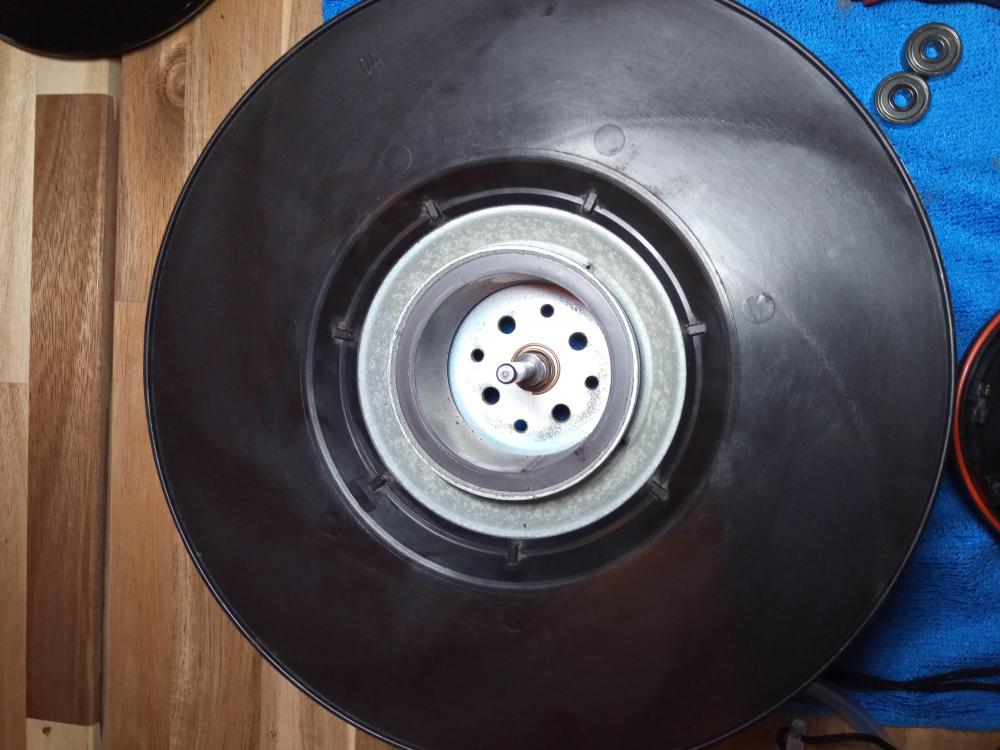
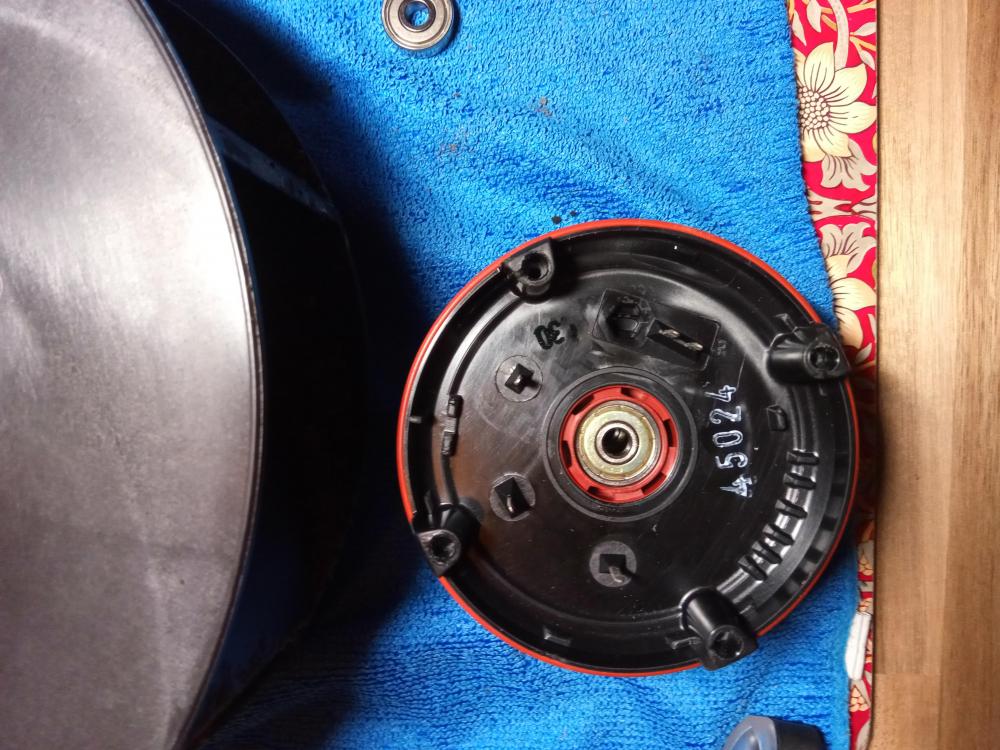
Following on from the excellent post by @DOIGAN where he replaced the bearings in one of the fans from his MVHR, this is a short post to detail the steps to replace the bearings in the extract fan in my Vent Axia Sentinel Kinetic Plus B (being a slightly different model and fan to that of the link below) The process I followed is basically the same as laid out by @DOIGAN in his original post. I've added a couple more pictures and descriptions below. To get at the fans, the unit has to be stripped down. First the duct spigots and blanking plates are removed. Both the back and front covers are then removed, allowing the top and side panels to be taken off - the side panels slide/interlock with the top and bottom panels. You should then have access to the fans on either side which are bolted to the poly core: I then disconnected the power connector to avoid having to try and unplug from the motherboard / cause any other issues. From this point I followed the process as per @DOIGAN Removing the circlip was a bit challenging, as for some reason the hub assembly would not depress, it turns out because the spring beneath wasn't seated properly. I managed to get the circlip off, but naturally it pinged up into the air and I spent several minutes searching for it until finally finding it some distance away. The bearings themselves (one on either end of the hub) popped out easily. I used the same bearings as @DOIGAN Reassembled and back into the MVHR unit. Cost - my time and £7.99 for a pack of 10 bearings vs £298.43 + VAT + shipping charge for a replacement fan from Vent Axia. Vent Axia were unable to give me any detail of the bearings used when I emailed to ask.
-
I wonder if it's as simple as that, larger volume to heat, longer and more efficient run and hence CoP.
-
No, mains fed. What size cylinder do you have?
-
I know of another Ecodan install locally who is only getting DHW performance the same as you @Keno 8.3 kW Ecodan, FTC5, and preplumb cylinder. Only difference to between my set up and that one: They have a smaller cylinder (200 litre), cylinder is located in unheated outbuilding and some of the pipework is uninsulated.
-
We have an 8.3kW Ecodan, FTC5 controller and 300litre preplumb cylinder. Heating CoP ranges between 3.4 and 4.1, yearly average 3.6. DHW CoP ranges between 2.1 and 2.5, yearly average 2.3 Economy setting, DHW heated to/ stored 48/49C