Roundtuit
-
Posts
1280 -
Joined
-
Last visited
-
Days Won
2
Everything posted by Roundtuit
-
We had to get permission from the local internal drainage board, but no EA involvement.
-
Ah; maybe not an alternative you want to consider then! I used Howdens Burford contemporary primed mdf skirting (99p/m) and architrave (79p/m), and would probably do the same again even if the budget was more flexible. Doors look great; I spent the saving on beer! ?
-
I didn't see it mentioned, but are you using oak architrave, or painted? If it's painted, forget the oak door linings and paint softwood to match; it will visually 'frame' your quality doors better, and you'll never give it a second thought once they're in.
-
The Timber Frame Goes Up
Roundtuit commented on Triassic's blog entry in Mr and Mrs Triassics New Home
Looks great! I look forward to seeing it all come together! -
Fabric vs bling
Roundtuit replied to Ed Davies's topic in Energy Efficient & Sustainable Design Concepts
I looked at rainwater harvesting; financially it didn't stack up (particularly as we're off mains sewage, so no sewerage charge). The environmental aspect is interesting though, but on the basis that Anglian Water can recycle water on an industrial scale far more efficiently than I can, I'm happy to contribute by buying it. A couple of thousand litres of rainwater might let you water the garden for a while during a hosepipe ban though... -
Plastering and the white room of paint
Roundtuit commented on vivienz's blog entry in Blackmore House
Great work; looks fantastic! -
ASHP- struggling to warm house in the cold weather
Roundtuit replied to Jude1234's topic in Air Source Heat Pumps (ASHP)
Agreed, hence my question about whether there are trickle vents in the windows. If there is, that may explain some heat loss, but more significantly, it will give an indication on whether the builder has got a grip on the principles of an energy efficent build. FWIW, my build (270 sq m) is well insulated, fairly airtight (approx 1) and triple glazed, with UFH downstairs and rads up. No heating upstairs would have been a bad mistake. Downstairs sits comfortably at 21-22C at the moment with maybe 4-6 hours a day of UFH from the ASHP, and I can get the open plan living room/kitchen/diner up to about 25-26C with a couple of hours of the wood burner running (4.5kw output), but even with double doors open into a full height hallway, not enough heat would reach the bedrooms. -
ASHP- struggling to warm house in the cold weather
Roundtuit replied to Jude1234's topic in Air Source Heat Pumps (ASHP)
Sorry to hear you're still having problems, but if all the heat is going upstairs, wouldn't the upstairs be warm? Something feels wrong somehow; you seem to be putting a fair bit of heat into the house, but not hanging on to it like you should in a well insulated house. Are you able to share any details on insulation specs or air tightness strategy? Do your windows have trickle vents perhaps? -
Wasn't your starting spec insulated plasterboard fixed to galvanised steel battens? Not sure how that can fit within a 60mm build-up? Perhaps you have a little more space to work with than you think?
-
Instead of putting PIR in the cavity why don't we put it on the inside
Roundtuit replied to AliG's topic in Brick & Block
The only downside I can think of is the challenge of fixing the pir internally. 100mm isn't a huge amount of insulation, but even that might be a pain in the ar$e to fix, assuming you fix with battens for plasterboard. By the time you've done all the additional fixing and battening, surely timber frame would be worth considering as an option (we've got 120mm in the frame, and an additional 40mm internally). -
Bpc ceiling vents
Roundtuit replied to Pete's topic in Mechanical Ventilation with Heat Recovery (MVHR)
I left them full length when fitting, and just made sure I taped any airtightness membrane above what would be plasterboard level. The plasterers boarded and plastered round them, and I cut off the excess with a multitool when the plaster was dry, leaving them flush with the ceiling. Simples! -
ASHP- struggling to warm house in the cold weather
Roundtuit replied to Jude1234's topic in Air Source Heat Pumps (ASHP)
How about air tightness? If you're a bit leaky, it negates the insulation. Might be worth a check round for draughts. I assume mvhr will be feeding cool air into your bedrooms; might be worth checking it's not 'over performing' in terms of air flow. The supply air temperature is going to be whatever the outdoor temperature is, tempered by whatever heat can be recovered from the exhaust air, so if its cold inside, it can't do much tempering... -
It's future proofed for putting a shower in at a later date, and the shower will go where a light switch would (unless I put a switch on the hinged side of the door...). TBH, now I've tried it, even if I had space for a switch I'd still go PIR sensor.
-
I fitted a pir sensor in the WC as I don't like pull cords, and I didn't have wall space for a switch outside. It works well, and in retrospect I might have put a couple more in other places. My mother-in-law did suffer a 'lights out' moment once, but to be fair, she had exceeded the allocated dwell time! ?
-
Assuming the boundary hedges are definitely yours, there is no statuatory protection in place (TPO etc) and no planning conditions to retain them, then I don't think there is anything to stop you doing a spot of gardening with a chainsaw. Are you cutting them back hard to get them back in good order, or grubbing out altogether?
-
Yep, another vote for osmo polyx oil. We used Matt on stairs and doors with rub down with a very fine sanding pad between coats; looks great and has finished dead smooth.
-
Solar PV Diverter setup - "Head Scratch"
Roundtuit replied to swisscheese's topic in Photovoltaics (PV)
We've got an Apollo Gem; the sensor cable can be extended up to 100m with something like cat 5. I thought we might need to do that as our incoming meter is in a box on the boundary, but the sensor is fine on the tails into the consumer unit in the house. Installation diagrams/user manual is downloadable from their website https://www.apollosolarelectric.co.uk . Not sure it matters where your pv inverter is? -
Should be fine with a ceiling fix as long as the glass spec is ok. That will look the dogs danglies!
-
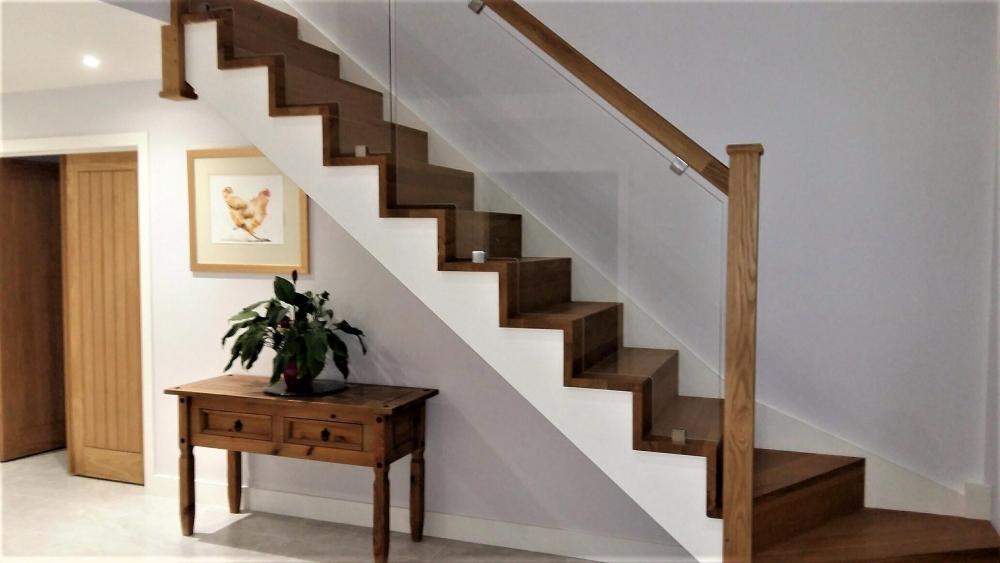
Ours are stairbox: Just something to be aware of: framless glass balustrades, i.e. without handrail, might not be as straightforward as you'd hope (or the style magazines suggest!) if you need it to meet building regs. Frameless would have been my first choice, but getting someone to make it to meet regulations started getting very expensive, with talk of steel strings clad in timber to take the loadings.
-
Consumer unit location
Roundtuit replied to Russell griffiths's topic in Consumer Units, RCDs, MCBOs
In the house we rented whilst we built, the CU was in the attached garage (no connecting door). It was fine until a lightbulb blew and tripped the RCD, and then it was a pain in the arse to go out and flick it back on. Ours is located in the house; not centrally, but with all the other plant, and that would be my recommendation. All cables lead to the CU, so what you save on one side you gain on the other. On a slight tangent, and for no reason other than debate, I believe that for disabled access purposes building regs stipulate the permissible height of a CU installation, and that a level door threshold into the house must be provided. If you put a CU in the garage, do you also have to provide level access to the garage? -
I never really considered that this could be a problem. We moved in in June and notified the local council so we could get wheelie bins and start the council tax ball rolling, and had BC completion inspection yesterday!
-
As above. No need to have external waste pipes; all ours run internally as I'd rather loose the space than see them on the outside. It just needs a bit more thought in the early stages.
-
Hi Tamara; you've found the single most useful source of self-build support! I'm building probably less than 10 miles from you; happy to share experience if it's of any help.
-
Sounds good in principle, but perhaps consider: - combined furniture store and site store wouldn't have worked for me; too much smelly, dirty, dusty stuff. If you're storing furniture, probably best to put it in dry, keep the doors shut and use something to absorb atmospheric moisture (like a dampstick). We hired one container off-site for furniture etc, and one on- site for building stuff (now it's ours, but I should have bought it 2 years ago...) - containers are great for secure storage, but don't easily lend themselves to other uses without a load of extra work as a) they're a steel box, and b) they're a fugly steel box. - containers hold their value well. If the cash flow can accommodate it, buy with a view to selling at the end, and spend the money on the garden room you really want! I'm pretty sure that generally no permissions are needed for a temporary site storage container. You could just ask the question of your planning authority to be sure, but I'd be inclined to find a sensible position for it where it's unlikely to offend anyone and just do it...
-
Cutting down a TPO tree by mistake - Enzo's homes
Roundtuit replied to Moonshine's topic in Planning Permission
I'm no Tree-hugger and have cleared my fair share of timber, but surely anyone certified as competent with a chainsaw would say "this one?, really?, are you sure?". The instruction to fell must have been a management decision, and as such, whether there is gain involved or not, I think justice should be seen to be done. Maybe I just don't like people taking the pi$$!