IanR
-
Posts
1841 -
Joined
-
Days Won
6
Everything posted by IanR
-

Act VI - Scene II - The Consequences of Space
IanR commented on AliMcLeod's blog entry in A house! A house! My kingdom for a house!
We went with Falzonal from Novellis. I believe the UK Distributers are: http://www.raaltd.com/falzonal-prepainted-roofing-coil.html I don't know that they are the only distributors, but that's who my installers bought it in from. I'm avoiding giving out the details for my installers, They did a good job, but deceived constantly with regards timing. Initially promised the timing I was after so that they got the job, but then just gave me constant BS about why it was everyone else's fault they were unable to start. Started 6 weeks late in the end and then took 8 weeks to complete a 3 week job, as they were running other jobs at the same time. RAA may be able to suggest installers. If you go that route, send me a pm and I'll let you know who did mine so that you are pre-warned. Out of interest, what's the cost per m2 you are getting for the Colourcoat? -
Act VI - Scene II - The Consequences of Space
IanR commented on AliMcLeod's blog entry in A house! A house! My kingdom for a house!
Mines a relatively simple roof, 15 degrees and no dormers (but a few roof lights), and a large area so I expect (hope) the price I paid will be at the lower end of an average domestic roof. Ours worked out at a little under £55 per sqr. m. (not including OSB substrate) Another thought: I'm not sure what the options are for fixing items like solar panels to a single ply membrane roof, if that's a consideration. With a metal standing seam roof you can fix to the standing seam with standard clamping brackets. -
Act VI - Scene II - The Consequences of Space
IanR commented on AliMcLeod's blog entry in A house! A house! My kingdom for a house!
I think once you starting looking closely at standing seam roofs, you'll not feel that a single ply membrane would look the same. While it's a good, long lasting product and very good value, I personally feel that they are very noticeably not a metal roof. We ended up going with Aluminium. Started looking at Zinc, but didn't actually want the natural colour of Zinc so looked at coated versions. Pricing was £100 - £120 sqr. m. and a few concerns about longevity if you don't get the ventilation gap right underneath. ie. any condensation on the underside will rot Zinc very quickly. We were told by a Zinc roof installer of a Zinc roof with corrosion perforation within 7 years due to blocked vent gaps on a warm roof. At one point Colourcoat Urban (steel) seemed very cost effective, and I was willing to accept a less traditional flashing around the roof lights to get the significant cost save, but when I came to actually order the costs rose significantly (not sure why) from when I had initially costed it and the pricing ended up slightly higher than Aluminium. For me the coated Aluminium gives a near identical look to (coated) Zinc, at better value and is more durable. As it's ductile all the flashing and joining can be done by traditional hand-formed methods so you get the idiosyncrasies of a Zinc or Copper roof. -
Do the out buildings currently have a residential use? What was the site previously? If currently residential and will be within the cutilage of the new build then as per JSH says: https://www.planningportal.co.uk/info/200130/common_projects/43/outbuildings
-
Wet room without mosaic tiles?
IanR replied to divorcingjack's topic in Bathrooms, Ensuites & Wetrooms
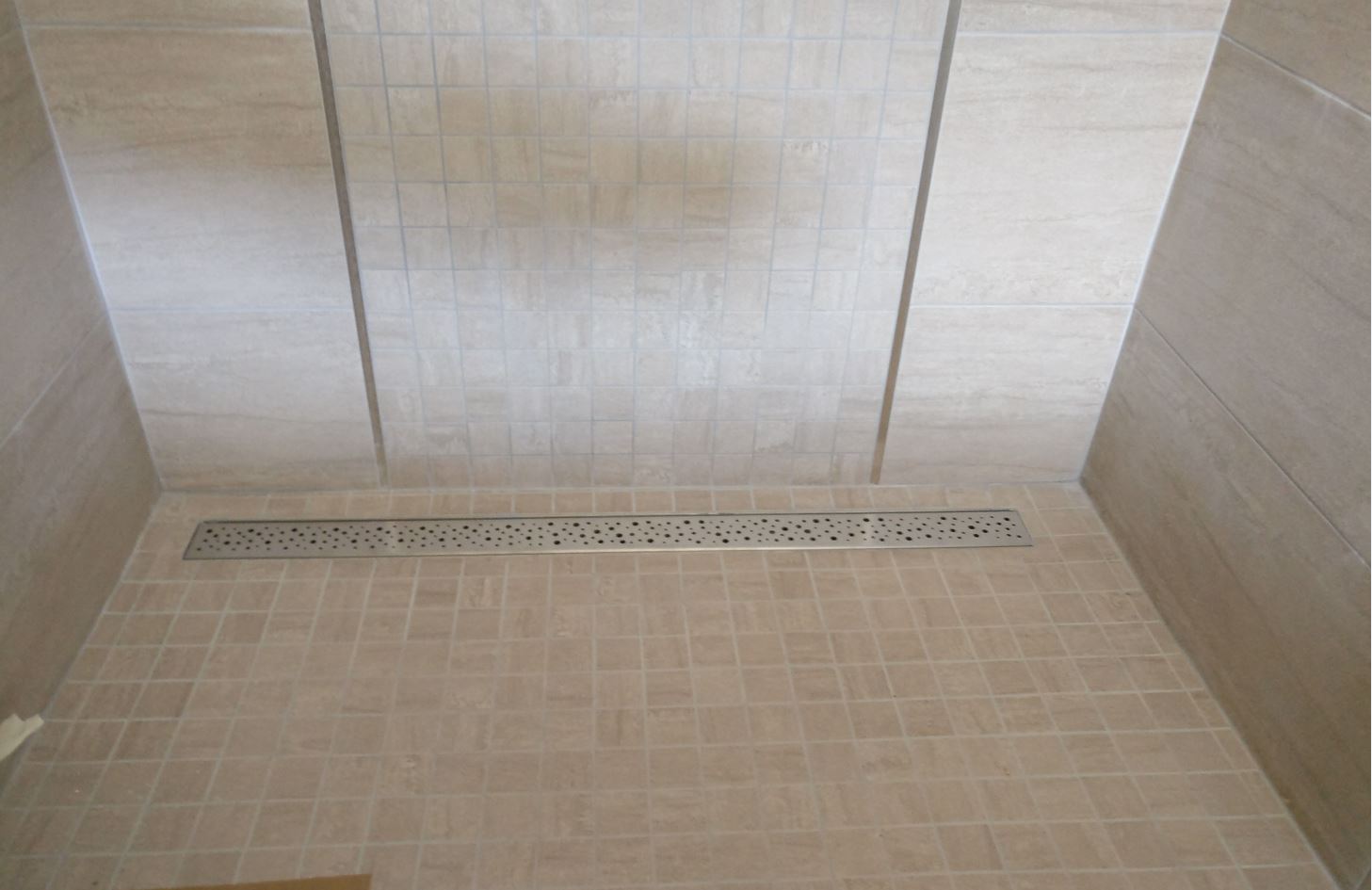
Linear gully above now tiled in to my ground floor, passive slab wet rooms. Slope formed in the slab and without a tray. Happy with the result, but met some resistance along the way from trades that "don't normally do it like that". (Not from the tiler, he liked it) Biggest issue for me was position of foul drains in the slab needing to align to an off-site cut frame. 3 out of 4 were close enough to not notice. 1 needed a shorter gully than planned as it was too far out to fit the original. Still went with mosaics on the sloped floor though, even though we could have done it in large format tiles. That was more for the perceived "gripier" floor.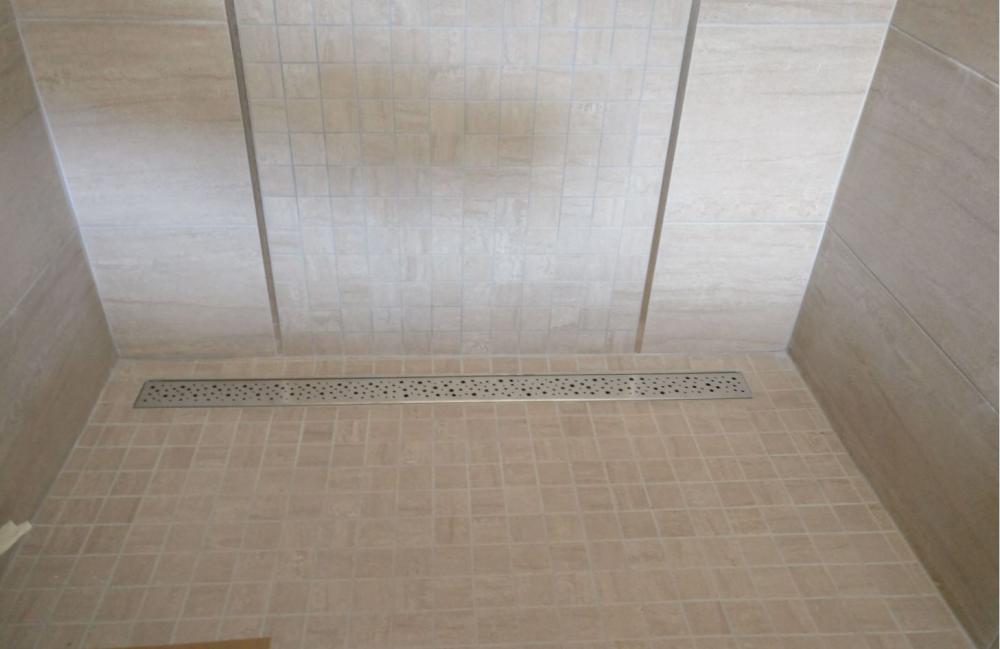
-
If you are targeting passive house levels of air-tightness, insulation and cold bridging then Touchwood Homes in Hertfordshire seem willing to travel any where in GB Their system is cut off site, but stick built. Costs and accuracy seem comparable to equivalent panelised systems with the similar timing from order to build - just less time in the workshop and a little more onsite.
-
Vat reclaim
IanR replied to johns's topic in Self Build VAT, Community Infrastructure Levy (CIL), S106 & Tax
Out of interest, how do HMRC find out that the actual build is not in line with planning? Are they asking for photos that then inadvertently show something that is not on the approved plans, or are they counting up toilet pans etc. on the receipts provided and working out too many have been claimed. Edited to add: Just reread and seen this comment. Thanks for advance warning...I won't be doing that. -
I'm going with an off-the-shelf solution from Nibe, which does cool the buffer. I'm having a 200ltr buffer which will hold about one third of the fluid in my system, requiring additional energy to cool initially. After that it's just the energy losses (heat gain from environment) of the buffer that would drop the efficiency I would have thought. But, it may help reduce short cycling when cooling requirements are low. If it proves to not require the buffer for cooling then I may look to re-plumb and bypass the buffer in cooling mode.
-
Nope, only time a roller was used was around a large roof light as it would have been near impossible to mask off.
-
No words of wisdom, but the decorators I've used have just finished the spray work at mine. 2 base coats of watered down contract emulsion and 2 top coats of Little Greene. Goes on very fast and the finish is first class. Seems to make the plastering look better as it gives few blemishes to focus on. One draw back is future repairs by roller or brush will likely stand out more, although the decorator I used believes some paints are more forgiving than others. The only thing I noticed is, just like for spraying cars, release the trigger as you change direction to avoid putting to much paint on.
-
Dodged a bullet yesterday...Kitchen company ceased trading
IanR replied to IanR's topic in Kitchen Units & Worktops
The chat from the "workers" is that they need the volume of the trade side to keep the workshops going, and if the don't offer credit they don't win the trade jobs. When they do offer credit, invoices are paid very late, and sometimes not at all. I am gutted for them, their workshops are very capable. -
Dodged a bullet yesterday...Kitchen company ceased trading
IanR replied to IanR's topic in Kitchen Units & Worktops
It seems to be a bit of a controlled "going down the tubes", ie. they knew the Insolvency Practitioner was turning up today, rather than him turning up unannounced. I went straight up there and made sure my order was all marked up as "Property of ....", While I was then arranging a Luton to go and get it collected, they called me back and offered to deliver it as long as I could take it that day, which of course I did. I must admit they've done their best to achieve the best possible outcome. One loose door fell out the back of the delivery van and damaged the corner, they've taken it back and have promised it will somehow be refinished and returned today. -
Dodged a bullet yesterday...Kitchen company ceased trading
IanR replied to IanR's topic in Kitchen Units & Worktops
...and it's served as a reminder, we did actually pay the initial deposit on CC. I've not got that much spending left, but will be using the CC more! -
I received the unfortunate news that the "hand made British" Kitchen company I'd gone with was to Cease Trading today. Not a company I would have thought would fail, been there a long time and appearing to be very busy, but apparently they've struggle with cash-flow on the trade side of their business. They had my paid-for Kitchen ready to ship next month for installation. It gave me a couple of sleepless nights, but I managed to extract the Kitchen and get it into storage yesterday. There's a couple of bits missing, and a chance I will get those as well. This has given me some anxiety throughout the build, when not being able to avoid paying up front for goods leaves you at risk of a company's collapse.
-
Just looks like the sub-base is going down, so was surprised to not see the drainage in already.
-
Good luck, should move fast now. I have to ask...where's your foul drainage?
-
While that's not like mine, I believe that will be OK, And it's reminded me that the deck is 18mm OSB3 not 22mmm (I'll correct my post) Part of my Standing seam is on a buildup of 350mm I-Joist structure roof, fully filled with blown cellulose fibre, 16mm Egger DHF board, 50mm battening to create a ventilation gap and then 18mm OSB3, breather membrane and standing seam. Tata actually looked at whether the ventilation gap was needed with the cellulose fibre fully filled roof, and their calculations said it wasn't. (Personally I wouldn't have gone without the ventilation gap)
-
Mine is effectively a cold roof. ie. It's a warm roof with large ventilation gap. There's a bit of change from £55 / m2 I'd quoted it a year ago and Colourcoat Urban (steel) was significantly cheaper that other materials at circa. £40 /m2. But due to delays on my roof lights the original company were unable to install and I had to requote. When I requoted in November last year Colourcoat Urban prices had gone up significantly. Different installers quoting £60 - £75 /m2. I couldn't get any feedback from Tata themselves as to why the price increase. Aluminium wasn't the absolute cheapest on the requote, but for me offered the best value solution. I also like the traditional hand-worked look of an ali roof. The prices quoted do not include the required OSB deck, that most standing seam roofs require. If you hunt around and buy by the pallet you should be able to get 18mm OSB3 for about £3 - £5 / m2 + labour
-
Help me with my little penetrations, please.
IanR replied to ToughButterCup's topic in General Structural Issues
If you need something to strap the ducts to to keep them upright you can hammer in some rebar and grind it off at floor level once the pour has cured. I did this also for UFH manifolds. With regards tolerance, I also stated 50mm, but this wasn't achieved in all places. While a total station was used to mark out, the process of digging the trenches removes most of the marking out. I had one that was about 150mm out. This wasn't a tolerance error, but a groundworks mistake reading dimensions. I caught it before the pour and was able to joggle it over within the thickness of the EPS so that it exited the floor at the correct location. Not strictly within the "all penetrations must travel vertically through the EPS" rule, but I checked with the foundation engineer and he was happy. -
What material you going with? I understand that with steel, another more ductile material needs to be introduced for the flashings, which then does not give the traditional appearance. I've gone with Aluminium in the end (was initially going with Colourcoat Urban), and here's mine (in progress): My details a little more complex than it needs to be, with the extra 45 degree chamfer profile on top. I lined the outside of the up stand with celotex, but this was too wide for the roof light mount, so needed the 45 degree angle to bring the width back down to the width required by the mount.

-
You need to satisfy that both the local authority and beneficiaries of the covenant "approve" the alteration. With the LA accepting the alteration is PD that's the fist bit done, but you still need to get the beneficiaries approval. To understand the minimum you need to do then you'll need that legal advice. My non-professional view is that "conterminous" means the owners with which you share a boundary need to give you written permission. I'd try a diplomatic approach to just those owners and see if you can talk them round. They may have misunderstood what you want to do. Not many people understand a drawing. If they unreasonably withhold permission then you could approach whoever "us" is that has the final decision. Us may be the freeholder of the building, or a previous owner or their heirs.
-
Glazing rep is due tomorrow. What should I ask him?
IanR replied to ToughButterCup's topic in Windows & Glazing
Walk through their delivery and install process if you want them installed. Our installers turned up with the window delivery and took 100% responsibility for the windows until handed over after install. Unfortunately I couldn't find someone that offered the same service for my roof lights. I was left responsible for receiving delivery and storing roof lights until installers came, and I was also responsible for the lifti. This did not work out well for me! Do they offer a passive house type install? I found standard installs would not provide the required air tightness, and the use of suitable tapes etc. was an extra cost. Following on, are the installers trained fro PH installs, and get them to talk through how and when the tapes are applied. There seems to be a few approaches to corners. I guess it's less important which method is used, as long as there is a method and they all work to it. For doors and full height windows, what's the threshold detail, and can you find common ground between them and your chosen floor/foundation. If you are going with off-site cut/manufactured upper structure you may be able to order windows off drawing, saving quite a few weeks build time, but if you have drop thresholds for doors and full height windows that's a dimension that not so easy to control at floor pouring stage, so if it's out of tolerance, how you going to bring it back into spec. If ordered off drawing, they need to allow for deformation (sag) of structure above wide windows. Very important for timber frame, especially so over sliders and bi-folds. You'll need the SE to state the expected deformation. -
New Bt connection... only got a slab!
IanR replied to Jimbouk's topic in General Self Build & DIY Discussion
I've been connected up this week by Openreach. I'd pulled the multi-core cable they supplied through the ducting they supplied from the agreed pole on the boundary right through the ducting under my slab and left the cable rolled up at the base of the pole and another roll on top of my slab adjacent to the duct. The Openreach Engineer was happy to connect the Master Socket to the loose cable, leaving sufficient cable length for me to relocate it to my preferred location at a later date. The only thing he did do was splice a twin core cable onto the multi-core as the multi-core do not fit easily into the Master Sockets. I do have my structure up, so I've not got "just" a slab, but he didn't seam concerned about leaving the connection loose. -
A builder with experience in converting something similar will get you to the quickest, cheapest, ball-park estimate. If it's a conventional Barn conversion I would have thought it would be possible to find another locally that has just been finished (possibly up for sale), or in progress, find the builder and invite them to come and look at your barn to give advice and outline costs with a view to quoting on the conversion once a full drawing pack is available. It will only be a budgetary figure, but to get anything more accurate will require significantly more work and investment. One thing to bare in mind is that a conversion will very likely be more expensive than a new build. They are, typically, less efficient with floor space, assuming there is a some original structure that the LPA wishes to be preserved and identifiable in the converted building which often leads to double-volume spaces with vaulted ceilings. This has to lead to higher £ / m2 figures. I'd be going with that higher figure from the architect, plus a bit more,
-
Welcome! You're going to need the "Swiss Army Knife" of options for Services then, I can't imagine there are two self-builders that are the same. I'd say the common ground on BuildHub, and eBuild before, is cost effective, low energy homes. I'm sure your professional experience will be warmly welcomed on the site and if you have interest and knowledge in low energy buildings there will be lots of opportunity to contribute.