


IanR
-
Posts
1857 -
Joined
-
Days Won
6
Everything posted by IanR
-
If your Planning is for a "Change of Use", or "Conversion" then that won't allow a knock-down and rebuild. Councils will often monitor how much of the original building will still be present in the converted building. The reason for this is that in general agricultural buildings are in a rural setting and outside defined settlements, so the planning policy will be against development. However, there is a contradicting policy that allows the re-use of redundant agricultural buildings, when they are suitable for conversion, deemed to be in a "sustainable" location, and there development will not be over-bearing on the rural setting. If the planning has been granted for the re-use of a redundant building, you can't then knock it down and rebuild. So, it depends on what you have planning for.
-
Welcome MrsB Potentially an interesting build. Are the pre-commencement conditions discharged, and if not do you know the costs for achieving this? As it's a Change of Use from Agricultural there's likely a contamination condition, which may be simple to discharge, unless the site walk-over high lights any contamination risks and then it could start to get costly. How about CIL? Has the local council signed up for the Community Infrastructure Levy, and if so who's responsible for paying it, you or the seller. The Barn may be exempt if it has been used for its lawful purpose for at least 6 months in the last 3 years, but this needs to be understood. If not you may be able to get self-builders exemption, there's a recent post on the forum that links to all the rules. With regards being structurally viable, part of the planning application will likely have included a structural engineers report to confirm this. Most Councils wouldn't allow a Change of Use on a Barn that wasn't structurally capable of the conversion. But, this will have been commissioned by the person that submitted the planning application so may be a little biased.
- 25 replies
-
- 1
-

-
- barn
- conversion
- (and 1 more)
-
Sounds like Rob's been able to help. You're welcome.
-
Willkommen! [that's just about all I can remember from the 4 years I spent in Köln]
-

Timber Frame, Passive Slab Build - Costings for Seperate Elements
IanR replied to Nick's topic in Costing & Estimating
There's a few companies offering an I-Joist structure, although only one I'm aware of that offers a package with a Passive Slab (or insulated strip foundations) which are who I used - Touchwood Homes. To save on typing, I made a few comments in this thread regarding my experience: My build is complicated by being a barn conversion with an existing steel frame, but I found, from the various different suppliers I got to quote, the I-Joist Structure was slightly less expensive than the twin-stud option, but required a slightly more complex periphery detail on the slab to achieve the same "cold-bridge" free junction at this point. In truth, there is a simple slab solution for the I-Joist that gets ~95% there. It does require a level of accuracy on the slab that general ground workers do not build to and as I was choosing to use local ground workers I went for the more complex option that allowed a little more tolerance on it's sizing. With so many factors effecting cost you're best going out to all the companies and getting them to quote. -
I'm thinking you need some professional support. A bit of basic googling suggests your planned internal drainage should be part of a multi-system approach to protecting the structure from water ingress. On its own it may be insufficient for building control. If other systems have been specified and employed then the risk of water ingress may be so low that there may be a better position for the membrane.
-
Slab with insulation above and and then screed on top is pretty standard. I assume the advice you had for using foam glass would be relating to a sole plate for any load bearing walls. The PIR insulation under the screed is non-load bearing, so can't go underneath any load bearing walls. If you have load bearing walls then you could use foam glass to reduce the cold bridge at the floor junction. No need to "stick" the insulation to the slab. I'm concerned something is being missed. Who specified the insulation under the slab, but tanking and drain channels above/within the slab? Is there any other drainage specified under the slab insulation, within the sub-base? Is it possible the drainage within the slab is belt and braces and will only be called into effect if there is a failure somewhere?
-
No, more like no. 1 on the sheet you linked to. Slab Membrane (tanking) Insulation (120mm - 200mm PIR) and form the channel at perimeter 75mm screed with UFH over the top of insulation and channel. Then male sure the channel drains well to a sump and keep the sump clear. I think I'd want a couple of pumps for redundancy to protect from pump failure.
-
No, with membrane beneath the insulation, the insulation would avoid you heating up the ground water and sub-base. If the slab is already in then I would have thought you need to insulate above the slab, on top of the membrane.
-
I did caveat my comment with "for me". I'd not seen this sort of detail before. In the OP you mention insulated slab, and to me if water is breaching the insulation it's going to negate it. ie. water at ground temp will get passed the the insulation and on to the underside of your screed with the UFH pipes in, so you end up warming up the ground water.
-
Neither of your sections show (for me) a viable floor. Are you expecting moisture to breach your slab and insulation (or is insulation between slab and screed) and therefore require draining from between the slap top and screed? Have you got the original engineering drawings of the "suggested" slab. Are you sure your "drainage channel" should not be running within the sub-base below the slab?
-
To be honest, I'm not clear on what you mean by this. Do you have a section that shows how it should be, preferably showing the floor/wall junction.
-
Is any part of your proposed foot print (now or in the future if you plan to add garages, outbuildings etc.) within the drainage path of the field and the ditches it drains to. If so then you should consider running land drains around the periphery of the area you wish to protect, and then on to a ditch at the lowest point on your property. The drains need to go at least 500mm deeper than you foundation. My current build is a change of use from Agricultural and there's about 2 acres or so of field that is higher than my foot print, which is in the path to the ditch it drains to. There wasn't much sign of surface water draining across and around the Barns I'm converting, but when we dug the trenches for the land drains I was shocked at how much water was moving through seams in the clay, below the surface. The field itself hasn't had any drainage work done to it in the last 25 years, but was moled at that time, and before that has much older clay land drainage. It all still seems to be pretty effective at draining the land and there's a significant amount of water that drains to the ditch below my Barns after the rain. I'm very glad I'm diverting it around my new foundation.
-
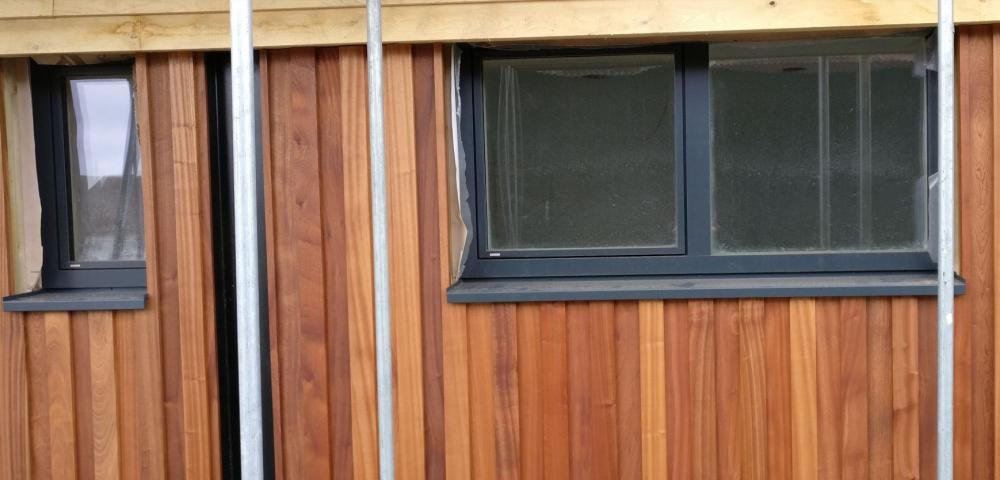
Also not the best pic, and reveals unfinished including missing posts: Both windows with same detailing at each end,
-
I've got similar cladding in 144mm/94mm boards and took the second option. Every opening has the same board set-out, and every opening is symm opp about its centre. I couldn't have lived it being random and different. Mostly achieved by adjusting spacing, occasionally had to rip boards down slightly to a narrower section. The spacing changes do not notice at all.
-
The Studio range is around 6% more than the equivalent Pure from Memory. But the Studio is not available in the 210 range, only the 310. The difference between 210 and 310 being a bit more insulating foam behind the cladding on the sash giving a slightly better U Value. Functionally and performancewise, there's not much difference between the Pure 310 and Studio 310. You are just paying a small premium for the flush profile giving the more contemporary look. Although the Pure is pretty contemporary in my view.
-
We have mostly timber/ali Internorm windows in our build, with white UPVC/ali Internorm windows and door in our Utility. I can't remember the price difference, but I'm sure it was in the order of 25% cheaper for the UPVC. Externally you can't see and difference between the timber and UPVC options. Internally it's down to the "look" you are going for. If you can get away with UPVC then I'd definitely go for it. Internorm UPVC are very well put together, very nice jointing in the frames, they look a quality product. UPVC frames are more robust that timber and are lower maintenance. Not that timber will be particularly high maintenance, but would require better looking after. The Internorm supplier we used made a point of mentioning humidity levels whilst plaster and decoration is drying out, and telling us to ensure the house was well ventilated during this period as the timber framed windows can be susceptible to swelling at the joints. This was part of our decision to have UPVC in the Utility, that and the money it saved on a few windows and a door paid for us to go up to the Studio range for the whole house.
-
How much PV and what capacity of battery storage do you plan? Are you expecting to run you ASHP in winter from PV/Battery?
-
I am putting my faith in the recommendation from a well established company that do Installations and maintenance from small domestic to large commercial jobs and are installers for a large number of brands (although not Panasonic). I also want a cooling solution, which is off the shelf with Nibe. Which is an expensive ideology for a self-builder. ...and unless you're set up allows for the avoidance of mains elec for the majority of heat and water, how much greener is it really than Gas?
-
Why's that. I'd be on Gas if it were available.
-
Thanks for the offer, but I'm going with a Nibe. I'm told once the deposit is paid I'll have access to everything I require. I just hope their idea of "everything" is the same as mine.
-
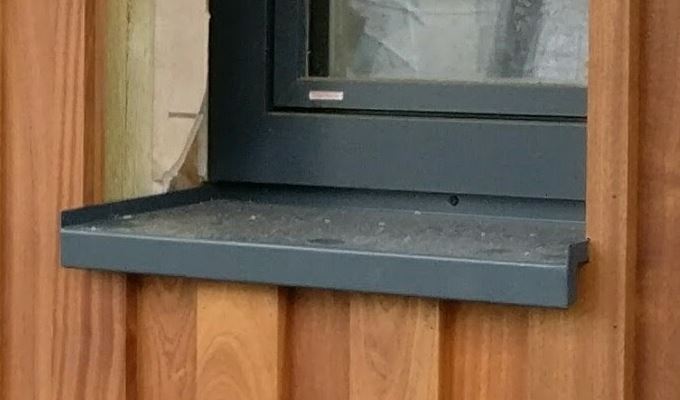
My Cills are 260mm deep. The outer face of the windows are 75mm back from the TF Structure, outside of which I have a 94mm vent gap plus 38mm cladding. This is for Internorm windows where the Cill attaches to a Cill spacer under the frame which is at least 10mm (maybe 15mm) under-flush to the front face of the windows. The Cills have a drip feature on the outer edge where there is a return flange back underneath the outer edge of the Cill making the edge of the Cill at least 10mm thick, and there is at least 10mm clearance between the back edge of this return and the outer surface of my cladding. Edited to add: [Cladding not yet complete into reveal] For Full height windows and doors, on ours the Cills are narrower since there is no cladding and vent gap, just plinth wall below DPC. Wouldn't that be the same for you?
-
I didn't find a single company that could do all systems. Even if you found one, I think you'd fall down on the controller side, ie. to find a single dedicated control system that could integrate the functions of all the systems. I have UFH installed by the slab engineer; ASHP and cylinders from one company; MVHR self-installed with plumber connecting the wet duct heater and cooler; Solar PV from the electrician; roof vents from another company; external blind from another company; and home automation from yet another company. My plan, to be implemented soon, is to delete the various dedicated control systems and have "some" home automation sitting over the top that integrates the different systems, along with shading, so hopefully everything is working together to either heat, cool or maintain the house temp. I don't yet have all the info I need from the ASHP manufacturer to know I can avoid using their controller, but hopefully will do soon. Everything else looks relatively straight forward.
-
Delicate, annoying opportunism. Advice needed
IanR replied to ToughButterCup's topic in Planning Permission
Not for "any reason", Class A just talks about the buildings, structures, machinery etc. without defining any uses. Classes B thru E then defines the Uses, of which habitation is not one. @recoveringacademic , I'm not ignoring what you have quoted the head of planning as saying, his/her comments are in line with the GPDO, ie. that temporary structures can be erected if "required temporarily in connection with and for the duration of operations being or to be carried out". But that doesn't mean lived in. If Part 4 Class A didn't exist you'd need planning permission for the port-a-loo, welfare unit and storage container etc. In my view, the caravan may be allowed to be there, if it is a site hut or welfare unit, but the owner does not have the right to live there. -
Delicate, annoying opportunism. Advice needed
IanR replied to ToughButterCup's topic in Planning Permission
Only if the site already has a domestic use class. ie. if it is within the curtilage of a dwellinghouse. (I believe - happy to be corrected if you can find a clause in the GPDO that says otherwise)


