


IanR
-
Posts
1857 -
Joined
-
Days Won
6
Everything posted by IanR
-
+1 It was explained to me the % overheating is in respect to the number of hours per year that would be over 25 degrees. PH rate the scale as: 0-2 Excellent, 2-5 Good, 5-10 acceptable However, working through this with Rod Williams, we didn't feel 5-10% was at all acceptable, so we made changes to bring the initial risk of 15% down to 1.5%. However, the advice I got was to not rely on manual processes like having to physically open a vent. Ideally you'd get to the Excellent range by passive means, and if not possible* then by automated means. * = not willing to compromise on that large glazed facade Once you are in the Excellent range there should then be manual process (opening windows etc.) available to then resolve the "extreme" conditions.
-
Out of interest, those that have done the PHPP themselves, how many hours do you think you spent using the PHPP software to initially model and then iterate the design options? I liked the thought of doing it myself, but felt it would end up demanding more hours than I had available at the time.
-
If you "hung out" on the AECB Forum and posted a few questions then in the passed you may have got a few contacts, but I'm not sure how busy that Forum is these days. Other than that, you've probably asked in the right place and some recommendations will likely come along. I used Dr. Roderick Williams of Williams Energy and thought he was very good. I used him due to his association with Touchwood Homes, who supplied my frame. I'm pretty sure he takes on non-Touchwood work.
-

Modesty/privacy options for large south facing glazing
IanR replied to lakelandfolk's topic in Skylights & Roof Windows
Are you estimating the solar gain based on a hunch, or are you thermally modelling the building (PHPP)? If you plan insulate and airtight close to PH levels you may not need much glazing to get all the solar gain you require. If you design in too much glazing you may give yourselves an overheating issue in summer and possible the shoulder months. If you want the double-height glazing for aesthetic/lifestyle choice then that's absolutely fine, but get it modeled so that you know if an overheating risk requires mitigation. -
"Real World" performance is nowhere near that declared to the Regulator! If it ever happened in Automotive there would be a scandal.
-
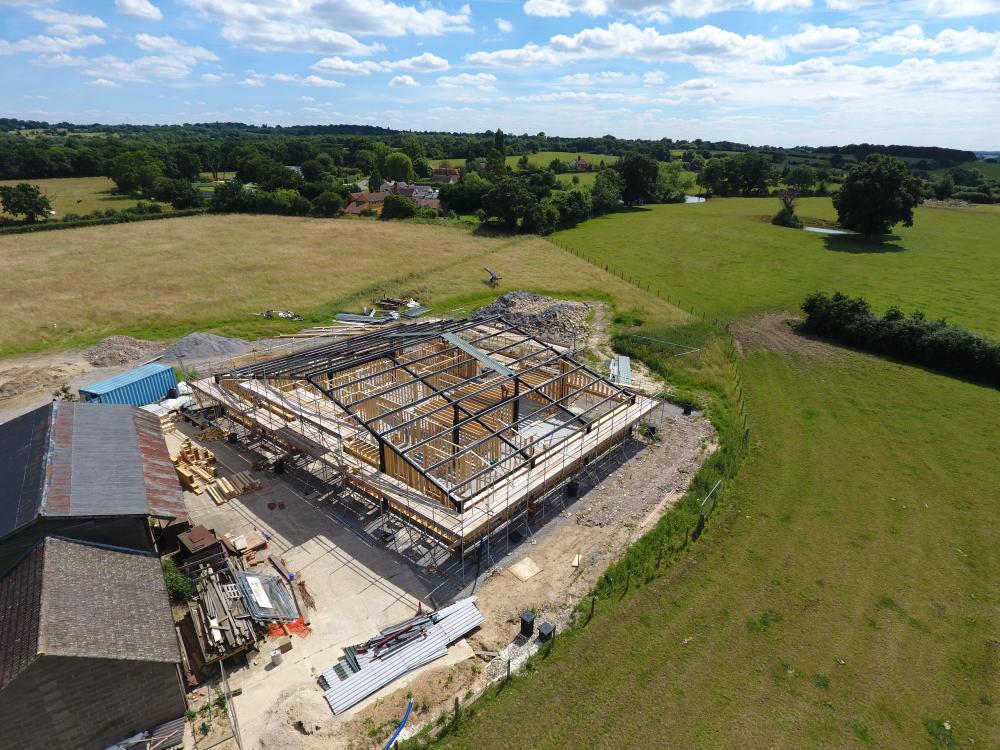
Apart from being pretty good at frame design, engineering and erection, one of their guys regularly flies his drone around taking pictures, so you get a great record of the build:
-
Health risks associated with passive houses
IanR replied to K78's topic in Energy Efficient & Sustainable Design Concepts
You may wish to reconsider this statement. -
Expanding Foam - an effective weather seal?
IanR replied to Stones's topic in General Construction Issues
On my window install the gaps were sealed externally with silicon bead because the expanding foam is not water tight. -
Health risks associated with passive houses
IanR replied to K78's topic in Energy Efficient & Sustainable Design Concepts
An article on a PH house overheating does not equal PHPP being unable to accurately predict solar gain. On the study I found and read regarding the block of housing association flats that were the subject of Telegraph story a while ago, it was not the tools at fault, but lack of experience from the PH Designers. There will be localised issues with any design/build process, mistakes happen. PHPP however gives you the tools to predict and test solutions so that risks are reduced. It's to be applauded, not condemned. Solar gain issues are present in many standard building regs builds. My current property, with it's room in roof, will regularly see 30 degrees in summer, when it's only mid-twenties outside. But nobody will have done any thermal modelling, so there's no one to blame. -
Health risks associated with passive houses
IanR replied to K78's topic in Energy Efficient & Sustainable Design Concepts
PassivHaus Institut claims there to be 60,000 Certified buildings in use in 2016. Checking the EU market, there were 880,000 Residential HRV units installed in 2015. Around 25% were localised/room only HRVs, with 75% being centralised systems. Germany, Austria, Switzerland being the more mature markets, UK expanding fast (double-digit growth), but lagging behind. Understandably HRV's are concentrated in Northern EU. [Non-heat recover ventilation units being nearly double the volume, but concentrated more to Southern EU.] Hardly a small market. There's a few sizable studies into MVHR/low energy homes/zero carbon homes that do detail MVHR issues with poorly maintained systems and lack of knowledge of occupants, but none suggest systemic/technology issues. However the one study that reports it, shows that even in houses with sub-optimal MVHR performance the air quality is better than the naturally ventilated houses in 80% of the those tested. This is not a new technology, it is not even a niche technology. If there were inherent flaws in the technology the data would be there to demonstrate it. If it's available I'd like to see it so that I am better informed. Without doubt there will be "local" issues with individual builds, there are too many variables for there not to be. PH principles put occupant comfort at the centre of its strategy, along with energy efficiency and affordability. The PHPP software aids making the decisions and compromises that come into balancing those three competing requirements. Most telling though is that it also informs the heating requirements for a building. If it didn't accurately analyse the environment and predict the energy usage then those people relying on it to size the heating systems would find themselves with properties they were unable to heat sufficiently. If that were the case there would be quite a few of those 60,000 customers very understandably making their voices heard... But I don't hear them... I must assume the PHPP software to be relatively accurate. But why wouldn't it be, it's "only" physics after all. -
Health risks associated with passive houses
IanR replied to K78's topic in Energy Efficient & Sustainable Design Concepts
Or, could you have 3D cold bridging in the corners causing a significant cold point that is below dew point for more of the time? -
Health risks associated with passive houses
IanR replied to K78's topic in Energy Efficient & Sustainable Design Concepts
That's quite an old study that was discussed over at eBuild, JH referred to it quite a few times. I don't agree with the title. Came down to poor installation of the underground duct. -
Health risks associated with passive houses
IanR replied to K78's topic in Energy Efficient & Sustainable Design Concepts
Like I said, I'd searched, but found any data to support your assertion elusive, so thought I'd give you the opportunity to post a reference. But if it doesn't exist, it can remain an 'intersting' theory.? And my comments on eddy currents are informed by my knowledge of automotive aerodynamics and CFD analysis. Your statement may be correct in the context of vehicle aero, but that's not the context of this discussion. -
Health risks associated with passive houses
IanR replied to K78's topic in Energy Efficient & Sustainable Design Concepts
Anything Google can find for you will be OK with me. I've found several large scale studies into MVHR systems in domestic homes, and most are critical about sub-optimal performance of poorly maintained systems or occupants unfamiliar with the correct use, but none comment on the phenomenon you mention, which is odd as it would be quite a serious failure. No, not really. Eddy currents for one will be caused around any sold objects, nothing like light. I'm certainly not convinced about the potential of mold growing within the thermal envelope of a PH-level insulated home. RH would need to be too high for too long, due to the temperature of the internal faces of exterior walls and even windows. Within the cavity, or outside the thermal envelope, if there is poor detailing, is another subject. -
Health risks associated with passive houses
IanR replied to K78's topic in Energy Efficient & Sustainable Design Concepts
Could you post a reference please. In an occupied house with people moving around, doors being opened and closed, convection currents and the MVHR extract and return vents I would naturally have considered the internal air volume to be well mixed, but you seem to be suggesting that with even with a theoretically sufficient ventilation rate from the MVHR unit, you could still get poor circulation to such an extent that localised areas of high RH could cause mold growth. I'd like to understand better the mechanics of how that could occur. Edited to add: Just did a little calculation, it would need the RH to sit at +80% for a week to promote mold growth in a typical PH insulated home, if there were no cold bridging issues causing a cold spot that brought the temperature of the internal face of the wall below what you would otherwise expect. -
Insulation for internal stud walls and above ceilings??
IanR replied to IanR's topic in Sound Insulation
I'm putting 100mm into 95mm studs following the advice from Rockwool that it will easily compress down. I assume though that performance will drop of if it's compressed too much. I got good prices locally from Collier & Catchpole BM But the cheaper RWA45 Acoustic insulation is not available in as many sizes as the FlexiSlab. I've therefore gone with a mixture of RWA45 and FlexiSlab The problem for me was RWA45 doesn't come in 400mm wide and cutting down 600mm was higher cost than buying 400mm FlexiSlab. -
I'll let you know in the new year. We're putting them only where we have hard floors as felt the extra hoovering the carpeted area needs puts more risk of damage and therefore skirting would be better. How do you plan to create the gap, We've gone with pre-finished Aluminium profiles, makes the job quite easy.
-
I can't deny, I was a little daunted by it initially and even tried to demolish part of it, but was told by planning "that's not allowed within the rules". I've grown to appreciate it now though!
-
Ah, OK, you were being non-specific when you said "hardcore". While there's probably a minimum bearing capacity in the spec for the soil under the type 1, there won't be for the type 1 itself, so you've not got a figure to test too to give you the peace of mind your architect is after. The Type 1 spreads any loads applied on it out to a wider foot-footprint of the soil beneath at an angle of 45 degrees, as does the EPS. So a 500mm wide ring beam, sitting on to 300mm of EPS and 500mm of aggregate, theoretically passes its load onto a 2100mm width of soil. The requirement for compacting the aggregate is to just ensure the load is passed on and spread wider, but doesn't itself come with a required load bearing capacity.
-
Is hardcore a suitable sub-base? As it's generic term I'm assuming it can't be certificated in the same way that say Type 1 can be. Or are you then putting a sub-base on top of the hardcore, and in that case you need to ensure the hardcore has the minimum bearing capacity stated for the foundation, which for mine was 100kN/m2 What's more important is that you have a "chain of custody" from Engineering specification to products used to ensure the Engineer's Insurance covers latent defects. (Unless the Engineer is overseeing the work).
-
That's a great looking finish, and obvious there's a lot of work required to get it to that level! Just to follow up on an earlier name I "introduced" for poured resin floors: The Senso/Sphere8 price was very competitive and I did like the quality of finish that I'd seen, but their payment terms have stopped me going with them. It's not clearly stated by them unless you ask, but their payment terms of 25% Deposit , 45% Staged and 30% Final are all required to be paid before any product arrives on site and any work has been started. Searching for a few Reviews I found a few that had been caught out and hadn't found out the Final payment is required 2 weeks before the job starts, until they had paid the nonrefundable deposit. These same reviews had issues with getting Senso/Sphere8 back to fix issues.
-
Yep, I looked at MBC and they quoted. I personally didn't have a great experience with them during the quoting phase. They were slow to respond and didn't answer questions related to their quote. Their frame was 10% more than TH, but that's close enough at an initial quote stage to mean on another job they could be cheaper. Their quote for my slab was ridiculously high which suggested they didn't want my job. This left a "nasty taste" and they'd have been better to explain either that they didn't want the job or what risk they saw that meant they needed to over double the real cost of installing it. Their panelised system was less suited to building around the existing structure, although this could have been worked on if I'd chosen to go with them. Smaller factors were that I preferred the TH method for the airtight layer, I saw this as easier to achieve a good result and longer lasting (just my engineering judgement) and I'm not convinced that installing Warmell into an internally open panel allows for easy, consistent distribution of the insulation. I'm sure they get the correct weight of insulation into each panel, but I fear it will be less dense at the bottom and increase in density towards the point it is filled from. To me this gives a risk of settlement. I caveat this with saying this is just my personal view of what I understood their process to be and have never heard of any issues, but my view of this was part of my decision. Definitely explore other options, not just Touchwood, but Beattie Passive, and perhaps Cygnum and Frame Technologies, but do your research...
-
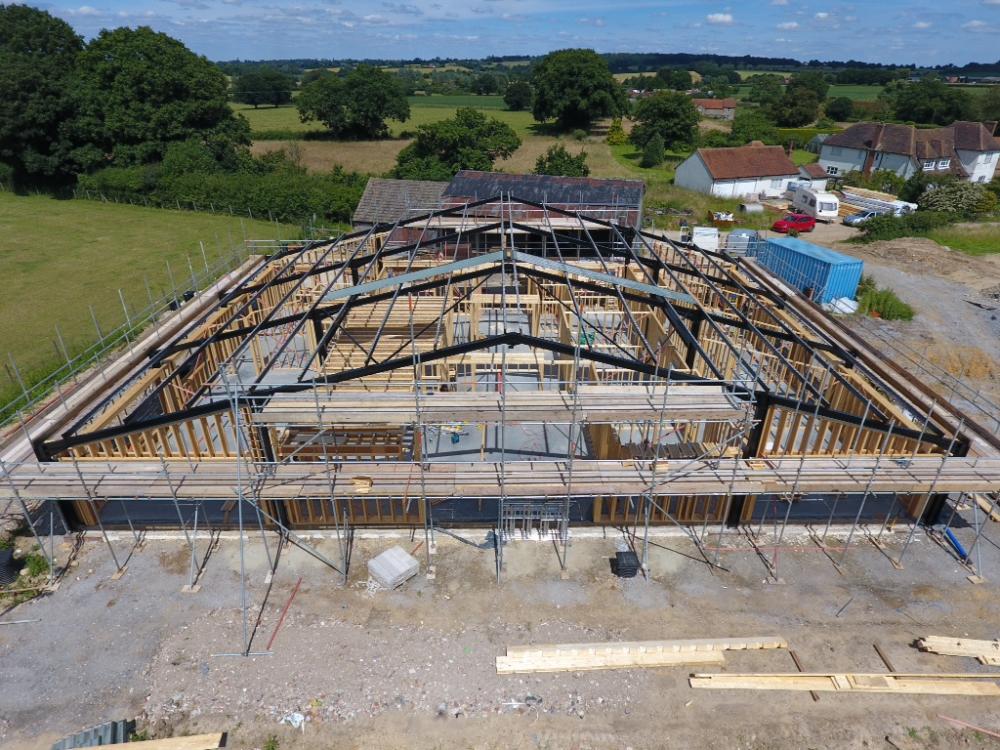
There's a few members here with, like myself, a Touchwood Home's frames and there were quite a few more over at eBuid, but with MBC dominating the discussions over there it possibly suppressed discussion on other manufactures and build types. Our frame went up this year (2016) during July and August and I'd rate my experience with Touchwood as a success. Our build is a Conversion of a portal framed cowshed, and the frame design and erection was complicated by the existing structure, that obviously needed to remain in situ during the build. Visible below is the original primary steel frame with roof purlins: The TH Design process was far more precise than I expected for the construction industry. I was able to laser scan the original frame and prepare an as-built CAD model for TH to then work around. This was invaluable, since the original frame was a long way from square and plumb with the top of the portal frame being as much as 115mm out of position in places. With my model imported this into their frame design software they were able to confidently design their frame dovetailing around the existing structure, and confident we weren't going to have some unexpected clashes on site. The original structure and especially the haunches at the joints, required bespoke detailing of the timber frame to incorporate and guarantee a robust airtight layer. The TH design process allowed all of these conditions to be assessed and solutions agreed before a single piece of timber went up on site. During the design process we exchanged 3D models back and forth to agree solutions and to ensure compatibility to raft and drainage etc. I also have from them a full 3D model of the final frame design that has informed follow on trades and helped decide MVHR duct, plumbing and cable routings. This didn't however stop me from being nervous during the first stages of the frame erection when it would become obvious if my as-built model and their frame were sufficiently accurate. But I shouldn't have worried, the two fitted together perfectly. Taking a step back, our decision on what build process to use, what type of insulation to use and what performance targets to set took around 9 months after our planning was approved. Once we had decided on timber-frame with cellulose fibre insulation and Passivhaus levels of insulation and airtightness the list of companies capable of delivering this and giving guarantees was surprisingly small. Having removed many of the variables, we actually found it relatively simple to compare quotes. There were slight differences with what was and was not included, but these were all relatively simple to assign a value too, to allow comparison. A huge positive I found with TH is there has been no extra charges from their initial quotation. If anything, the content probably grew a little during the design stage, but everything must have been within a contingency they had allowed for, since they didn't ask for anymore money. With the majority of issues foreseen and resolved before the frame erection started, the frame build went without a hitch. Their frames are a mixture of pre-cut and cut on-site to a cutting list (whichever is more cost-effective), and stick built. I believe they're on site around 4 weeks for a "normal" build, it was a little longer for mine. While a panelised process may take less time on site, the overall timing would be around the same. For me, they turned up on the day they said they would and finished about a week later than expected. I'm looking forward to the airtightness test. Unfortunately, due to a hiccup with the roof lights I'll not be able to test with the structure still open, so remedial work will be a little more difficult, but I have high hopes. The airtight layer on a TH frame is "simple by design", and looks very robust. I believe their claim to generally be better than 0.2 ACH @ 50Pa, and sometimes be better than 0.1 ACH, but the proof of the pudding...
-
Members' experiences of Timber frame and slab suppliers
IanR replied to TerryE's topic in Timber Frame
We have a Touchwood frame on an AFT Engineered raft. I looked at a lot of options for both, starting with SIPs suppliers and val-u-therm type panalised suppliers and eventually seeing the light with the help of ebuild and looked at all the blown cellulose fibre insulated frame installers I could find. With all the positive feedback on here and ebuild for MBC it was difficult to discount them, but I didn't have a great experience with them through the quoting phase. I did consider getting insulation for the slab directly from Kore and having it Engineered by TSD as this option was very cost effective, but it was most cost effective when it had a simple single perimeter ring beam that really needs to be combined with a twin stud wall to deliver a fully cold bridge free design. Once I'd decided to go with an I-Joist structure it required a slightly more complicated periphery detail and AFT for me had a slightly better solution at a similar price. For me the I-Joist structure from Touchwood was 10% cheaper than the twin stud from MBC. The Touchwood frame however required a slightly more expensive slab detail, but overall it was still slightly cheaper as a package. The cost from MBC to do the raft was so expensive I assumed they didn't want the job, so I'm comparing the price of a TSD designed, Kore supplied raft. Beattie Passive was about 50% more expensive for the frame and foundation package. The Val-u-therm option was about 10% more. SIPs options were about the same to achieve the same U Value, but no Airtightness guarantee, and no cold bridge free solution. My groundworks team installed the AFT raft. I got more involved than I would have liked as there was an inability to read a drawing. Should probably have got AFT to do the install, but no real complaints. The Touchwood frame is superbly designed, it really is very 'clever', and it was really well put together. It's been a pleasure working with all at Touchwood. -
I think you'd struggle to beat the low capital and use costs of gas with an ASHP. Perversely, a poorly insulated home that can attract a higher RHI payment, may roughly draw even eventually. I'm going ASHP only because gas is not available and it's competitive compared to oil or LPG.



