


IanR
-
Posts
1857 -
Joined
-
Days Won
6
Everything posted by IanR
-

Delicate, annoying opportunism. Advice needed
IanR replied to ToughButterCup's topic in Planning Permission
I saw that, but he didn't clear the conditions until 2008, so it might be quite tight. Probably knows what he's doing, and got the slab down in time. -
Delicate, annoying opportunism. Advice needed
IanR replied to ToughButterCup's topic in Planning Permission
I looked on the portal, and there's no provision for a habitable caravan, so any temporary buildings allowed are for storage, welfare etc. in relation to the build of the stables. If he's living in it then he's in breach of planning, and you'd be best to flush that out. The planning for stables was 2003, expiring 2008. I assume he got started before 2008? When did the caravan turn up? I also notice that he didn't loose the Appeal for the Dwellinghouse, but rather was a few days late in submitting the Appeal so the Inspectorate refused to hear it. He's likely to resubmit the application (with a few changes) expect a refusal, and get his Appeal in on time this time. -
Delicate, annoying opportunism. Advice needed
IanR replied to ToughButterCup's topic in Planning Permission
I definitely agree with the "pick your battles" option, but double-check the potential outcomes, just in case it could be deleterious to your own site. While he has right to site a caravan, does he have the right to live in it? If there's not planning or PD for a dwellinghouse I can't see that he'd have the right to live on site during any works towards building a stables. If he doesn't have the right to live there then he is of course in breach of planning. I'm not clear in this instance if that breach would be immune from enforcement after 4 or 10 years. If it would be considered an unauthorised Change of Use ie. agricultural or equestrian to dwellinghouse, then it would only require a 4 year breach. It remains a breach until the LPA issue an Enforcement Order. So even though they have noticed it and are investigating it, they haven't stopped the clock until the Enforcement Order is issued. If he gets beyond the 4 or 10 year period, which ever applies in this case, then he could obtain the Certificate of Lawful Existing Development, and therefore the right to continue to site, and live in a caravan there. That may not be a good outcome for your site. He won't have the right to build a new house, but he has the right to continue to live in a caravan, or pseudo-caravan for perpetuity. One option could be informing the Council Tax office that he is living there. If he goes on the record to deny that then he won't be able to later claim that he's been in breach of planning. -
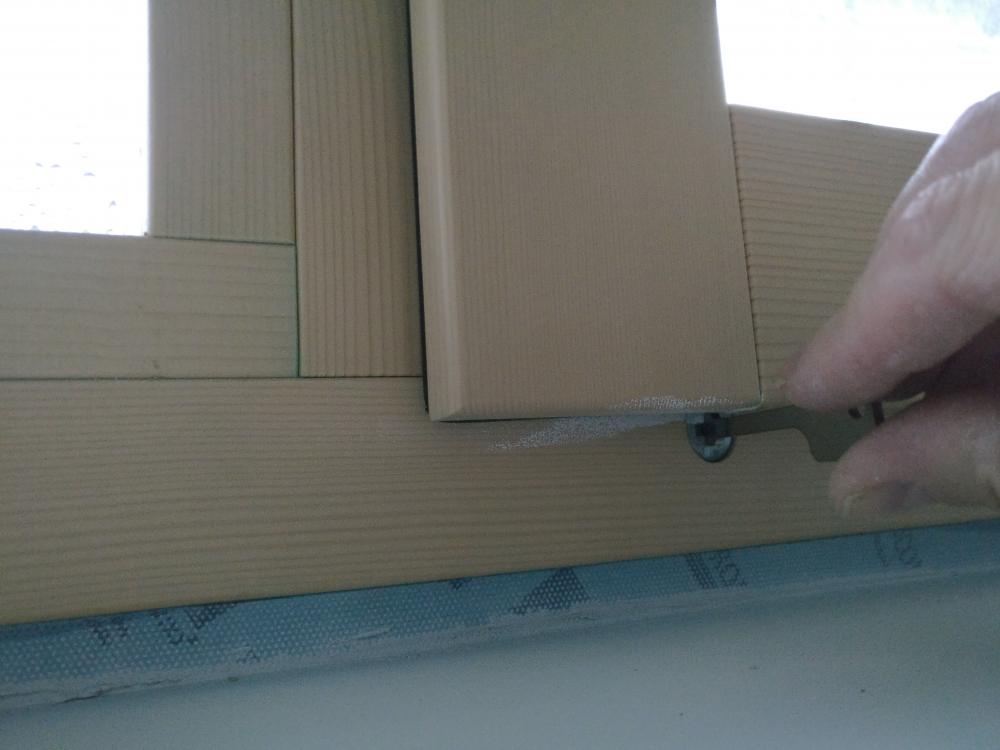
On mine, it looks like there's 1 or 2mm extra space. Excuse the paint over spray, only just took off the masking to take the picture.
-
That's a bit worrying though. Is that the same for all windows where it's fitted? Ours are HF310, and the turn lock can be operated when the window is closed.
-
I've just checked my ecoHaus/Internorm order and it was recorded under Accessories as "with turn lock". But it could be referred to as a night vent, I guess - since it makes the window more secure when left tilted open,
-
Looks to me like a 'turn' lock. Ie. Locking the turn function, so it can only be tilted.
-
Well, the Statutory Instrument is the Law for PD, and it doesn't include the word "installation". The guidance on the portal however, by mis-quoting, doesn't help arguing this with the LPA. I'd definitely refer to this document (page 100 class G): http://www.legislation.gov.uk/uksi/2015/596/pdfs/uksi_20150596_en.pdf when contacting the LPA.
-
Anyone mix their own Epoxy Mortar? (for concrete repairs/levelling)
IanR replied to IanR's topic in Floor Structures
@Onoff I assumed SBR was what was mixed into self leveling compound, although weaker than you suggest. Reading up on it, it is a recommended mix just as you have done it, for thicker repairs. I read a few comments though than it can get difficult to work with when used in higher concentrations. @Steptoe the epoxy mortars are sometimes called patch repair, or concrete repair, so this is what I wish to self mix. I've got a few full height windows so I'm needing a fair bit of it. Seems a waste to spend around £400 on pre-mixed, if I can mix it myself for less than £100. @PeterW , @JSHarris , Bingo.... this is what I was hoping for, I thought it was along these lines but didn't have the confidence to order it in without some confirmation. Thanks all! -
Where did you get this quote from? The word "installation" doesn't appear in the English GPDO (2015), and from a quick scan of the above, nor in the Scottish version. The English version states: I therefore change my view. The ASHP just needs to be on the MCS list, the installation doesn't actually need to be MCS Certified.
-
That's how I would read it. ie. the whole installation must be MCS compliant, so needs to be installed by an MCS installer. I'd look into how she got the ASHP removed. The PD for ASHP does not require a Prior Notification to the Planning Authority, so no neighbour consultation is required. I can't see how she could have used a planning issue, unless it just didn't meet all the caveats of the PD and she high lighted this to the LPA.
-
Anyone mix their own Epoxy Mortar? (for concrete repairs/levelling)
IanR replied to IanR's topic in Floor Structures
Thanks @8ball I'll give them a call and see if they have a view. @Declan52 the back fill of the drop thresholds is up to around 40mm thick, my concern with using a cementitious product is shrinkage and cracking and it coming loose from the main slab. My experience is limited, but I have just that situation on my current house where a self-levelling compound was used to back fill the gap on a retro-fit set of french doors and I'm trying to avoid a repeat performance. I'm sure a self-levelling compound would be OK for the mat wells, however the mat wells join into drop thresholds, so if I can use the same product that would be preferred. I have actually just trialled one of the shower floors with a self-levelling compound and am waiting for it to fully dry. If this goes OK I may stick with the self levelling compound for the others, it is a lot cheaper than resin based products. -
In looking for epoxy mortar it seems all the pre-mixed stuff is priced similar to raw epoxy resin price at £60 - £80 per 10kg rather than the kiln dried sand constituent at £20 per 25kg. Which seems a bit high when I'm thinking it will likely be a 1:5 mix or weaker. So, anyone mix it themselves? if so what ratio? and where did you purchase the Resin? This is to fill a few holes in the slab ie. The drop thresholds for full height windows and doors, to fill the internal gap between slab and frame To level the base of Mat wells that were cut in after pour. To tidy the slope and around the gully of wet room floors, that were also cut in after the pour. Thanks!
-
Cheap, Thermally Efficient Non-Structural Wall Detail
IanR replied to Nick's topic in General Construction Issues
I would have thought "standard" timber studs of a suitable depth to enclose sufficient insulation to meet Buildings Regs would be the most cost effective. Any chippie would be able to build it without it being Designed and Engineered, and Building Control would most likely pass it without needing a full set of calcs to prove it's strong enough. I-Joists (and twin stud) construction however comes into its own if you want to insulate to a higher level than building regs. They both offer a cost effective deeper wall (to house more insulation) with a lower timber fraction than standard stud. In my view an I-Joist wall could potentially give a "cheaper" wall than twin stud (but very difficult to get like for like costings to know for sure), but would possibly require a slightly higher cost slab/foundation to eliminate the cold bridge at the wall floor junction, IF that's what you were looking to achieve. -
Or whoever measured up. Did they ask where the Finished Floor Level is to be? We cut our mat wells in after the slab was poured. Wasn't the plan, the main contractor ran out of time when preparing for the pour and didn't get the formers in to cast them in situ. We cut ours in 25mm deep, to then leave space to use a self-levelling epoxy screed/mortar to create a level base. Finished depth will hopefully be 15mm and mat very slightly (2-3mm) over-flush to finished floor. Cutting it in after the pour was not a nice job in C35 concrete. Beforehand everyone was telling me how easy it will be. No one thought that after the job was done. It is doable though with the right tools.
-
Cheap, Thermally Efficient Non-Structural Wall Detail
IanR replied to Nick's topic in General Construction Issues
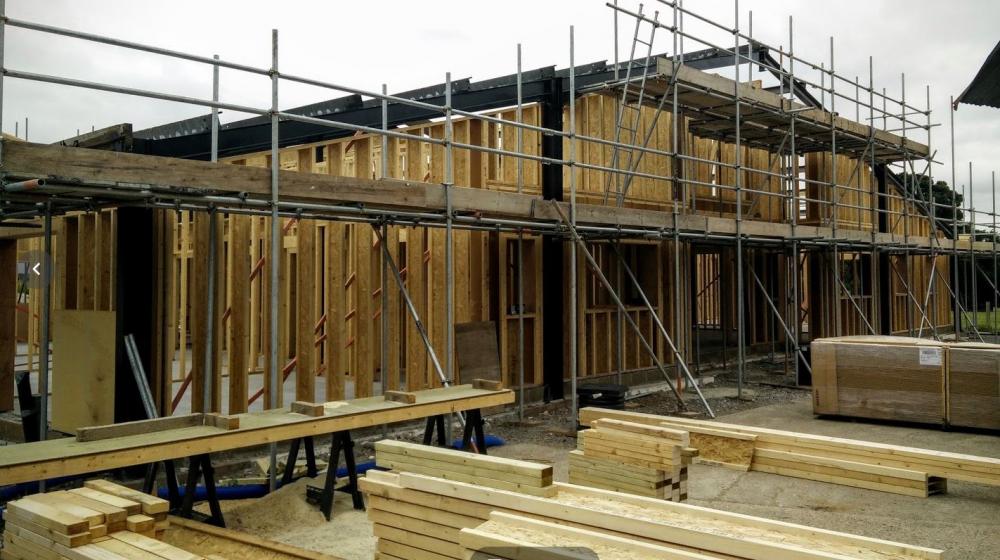
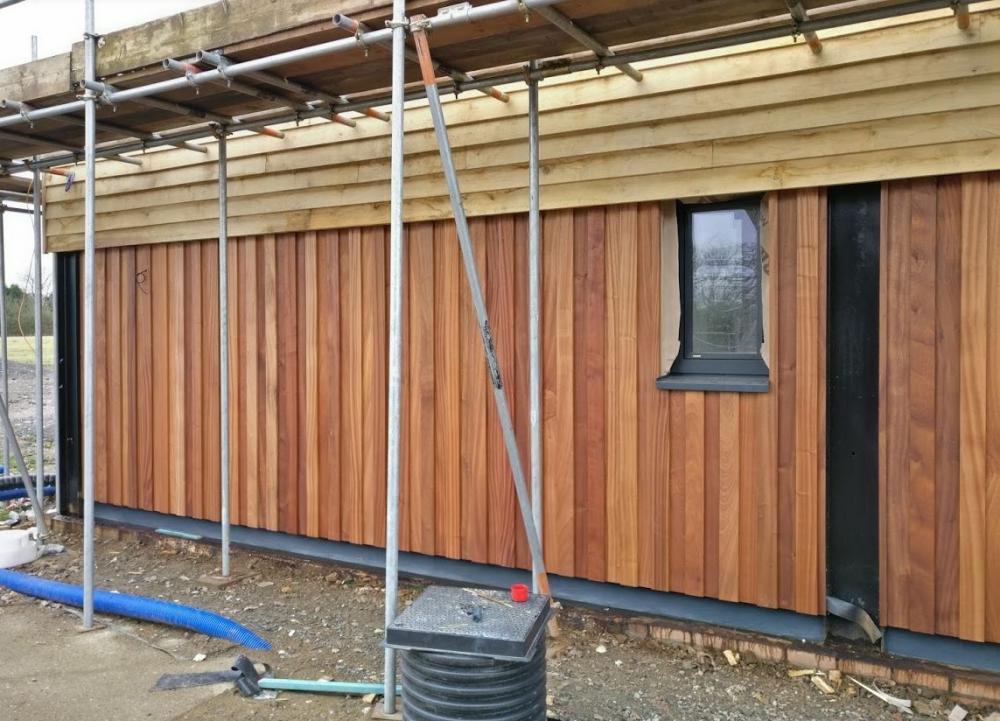
A 12m span is easily achievable in the typical steel sizing used for Agricultural barns, without stepping up to the monsters used these days in warehouses and distribution centres. The sketch below was for the structural changes I made to the primary frame of my barn. The high lighted yellow portion is the main barn span and is what your are describing and the areas crossed out on the first portal are lean-to bays that are add-ons. The distance between the two high-lighted vertical columns is 45 feet (13.7m). The width of each bay 19'6" (6m). Ridge height around 6.5m. Columns are 10" x 5.75" and the roof portals are 8" x 5.25". Not shown are the 173mm Z Purlins and 9" x 3" Eaves Beam timbers similar to what you describe. Typically the first bay is braced as shown and the follow on bays lean against the braced one. I removed the low level cross-bracing (simple 2" tube) as it got in the way of an open area I wanted and had to replace it with the giant goal-post arrangement you can see between the internal columns of the centre bay. As I said previously, the portal frame structure is designed for a light-weight roof, ie. profiled sheet steel, corrugated cement board or insulated profiled panels. I'm not sure it will hold up the weight of structure required for a domestic warm roof that you'll be after in your double volume area. I'm not sure how much this image shows: The steels are half in - half out the external wall. The sheathing on the timber structure actually notches around the steels so the wall narrows across the width of the steel. And then when the cladding does its bit, the lower portion of the steels are visible and the upper covered, as per planning requirement. I know I sound like a broken record, but in your shoes I'd do it with a large glulam ridge beam and I-Joist roof structure. I'd hate to add up what it's cost me to integrate the steel frame. But I had no choice, my planning is for a conversion, not a new build.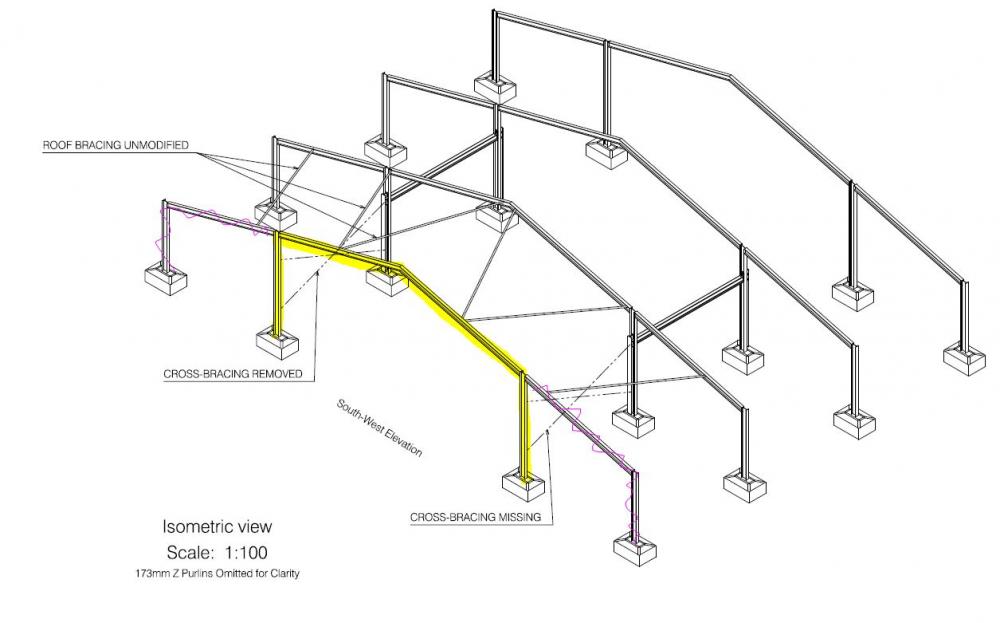
-
Cheap, Thermally Efficient Non-Structural Wall Detail
IanR replied to Nick's topic in General Construction Issues
Ah, this is two storeys Are you expecting a completely open ground floor, with no internal columns? You'll need a Structural Engineer to work out the most economic way of achieving that if you do. If I've understood your orientation correctly I see you needing an 8m steel at first floor (running parallel with the ridge) that will require structural gable end walls for it to sit on. Maybe you need to work up a section. While you are thinking your timber walls will take the wind loading, where are they transmitting those loads to. Do you plan to structurally tie them into the steel frame at the eaves and first floor? Personally I'd start by trying to do it in timber, with steels to reinforce if a timber member gets too big. Having had to work around a steel portal frame I'd certainly try and avoid it in the future. Ridge height is very difficult to control across each of the portals. The wider the span and shallower the pitch the height variance is increasingly sensitive to the length tolerance of the beams and weight on the roof. I assume you'll need 3 portal frames to make up 2 x 5m bays, there's a risk of the ridge not being visibly straight. This goes unnoticed on agricultural buildings, but probably not on a house. Portal frames are also designed for a light-weight roof covering, what did you have in mind? For mine the steels are outside of the thermal envelope. Due to a planning caveat they have to be externally visible in some areas, so also outside the cladding, but covered in others, so behind the cladding. [But: I do have 4 steel columns that are internal to my floor plan, helping hold up the roof, but due to how they are boxed and insulated they technically remains outside the thermal and airtight envelopes] When I mentioned the DHF board that was for the structural timber frame scenario and no steel portal frame. I found it was relatively easy to develop a hybrid (timber and steel) structure where timber walls, inline with and attached to the steel columns, where capable of supplying the racking support to the portal frame and the portal frame capable of dissipating the wind loads on the timber walls. But, if you've got that amount of structural connection between the two how do you then thermally isolate them and stop vapour getting to the steels, unless you can wrap the whole structure with external insulation, leaving just the floor connections to resolve. -
Cheap, Thermally Efficient Non-Structural Wall Detail
IanR replied to Nick's topic in General Construction Issues
Not sure where you are in the country, but I had very good Service from John Payne Insulation in Norfolk. They travelled to me in Essex, but I got the feeling they wouldn't like to travel much further. Very approximately, expect to pay £25 / m2 of wall/roof area for installed blown cellulose fibre at 300mm/350mm thick.. Warmcell costs have gone up since manufacturing went abroad (I think Warmcel was bought out???). I know JPI are looking at and trialling alternative brands to reduce costs. -
Cheap, Thermally Efficient Non-Structural Wall Detail
IanR replied to Nick's topic in General Construction Issues
Just taking a step back... The title of this thread is "Cheap, Thermally Efficient Non-Structural Wall Detail", however what you are developing here is a structural wall. Have you talked yourself out of the steel portal frame à la "BarnHaus"? or is this still your current direction. If you are still considering the steel portal frame then you could consider a less structural options than the I-Joists to make of the external walls. At the moment there is a double-count in your strategy ie. both the steel columns (suitably braced) of your portal frame and your I-Joists of your wall detail are independently capable of holding up the roof. My current build is a conversion of a steel portal framed cow-shed and in the early days I enlisted some help from Dr. Ed Green to develop early concepts on integrating the portal frame, due to his involvement with Barnhaus. I wasn't interested in the straw bale insulation, so we looked at several other options. and always the plan was to keep the steel outside the thermal envelope and ensure no warm moisture could get to it. Integrating the steel structure into the timber frame structure adds an extra layer of difficulty. The portals of the the steel frame will require racking bracing at wall level (as well as the roof) and as you have drawn it the racking braces will run through the I-Joists. It would be much easier if the steel columns were external to the wall, but this looses you some floor space you are trying to retain. Mine are half in, half out - a compromise that adds complexity. Your choice of steel portal frame is due to room size. What's the roof, ie. pitched of flat, and what way does it run. It's quite possible you could do this with Glulam and I-Joist to avoid the Steel Portal frame, and simplify your structure. With regards to your I-Joist wall detail, and to play devil's advocate, if cost and wall thickness are critical then there's no need for a service void if you are only running suitably sized cables in the external walls. But you shouldn't run plumbing. Also, your VCL could be achieved with a foil-backed plasterboard if your wall build up is so designed. Also, your outer sheathing could be both racking support and the airtight layer with something like Egger DHF board, avoiding the need for any airtight or VCL membrane. Designed right, its a cost effective solution. -
Getting large bits of glass up onto a roof
IanR replied to thomas's topic in Skylights & Roof Windows
Do you need to lower it into position once on the roof? If so I think you'll need a crane and vacuum lifter: https://www.coppard.co.uk/pages/cranes/valla-20e.php [I have no experience of this company] The company I used only had bigger toys:
-
My stick frame was purchased as part of a design, supply and erect package with an air tightness guarantee. I'm not able to erect myself so I needed to pay someone to do it and I feel the 20 years of experience with the system the company I used has benefited the built frame and I hope the air tightness (not measured yet). If however I could have erected the frame myself and I was "just" after very good air tightness rather than "best in class" as well as a cold-bridge free design, then I would look to Cullen Timber Design Ltd. to design and sign-off the frame. If needed they can send cutting lists direct to joist/beam supplier and provide a very detailed drawing pack. What I mean by the air tightness comment is that the frame design inherently has good, robust air tightness detailing that I feel would deliver a very good result, but the experience of the install team lifts it to a level probably not achievable by someone new to the product. CTD did the frame design part for my package and it was a very good experience working with them develop the frame for my rather complicated site.
-
Does it have to be a plate of a certain size? Could you use a plate of 1/2 or 1/4 the area and therefore use 1/2 or 1/4 the load?
-
Yes, because it only has to get to xKg or xkN at the plate, not the entire axle weight, so doesn't need to lift the back of the vehicle entirely off the ground. ie. some of the weight is still taken by the suspension/wheels
-
I edited my note just as you posted this
-
Nope, it will just require the jack to lift further until the entire axle weight is taken by the plate (and the suspension is at full extension and tires lift off ground) Edited to add: If you're jacking under the Axle and not the Chassis, then it makes no difference to what you are calling the Unsprung scenario





