


JohnMo
-
Posts
13292 -
Joined
-
Last visited
-
Days Won
200
Everything posted by JohnMo
-
A lot of the rules depend where your house is located, England, Scotland etc, town or rural and the speed limit at your entrance. Your local Authority should have a road design guidelines document, this where you will find all the information. It should be available online. The general way it works is, you must be able to be stopped on your driveway with the gates closed and the front of the vehicle be off the road. - so gates are setback from road edge quite a bit. Then from the drivers seat, you should be able to see left and right what is coming down the road. The higher the speed limit the further you have to be able to see.
-
Missed that one
-
Sorry ours is a Harquin treatment plant and there is only one connection to the compressor. No solenoids or timers.
-
A few things affect warm up time. So answers could be correct but only approx. Anything from 3 to 6 hours is best guess. 1. UFH pipe spacing, 150mm is quicker than 300mm; which can be quite slow. 2. Flow temperature, the higher the temperature, the quicker the heat up time, but much more likely to overshoot the thermostat set point. 3. Amount of insulation under the screed, but also the amount of insulation in the walls and roof. More insulation should allow the most amount of heat to be transferred to the screed and room. 4. Depth of screed, deep screed slow to heat up compared to shallow screed. Deeper screed is slower to cool down. Example, my house. 190m2, 300mm UFH spacing, 100mm thick concrete screed, 200mm PIR under screed. U values, wall 0.14, roof 0.12, windows 0.8. Flow temp 30degC, heating time generally 5 to 6 hours overnight. But the floor then retains the heat until the next overnight heating cycle.
-
I would ask for supply to be cut off via your supplier. They will most likely want to take the meter away and cap the pipe. Once this occurs your standing charge should become deleted. This should be reverse of what we had when being connected. Once meter installed standing charge started, even though a gas supply was in the property for several months.
-
I did the install, but had contractors digging the hole for treatment plant.
-

Siberian larch vs sweet chestnut cladding
JohnMo replied to PeachyBeechy's topic in General Construction Issues
Our Scottish Larch has been on for around 11 months now and has stays remarkable straight. So no complaints, photo was taken a couple of weeks ago after oiling. About 30 roads miles from woods, to saw mill and my house.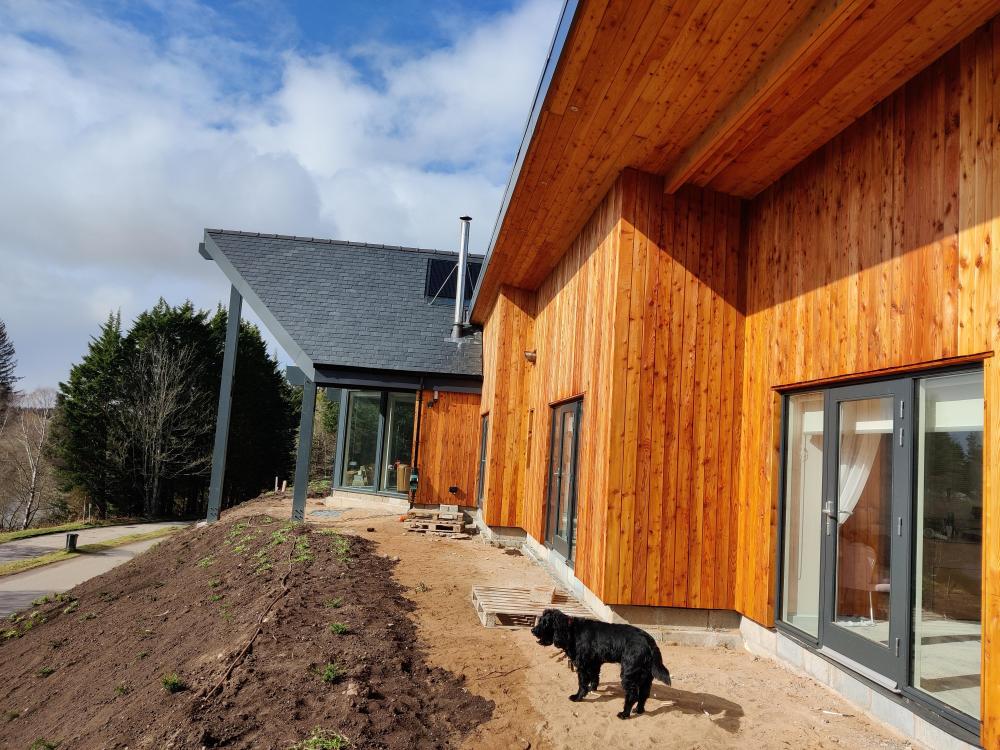
-
Ours is sat on a concrete slab (3x2) and half covered in soil. The soil has certainly reduced the noise (added benefit).
-
I would call them, sound them out, as they are giving their phone number and also check out web shop, Facebook or even Google for feedback on the company. But noticed they only have two reviews as a seller on eBay, nearly all their reviews are as a buyer.
-
Hybrid inverter for small in roof 2kw array - help please!
JohnMo replied to Timmyk's topic in Photovoltaics (PV)
You may want to add an external DC isolation switch also. Will make future maintenance easier, such as inverter replacement, otherwise how do you disconnect the DC wires from the inverter etc. The wires will always be live. -
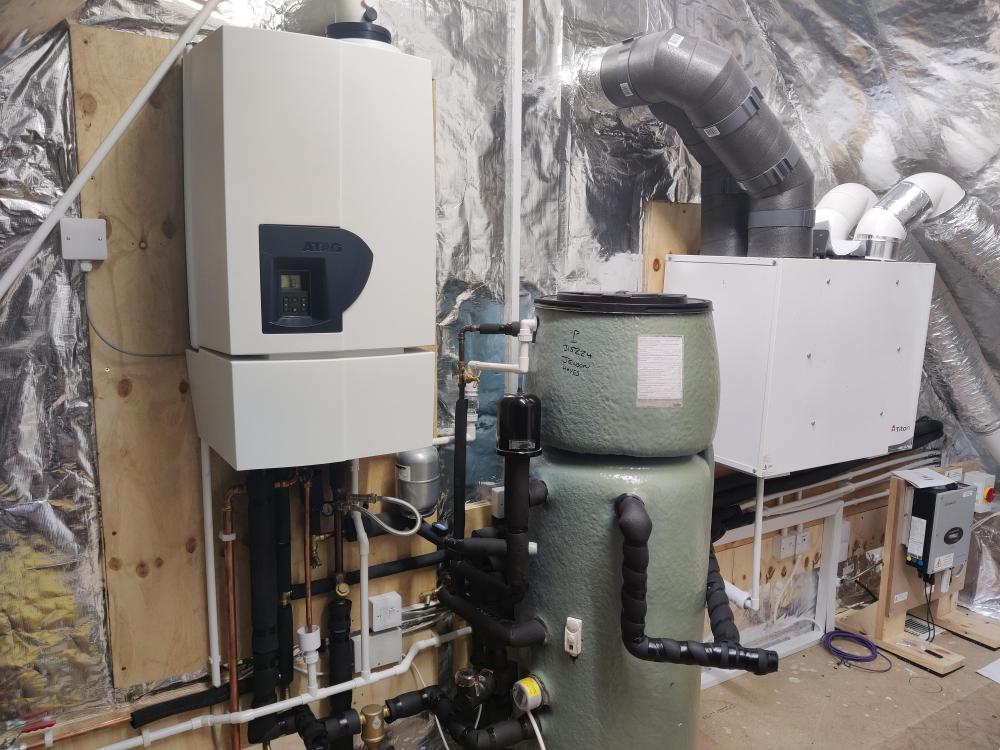
The green/blue cylinder is actually a thermal store, which I referred to as a cylinder. Sorry this may have confused. The white box on the left is the combi boiler. The one on the right is part of the ventilation.
-
Dread to think what he will charge you to do the full house electrics. About a hours work or should be. Price the bits on Screwfix, but doesn't look to be much on the face of it.
-
If the duct (75mm) is with the insulated envelope of the building, I see no advantage to them being insulated. The extract duct work will have inside building temperature air within it, so no heat transfer in or out. The supply ducts, will have cooler air within it (on a cold day) so there will be a heat transfer to the duct, which is a good thing as you are less likely to feel drafts. Ducts (75mm) outside the insulated envelope of the building, needs to be insulated, mostly for condensation and or heat loss reasons, plus building regs require it. Large ducts to and from outside to MVHR unit, insulated, inside or outside insulated envelope of the building, mostly for condensation and or heat loss reasons, plus building regs. Large ducts MVHR to plenums treat same way as 75mm ducts.
-
Read for yourselves. Implementation 1 April Installed products only. But lots of conditions, inclusions and exclusions. https://www.gov.uk/guidance/vat-on-energy-saving-materials-and-heating-equipment-notice-7086
-
To expand on what Nick has said. Our system is pretty much as described above, minus the accumulator. Which I have thought about also. Our combi heating circuit is connected to the heating coil in the thermal store only. The cylinder is heated to 34 degs with a 4 deg hysteresis. Boiler heating temp is set to 35 degs with a max temp of 55 degs. On our boiler we are able to set the gradient of the heat input, so have set as low as possible. The boiler starts when the cylinder is at 30 degs, and takes around 20 mins to heat the cylinder to 34 degs, very slowly ramping up the temperature output of the boiler. Boiler stays in full condensing mode at all times. UFH pipes are connected to thermal store. UFH manifold temp set at 30 deg. We have an immersion in the cylinder also connected to solar PV and will be adding solar thermal in the summer, to displace some gas usage. DHW goes through the DHW coil at the top of the thermal store prior to going in to the boiler.
-
One thing you have to consider when specifying an MVHR unit is the pressure drop from the duct runs and the outlet nozzles etc. You need to see the MVHR fan curves (supply and extract) that way you can see exactly at what point on the flow/pressure curve you are at, when at normal speed and boost. The higher the pressure drops the system causes the harder the fans have to work to overcome the system resistance. Once you know the above, you should be able to see where you sit on the noise curve for the MVHR fans. Also you need to consider duct noise generated by flow velocity, and the attenuation given by supply or extract nozzle and plenum chamber (distribution box). All in all lots to consider, but generally oversizing MVHR units is the way to go, but not so big that min speed is over the duty point of the system. Also ducts are better larger, as the longer the run the higher the resistance to flow (pressure drop). So one reason you may have been specified different units, could be duct size and duct length, as shorter bigger ducts (or double/triple ducts) have less flow resistance and a smaller unit can more easily cope.
-
Read the article in this thread, although it mentions no modulation, everything applies at Min load on a modulating heat pump or boiler.
-
What about tcvs and thermostats? It sounds like the system should be large enough to run without or with a small buffer, as long as you are not chopping up in to very small circuits with lots of tcvs and thermostats. If you are running weather compensation and have the system balanced you should be able to run without any (or very few) additional controls.
-
Square Buffer 450mm high, 300l cylinder 2053mm high. What is your heating system, as it seems a large buffer requirement. Do you have lots of TRVs on rads or lots room thermostats? Or a huge boiler/heat pump in a small property?
-
No just left it in the open.
-
You need to balance the system well, but I would try to limit them as much as possible. Possibly bedrooms only. The basis of the article will still hold true, with modulation, you have a little more room for error. Then work out your system capacity, with those radiators with trv closed and make sure you either have a buffer big enough to cope. Problem is anything warmer than design, the end of the modulation range can still be too large a capacity for demand. Take a look at heatgeek.co.uk also, which has a few good write ups on system balance and how to best operate weather compensation.
-
You can get a square 100l buffer that is designed to sit under the cylinder. So find the cylinder and buffer sizes and there you go.
-
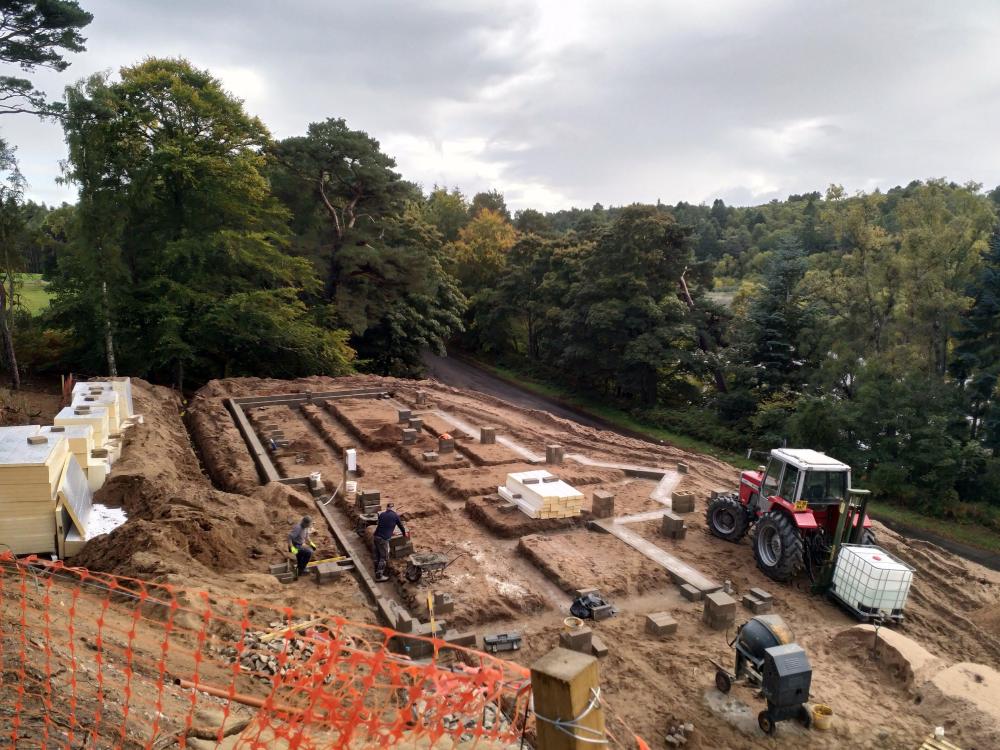
I stored our floor installation in the open weighted down with concrete blocks, spent around 2/3 months like that. Was more worried about it be stolen, but two piece were blown into the trees one windy night and wrecked. Cement get it in plastic bags.
-
Generally the bigger the unit, the less it has to do, so is used at the low end of its performance curve, so for a given duty will be more quite. Pre heating - we are in NE Scotland and not needed it so far this winter, I wouldn't bother. Only really needed below around -5 (ish) Post heating, unless your heating demand is below 10w/m2, there is not enough heat carried by the air to be effective. Enthalpy, again would not bother, not really any benefit in our (UK) environment. We don't get the long periods of sub zero temperature, which leads to air drying. Which is where enthalpy comes into effect. The other thing to consider is Coanda effect supply nozzles. These can be used to throw air across a room and simplify pipe routes. I used two units one small doing two bedrooms and two en suites and a large unit to do the rest. Simplified the routing considerably.
-
There's two ways to look at this. You take the combi and use as a combi, just make sure its not massively oversized for your needs, over wise it will short cycle on heating duty. The way is make sure it's not undersized and the DHW is then rubbish. But as you are used to using a cylinder and already have space, upgrade to unvented cylinder.





