


PeterW
-
Posts
18480 -
Joined
-
Days Won
207
Everything posted by PeterW
-
Cut at 45 degrees and just a couple of BFO screws through the bottom (drill them first) and then same through the side into the frame.
-
Yep that’s the plan. Crack on.
-
As @Nickfromwales says - DO NOT TOUCH THE GAS VALVE !! Has it lit since you changed the gas bottles ..??
-
Rainwater overflow can’t go into your soil / sewer without permission - it has to go to soakaway.
-
Rawlins sell it. https://www.rawlinspaints.com/home/roof-paints/flat-roof-paints/3874-eagle-desmopol-liquid-polyurethane-membrane.html
-

Ground bearing or Raft? (Insulated foundation - Kore)
PeterW replied to SuperJohnG's topic in Foundations
A raft is normally a thickened edge with steel etc that is designed to work as a stressed member. An insulated slab is just that - a slab of concrete with mesh in it and pretty much that’s it. -
Ground bearing or Raft? (Insulated foundation - Kore)
PeterW replied to SuperJohnG's topic in Foundations
They mean if they have to calculate complex loads across mixed substrates such as made ground or different gravels etc. TBH that is a very good price anyway - £1000 all in, even if you need a raft..?? -
Grinding/Polishing Indian Limestone?
PeterW replied to efunc's topic in Landscaping, Decking & Patios
You can't recover the colour on black limestone without using a dye or re-splitting them - you may be just as quick buying one of the limestone restorers and sealers. https://www.azpects.co.uk/products/easyseal-back-to-black.aspx -
You’ll need about 4-5 bags (isn’t one ceiling sloping though ..??) so just ask the merchant what they have got and a price.
-
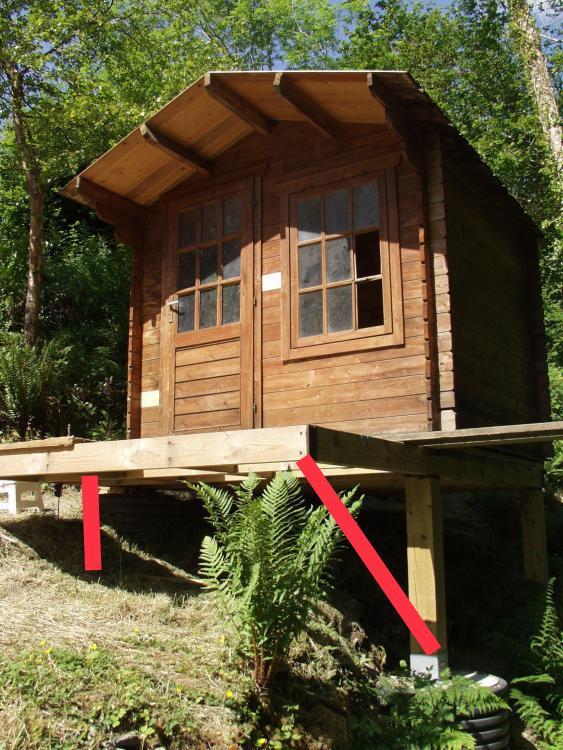
Like this Short one on the left into concrete. Long angled one on the right to the pad
-
Just looking at the Engineers drawings ... It shows collar ties at about 1.3m high by my calculations. Are there purlins down the sides and are you adding a dormer as you only have about 1m or so with decent headroom
-
Cheapest way will be deck boards - they are very cheap in the sheds and tanalised too so won't rot in the welsh rain.. Your support..? I'd dig a hole inside the deck somewhere near the low edge and just screw a 3x3 to the inside of the frame and concrete the bottom end into the hole as you will never see it. Higher edge I would run a 3x3 down from the furthest corner down to the top of the concrete pad and it will easily brace the deck. It is cantilevered anyway so won't move.
-
Skim is short for skim coat plastering, which is a 2-3mm covering, where plastering can refer to an 8-15mm two coat surface covering. Let the plasterer get his own product - some like board finish, others multi finish.
-
You also have an insulation layer that is pretty impervious to damp. Unless you have a very high water table, then you will not have a problem
-
Folds don’t cause cracks - not sure who told you that. if it’s only to stop screed running through then any cheap plastic will do - check Screwfix.
-
No - the point of a windpost is it resists buckling and transfers the load to the floor structure. Most houses don't need them as there are perpendicular walls (don't need to be load bearing) that do the job anyway.
-
Strong blocks won't help you with a long wall - only bracing or wind posts as per @Mr Punter will help with that.
-
What are you building that needs 10.4N blocks..? 3.6N are good to 3 storey, 10's are used for significant point loading or high stress situations
-
What is the span the opposite direction...? and is the ceiling coming down..?
-
It is about depth of joists when you do large spans, not width.
-
You are supposed to install a vapour shield onto the bottom of worksurfaces - usually comes with the dishwasher. I've seen this happen on doors and tend to use dishwashers with visible control panels
-
If this is being done under building regs then you will need to prove to BCO that this is acceptable. In terms of loading, static loading of 0.5 is used for clear floors with light loading. If you add stud walls then 0.75-1 is where you should be planning to stop movement. All tables for floor joists assume a dynamic 1.5 loading in addition which is where your bath/shower etc come in. Assuming you currently have 44 x170 joists then your maximum span would be at C16 3.963m under BS 5268-7.3, and that is for a ceiling joist. Convert this to a floor joist and then take the consideration in BS 6399-1 which is the new standard, then to get your spans you are borderline on using 88x170, or double up joists. These would need to be bolted together - not screwed - at 600mm centres to ensure the strength is reached.
-
From the person building an underground house...... or a cave..???? ?
-
Help with hanging things please.
PeterW replied to Moira Niedzwiecka's topic in General Self Build & DIY Discussion
Fischer plugs for the light stuff. These for the heavier stuff https://www.wickes.co.uk/GripIt-20mm-Plasterboard-Fixing---M6-x-30mm-Pack-of-8/p/121052 -
As @Nickfromwales said - certain installations require different rules. Also depends on where the join needs to be - pre or post regulators, above or below ground etc as the rules for LPG are different. You need a GSR engineer with a ticket for LPG to work on this.


