


PeterW
-
Posts
18480 -
Joined
-
Days Won
207
Everything posted by PeterW
-
As @Temp said - you will need to insulate the walls so how do you plan to do that ..? I am also interested how using steels will get you more space than an attic truss - are you going for a steel purlin arrangement with thinner rafters..??
-
Yes it’s airtight enough for MVHR. And PIR in cavities is horrible to work with and expensive as you need the 1200/400 boards and they need to be fitted properly to work. It needs care and attention at detail areas by the brickies. Beads full full the cavity with no gaps and mean your brickwork and blockwork can go up a lot quicker.
-
Looks like a split unit and that is the refrigeration unit outside and the heat exchanger inside. That will be noisy as you’ve basically got a big fridge running in reverse indoors. That tank install should have all the hot pipework insulated to meet regs too - so the install is non compliant with building regs.
-
It’s the water temperature not room temperature you need to be concerned about so just turn the blender down and as you say increase by 2-3 degrees a day from 20 up to 38/40 or whatever it’s designed to run at.
-
External brick, 150mm cavity, medium density block and blown graphite beads. Then line with 25mm PIR between battens and aluminium tape all joints before boarding with standard plasterboard and skim. This gets you decent thermal performance plus the PIR and batten increases this plus provides an air tightness layer that most builders can understand without the use of special membranes. Brand on PIR is irrelevant - buy what is cheapest locally. Blown beads aren’t a DIY install so just find someone with a decent spec - we specify Instabead Diamond which is about the best you can get.
-

And the best cure for this is ....
PeterW replied to ToughButterCup's topic in General Self Build & DIY Discussion
Using board adhesive as @Russell griffiths said rather than no nails etc would do that anyway so no need as the adhesive has a fire rating. -
Economical way to combine soundproofing and UFH
PeterW replied to Adsibob's topic in Underfloor Heating
Looking at this objectively and also financially (given I don’t know where you are in the U.K.) then this looks a very expensive solution to a problem you don’t need to have. UFH in older houses with poor insulation generally doesn’t work well - rate of heat lost vs heat input in solid walls will mean the UFH will struggle to keep up. You say you run the CH now for 7-8 months - UFH won’t fix that unless you fix the source of heat loss. As others have recommended you need to increase the levels of insulation in the new areas past building regs. New ground floors should be a minimum of 130mm of PIR or 250mm of EPS. Walls should be increased to 150mm full fill cavity or lined with 50mm PIR or PIR backed plasterboard. Attic ceilings should be 150mm of PIR preferably 100mm between and 50mm over rafters. All joints should be taped and you should also ensure any flat ceiling areas in the new build are 400mm fibre insulation. In terms of existing walls, then consider internal insulation now whilst the walls are bare - 50mm PIR battened back to the existing walls with 25mm infil between will allow you to completely skin the inside of the house with a single layer of insulation with no gaps. The batten layer allows you to have a service void where needed and also fix ordinary plasterboard so is cheaper than using insulated plasterboard. Without removing the joists or doing a lot of additional work you are not going to remove the noise transmission 100%, and tbh that is something you need to work out if you really need. I would assume the joists are all at 24” or 600mm centres, so first job is to get those beefed up to stop bouncing or the floor acting like a drum. Again, assuming they are 8x2 joists get the the builder to put noggins every 1200mm with 6x2 flush to the surface of the current joists and then D4 glue and screw new 22mm Egger or Caberdeck to the joists. This will stop the floor moving but also leave a void for 50mm of acoustic rockwool insulation above the ceiling that will reduce your sound transmission between floors. Finally as I said before I would ditch the UFH in the first and second floor and go for designer rads or similar. You can still have zone control using rad valves but you will save massive amounts on the products you’ve specified. Your current Cellecta/Ply sandwich is about £30 or so per square metre excluding the two lots of labour to lay the individual layers, shop around and decent P5 Egger or Caber is £6-7. That £23 pays for over 4 sqm of 50mm PIR for your walls so you are cost neutral before we factor in anything like the costs of the UFH itself which given your builders prices I think is very expensive...!! I would seriously consider back to the drawing board and do a fabric first approach and then look at what you are trying to achieve as I can’t see how some of the products you’re using will give you any benefit in either short or long term. -
That equates to £300 per cubic metre... which means that from materials perspective I would go with self compacting concrete laid as early as possible as even if it is around £150/CuM as @Oz07 says it can be laid relatively quickly so I expect with labour you are talking much less.
-
This can sometimes mean the flow control valve has failed or is scaled up. They become stiffer and then the control dial pins sheer when it needs too much force to move the flow valve. At this point if you’ve replaced PCB and now need new front cover and potentially the flow valve I would be swapping the whole unit.
-
Isn’t that what we have those lovely new type 45 destroyers for ..??
-
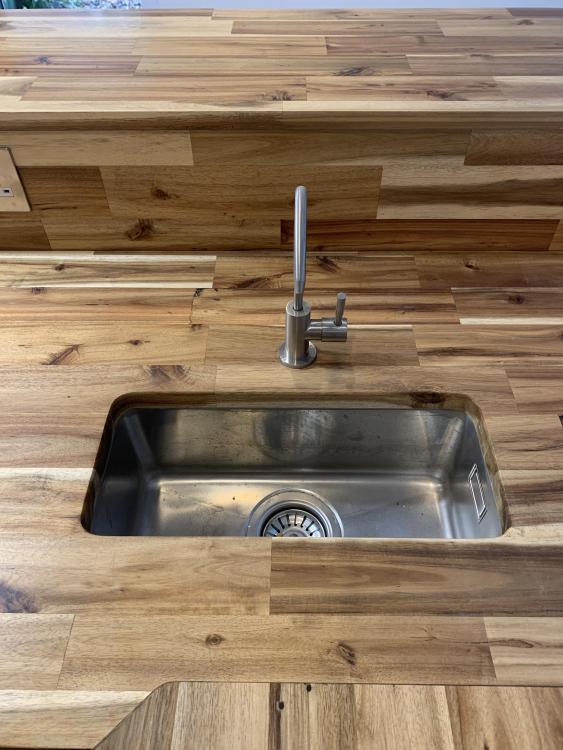
Yep the hob is to the left and the main sink is about 2.5m behind. Wasn’t expensive and the only fun bit was cutting the worksurface which was done with a bearing bit on the router.
-
Done exactly that with one of these https://www.ebay.co.uk/itm/372600304837 Has a cold only fed tap to it through a 10” carbon filter in the cupboard below.
-
Engage your BCO, send the plans and then ask for an inspection schedule. That will then give you the answer to the question. In these sort of instances I would use a private company as they tend to be more forthcoming with the information and more flexible.
-
Extraction in between ceilings
PeterW replied to canalsiderenovation's topic in Kitchen & Household Appliances
In that case I would put one of these in the ceiling with a short duct off the back through the wall. https://www.airflow.com/Product-Detail/mixed_flow_fan1/iCON-60-Fans/72591701/iCON-60 -
Extraction in between ceilings
PeterW replied to canalsiderenovation's topic in Kitchen & Household Appliances
Don’t forget fans are big holes in the wall ..! Back draft and other types of iris seals are really important in this situation -
As @ProDave said - you can’t get to anywhere close the levels of thermal insulation and probably air tightness needed to get to not needing any heat on upper floors. I am with your builder who is suggesting radiators - by all means if you’re putting in new ground floors then UFH (at 100mm centres) would work but a higher temperature system with rads would be required
-
https://www.lightningmaps.org/blitzortung/europe/index.php?bo_page=archive&lang=en
-
Extraction in between ceilings
PeterW replied to canalsiderenovation's topic in Kitchen & Household Appliances
Worth looking at Klarstein extractors https://www.klarstein.co.uk/Home-appliances/Cooker-hoods/Substructure-cooker-hood/High-Line-Ceiling-Hood-77cm-410-m3-h-75W-3-Steps-Remote-Control-Black-77-cm.html -
Is the old part of the house on RCBO or MCB...?
-
Don’t forget if you install it then it has to be maintained annually. It can also increase the chance of strikes due to creating a large earth potential structure where previously other items may have got hit. Given it’s an existing building you should be able to see evidence of any previous issues. Surge protection won’t protect from a direct lightning strike - the current involved will cause significant damage to everything in the path to ground.
-
Is that 30% ex works or 30% to site ..??? A full load of SIPs from Europe to the UK will not be cheap to transport.
-
B&Q quality is horrendous - no idea how they can warranty to 25 years as the cabinets chip as you are building them....
-
Just a brand of cement board. STS is the same as Hardiebacker or Aquapanel
-
Sounds like that will work fine and your overhang will work.
-
You will have to have trickle vents if you don't have MVHR.



