billt
-
Posts
499 -
Joined
-
Last visited
Everything posted by billt
-
Boiler control using the Drayton Wiser and opentherm.
billt replied to chris_x's topic in Boilers & Hot Water Tanks
I have a Viessman 100, allegedly Opentherm compatible and a Drayton Wiser also allegedly Opentherm compatible. They don't talk to each other. Also tried an Opentherm to Arduino adapter which didn't talk to the boiler either. I get the impression that Opentherm has lots of different dialects which don't necessarily communicate, a bit like Zigbee. -
Using a PV energy diverter to heat a hot water tank.
billt replied to Marvin's topic in Electrics - Other
It also depends how you go about it. If you make and install it yourself it can cost very little. In a previous house I made a 10 output diverter which worked on the energy bucket principle to ensure that no energy was exported, the electronics didn't cost much and I didn't have to pay an expensive electrician to connect it. Here I use and even cheaper and simpler version, a Tasmotaised switch which is controlled by the HA system to switch on when when excess solar is being produced. It's not accurate as the system is off grid with batteries, so precision is not required. -
Yes, had it for a couple of years. Gave up on Z-wave some time ago. MyZ-wave devices were quite old and not very reliable, the more modern Z-wave devices were better, but they're all expensive. Zigbee has been pretty good, for a reliable network you do seem to need a few permanently powered devices to act as hubs; if you have a few of those the battery powered sensors work well. (The Drayton Wiser heating control system uses a different flavour of Zigbee and was not very reliable, had to add 3 switched sockets to get the network to be fairly stable.
-
What 5kW Heat Pump for Homely (Modbus)?
billt replied to Ewan's topic in Air Source Heat Pumps (ASHP)
+1 for the Samsung Gen 6. It's pretty cheap and, if designed and installed properly should be pretty much as efficient as the newer models. Just bought the 8kW version, I was going to use a Vaillant but decided the price premium wasn't justified. -
I've just bought one of these https://directheatingsupplies.co.uk/products/honeywell-v4044c-1569-3-port-valve-28mm?_pos=2&_sid=02d795d3f&_ss=r You can use a mid position valve as a diverter, connect the white and grey wires to the switched output and don't connect the orange wire. That's what I did on my CH system.
-
I have copies of the Stroma FSAP software which seems to be usable without paying a fee. https://www.stromacert.com/members/software-release-notes It's fairly easy to put in the details for your own house, if somewhat tedious. You can then play with various modifications and see what happens. However, the EPC is a fairly useless tool for assessing if a house performs well or not. The easiest way to improve the EPC score is to add PV modules. I can make my house move from a D to an A by including the PV array. It's virtually impossible to make a significant improvement by improving insulation. The other things that improve the SAP score are using mains gas central heating (rather than oil, wood or heat pumps) and removing any secondary heating systems and associated chimneys.
-
And if you're interested in CO2 intensity there's this site https://carbonintensity.org.uk/ which shows the current and forecast CO2 intensity of the grid. It also shows the regional breakdown. Usually lowest in Scotland and the north of England and highest in the south west.
-
There are systems which can legally do this, but they will be expensive. For instance the SMA Sunny Island inverters can be set up to do this and I believe that they are now certified for grid connection. However they aren't cheap the SI 8.0 is about £3500 now, before battery and ancillary costs.
-
SMA have a design tool which you can use for 'what if' scenarios. It will also tell you if the panels exceed the capacity of the inverter. https://www.sunnydesignweb.com/sdweb/#/ You have to create an account to use it.
-
There's a high probability that I know already.
-
No because it will be 42 minutes wasted and probably full of rambling and repetition which could be better presented as a text summary to be read in less than 10 minutes.
-
Noise requirements and planning consent
billt replied to JamesPa's topic in Air Source Heat Pumps (ASHP)
An interesting idea, but I suspect that it's not right, after all an air conditioning unit is a heat pump and the rules for air conditioners seem to be the same as for heat pumps, unsurprisingly. I doubt that you'd get very far using that as a defence. I'd probably just have done it as well. -
Can this be wired into a 13a plug?
billt replied to CotswoldDoItUpper's topic in Electrics - Kitchen & Bathroom
Some induction hobs are designed to be able to work from a 13A plug. They limit the total power to the rings to use less than 13A. This probably isn't one of those though. -
I think that you'll find that most swimming pool heat pumps have a defrost function. Mine has, as did th eancient Calorex model that it replaced. They can be used in the spring/autumn when you can have low early/late temperatues and icing is going to occur, even though midday temeratures may be mild. I'd be very surprised if the OPs heat pumps were designed for swimming pools though. A quick search finds this http://www.gasapplianceguide.co.uk/Heat Pumps/Technical Info/Calorex heat pumps 1.pdf which shows that it is designed for normal heating purposes but only has an output of 6.56kW at 0C air temp/ 35C water temp, IOW it;s not going to be capable enough in very low temperatures. Earlier in the brochure it suggests that it should use a supplementary boiler in very cold weather.
-
No. Mine's a hobby project so return on investment isn't a factor. The initial system might have paid for itself in 35 years. I've in the process of testing another 32 cells to increase the capacity to 68kWh, but the repayment time for the whole system has dropped to about 11 years with the increase in electricty prices. In theory the batteries should last a long time. Typical cycle life is claimed to be 3,500 to 6,000, or 10-16 years if cycled fully every day. If the system is reasonably sized they shouldn't be cycled fully very often so the cycle life should be longer. Aging is a different and unknown factor.
-
Aqua wet wall panels vs tiles for the shower room
billt replied to Gow's topic in Building Materials
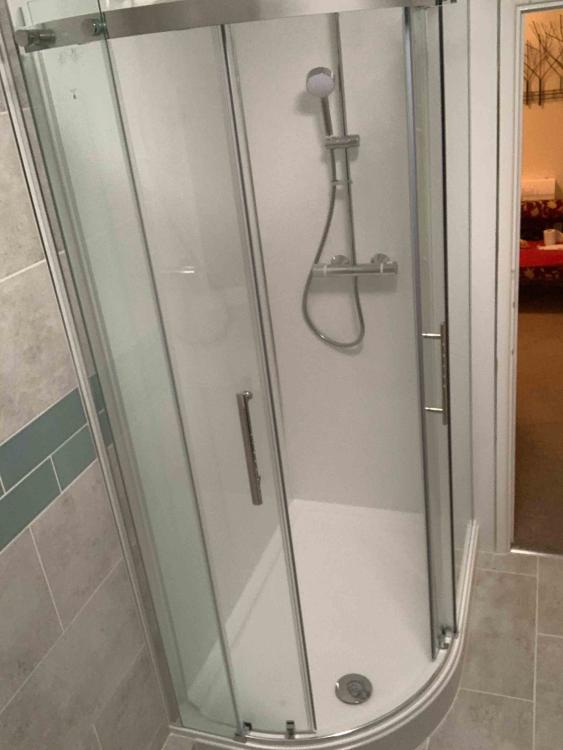
Well I've used Multipanel twice and I like them. The first one I installed myself and used one of the methods they suggest which is to ovelap the panels with the floor covering but cut the back of the bottom of the panel back at an angle to form a drip. The panel can't sit in water and water shouldn't wick up behind the panel. The second one was installed by a plumber I chose more or less at random. He did an excellent job but he didn't use the Multipanel sealing kit for the bottom edge which I had supplied, which should do a much better job of sealing the bottom edge than the standard sealer which he used. (This was done during covid and we weren't there much to supervise.) A lot of the designs are pretty horrible (can't see the point of imitating tiles or stone myself). These are simple white background with small reflective speckles to break the white up a bit. They are much easier to clean than tiles. Can't speak for longevity as we left the house with the first one after 7 years, but there was no sign of deterioration. But we don't have 6 showers a day everyday.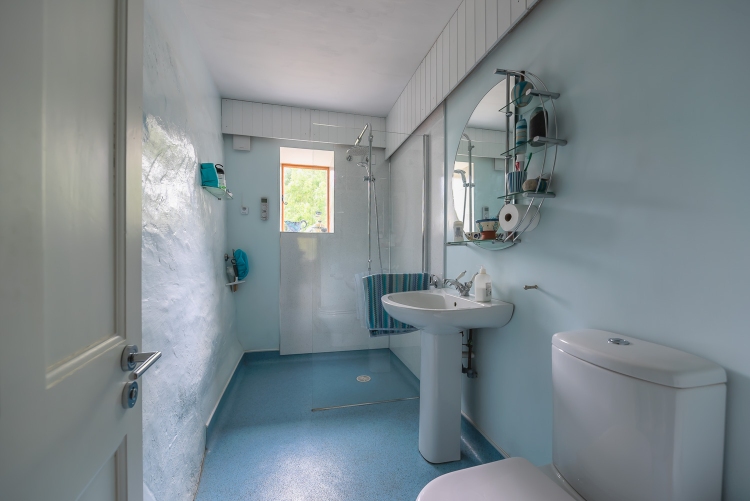
-
If it's a Lithium battery it shouldn't charge at all below zero, it'll seriously shorten the life. Mine are outside and they were switched off over the last few days. I might use a couple of those vivarium/propagator heat pads under them with a thermostat. Even an insulated cover won't stop the freezing in the weather we've had recently, you need some heat. You could take the view that the number of times that you get sub zero temperatures aren't worth the effort of protecting against.
-
Compensation curve - compensating against what?
billt replied to DeanAlan's topic in Air Source Heat Pumps (ASHP)
It is compensating for changes in outside temperature, when the outside temperature drops the heat loss increases so the water flow temperature needs to increase to compensate. A properly designed weather compensation system has two adjustments, the slope of the curve and the offset of the curve and it's a bit of a tedious trial and error job to get them to match the house characteristics properly - it's an open loop system. The USAians seem to call it outdoor reset control. https://www.pmengineer.com/articles/86699-outdoor-reset-control-no-quality-hydronic-system-should-be-without-it https://www.pmengineer.com/articles/91930-how-to-use-outdoor-reset-controls-in-renewable-energy-heat-source-systems -
I think that you will always get a plume from a condensing boiler, it's not likely that they are going to be able to condense all the water vapour. Mine always produces a plume, yet the flow temp this morning was about 52C and the return 35C. Even when reheating the cylinder with a flow of 72C, the return was 46C. Denser plume when heating the cylinder, but still a plume when heating the radiators. Might be worth checking the drain for a blockage.
-
I made what is in effect an external CU using one of these https://www.tlc-direct.co.uk/Products/CMSB504015.html It needs a simple key to open so can't be fiddled with by any random person and it is mounted under an overhang so isn't subject to direct rainfall. I would be uncomfortable fitting something like that where it could be subject to direct wetting, probably irrationally.
-
I have. I needed an SMA inverter fixed, SMA offered an exchange at a fair price but it would be sent from Germany. They wanted an EORI number and I got one. All done online; a bit tedious but not impossible. It'll probably never be used again.
-
On the face of it, without much information, that doesn't seem an unreasonable energy consumption. It would translate to about 75kWh of heat energy if the heat pump had a CoP of 3. We live in a 190 sq.m. detached bungalow of indeterminate age, poorly designed for energy use but with as much insulation as is practicable and our energy consumption for heating and hot water has been 100-110kWhr for the last few days. (Maximum has been 170kWh.) If the installer made a reasonable survey, the fact that a 17kW heat pump was specified implies that the property has quite a high heat demand. I reckon that we could get away with a 7kw heat pump in our house.
-
Where is the kWh price heading in 2022?
billt replied to epsilonGreedy's topic in General Self Build & DIY Discussion
So you're actually paying 32.15p/kWh after the government energy price guarantee, which is pretty much in line with what everyone else is paying. Our daytime rate is 64.71p/kWh, reduced to 41.63p/kWh after the price guarantee. I rather thought that a lot of people had been talking about it for quite some time. The standing charges are unjustifiably high as well. -
Sounds like nonsense to me. Our 3 French doors all open outwards, I'm pretty sure there's no particular security issue with them. (There used to be a potential issue with exposed hinges where the hinge pins could be knocked out, but there are lots of ways of mitigating that.) Our front door opens inwards and demonstrates a downside of inward opening doors; it is exposed to the weather and quite a lot of water drips off it inside if there's been heavy rain.
-
I don't think G98 certification disallows island operation; presumably the inverter must be wired in such a way that the grid is disconnected in the event of a fault, but can still operate in island mode.