billt
-
Posts
499 -
Joined
-
Last visited
Everything posted by billt
-
This tool will give you a good idea of how much you can generate. https://re.jrc.ec.europa.eu/pvg_tools/en/ Battery size is usually calculated by working out how long you want autonomy for. If you use 8kWh a day and you want 1 day autonomy you need about 8.5kWh of storage which would be about 170Ah for a 48V battery. Note that solar production is very variable and you'll get very little in the winter when you're running the ASHP most. My system has about 15000W of panels and averaged about 4kWh per day last December but 44kWh per day in May. Being further south and probably having a better site you may get less variation than that but it's still going to be large.
-
Electric ovens with lower peak energy demand
billt replied to Nick Thomas's topic in Kitchen & Household Appliances
Yes, get one of these air fryer/mini ovens that the save energy pundits are hyping at the moment. Spend £100 to save 10p. I'm pretty sure that all ovens will use on/off switching. It's cheap, reliable and there isn't a rational case for using complex electronic control. -
Having installed similar brackets I can say that roof timbers aren't precision made and you will get height variation. My brackets could have the height adjusted slightly by controlling the torque on the fixing screws. Tighten the back one and the front rises, tighten the front one and it falls, but that's only a very small adjustment. For anything more than that I used packers between the bracket and the rail. Unfortunately it's a bit time consuming if there are several that need adjusting.
-
Don't understand. Our 7 hour rate has reduced in price, now 17p per unit, day time rate 44p per unit. The rates don't vary depending on the size of the property.
-
In the days of 50W halogens I'd agree, but with low energy bright and dimmable LEDs they have their place. We have them in our kitchen and they are good for task lighting; 4 over one work surface , 4 over another work surface and an odd fitting over the island. They're switchable in groups so that you only have them on over the area that you are using. They give decent light where you are working and you don't shade it as you would with central lighting. We also have a long narrow hallway which was lit with 4 pendant lights (with cfls) when we moved in. It gave a horrible dim, flat light. I've put in 8 downlights in 2 groups. The pools of light on the walls and the increased brightness make it a much more pleasant space. No, I wouldn't choose them in a living area, preferring to have a mixture of freestanding lamps and uplighters to provide variation in lighting
-
The water level in the tank that supplies the cylinder needs to be higher than the top of the cylinder, preferably by more than 400mm. You also need to be careful how the vent is arranged with respect to the HW takeoff. I have a similar arrangement with a very low level difference and I get air drawn into the HW outlet because I didn't arrange the vent properly. haven't been able to face rearranging it yet.
-
There's a forum dedicated to this sort of thing and you're more likely to get a good answer there. In fact you'll probably find the answer in their FAQs or with a search. diysolarforum.com It's US based, but most of the info is applicable elsewhere.
-
Yes, if you don't have an export contract they won't pay for exported power.
-
You might find this article by John Cantor interesting, he discusses the cons as well as the pros. (Basically they're noisy and draughty, although those issues can be mitigated to some extent.) https://heatpumps.co.uk/2021/07/21/is-a-reversible-air-air-heat-pump-a-proper-heating-system/#comment-114874
-
If you're using Tigo optimisers you can use modules with different orientations, that's one of their selling points. One of my systems has 4 modules on a 38 degree roof facing more or less south, 2 modules on a vertical east facing wall and 2 modules on a vertical south facing wall. They all have Tigo optimisers and the system works. I did this because the roof panels didn't have a high enough voltage to start the inverter and there was no more space for panels. The extra panels don't provide much energy, but they raise the voltage enough to make the inverter start. It wouldn't work without the optimisers though.
-
I'm not a bricklayer or an architect, but I thought that that sort of arch was intended to support the structure above it, so an extra lintel shouldn't be needed.
-
Sorry, but vegan merely means that you don't eat eggs and dairy products as well as not eating meat/fish. It is perfectly possible to prepare vegan food without buying ultra-processed rubbish. It predates the modern bandwagon by several decades. (Consults Wikipedia - in fact it dates back to 3300-1300 B.C.)
-
I wouldn't be so quick to condemn it. The black box above the pump is controlling a blending valve, so it might not be as bad as people are assuming. If the system is only UFH with no radiators then it's probably a perfectly acceptable system. These valves usually have a controller to set the temperature so I'd guess that the temperature sensor on the manifold flow does to a controller (presumably the off white box labelled EMR-1) and the controller sets the blending valve to the right temperature. Just because it doesn't look like a modern installation doesn't mean that it's defective.
-
Power requirements for external swimming pool and pool house
billt replied to Thorfun's topic in Electrics - Other
The maximum input to the heat pump is 3kW and when the water's cold it takes less than that. 3 x 24 x 10 is 720kWhr. This year the total consumption was 1245 kWh - we don't use the pool much. When we bought the place we were going to get rid of it but decided to keep it for a while. I have a large PV array and only run the heat pump when the sun's shining so it has zero running costs. If you keep the pool covered most of the time I doubt that there's that much difference in chemical use (reducing evaporation reduces the chlorine requirement) and if leaves etc aren't blown into the pool there won't be much more cleaning to do either. You're right if it isn't covered. -
Power requirements for external swimming pool and pool house
billt replied to Thorfun's topic in Electrics - Other
We have an outdoor pool that came with the house. The filtration pump uses a maximum of 800W (about 3 amps) and the ASHP a maximum of 3kW (about 12A). The other things are likely to be trivial. This is for a pool of about 76 cu.m. volume, 10m x 5m area, with a safety cover which reduces evaporation and hence heat loss. The size of the pump and the heat pump depend on the volume of the pool, the bigger the pool the more water you have to pump round and the more energy you need to heat it. The heat pump we use has a nominal (i.e. exaggerated) output of 21kW. That takes about 10 days of continuous operation to get the pool to 26-7C at the start of the season. Once it's up to temperature it can run for a shorter time at lower output. -
Local Electricity Bill... or fight to improve SEG
billt replied to Benguela's topic in Photovoltaics (PV)
2 points; E7 daytime rates are always higher than the standard tariff and tariffs vary by electricity board region, so comparing your standard rate tariff with my economy 7 tariff is meaningless. Octopus are no worse than any other supplier, the variable tariffs will all be much of a muchness. -
Local Electricity Bill... or fight to improve SEG
billt replied to Benguela's topic in Photovoltaics (PV)
Octopus rates aren't that cheap. The Go tariff is 7.5p per kWh for 4 hours during the night. The rest of the time the rate is 40.06p/kWh with a standing charge of 47.86 p per day in my area. My Octopus economy 7 rates are 21.4p per kWh night and 29.9 p per kWh day with the same standing charge. What you save in the headline rate they get back in the daytime rate, rather like economy 7. -
Radio 4: solar panels aren't designed for this temperature ....
billt replied to ToughButterCup's topic in Photovoltaics (PV)
Yes it's true. The output drops with high temperatures. There's a characteristic in the panel spec called NOCT, typically about -05% per degree C increase. If the module is at 55C (quite likely in these conditions, the output will be reduced by about 15%. However it's not particularly important as a midsummer day with near constant sun is going to generate more energy than a cool cloudy day. -
Probably not, but it depends where you are, what your electrical consumption is and how good the site is. If you are thinking of replacing a gas boiler with a heat pump you definitely won't be able to do it. I have a sort of off-grid system which is well over sized and it won't cover our winter usage. This shows our monthly generation which varies from 115kWhr in December (3.7 kWhr per day) to 1352 kWhr in May (44kWhr per day). That's a 12:1 variation through the year; in fact it would be more than that but quite a lot of potential generation in the summer is lost as it can't be used. This site isn't ideal and you could get more winter power with a site on the south coast with ideal orientation and no shading. The other issue is how long you need autonomy for, IOW how much battery storage you will need. You tend to get several days together with no usable solar in the winter. You will need enough storage to cope with this and hope that you get a good sunny day at the end! For instance, our big array averaged 2.2kWhr per day in late December and didn't get to a reasonable 11.2kWhr until the 9th of January. If you are very frugal and only use 8kWhr per day you would need at least 10 days of storage or 80kWhr and it would probably still not be enough. People who seriously go off grid have a generator to cover winter/dull day shortfall.

-
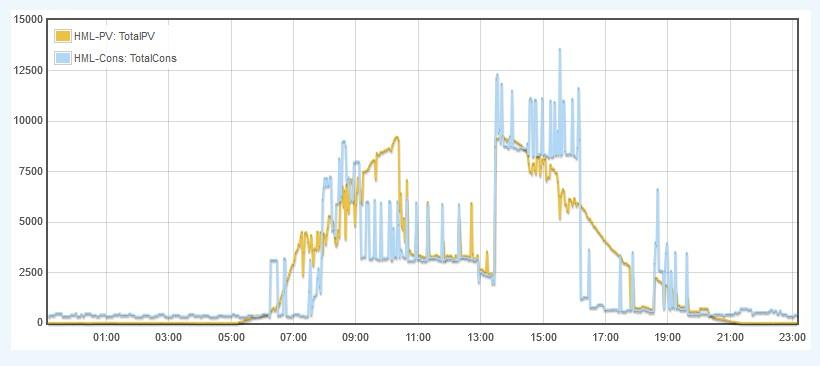
63kWh here. It could have been over 80 but the batteries were full at 10:30 and the inverters throttled back. However, only got 9.9kWhr on the 5th of June.
-
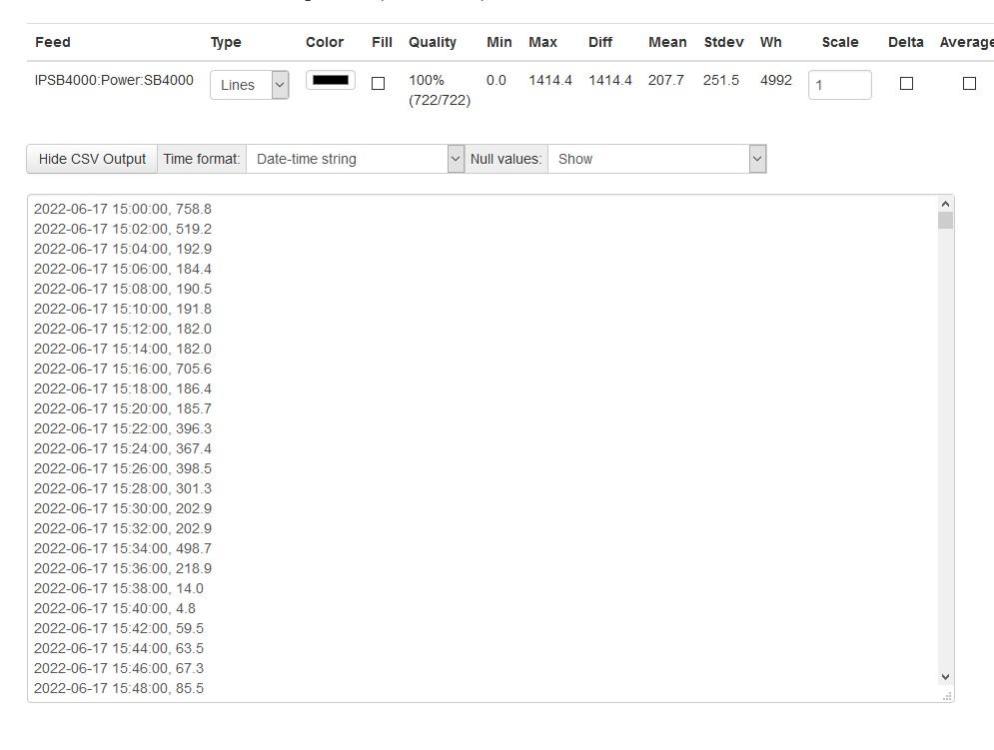
I'm sure that you can, although it's not something that I've done. I think that it uses a modified version of the Open Energy Monitor CMS so the data is there. I upload to a local EmonCMS instance and that does all the processing that I need. If you want any more information https://docs.iotawatt.com/en/master/ should tell you all that you want.
-
Yes, it's a US company and they only sell direct, but they do respond promptly. They were out of stock of the 240V reference transformer when I ordered the latest one. Any 9V AC transformer should work, you can calibrate it in the Iotawatt setup. I had a couple of these left over https://shop.openenergymonitor.com/ac-ac-power-supply-adapter-ac-voltage-sensor-uk-plug/ and they work fine. The power supply is a standard 5V usb supply. Incidentally, if you're installing many CTs in the consumer unit, it's better to use small toroidal ones rather than split core as they're much more compact. They seem to be a bit difficult to get hold of here. I had some of these https://www.brultech.com/store/index.php?id_product=45&controller=product from another project.
-
It's worth looking at the Iotawatt. https://iotawatt.com/ They don't advertise, so you won't have heard of it, but having tried the Emon devices, the Brultech GEM and Brultech ECM, the Iotawatt is the best of these. (I wouldn't consider the emporia - don't like cloud dependency.) It's a development of the Emon monitors, but it's a neat solution, logs locally (but can upload to other databases). I've just bought my 4th, arrived from the US in just over a week. It will do everything that you list, it uses a voltage transformer for a voltage reference, so measures power correctly. 3, you just put a CT on the feed from the PV inverter. 4. The Iotawatt can record either the actual power on a circuit, including direction, or it can just log positive or negative power. 6. Presumably you can get access to the individual feeds for each device so you should be able to monitor them separately.
-
Yes to the first question less any losses, which could amount to 15-20%. Yes to the second question. The peak power available depends on the peak discharge current capability of the batteries, but increasing the voltage reduces the current demand. My system uses 400Ah LiFePO4 batteries which can be discharged at 3C or 1200A, theoretically that's 57kW, but the inverter is limited to 6kW continuous, 8kW for 30 minutes or 9kW for 5 minutes. However the inverters (SMA Sunny Island 8.0H) can be paralleled to increase output or 3 of them can be used in a 3 phase system.
-
Standard solar diverters are incompatible with heat pumps. The principle of the diverter is to switch the immersion on when generation exceeds local consumption and switch it off when consumption exceeds generation. Because local consumption changes from second to second, as does PV production, the immersion is switched on and of very frequently. An immersion heater can cope with this but it won't do a heat pump any good at all. If you want to feed excess solar production to a heat pump you are going to need a more sophisticated solution, possibly battery storage, which will be expensive and inefficient or a delay system to make sure the heat pump runs for some time after it has been started, but that is likely to use mainly grid supplied power rather than locally generated power.