billt
-
Posts
499 -
Joined
-
Last visited
Everything posted by billt
-
uPVC, Timber or Timber with Aluminium Windows?
billt replied to Lucy Murray's topic in Building Materials
Softwood 100 years or more. When we moved here in 1990 the (1920) windows looked to be in a terrible state, putty missing, glass loose, joints coming apart. But closer inspection showed that the wood was in good condition, so I took the opening lights apart, remade the joints, stripped down to clean wood, re-glazed and painted them properly. 27 years on I've started the process of replacing the single glazing with double, which involves removing the opening lights and deepening the rebates. The wood is still completely sound, despite having been repainted only once in 27 years. -
Appliances: brand new or brand name?
billt replied to Crofter's topic in Kitchen & Household Appliances
ITYM "Fancy electronic goods can confuse the heck out of guests." I'm old but technically literate and I find the interface design of many consumer goods appalling, but they've been doing that for years, it's just easier to design a lousy interface with computers. Simple things can be bad as well. Last year we stayed in a place with an ancient solid ring hob. All the markings had worn off, so you didn't know which knob controlled which ring and the idiot designers had inverted the sense of the controls, so to turn the heat up you turned the knob anti-clockwise! -
Graf waste water treatment plant, any thoughts?
billt replied to joe90's topic in General Self Build & DIY Discussion
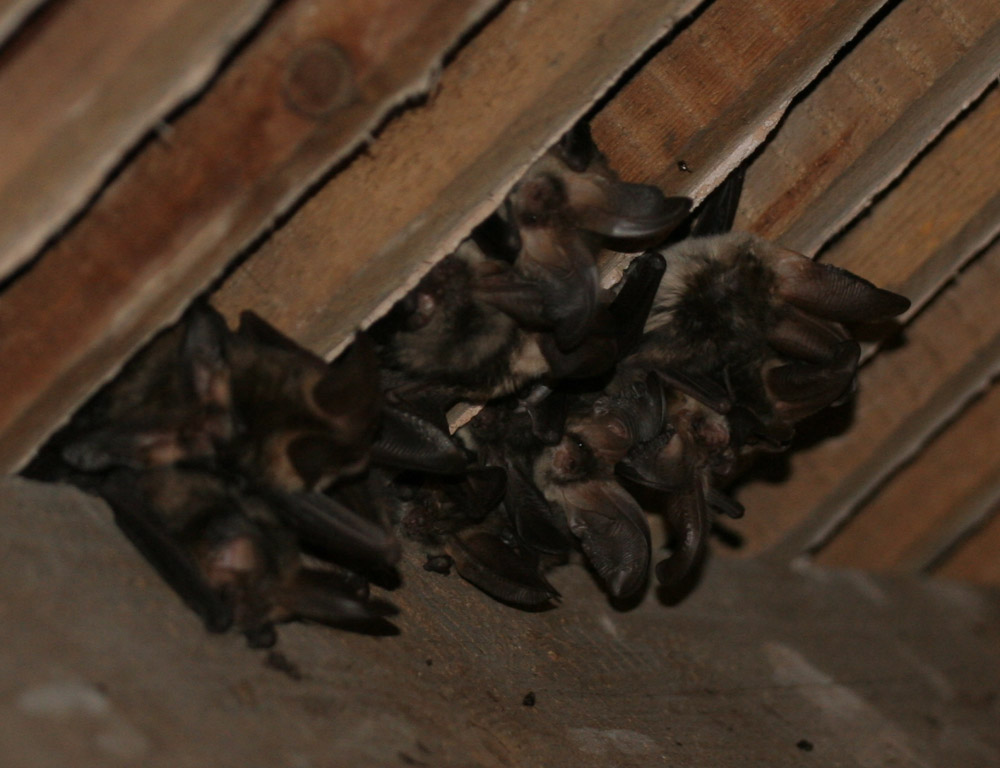
Noting wrong with bats; as long as the ecologists don't know about them!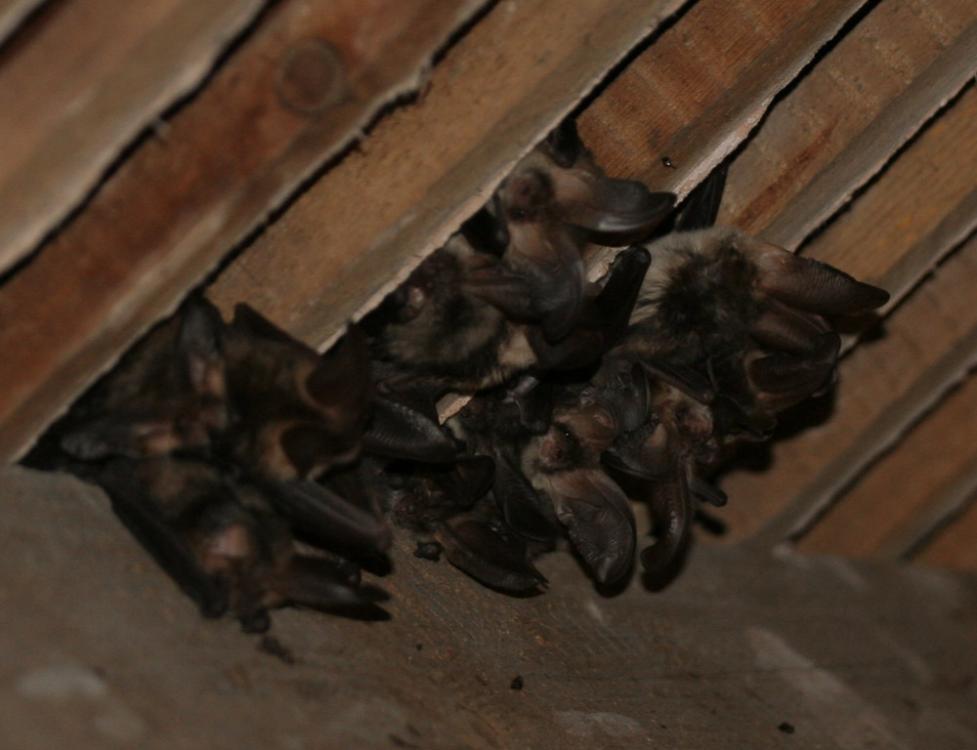
-
Non-potable water supply during build
billt replied to Ferdinand's topic in General Self Build & DIY Discussion
I don't think it's that simple. " Section 76 of the Water Industry Act 1991 (temporary hosepipe bans) (Flood and Water Management Act 2010) 76 Temporary bans on use (1) A water undertaker may prohibit one or more specified uses of water supplied by it if it thinks that it is experiencing, or may experience, a serious shortage of water for distribution." So the ban is on using a hosepipe supplied with water from a "water undertaker" who set the rules, not water from a private supply. There was a mini boom in borehole drilling in the wealthy SE during the last water shortage. No doubt if there is another water shortage and another borehole boom the PTB will think about extending control to private supplies as they will hasten the depletion of aquifers if there enough of them -
About 3 years ago I wanted to add to our PV installation, quite a large (by domestic standards) ground mounted array. We could have just installed it and probably no one would have noticed, but I thought it probably best to get PP for it. Unfortunately there is a small moated site (a square ditch) about 30M behind our house which was scheduled a few years ago (a process which is done on the say so of one individual and to which there is no realistic prospect of appeal). This meant that our application was referred to English Heritage and the county archaeologist (who had already spotted the application, as it's part of his job to monitor planning applications) and resulted in an archaelogical condition being added to the consent. I was pretty disgusted at that as the site is well away from the scheduled monument and the ground disturbance was only about 2 dozen post holes for the array mountings and a 20M trench, the costs of a watching brief would have been totally disproportionate to the value of the project - about 10-15% of the total cost. In fact the county archaeologist was very helpful after I had whinged to him about the unreasonableness of the condition. He offered to come out and do the watching brief himself during the morning when I drilled the mounting holes and dug the trench. I thought that was a very fair and generous action considering that it was well outside his job remit, so they aren't all bad. (Mind you, I never submitted a written scheme of investigation, so my PP is probably void!) Unfortunately, the presence of the scheduled monument mean that any future planning application for work on our property will have an archaeological condition, which will make me very wary about applying in the future.
-
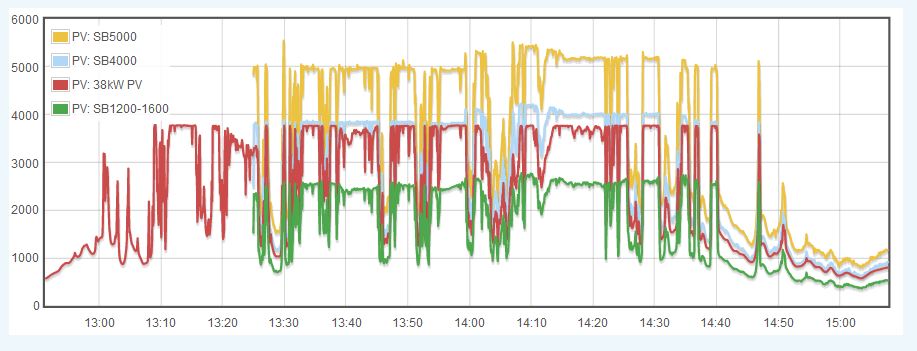
Is the algae all over the panel surface or just at the bottom edge? Some of my ground mounted panels get green mould on the bottom edge where water stays for the longest time, but it doesn't get up to the active area of the panels, so doesn't affect the output. Not reaching peak output is almost certainly due to the panels warming up. My roof mounted system very rarely gets up to the inverter output unless the day is very cold as the output is reduced due to heat. The larger ground mounted arrays reach peak output much more readily as they are in free air and stay significantly cooler. You can see the difference here. The first graph is from Sunday when we had more or less unbroken sun and all the panels got warm. The 3.8kW system only reached 3.1kW while the 5kW system just about reached 5kW. Today with broken sunshine, a much cooler day and some wind the 3.8kW system got to 3.77kW (about the most it ever gets too) and the other systems clipped as well..

-
If you have panels at a low angle in a dusty environment, or have a big issue with bird droppings it may be worth cleaning them occasionally, but it's a waste of money and effort to clean them for normal installations in a clean environment. Our first installation was done in June 2011 and as it's effectively at a third floor level it's impossible to clean without a cherry picker. There is no sign of any output reduction due to either dirt or panel aging. First full year generated 3559 kWhr. Best year was the 3rd year with 3751 kWhr. Last year (5th full year) generated 3679 kW hr, 1.9% down on the best year and 3.4% up on the worst year. If dirt was a real issue there should be some clear drop in output, but there isn't any.
-
I have a Sipgate number, but mostly use the Betamax/Dellmont services, voipcheap.com, voipcheap.co.uk, SMSListo etc, etc. They are cheap and I have found them reliable. They will let you spoof any phone number that you own, but do tend to present the number as International, which could be an issue for some.
-
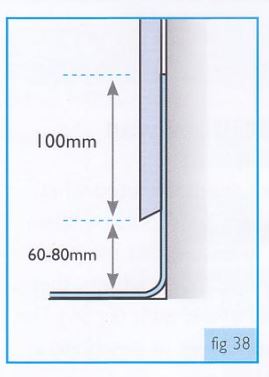
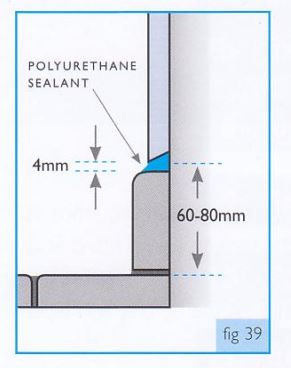
We used wall panels in our shower room and there is no visible sealer. The vertical corner and edges are finished with a narrow metal trim which has sealer internally, but isn't visible. The bottom overlaps the vinyl floor covering and doesn't have any sealant, but you would need sealant round the bottom edge if the panel was meeting a shower tray. We like the panesl a lot, much easier to keep clean than tiles.
-
Pretty, but is it efficient?
billt replied to ToughButterCup's topic in Energy Efficient & Sustainable Design Concepts
That bit's almost certainly right, a tracking system, (assuming an unobstructed horizon) harvests significantly more energy than a fixed system, and roof mounted systems lose output owing to heat which a freestanding system will suffer from less. The best bit about the price is that delivery, foundations and installation are all extra, so you'ld probably be looking at the best part of £20,000. A product looking for wealthy green idiots. -
I thought that the OS did most of their mapping from aerial surveys these days, but it seems that there are still ground surveys done. https://www.theguardian.com/money/2007/jul/21/careers.work4 Although it's from the Guardian it looks quite credible. "An Ordnance Survey (OS) surveyor will survey every new building within six months of completion. The data is passed onto the UK Land Registry."
-
It's possible - anything's possible but it's definitely not worth it unless you like a challenge and messing with this sort of thing, and probably not even then. Are you sure that there's a 16A (4kW) limitation? http://www.nienetworks.co.uk/Connections/Generation-connections/Small-scale-generation says that up to 20kW single phase or 5MW three phase is possible. If it's like the rest of the UK you can connect up to 16A per phase without getting prior authorisation, anything more needs permission, which may be the source of the claim.
-
Where and how best to install temperature sensor in UFH screed
billt replied to readiescards's topic in Boffin's Corner
Put mine in 10mm cu tube. Just big enough to take the DS1820 sensor and cat5 cable and smooth enough to be able to push the sensor to the end of the tube. ST is seriously over thinking things, from a theoretical point of view. Although there will be some temperature variation between loops, it's going to be small and unimportant in the scheme of things. One carefully sited sensor (away from the edges) is quite adequate. Mine are used to control the heating as well as for logging. (The kitchen floor is an electric mat with inadequate insulation, so responds more quickly than the water fed and better insulated other rooms. It isn't used much, but the sun was out yesterday, so it didn't cost anything to run.)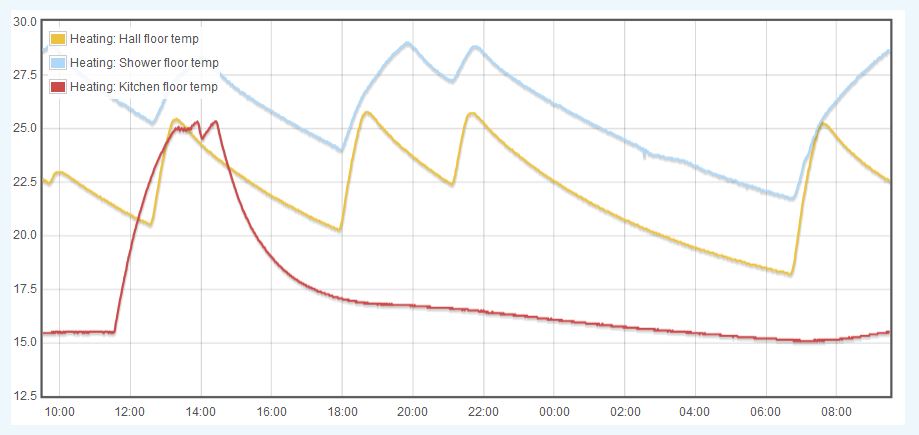
-
Does anyone know anything about these? My sister in law is trying to sell her house in NI, which was seriously reconstructed in 2000ish. Apparently it can't be sold because of some problem with the septic tank. The incoherent part of the story that we've had is that they didn't get PP for the septic tank and need to apply retrospectively. That looks like nonsense as the time limits are 4 years (10 in some cases) both of which have long passed. There does seem to be some legislation from 2006 which seems to require all domestic sewage treatment installations to be registered with the NIEA. As it's retrospective legislation I doubt they knew anything about it and won't have registered it. Does anyone have any experience of this sort of thing in NI?
-
It's just the house builders annual call to get rid if the green belts. They've been doing it since green belts were imposed. Of course it would be ideal for them, nice green field sites, easy and cheap to develop and close to demand so they can charge premium prices - lots of lovely profit.
-
I'd buy, in fact I've got 3 that I've bought. You couldn't have bought the materials for the cost of the sheds. Yes, they're not the last word in quality and they would have been more substantial if I'd built them from scratch, but they're still standing and keeping the weather out and I didn't have to waste days building them. The trick is to find a decent supplier, they don't all charge the earth for rubbish!
-
Not exactly. Smokeless zones were introduced in order to reduce the smogs and poor air quality produced in the days when most people burnt coal. They don't stop you burning coal, but it must be "smokeless" coal, good quality anthracite, coke, or other manufactured coal. It doesn't stop you burning wood either. I think if you do burn wood in a smokeless zone it has to be in an approved wood burner. Of course that doesn't stop the smoke if you burn wet wood slowly! Quite a lot of the country, including many towns, isn't a smoke control area, so it wouldn't apply anyway.
-
Reminds me of Flanders and Swans Design for Living (1956). "Flanders: Have you a home that cries out to your every visitor, "Here lives someone who is exciting to know"? No? Well, why not... collect those little metal bottle-tops, and nail them upside-down to the floor? This will give the sensation... of walking... on little metal bottle-tops turned upside-down."