billt
-
Posts
499 -
Joined
-
Last visited
Everything posted by billt
-
10 Year Rule and immunity under the 4 year rule.
billt replied to ToughButterCup's topic in Planning Permission
Blaster Bates, Shower of Shit over Cheshire. -
Insulating is always a good idea, but PV panels have a very long life if not damaged. Most have a spec of 80% output at 25 years and will still be producing for many years after that. And the 80% is pessimistic. Of course that sort of life expectancy will be for the worst conditions; high temperatures and high insolation, in the UK the stress will be much less and potential lifetime longer. Some of my panels are 8 years old and show no signs of degradation. If you source the components yourself from a reasonably priced supplier and don't have to pay the installers surcharge it will almost certainly be worth doing. If you have to pay someone to install it maybe not, but cost effectiveness of these systems is complicated and installation specific. However, that roof still looks problematic. It's got a gable in the middle so you'll have to arrange the panels round that. In combination with the hipped roof it will be difficult to fit many panels and they are likely to look terrible. i'm keen on PV but if I was building that house I wouldn't install panels on the roof. It doesn't look as if you can get much on there, it will likely make the appearance worse and it probably won't reduce your electricity bills much: most of the production will be in summer which isn't when you consume most energy (unless you have a swimming pool heat pump).
-
If you're not in a special area (conservation area, AONB, national park etc) roof mounted panels are permitted development. If I'm reading that drawing right it doesn't look very suitable for a PV array; hipped roof with lots of gables, so restricted area and lots of potential for shading which can significantly reduce output. Panels produce about 200W/m2 so you'ld need 15 square metres of panels for 3kW.
-
What does your home cinema look like?
billt replied to Adsibob's topic in Networks, AV, Security & Automation
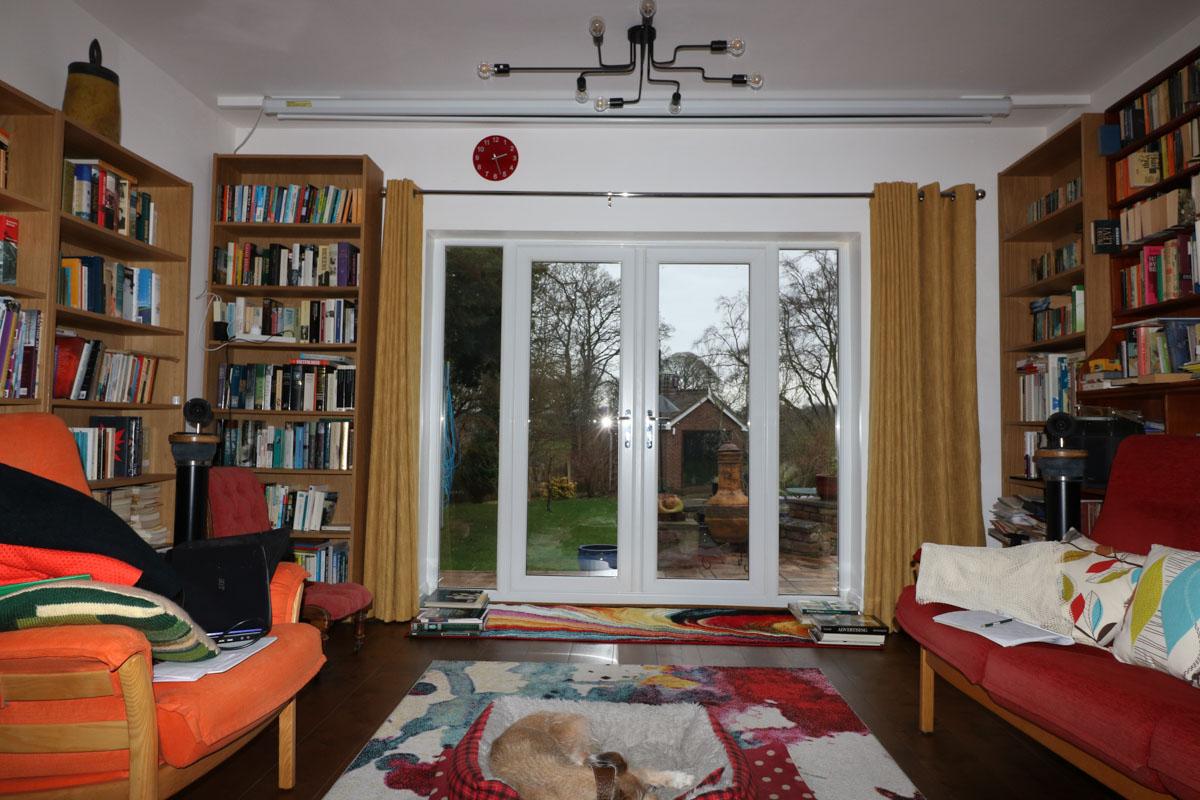
This ours. We don't do minmalism. Fortunately clutter disguises the speakers.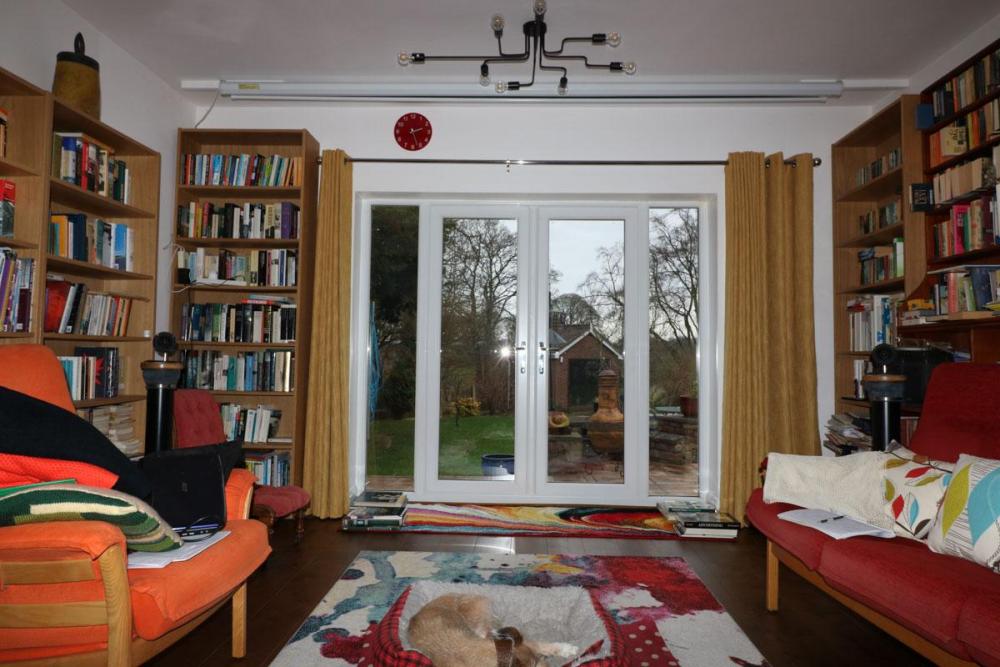
-
Pocket Thermostat/NTC probe - Thermal Paste?
billt replied to OldSpot's topic in Boilers & Hot Water Tanks
I don't think there's any point in using thermal paste in this application. As the pocket is immersed in the fluid and more or less sealed, the air in the pocket will be pretty much at the fluid temperature, so good contact with the metal isn't needed. If it was surface mounted and surrounded by cool air it might be different. In any case your don't need absolute accuracy, just consistency. I've used one of those ESI thermostats; they're OK but the hysteresis is too small and not adjustable. -
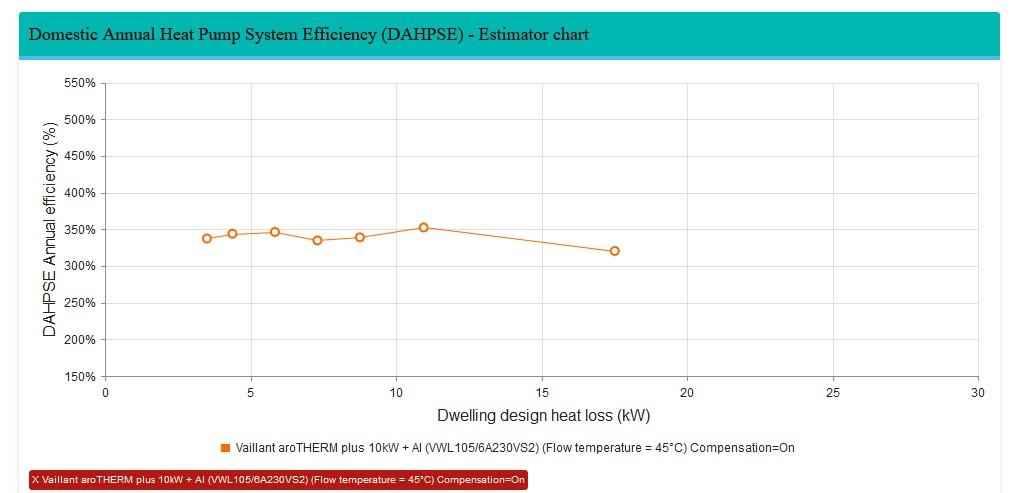
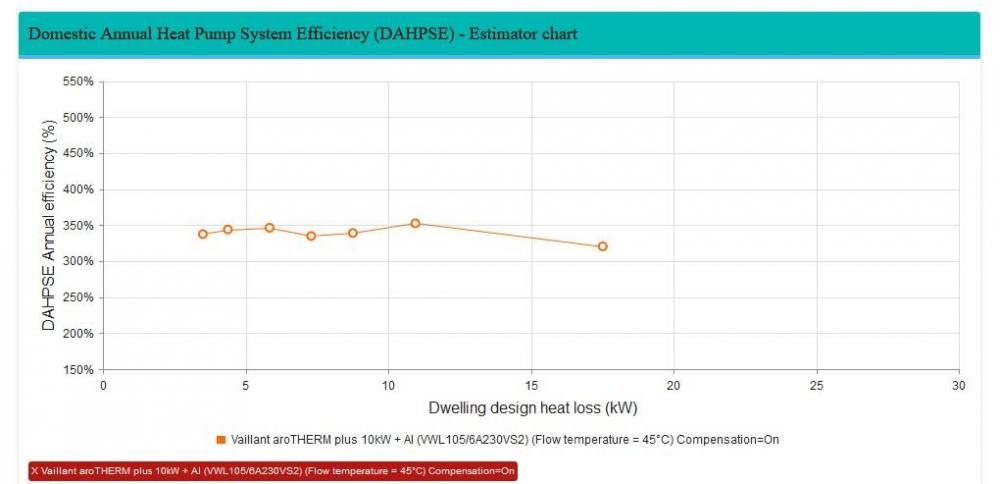
I would guess that you either choose the flow temperature for a constant temperature or there is an optional control system thaht uses either weather compensation or load measurement to adjust the flow temperature. I'd guess the F is for HW heating with a high flow temperature. If you scroll down on the page you linked to there is a more detailed spec to look at (although it's not detailed enough). There's an interesting BRE page which will estimate annual efficiency of a heat pump system. .https://www.bregroup.com/heatpumpefficiency/index.jsp It lets you select the heat pump, flow temp etc and shows a graph of the estimated COP.
-
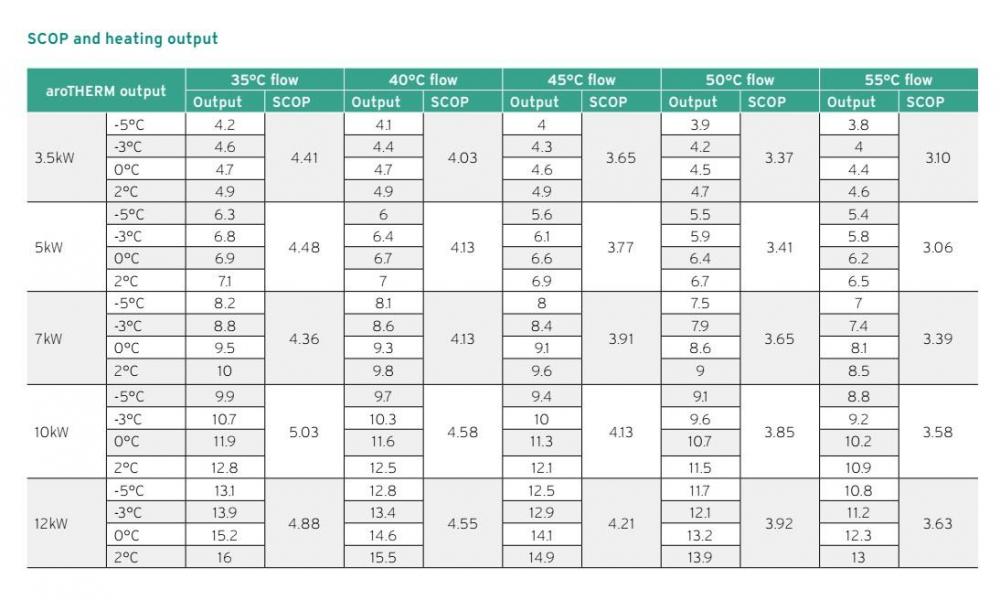
ITYM "some" systems will do that. The Vaillant arotherm+ 5kw has a COP of 3.41 at 50C, the 7kW has a COP of 3.65 at 50C, those aren't in the region of 3.9, but they are over 3. Yes the 12kW just about gets to 3.9, but that's one of a range of 5.
-
That really depends on your rates. Here, using those values, the heat pump would cost 37% more to run at night rates and 92% more to run at day rates. And, of course, if you have over sized radiators the boiler should be running at a lower return temperature with efficiencies of well over 90%. (I've been looking at the feasibility of a heat pump, and with a few radiator enlargements (doubling some of them) and a bit of pipe enlargement it looks possible to get a system with a cop of over 3, which is approaching acceptable running costs (a mere 25% higher than gas), which could be hobby project to waste a few thousand on to get rid of the gas connection.)
-
Why do you want to change from a combi boiler to an ASHP with such stringent conditions? Does the combi need replacing? An ASHP is going to be a worse fit for your lifestyle and cost more to run as well as having a big ugly box outside. It's likely cost a lot to install too. You are proposing a system with greater complexity for no benefit. I don't see the point, perhaps you can enlighten us.
-
The answer to that is yes, you or your electrician are supposed to inform the DNO, even if you don't export anything. It's being connected to the grid with a gt inverter which matters.
-
They're great for driving on footpaths.
-
Design considerations for new homes
billt replied to SteamyTea's topic in Energy Efficient & Sustainable Design Concepts
Thanks for the gratuitous insult. -
Design considerations for new homes
billt replied to SteamyTea's topic in Energy Efficient & Sustainable Design Concepts
No, the property is unoccupied and unheated, which was my point. It stays at a reasonable temperature without any heat input despite being not terribly well insulated. -
Design considerations for new homes
billt replied to SteamyTea's topic in Energy Efficient & Sustainable Design Concepts
I wasn''t actually making any assumptions about who was building these houses. My point about not needing heat pumps is the same point that has been made on this forum in the past; if the heat demand is low the capital cost of a heat pump and all the other plumbing is not justified. The 50 sq.m. flat we own was built in the 80s with 1980s levels of insulation. The heating demand is actually very low. It hasn't been heated since the beginning of October; the living room temperature is 14C at the moment, the lowest that it has dropped to was 12 on the 5th of November. Sorry, I simply don't understand the desire to be blasted with high pressure water. Our water here is gravity fed with about a 2M head. The showers are entirely satisfactory and the baths fill up in a perfectly acceptable time. A mains fed 9-10kW electric shower should be perfectly adequate. A 50sq.m. house is going to be a basic bottom of the market home, not a luxury home. -
Design considerations for new homes
billt replied to SteamyTea's topic in Energy Efficient & Sustainable Design Concepts
I'm mystified why a new build home of 50 sq.m. needs a heat pump or cylinder. It should be built with good enough insulation to have sufficiently low heat demand that electric resistance heaters will cope. Can't see the point of a heat pump with very low heat load. Like wise you can use instant water heaters and electric showers. At a guess the heat losses from a cylinder (which are quite high especially with the small cylinder needed in a small house) would make up for the use of direct electrical heating. Anyway the grid will be zero carbon next year and electricity will be so cheap it won't need to be metered. We own a flat which is about 50sq.m. It has an airing cupboard which must have had a cylinder at one time. The airing cupboard doesn't impinge much on the floor space. An ASHP could go on an outside wall if mandated. PV is an irrelevance in a small house, so I don't really see what the problem is. -
Reginox composite granite sink vs stainless steel
billt replied to Adsibob's topic in Kitchen Units & Worktops
Bought an eastern european ebay special (£127 for a bowl and 3/4 1100mm white sink) a year or so ago. It's a great improvement over the useless black ceramic sink that came with the house. I do have concerns about cleaning it. The recommendations seem to say don't use abrasive products or harsh chemicals which does seem to imply that they are more delicate than ss or ceramic. We've taken to wiping it down after each use to make sure limescale doesnt build uo. -
An additional point of confusion which tripped me up when I wanted to use Opentherm. Opentherm controllers don't necessarily work with all boilers, in particular they seem to be setup to work with combi boilers; system boilers are a bit of a nightmare. I found this out when I tried to use a Drayton Wiser controller with a Viessman 100 system boiler. they both claimed to be Opentherm compatible, but they don't work together. In particular they don't communicate about hot water heating. The boiler needs to be set to high flow temperature when heating water rather than modulated down when heating radiators. I see from the Honetwell T4-M manual that it doesn't support DHW - although the T^-RHW does. Having played with a few options I'm not convinced that Opentherm offers much in reality. There's a weather compensation option on the boiler whihc does more or less the same thing.
-
But it is dedicated. That circuit is intended for the connection of the PV inverter only, hence dedicated to the PV system. It's not electrically separate but it is functionally separate.
-
There will always be voltage on that circuit when the grid is connected and the breakers are closed, but no power will flow if the panels aren't producing (and there's nothing else connected). You're making the assumption that because it's called a circuit it is completely separate from the other circuits. It isn't. When all the breakers are on all the circuits are connected together, there is no electrical separation between them. The breakers are there for protecting individual circuits in the event of a fault and convenience for modifications/fault finding etc.
-
Was that the bloke with the pick? That'll teach him.
-
Attempting a straw bale, off-grid passive house in Somerset
billt replied to Smallholder's topic in Introduce Yourself
No the maths doesn't add up, but usable capacity depends on the type of battery. Deep cycle lead acid is recommended to use not more than 50% of their capacity, they are also pretty inefficient as they need to be (in effect) over charged to keep them healthy. LiFePO4 batteries can be used over 80% of their capacity and they are a lot more efficient than lead acid. The combination of greater usable capacity and much greater lifespan makes LiFePO4 batteries the rational choice for this sort of application. The most cost effective cells that I've seen are about $280 for 3.2V 280Ah. So a 4 parallel 16 series bank which could store over 100kWh would cost about $18,000. On the other hand a 16S bank of Winston 1000Ah cells (which have a better reputation) would cost about $20,000 -
Attempting a straw bale, off-grid passive house in Somerset
billt replied to Smallholder's topic in Introduce Yourself
Those are daily averages, so multiply by days in month to get monthly averages. e.g. November is 540kWh in the month. -
Attempting a straw bale, off-grid passive house in Somerset
billt replied to Smallholder's topic in Introduce Yourself
Not the OP, but I have a 15kWish array with batteries. the PVGIS projections for our location give these average daily values, adjusted to 20kW. Jan 14kWh Feb 23kWh Mar 41kWh Apr 60kWh May 65kWh June 69kWh July 67kWh Aug 56kWh Sep 47kWh Oct 29kWh Nov 18kWh Dec 13kWh These are theoretical results for a grid tied system, so the actual output in the summer will be limited to the storage capacity of the batteries. There is also a daily loss of about 2kWh due to inefficiencies in charging and inverting. Of course averages hide significant daily variations, so to be off grid you would want at least a weeks worth of storage, which is likely to be a lot of batteries. Even that might not be enough as you can get many overcast (very low energy) days in a row. We only have just over a days storage. So far we've had to supplement the PV on 8 days. Over winter it's likely to be every other day. We are further north than Somerset, so the OP should get slightly better results. -
Why is my house so cold?!
billt replied to Cognis0's topic in Energy Efficient & Sustainable Design Concepts
Yes, but yours is nearly a Passivhaus so needs very little heat input, and it's already up to temperature. Any house will eventually follow the mean outdoor temperature when not heated, though it may have a very long lag. -
Why is my house so cold?!
billt replied to Cognis0's topic in Energy Efficient & Sustainable Design Concepts
No one seems to have pointed out the obvious: the house isn't being heated enough, or at all. Get the boiler fixed. 13C is about right for an unheated house at the moment. If we go away for a few days with the heating set to frost protect the house is cold (if I've forgotten to turn it back on remotely a few hours before we arrive). Heating on for a few hours and it's back to normal. All the stuff about insulation etc is fine, but it won't make the house any warmer.