


BotusBuild
-
Posts
1461 -
Joined
-
Last visited
-
Days Won
10
Everything posted by BotusBuild
-
How far back to sit my windows ?
BotusBuild replied to Big Jimbo's topic in General Construction Issues
I'm being thick - where is the thermal bridge? -
So far, we have no evidence of that particular area being a problem, only the two parts by the outflows, but of course, time will tell
-
@SteamyTea - thank you for your concern. Thinking about it, the GRP was laid about 4-5 weeks ago now (time flies when your having fun), so just as the wet weather imposed itself on Kernow. As you know it can be raining in the North and bone dry in the South of the county. We caught the dry(er) bit. I did not take pictures. It was covered before hand. It was not raining when they laid and while it was curing, or when they painted. They did re-cover in between "sessions". Nosey neighbours do come in handy for such info 🙂 That said, the guy was honest about some wet OSB board (where some rain seeped between overlapping plastic sheet) which was allowed to dry in the sun before they laid that couple of square metres (out of approx 200 sq m). I am keeping a very careful eye on what is happening. So far, all seems well apart from the two areas discussed in this thread.
-
I had GRP laid a couple of weeks ago, with 3 outlets through parapet wall, also made out of fibreglass. These are not currently feeding into a hopper/downpipe, and I detected two bits dampness in the locality of two of these outlets. These two happen to be where most of the water is coming off the roof and a certain amount of pooling exists on the roof by them. I think what is happening in my situation is that the water is tracking back on the underside of the outlets when we have had high winds and rain. As a temporary attempt at fixing, I have made small cuts in the bottom edge of the outlet on the outside and bent the edge down a little to encourage the water to fall away quickly before it can track back along the underside. I have also, on the one worst affected, now put some visqueen plastic along with some CT1 to provide a seal against any tracking back. I'll monitor over the next couple of weeks and may also make appropriate use of a new foam gun and expanding foam - old foam gun thrown away in disgust when it stopped me doing this at the weekend 🙂 HTH
-
A time-lapse (of sorts)
BotusBuild commented on BotusBuild's blog entry in South East Cornwall Low Energy build
She's is doing OK thank you - I have my assistant back, although not quite as able as before. Once we have backfilled completely, we'll know better. How is your's coming along? -
We have a mortgage on our current house with Nationwide with a Loan to Value (LTV) of about 15%. We're both closer to retirement than starting work, and we were transparent about what we were doing (except for my rolling "2 year" completion timeframe)
-
Heat Pumps: What They Really Mean For You - BBC1 8pm today
BotusBuild replied to MAB's topic in Property TV Programmes
I started reading the article this morning and stopped as soon as they stated that all heat pumps provide air conditioning in the summer. Just checked, and that part of the article has been removed 🙂 So much for accurate journalism on this topic. There are other things in the article (a regurgitation of an earlier article by the way) that still wrankle with me; the "larger radiators" comment without proper explanation, and the number of trained installers - like you HAVE to use a trained installer (which you do for some I admit) I shall not be watching this program so as to protect my blood pressure 🙂 -
Plywood, OSB or Cement Board? (external frame wall)
BotusBuild replied to BotusBuild's topic in General Construction Issues
To help, here is a picture of one such studwall - the gaps will be filled with PIR and foamed round, ( outseide lat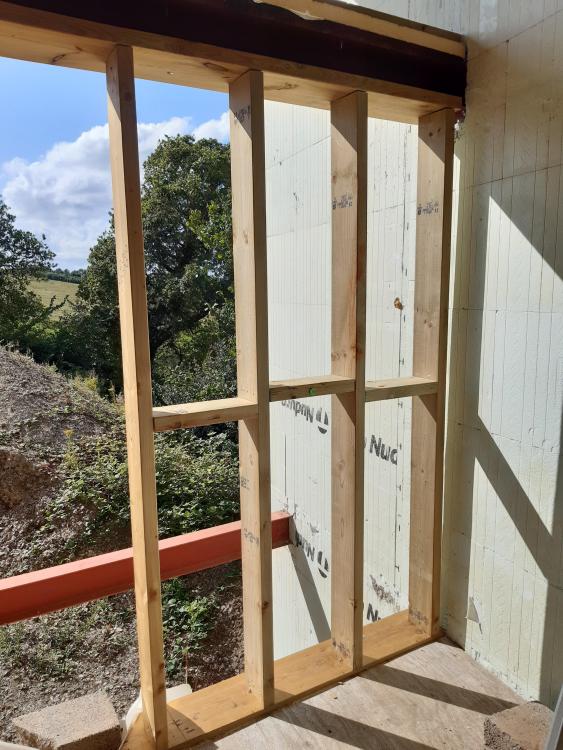
-
Plywood, OSB or Cement Board? (external frame wall)
BotusBuild replied to BotusBuild's topic in General Construction Issues
Anyone got any comments on this please -
While that is definitely a good perception, traditional brick and block houses can be built to meet new building regs, and can be built to exceed. The key to any build where you want to minimise in the energy input to the final build is insulation, insulation, insulation, and that includes air-tightness. What you need (in my personal opinion) is a youngish builder who already has a reasonable level of experience, who is prepared to build over and above the building regs and to address those key items while they are building. While this seems a tall order, the earlier recommendation by @Temp to visit some local "one-off" build sites is seconded by me. Alternatively visit local builders merchants or tool hire shops and ask them for recommendations. I found my GRP roofer in this way (and I am very pleased!)
-
Plywood, OSB or Cement Board? (external frame wall)
BotusBuild replied to BotusBuild's topic in General Construction Issues
*scratch coat 🙂 -
Hi all, I have built some external frame walls (studwork) below and alongside some windows. My question is what sheet material should I use on the outside (exterior) of the studwork? The exterior will be clad, most likely, using stone slips, the build up will be: sheet material (the focus of this question) weather resistant material (Visqueen or similar?) wire mesh scratch cost mortar setting bed coat stone slip Any handy diagrams will be appreciated 🙂
-
My guideline is "if I am asking, then it's wrong and needs fixing" Personally that would bug the hell out of my OCD. Get it changed. PLEASE 🙂
-
What am I doing wrong? Trades going AWOL
BotusBuild replied to SimonD's topic in General Self Build & DIY Discussion
I "lost" a steelworker. Never found out whether he didn't like the site, the prompt payments, or met with terrible accident. Fortunately found a new one. It's why I specify the work to be done and when I expect it to happen by( if that is a reasonable ask). If neither happen, I state it will be considered a breach of contract. No, the first steelman never got his final payment 🙂 -
Since starting this build we've had a handy mound of "spoil" from which I have been taking regular photos from the same(ish) spot to remind me of progress during the "down" days which we self builders all suffer from time to time. I thought I'd share this with you. It starts in May 2021, when the major groundworks had been underway for a few weeks and goes up until April this year - about 2 years. First a picture of the mound of spoil for reference: and now the "timelapse": Since that last picture we've been putting on the warm roof structure, so any further photos from this vantage point don't show much sign of progress. so until something significant happens in August this view won't change much
-
It's part of the safety features for closed hot water systems - yes, it is normal (and looks different depending on which plumber fits it 🙂 )
-
Canski, I got most of my drainage pipe online for the exact same reason - merchants were more expensive, in particular Travis Perkins. Trade Pipe, Plastics Express were two that I used. I did have to do emergency buys at TP when something went wrong (and that hurt!) Just think carefully about delivery if you are not onsite. I had delivery to home, and schlepped stuff down to site on my roof bars 🙂
-
Warm roof - which vapour control layer and which PIR?
BotusBuild replied to BotusBuild's topic in Flat Roofs
Part is flat, see photo above, part is a single slope of about 9-10 degrees, but essentially being treated as if it is a flat roof. The whole lot will have a green roof on top of the warm roof construction -
Warm roof - which vapour control layer and which PIR?
BotusBuild replied to BotusBuild's topic in Flat Roofs
The Nudura in the above diagram is shown in this photo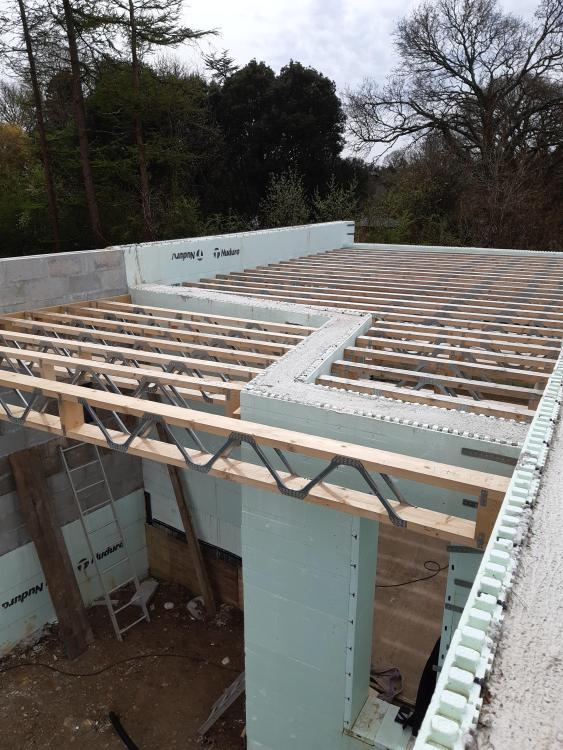
-
Warm roof - which vapour control layer and which PIR?
BotusBuild replied to BotusBuild's topic in Flat Roofs
-
Warm roof - which vapour control layer and which PIR?
BotusBuild replied to BotusBuild's topic in Flat Roofs
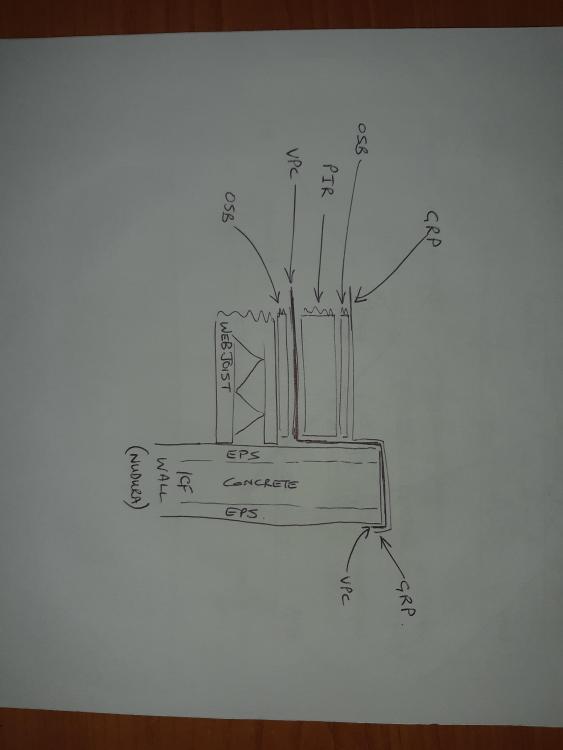
Back to the VCL. For the flat roof build up in the OP, if I've laid OSB over the top of the joists how the heck would I get VCL to go down, past the joists as suggested by Dave Jones. Doing that would be a ballache. Surely the VPC should go up and over the wall, with the PIR on top of it? FYI, the exterior walls continue up above the joists to withhold the warm roof and then a green roof. The GRP will also go up and over the external walls. I'll add a drawing later, and maybe a photo or two -
Warm roof - which vapour control layer and which PIR?
BotusBuild replied to BotusBuild's topic in Flat Roofs
Can you show a diagram of this so I totally understand what you mean? Thanks -
Warm roof - which vapour control layer and which PIR?
BotusBuild replied to BotusBuild's topic in Flat Roofs
Why both? -
Warm roof - which vapour control layer and which PIR?
BotusBuild replied to BotusBuild's topic in Flat Roofs
A what? Can you provide an example -
The time is approaching for the roof to go on at Botusbuild towers 🙂 It's a warm roof construction, essentially a flat roof (single pitch at about 9 degrees). From the web joists (400mm c/c) it will be constructed as follows: 1. 18 or 21mm OSB or ply 2. vapour control layer 3. 150mm PIR 4. 18mm tongue and groove OSB (GRP installer recommendation) 5. 2 layers 600 weight GRP 6. In time, a green roof will be installed Questions: 1. Any views on the choice of first layer board? 2. Recommendation on the vapour control layer to install 3. So many to choose from - which PIR should I use?



