
BotusBuild
-
Posts
1408 -
Joined
-
Last visited
-
Days Won
10
Everything posted by BotusBuild
-
Improving an "ok at best" ASHP installation
BotusBuild replied to pstunt's topic in Air Source Heat Pumps (ASHP)
Hi. A stable conversion implies that you probably had to add in whatever insulation, air tightness etc. into the building. As you know the quantity and quality of the insulation added, and the level of air tightness you have achieved will be key to how much of the energy you are putting into the building is being retained, and for how long (during that cold snap, energy would have been flowing out of all buildings quicker than normal). If you have not had a heat loss calculation done already, I would have one done to begin with, then at least you will know where you stand with regards the system you have installed. Most importantly this will also tell you whether the Grant ASHP that you have is sufficient to provide the energy input your building requires. Until you know this, fiddling and fettling with the rest of the system should be avoided. -
We had to have our temporary supply installed, but then ran a looooonnnnnggg extension lead. Even now the supply is inside the house (recent move) we still have the extension to power the temporary lighting, the radio and the power tool battery charger. The extension lead will likely be enough.
-
Shame you're so far away 🙂
-
Which to do first? Walls or floors?
BotusBuild replied to BotusBuild's topic in General Self Build & DIY Discussion
No room for no gap then 🙂 -
Which to do first? Walls or floors?
BotusBuild posted a topic in General Self Build & DIY Discussion
Internal floors and walls are on my mind, keeping me awake at night. Which should I do first? Floors first? Once complete you have to protect them for a (long) period of time from scrapes, bumps, plaster splashes etc., but once done you know where the walls have to finish 🙂 Walls first? Do all your plastering and any painting etc. without worrying about damage to the floor. Do you bring the plaster board/plaster down to the base floor (18mm plywood), or leave a gap? How big a gap? So, I am thinking walls first. FYI, I will be be laying UFH on the upper floors -
I've been trying to find someone to render the outside of the new build near Saltash (very South East of Cornwall, just over the river from Plymouth). There are some skills/jobs that I am deciding need to be done by others 🙂 There is about 200m2 of walls to be rendered. I know the weather will likely not be suitable for a few months yet, but any recommendations would be most welcome - DM me if you want. Thanks Stuart
-
That is looking very smart indeed - well done!
-
We got the North side of the house bit right 🙂
-
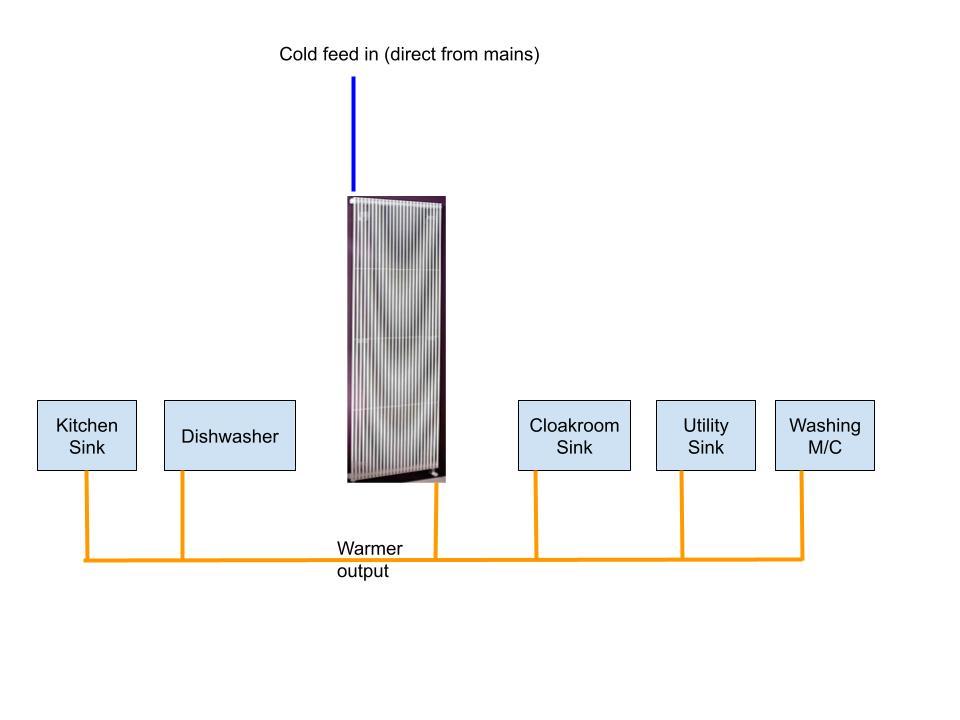
Good point, so this would be better then (with signs on the cloakroom and utility sinks "not drinking water")
.jpg.1aad57255c8669ec3ba30a5275c47139.jpg)
-
I've just had a simpler-to-implement and probably better idea, that I think may work. Use a slim vertical radiator, run the cold water through that, effectively using the radiator to cool instead of heat. In my situation, I can possible also run the cold feeds for the utility and cloakroom sinks and the washing machine through this as well, increasing the amount of cold water going through the cooling radiator. Something like this:
-
As I pondered how much more 2x4 I needed to create various partition walls yesterday, with the plans in front of me, my mind wandered as per normal onto all sorts of other "to be done yet" items on the build, one of which was this very point. I had either what is to be proven as a brilliant idea, or just another piece of hair-brained craziness (I think probably the latter, but anything for a laugh). Install a screed floor with stone floor tiles in the pantry in which there is a matrix of pipes (ala UFH) through which the cold water feed for the kitchen sink and dishwasher will pass. Each time the sink or dishwasher is used, the cold water will remove some heat stored in the floor. Given the small floor size this is likely not to remove much heat so then I started thinking of running the pipes in one of the walls as well, or through concrete cast shelves 🙂 As you can tell my brain was out of control.
-
A time-lapse (of sorts)
BotusBuild commented on BotusBuild's blog entry in South East Cornwall Low Energy build
Latest "from the mound" picture. (could have been taken back in August, but I forgot 🙂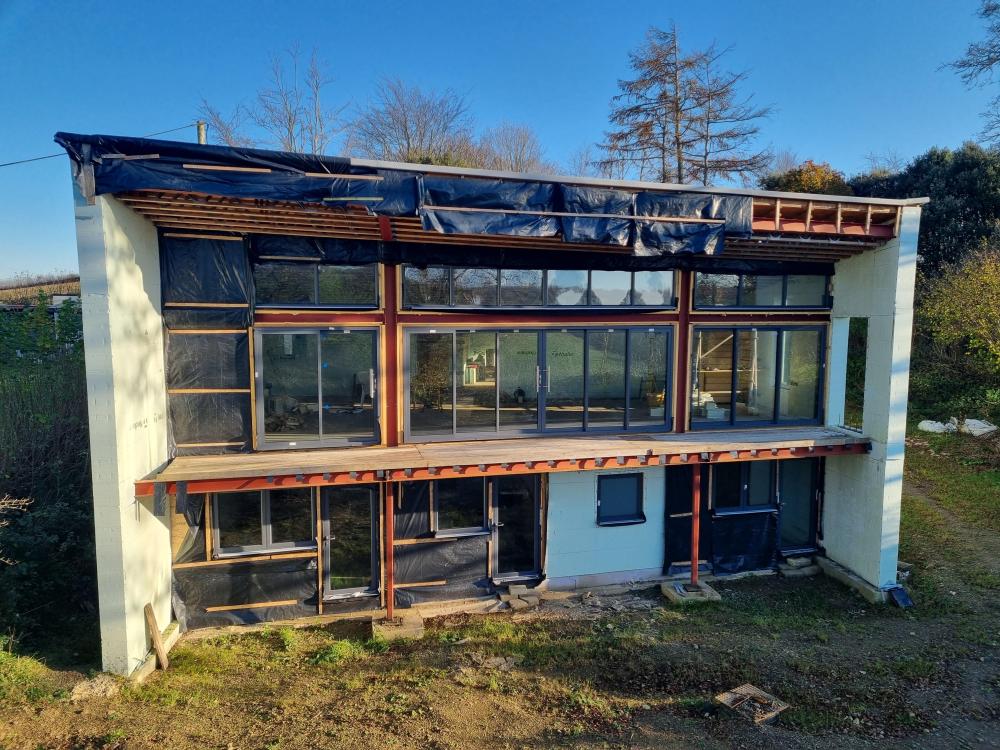
-
Draining external taps prior to the BIG FREEZE
BotusBuild replied to Adsibob's topic in General Plumbing
After last Winter's big freeze and the resulting burst pipe - we happened to be onsite when it happened thank goodness - we insulated the above ground pipe and tap with various offcuts of PIR and EPS we had. -
Me, me, me, please, I live to break govt websites
-
Tommy, it would be good if you can say what manufacturer e.g. Nudura, and provide some detail on what parts e.g. straights, corners??
-
Best Water-resistant Shuttering Board?
BotusBuild replied to Mulberry View's topic in General Self Build & DIY Discussion
I was just going to say, GET THE NUDURA PROPS 🙂 Out distributor also supplied a whole load of bracing brackets of varying types . I just added a few more bits of ply and 2x4 to brace windows and door openings (to be sure) -
Take those two clips off the joist. Manoeuvre the pipe to where you want it to be, replace the clips. Looks like you have enough play in the plastic pipe
-
Chinglish has expanded to include diagrams 🙂
-
I used Jackon Raft it had 250mm concrete, 2 layers A393 mesh taking ICF walls (Nudura). We also put the UFH pipes tied to the mesh. All done ourselves apart from the concrete pour. See these blog entries:
-
It helps stabilise the tap from rocking side to side. Don't ask how I know
-
@Moonshine - is this being installed in a new self build? The way I read the GOV.UK website, the grant is only issued if you are replacing a gas boiler. Am I looking at the correct web pages or is there a specific grant for new self builds?
-
Supply & Meter move: what about CU and sockets?
BotusBuild replied to BotusBuild's topic in Power Circuits
RESULT!! Supply moved on Thursday morning, CU and sockets moved, and CU tied to new earthing rod (previously tested by electrician), then E.On contractor moved the supply, tested connections and decided he could connect the tails from the CU to the isolator. We have power into the house. Time to start cabling I suppose 🙂 -
Durisol - in administration
BotusBuild replied to PeterW's topic in Insulated Concrete Formwork (ICF)
Is that low smoke cabling so as to avoid conduits? Come across a few jobs where this was the case only to fall foul of protection measures. Unless you put them deep enough, you'll still need protection. Cost of cable over normal will be in the same ball park as normal plus conduit. You can form a channel that is almost key hole shaped so the conduit 'clips' in. I am at the time to install cabling, and conduit and "normal cable" it will be having consulted a number of electricians. Once I have sourced the materials are @FM2015 and @SteamyTea still good for tea, cakes and filming 🙂 -
Supply & Meter move: what about CU and sockets?
BotusBuild replied to BotusBuild's topic in Power Circuits
Follow up - New earth rod fitted by myself and tested by certified electrician - better impedance than the one currently in place (very pleasing result). Supply and meter moves this week, electrician allowing me to move the CU and tails, and sockets to new location. -
Coming to this late. my two pours in SE Cornwall were about 12 months apart. Very drekley 🙂