


Mr Punter
-
Posts
8303 -
Joined
-
Last visited
-
Days Won
24
Everything posted by Mr Punter
-
Chip in concrete floor beam end, what should be tolerated?
Mr Punter replied to epsilonGreedy's topic in Floor Structures
No, you unroll DPC straight on the top of the sub structure blockwork and beams on top. No mortar. -
Corian is softer than the quartz based materials like Silestone. It is not scratch resistant but you can polish scratches out. It also tends to mark so if, for example, you are preparing strawberries on it you will be left with marks that cannot be wiped off. You will need a scotchbrite and cream cleaner. The solid colours can be joined seamlessly. I prefer quartz as it in non-permeable and scratch resistant. Just don't put hot pans on it.
-
Oil is only for engineering bricks - especially blues.
-
300mm thick is fine for domestic up to 3 storey and the 1m depth is often just frost protection / rule of thumb but if you have point loads from columns you may need thicker / wider and / or rebar. Your SE should advise. We have had to do 1000 x 1000 x 400d concrete pads for some columns.
-
I still don't understand the issue. Is this an existing house you bought? Why did you get the tests done? What do you want to achieve?
-
Wall fasteners for 75mm stud wall?
Mr Punter replied to MJNewton's topic in General Construction Issues
Can you just fix some brackets onto the wall at the top with screws and rawlplugs, then screw into the side of the stud to hold it firm? https://www.screwfix.com/p/sabrefix-heavy-duty-angle-brackets-galvanised-60-x-50mm-10-pack/61576 -
Often have more than one engineer. Sometimes piling and ground beams, masonry, timber frame and balconies can each have input from different engineers.
-
What is the issue you have? Is it cold, damp, mouldy, high heating costs etc? The detailing of insulation / DPC / DPM gas membrane / insulation junctions can take many forms and there is not always a right or wrong, but some can be better than others. Because the house is complete any remedy suggested can only be applied to the as built, not to how it may have been better in the first place.
-
I like the Gridshell building at the Weald and Downland Open Air Museum. Should not take you too long to design something similar for your client's granny annex... http://www.fourthdoor.co.uk/unstructured/unstructured_06/gridshell_photo_essay.php
-
What is the negative effect of too much mortar plasticiser??
Mr Punter replied to epsilonGreedy's topic in Brick & Block
I prefer hydrated lime to plasticiser. -
It is tricky to do setting out manually if you have a sloping site, different levels or steps in foundations. If the plan is straightforward and the site is flat then no need for a Total Station bod.
-
I would look at https://www.screwfix.com/p/timbascrew-wafer-timber-screws-gold-6-7-x-200mm-50-pack/6787j . 50p each, wafer head and you will get 50mm embedment into the OSB / joist which will be plenty. Can you check from underneath to make sure the fixings are locating OK? It is quite easy to miss a 45mm wide target especially if you are butting board edges over a joist. It may be better not to line up the boards with the joists - just lay in staggered rows and screws along each joist.
-
Agree with @Russell griffiths to get a surveyor with a total station. After the ground beams were in ours did all the soil pipes, wind posts and steel column base plates, as well as walls. Marked with a Hilti pin on the concrete and coloured with spray. I still like to use a tape as a sanity check sometimes.
-
If you are using a Paslode and the fixings are visible, buy and fit a "No Mar" tip so the timber does not get the little indents.
-
DWG TrueView
-
Can Compacfoam take the load? Compressive strength calculations
Mr Punter replied to gravelld's topic in Doors & Door Frames
The weight of the window will often be held by chocks or packers so the effective bearing is hugely reduced. Your slider is less than 100kg per linear metre. A single skin single storey blockwork wall is about 500kg per linear metre. All looks fine. -
Block & Beam floor, max overhang into cavity.
Mr Punter replied to epsilonGreedy's topic in Floor Structures
Don't butt them, offset one bay by using a block widthways in the first row of one half, so the beams are staggered on the sleeper wall. You may end up with a few odd bits where you can't use full infill blocks but you can fill this with concrete. -
Block & Beam floor, max overhang into cavity.
Mr Punter replied to epsilonGreedy's topic in Floor Structures
The beams don't normally span from outside wall to outside wall, so you may be able to lap them on the sleeper walls. If you have rigid insulation going down past the beams it would be better to keep the cavity open and trim them back if needed. -
Electric suction pump to lift water 1metre.
Mr Punter replied to epsilonGreedy's topic in General Self Build & DIY Discussion
How will the water get under the floor in the first place? -
Exposed Wooden Joist Into a Steel Beam - which Hangers?
Mr Punter replied to RachelA's topic in RSJs, Lintels & Steelwork
A steel fabricator would be able to produce what you need by welding support pieces onto the web / flanges of the beam. They need to be able to support the timbers and stop them twisting. They may also need to prevent them moving in or out, so a through fixing may be needed. You will need to find a solution that satisfies your aesthetic aspirations as well as one that is structurally acceptable. You will need a section drawing showing the timber joist, roof deck, wall and steel. Building control may ask for SE calcs. -
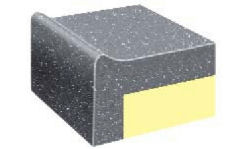
You could have a worktop with a waterfall front edge.
-
Pressure Test Length / Pressure Dropping
Mr Punter replied to jamesmonk83's topic in Underfloor Heating
Pump it back up to 6 bar in the morning, then check again in the evening. If it still falls, check your test equipment is not leaking. -
Anchor bolt thickness and spacing
Mr Punter replied to Vijay's topic in Insulated Concrete Formwork (ICF)
Looking at the pic they could have been 600 ctrs? Was a while ago now. It looks like 1 for every 2 plastic ICF ties. Not for roof plate as we only did ICF for the basement and went timber frame above.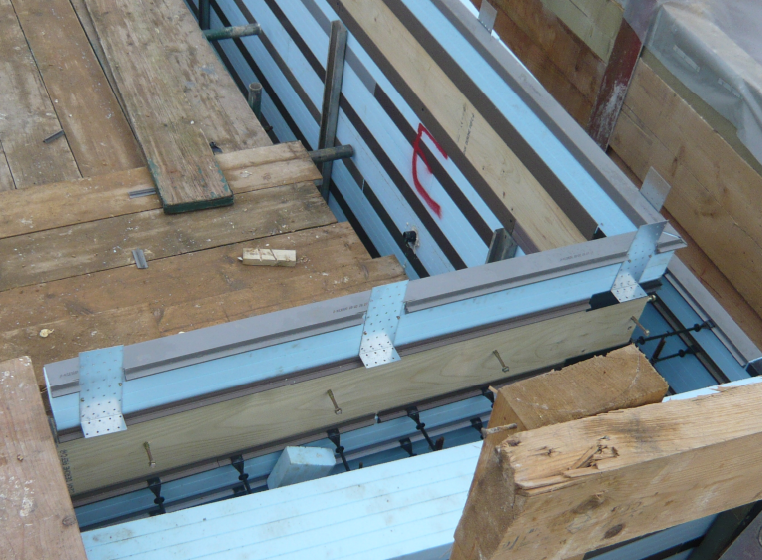
-
Is there a Rule of Thumb for estimating the ....
Mr Punter replied to ToughButterCup's topic in Electrics - Other
What is this used for? A long time ago it was 2.5 for power and 1.0 for lights. Now it seems to be 1.5 for lights. -
Anchor bolt thickness and spacing
Mr Punter replied to Vijay's topic in Insulated Concrete Formwork (ICF)
Using Polarwall I replaced the inside XPS with 10 x 2 timber with coach screws at 400 ctrs facing the core. Screwed them in about 40mm deep with an impact driver so there was 60mm cast in the concrete core. We later used face fix joist hangers. I think we went with 10mm coach screws. https://www.screwfix.com/p/turbocoach-coach-screws-yellow-zinc-plated-10-x-100mm-50-pack/89717

