


Mr Punter
-
Posts
8581 -
Joined
-
Last visited
-
Days Won
27
Everything posted by Mr Punter
-
Leaking stop tap: why does it always happen to me?
Mr Punter replied to ToughButterCup's topic in General Plumbing
Where we are they fit water meters externally at the property boundary, so it is easy to isolate there with the stop valve next to the meter. -
Hi @SeanBirt and welcome Why not get a timber frame company to price this for you? If they do the work they will also supply all the required structural drawings and calcs for building control and advise on the most suitable blocks / bricks for the base courses. I often see 140mm blocks for 140mm cls walls. They may be able to supply the kit cheaper than you can buy the materials and make it yourself and it will all be done to correct spec.
-
You can run pipes and wires under and behind kitchen units. For the island these will need to run under the floor then come up. You could create a channel in the floor or you could create a small tunnel for the pipes to sit in with 30mm insulation above and 30mm supporting either side. You really need to minimise what goes under the floor and keep any joins and fittings to as few as possible. 60mm is fairly poor for insulation and UFH. Why not have more insulation and lose the screed and have an overboard system? You can still have a tiled finish.
-
Nope. You can sell off plots in your garden without tax. If you decided to build them you would probably be liable. https://www.thisismoney.co.uk/money/experts/article-3420863/We-thinking-building-house-garden-pay-CGT-sold-it.html
-
No. As long as the plots were part of the garden and sold off before the house, no tax payable.
-
If you post the figures or PM me I and others can have a look. As a novice you may well have overlooked things. Which will pale into insignificance compared to the construction and resales. I think you would maximise your position with minimum risk if you were to sell the plots with the proviso that the work is completed within a fixed time. You could use some of the cash to make any required improvements to your house to ready it for sale. You could then sell your own house after the new houses are completed. No tax payable on anything and no risk.
-
As a minimum, get a valuation of the site as is, the GDV and a build cost estimate and put these on a spreadsheet. Depending on where you are located, try build costs of between £1,500 and £2,000 and see how this impacts on profit / loss. Don't forget to factor in plenty for professional fees and contingency. Your main risks if you go ahead are Health and Safety / CDM, poor budgeting, escalating build costs, unexpected / unknown fees, contract management, quality management, achieving GDV estimates and achieving timely sales. As you are a novice you may do better to sell the land, taking the uplift in value from your PP, or otherwise risk losing your shirt and your sanity.
-
Would you suggest poly beads or fluff?
-
Part M does not apply as this is an extension. They can only kick off if you make it worse.
-
I have had similar with wide plank concrete where 400m2 was too small for them. I guess it depends how busy they are. I saw on their video they were using a hiab to install them. They look lightweight compared to the hollowcore.
-
No minimum. It is normally the long radius bend at the base of the stack and your floor makeup that will decide.
-
I think he meant 12.5mm
-
Is the best/only design resource needed Approved document H. Most of the pipe manufacturers have design guides. The vertical distance below the FFL of the house that the foul drain can start moving to the side from the stack location (ADH has this at 1.3m in some situations). No comprende The minimum internal diameter of the pipe (75mm?) required. 110mm O/D plastic pipe is standard The minimum fall of pipe (ADH seems to have this at 1:80 / 12.5cm every 1m) required. Yes. 1:60 even better minimum depth of pipe under ground level (ADH seems to 150mm from the crown of the pipe) As long as it is protected and pedestrian only area Man hole covers at every junction point Preferred but not always essential rodding access points? Not always needed if you have inspection chambers
-
The wide plank concrete should be supply and fit. They will spec the crane and sort the RAMS, lift plan, appointed person, banksman, slinger signaller etc.
-
Beware of mortar on wall ties and in the cavity at the bottom. Joint the wall properly. We have done these in rendered medium density block. Passed without issue.
-
Relative costs of roof works/new storey
Mr Punter replied to Angel's topic in Lofts, Dormers & Loft Conversions
Perhaps if you let us know your budget someone may be able to let you know which option is within reach. Are you doing any work yourself? You can then get some quotes. -
What reasons did they give for turning down the dry riser and enhanced smoke detectors @Patrick? The water pump is a no-no. They like sprinklers because they are automatic, effective and cover the whole house. Apparently nobody has (in this country?) died in a house fire where a domestic sprinkler system was correctly installed. Have you got any quotes?
-
Relative costs of roof works/new storey
Mr Punter replied to Angel's topic in Lofts, Dormers & Loft Conversions
A couple of quick points: If you demolish and rebuild you can get a brand new 2 storey house configured exactly as you would like. You could reuse the foundations and retain the garage. You will be able to reclaim the VAT. There is likely to be asbestos in the building so I suggest having a comprehensive survey carried out for this. -
Thats the last time I ...
Mr Punter replied to ToughButterCup's topic in General Self Build & DIY Discussion
Try removing batteries, washing in lots of clean water, thorough drying, then restart. Probably will not help but at least you tried to resuscitate the patient. Sugary coffee is worst. -
I think this is a Velfac or IdealCombi composite window. Ideally you would have the glazing near the insulation layer but I don't think that will work with the brickwork. Just make sure you foam between the frame and the timber cavity barrier. You should also tape between the window frame and your vapour barrier to stop air leakage. The window manufs may have a detail / spec for this.
-
Basement retaining wall and interaction with existing house foundations
Mr Punter replied to Moonshine's topic in Foundations
If you are not experienced it is high risk to design your own temporary works. You will need some working room around the basement retaining wall. I have used open augered concrete piles with a bit or rebar in this situation before and king pile steel with sleepers for the less crucial bits.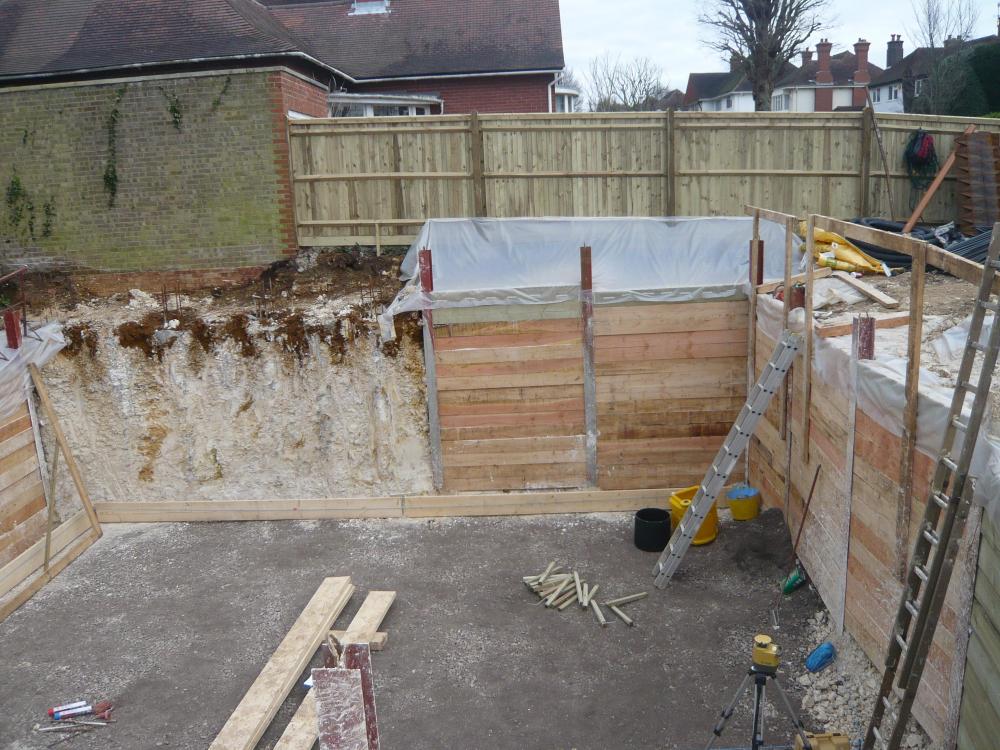
-
Which is why I said
-
The additional volume does not cause any heat to be wasted (although the insulation over the larger sloped surface area would need to be improved to compensate). The insulated space is ideal for siting MVHR and ducting.
-
I really dislike meter boxes on the front of houses. They are really ugly, especially in a terrace. Also, the doors often fail and the boxes tend to break and discolour. Surely they can be improved?
-
It seems that the definitions vary but I believe the following are widely accepted: With flat roofing, cold roof is insulation between rafters, ventilation gap, decking and waterproofing. Warm roof is insulation above rafters. Some have decking above but strictly the waterproofing should be straight onto the insulation. With pitched roofing, cold roof has insulation at ceiling level with the loft ventilated, warm roof is insulation between the rafters (perhaps above / below as well), (sarking) membrane, vented gap and roof covering. I never hear anyone refer to 'cold loft' construction even though it is more technically correct.


