


Jeremy Harris
-
Posts
26430 -
Joined
-
Last visited
-
Days Won
360
Everything posted by Jeremy Harris
-

So how accurate are quotes and estimates then?
Jeremy Harris replied to Roz's topic in Costing & Estimating
Yes. A fixed price isn't "fixed", if there are cost changes outside the contractors control then the price can change to reflect those changes. The most common example is when exchange rates vary, changing the cost of imported materials. A firm price contract is "fixed", in that the price cannot change without mutual agreement by both parties to the contract. In most cases what people really mean when they say "fixed price" is firm price, and I bet that difference in contract definition has caught out a lot of people over the years. -
I agree, but the spec and manual stipulate that it shouldn't be used with a PV installation that's over 2.5 kWp. I've no idea why, as if these units are fitted with lower power electric heating elements (which I think they are), then it shouldn't matter at all how large the PV array is. TBH, I'm inclined to think it may well be a cock-up or misunderstanding by Sunamp, as I can't understand the logic behind it. Yes, ours is an SBC_01_PV, and I have a time switch in series with a 20 A boost on/off switch that bypasses the excess PV generation diverter, so that I can switch in a timed 2 hour early morning boost if the Sunamp will accept a charge. The logic is this: If Sunamp is fully charged from PV during the day, then the contactor will be open, so the timed boost has no effect. If Sunamp isn't fully charged from PV during the day, then the contactor will be closed, so the timed boost charges the Sunamp at a ~3kW for up to 2 hours (enough for two morning showers, with ~50% extra, just to be sure). I'll have a closer look and see if the SBC_01_PV control box we have (not sure what the _PV suffix indicates) can be set up as an HW+i, and whether or not that significantly changes the charge acceptance threshold. The specification seems a bit vague on this, as whilst the text for the SBC_02 indicates that it can be set to "Option 2 on: electrical input is from solar PV diverter. High current relay will be activated to allow input whenever possible." the temperature control set points in Table 3 don't seem to indicate much, if any, real difference. Also, the text for the SBC_02 still mentions that the charge acceptance points that can be selected are either 90% discharged or 50% discharged, the same as for the SBC_01. I'd be interested to understand what the difference is between the SBC_01 and the SBC_01_PV is, too, as our box is clearly labelled as an SBC_01_PV for some reason.
-
Unfortunately the SBC_02 control box is physically different to the SBC_01 control box internally, from what I've seen. The SBC_02 is only capable of switching a low powered electric heating element, I believe, as the Sunamp that it is designed to operate cannot be used with a PV array of greater than 2.5 kWp, according to the manual. I seem to remember reading somewhere that the heating element in these units is 1.5 kW, rather than the 3 kW that's in ours, but I could be mistaken.
-
It's more than odd, because whilst up at the NSBRC at Swindon on Friday I was talking to someone who has an older prototype, or pre-production, control box on their Uniq and that has far more functionality, and doesn't have any of the daft "wait until ~50% discharged before accepting any charge" nonsense. He was telling me that his controller enables charging as soon as there is any spare capacity to accept any charge, which is exactly how the old Sunamp PV used to work. In many ways, the Sunamp PV charging system was superior, as it would always try to maintain the heat battery at ~65 deg C if there was any power available to do so. This was pretty much ideal in terms of being able to utilise any available excess PV generation, and also made sure that the unit was always charged up to the maximum possible whenever it needed to be.
-
FWIW, I've changed our heating so that it only comes on during the E7 period, between 11:30 and 06:30 at the moment. This seems to work fine for us, as it just charges up the concrete slab using off-peak electricity (not a great saving as the ASHP rarely draws more than about 800 W) and the slab seems to still be plenty warm enough to keep the house warm in the evening. The room stat will almost certainly not start to call for heat until the early hours, I suspect, as I've yet to see it calling for heat by the time I've gone to bed, and I would guess that the house doesn't cool down enough for the stat to switch the UFH on until maybe a couple of hours or so before dawn.
-
Here's the latest manual I have (may be out of date now, but I'm not aware of a newer version): UniQ manual 180719.pdf
-
No, it's definitely around 50%, for sure, as I've tested this many times now. Our usage pattern means that we draw around 3 kWh to 4 kWh from the Sunamp very soon after the early morning boost, when it is fully charged. I then expect it to be ready to accept charge from excess PV generation during the day, but 9 times out of 10 it won't be, as it doesn't think it's discharged to 50% (and to be fair, it almost certainly isn't). If I power the controller off and then on again immediately after the last morning shower it always, without fail, switches on and starts to accept charge from the PV when it becomes available. If I don't switch the power off and then on again the Sunamp will go the whole day without using any of our PV generated energy at all, which rather defeats the main reason I have the thing. What's worse, is that if I don't do this reset procedure, then there is a good chance that the Sunamp controller still won't enable any charge for the next early morning boost period. We've run out of hot water because of this, because although it may start to deliver hot water for the first shower the next morning, if that's longer than normal then the second shower will run cold (we've had this happen). Resetting the controller by turning the power off and then on again always works, and for as long as I remember to do this every morning the Sunamp works extremely well indeed. Today is a good example. At around 07:30 I did the reset procedure and by around 11:30 this morning the Sunamp was fully charged from excess PV generation (my car is currently charging at around 3.5 kW from excess PV right now, too - it's a nice, cold, clear day here). Had I not reset the Sunamp this morning then it would be sat there doing sod all, and we'd either have had to pay to charge up from the grid in the early hours tomorrow or we may well have ended up with a cold second shower tomorrow.
- 186 replies
-
- 1
-

-
- sunamp
- energy efficiency
- (and 1 more)
-
FWIW, we were using these to tie cable looms in the mid-1970's, so I've no idea why they've never really caught on.
-
I bet that's a mouse, rather than a bird. For some odd reason mice seem to like chewing certain types of plastic and rubber, for example they just seem to love chewing black neoprene pipe insulation. Be interesting to see how the heck a mouse has got up there, though, although I'm convinced the little buggers can climb up rough surfaced walls, as I've never been able to understand how they used to get into the loft of our old house without climbing up a brick wall and getting in under the eaves.
-
Anyone used online 3D printing services
Jeremy Harris replied to Gone West's topic in Tools & Equipment
Seems to be on flash sale at Gearbest right now: https://www.gearbest.com/3d-printers-3d-printer-kits/pp_337314.html as long as you're prepared to change the plug (the UK plug version is a lot more expensive for some bizarre reason). -
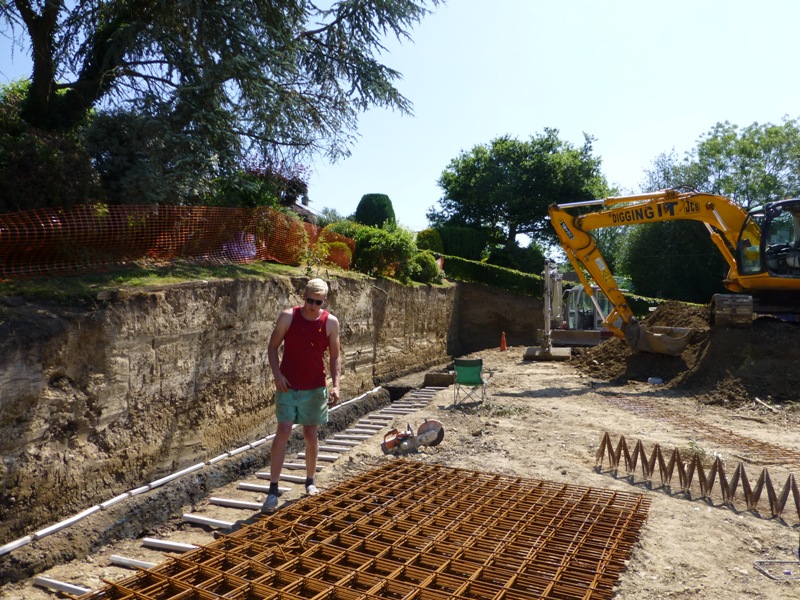
Yes, that 45 degree down from the outer edge of the foundations is a worst case critical angle of repose for soil (bearing in mind that the critical angle of repose is measured upwards from the lowest horizontal point, i.e. the base of the trench). The critical angle of repose for soil ranges between 30 deg and 45 deg, so as a downward angle from the foundation, measured relative to surface level, the angle translates as between 45 deg and 60 deg for normal soil. For something like compacted clay the angle is much steeper, and can be near vertical, as seen below in the up to 2.5m deep excavation we did in order to level our plot.
-
Looking for a part time Project Manager
Jeremy Harris replied to Wrekin1's topic in Project & Site Management
I found that one or two of the frame suppliers we approached were able to recommend a project manager, although in the end I opted not to go down that route. I also met up with one project manager, who I'd have found easy to work with, just by doing a web search for project managers within reasonable travelling distance. That chap had set up a small business specialising in project managing small building projects, and IIRC there were three of them working out of a small home office. -
With respect to the UK resellers, I'd suggest that they aren't aware of the essential requirement to provide ventilation under all PV panels and I'd question how much real world experience they have with installing in-roof PV systems. It doesn't matter whether the underlying roof is warm or cold, as the heat comes from the sun shining on the panels. They can easily reach temperatures of 50 deg C plus in bright sun, and that heat needs to be got rid of, and the way all PV panels are designed is for over-heating to be alleviated by free air ventilation under the panels. That's why both Easyroof and GSE show the same fixing method for the in-roof frames, with spaces above the sarking provided by counterbattens to allow the essential ventilation. The eaves and ridge ridge also need to be ventilated to allow air to flow up the roof behind the panels. The main problem is that the panels will have a much reduced output if they run hot, plus the reliability may be impacted, too. Anything you can do to aid the cooling of the panels will improve both performance and reliability.
-
How are you providing the essential ventilation under the panels? The panels need cooling, from air flow underneath them, hence the need to raise them on battens fitted to counterbattens, as shown in that screen shot (which is exactly as ours are fitted). We also have sarking, but that's overlaid with counterbattens that run along the line of each rafter, then battens to which the frames and slates are fixed.
-
A pump chamber system can work OK, but they cost a fair bit to both buy and install, and you need space to locate the tank. The tank has to be sized for the size of house, to allow the foul drains to work for a day or two when the pump fails, to give time for a replacement to be fitted. It also normally needs an alarm system, so you know if the pump has failed. We lived in a house with a pumped system and it was OK, but we did inherit a new spare pump with the house (which we didn't need to use, so passed it one when we sold the house). I lifted the lid on the pump chamber to see how hard it was to change the pump and it looked easy enough. Not sure it's a job I'd want to do in mid-winter, though. Personally I'd do all you can to avoid having to have a pumped system if you can, as they are, in my view, a last resort solution.
-
Our passive slab also needed the rest bend to be in the sub-base, just like @PeterStarck, with vertical pipes coming up through the insulation. There's no easy way to fit a rest bend into the insulation layer I'd have thought, plus ideally you want to pressure test the pipe run (which BC will sometimes ask to witness) before you have it fitted into the slab.
-
IIRC, Part H was amended about 10 years ago or so to remove the old maximum gradient recommendation, although there is still a lot of erroneous information around on the web, describing how to create a backdrop etc as if this was still a building regs requirement whenever there is a steep gradient.
-
Yes, we have the GSE system. No need to drill any holes anywhere for cables, they run into the big hole in the centre and then out under the battens at either side.
-
Yes it is, and my experience is that only acetone or MEK will dissolve uncured PU foam. MEK is slightly kinder to skin than acetone (although there's not much in it), and both are available online for around £20 for a 5 litre container. I've yet to find a readily available solvent that will touch cured PU foam though, so it's important to clean up before the stuff cures.
-
Things going bump in the night!
Jeremy Harris replied to Redoctober's topic in General Self Build & DIY Discussion
Our house (timber framed) makes noises from time to time. Sometimes we get quiet bumps, sometimes (when the sun comes out) we get fairly loud bangs from the uPVC guttering expanding (which also made it "walk" sideways, until I fitted some stainless screws to stop it). The noises are more noticeable because the house is so quiet, being well sealed and insulated. I'm sure our old house made some noises, too, but we rarely noticed them as the background noise level was a lot higher. -
Anyone used online 3D printing services
Jeremy Harris replied to Gone West's topic in Tools & Equipment
Really interested to hear how you get on with it, as I've been toying with the idea of getting something similar for a fair time now, as there seem to be lots of potential projects that would be made simpler with a 3D printed part. -
Will I need a compound mitre saw for a diyMax build?
Jeremy Harris replied to epsilonGreedy's topic in Tools & Equipment
I treated Titan stuff as disposable at first, but have changed my mind having bought a cheap drill that seems damned near unbreakable. It's been thoroughly abused, but refuses to give up. No idea how Titan compares to Evolution, other than I suspect both are really no-name Chinese stuff that gets badged with these names by UK sellers. Might even be that both come out of the same factories in China! -
Comfort cooling MVHR
Jeremy Harris replied to AliG's topic in Mechanical Ventilation with Heat Recovery (MVHR)
Some of the ducts are visible in the services room, so if there was any problem it would show there, as they will be cooler there (as that's where the manifold/plenums are located) than they would be anywhere else in the house. -
Comfort cooling MVHR
Jeremy Harris replied to AliG's topic in Mechanical Ventilation with Heat Recovery (MVHR)
Good point, the incoming ducts from outside definitely need insulation, as both can get pretty cold. In our case, if we ever use the heating function in the MVHR the exhaust air can easily be well below zero; I've seen it down to about -5 deg C at times. -
Comfort cooling MVHR
Jeremy Harris replied to AliG's topic in Mechanical Ventilation with Heat Recovery (MVHR)
Both the duct cooler and the MVHR produce a fair bit of condensation and both have drain trays and condensate drains. The MVHR generates a lot of condensation when in cooling mode, enough for there to be a constant trickle of water down the drain, as the cooled surface inside the unit seems to operate at a pretty low temperature; it's not unusual to see it operating at around 3 or 4 deg C at times. Condensation inside the ducting after any cooler isn't really possible, as the ducts will always be warmer than the cooling surface, and the air will have given up a lot of its water vapour as it passes through the cooler. The air on the house supply side of the cooler will be pretty dry, so it's very unlikely that any of the ducts will ever get below the local dew point for the air they are carrying. There is a risk that the outside of the ducts that are carrying cool, dry, air may attract condensation, but in practice I've found that the twin wall semi-rigid ducting seems to be well enough insulated for this not to be a problem. All our fresh air supply ducts are also well away from any areas in the house that might have higher levels of water vapour, like the kitchen and bathrooms, which probably helps. All our fresh air supply ducts also run in the first floor void, which is filled with rockwool acoustic insulation, which may or may not help.
