Jeremy Harris
-
Posts
26430 -
Joined
-
Last visited
-
Days Won
360
Everything posted by Jeremy Harris
-
With mine I just press the button on the remote (or via the Connected Drive app) up to 30 minutes before I want to drive off and it turns on whatever heating/cooling is needed so that all the windows, mirrors etc are clear and the interior as at whatever temperature I've set it to, by the time I get in. The Prius had a similar feature on the remote, but only for pre-cooling, which wasn't something I often used. The BMW preconditioning feature seems a lot more useful, so much so that I find I use it all the time. If the car happens to be plugged in to the charger at the time it draws all the power needed to pre-condition the car from that, which makes a noticeable difference to battery range.
-

ASHP- struggling to warm house in the cold weather
Jeremy Harris replied to Jude1234's topic in Air Source Heat Pumps (ASHP)
Just to second what @PeterW has said, run the ASHP for as long as you can, ideally on E7. Last night was the coldest we've seen in a long time, and our ASHP ticked over all night on E7 at around 800 W consumption, and turned off around 06:00 this morning. Our slab is currently at 23 deg C, with the rooms around 22 deg C. Flow temperature into the UFH was around 26 deg C, return temperature around 21 to 22 deg C. Our ASHP is rated at 7 kW output, but it never runs that high. I doubt we ever run it at more than around 3 kW output. I'm going to hazard a guess that we will get a bit of solar gain today, as the sky is very clear this morning, so in all probability we won't need any more heating until the E7 period this evening. Our ASHP used about 5.5 kWh last night, and probably delivered around 15 kWh of heat to the house, which is a lot for us. I can't complain about the running cost though, as even in this cold weather the electricity consumption of everything else in the house is significantly greater than that consumed by the heating. At E7 rates I would guess that our heating cost for this 24 hour period will be around £0.50 at the most, which seems pretty reasonable. We have frost on the outside of all the windows this morning, too, first time this year. We've had condensation on the outside of the windows a fair bit, but it's not frozen before now. Shows how good the glazing is, though, as the inner pane of glass is around 18 deg C, with the outer pane below zero. -
When I looked into fitting a system self-install was not an option. There was no reason why a competent person couldn't install a sprinkler system, other than the fact that to get accepted either as part of a mandatory requirement, or by an insurer, meant having to have the system certified. I couldn't find any way around this. There was also the problem that, when I was looking, none of the suppliers would just sell the kit, they all wanted to undertake the installation as well. Mist systems seemed to me to be a lot better than conventional sprinklers, primarily because they seem just as effective and cause a lot less water damage. I believe that water damage from a faulty installation causing inadvertent operation may be one reason insurers want these things to be certified.
-
Still a bit warmer here, -2.6 deg C outside at the moment and Boscombe Down is reporting -4.7 deg C, Southampton -7.0 deg C, Middle Wallop (where my wife is currently driving to) is -5.0 deg C.
-
Our bathrooms are areas where I didn't fit motion sensors, as we don't want the ensuite bathroom lights to come on in the middle of the night.
-
Comfort cooling MVHR
Jeremy Harris replied to AliG's topic in Mechanical Ventilation with Heat Recovery (MVHR)
All I can say is that we are very happy with our Genvex Premium 1L MVHR, with it's built-in comfort cooling and heating. It does exactly what it says in the spec, and happily pumps cool air (at around 8 to 10 deg C) out of all the fresh air feed terminals when it's in cooling mode. As for electricity consumption, then at full power in cooling mode it draws between 400 and 500 watts. As cooling is only required when the sun is shining the running costs for us, with loads of PV on the roof are zero. However, if we didn't have PV then the Genvex would cost around £0.08 per hour to run, so not exactly expensive. I can only imagine that you were sold something defective, that failed to do what it was supposed to. That doesn't mean that all products of this type are as equally flawed, though. -
Comfort cooling MVHR
Jeremy Harris replied to AliG's topic in Mechanical Ventilation with Heat Recovery (MVHR)
Ground Source Heat Pumps tend to be expensive, and will rarely recover the higher installation cost over their lifetime in terms of running cost savings, IMHO. We did look at installing one initially, but soon changed our minds when we looked at the prices. An ASHP will cost more to install than a gas boiler, I suspect, but does give the option of being able to both heat and cool the UFH, which we've found an advantage. if you have a sufficiently well insulated and air tight house, then you can cool it OK with an active MVHR, like the Genvex unit we have, which can both heat and cool the house using its internal air-to-air heat pump. This only provides a limited amount of cooling though, not enough to overcome a lot of solar gain. If you have mains gas, then I think the most cost effective option might be to stick with a gas boiler for the heating and hot water and just install a stand alone air-to-air heat pump. These are pretty cheap and can provide a higher cooling capability than cooling built in to an MVHR. -
It's a thermal detail that isn't often picked up properly, AFAICS, but it is important. Window and door frames are the most thermally conductive parts of a window, so to minimise heat loss through them, and perhaps more importantly reduce the condensation risk, the minimum amount of frame needs to be exposed on the cold side. If there is insulation all around the edges of the frame, so that only the outer face that's visible is exposed to the colder environment outside, then that improves things a lot. If the frame projects out with no insulation around it, then the area of frame exposed to the cold side is greater (the outer face plus the area of the edge that projects outside the house insulation). When our windows were fitted I made sure they were set into the insulation layer, so the frames don't project out at all, as I was OK with having relatively deep reveals in order to get much better thermal performance from the doors and windows. If you choose to accept a deeper external reveal, then you need to close the cavity around the aperture with a firestop plus a batten to support render board, for a rendered finish. For a brick finish then the brickwork can be returned in to provide both the firestop and close the cavity externally An alternative, if you want the windows and doors to project out, with shallower reveals outside, is to fit them rather like an insulated Velux, with peripheral insulation so that the heat loss from the projecting edges of the frame is reduced. To do this probably means using fixing straps to secure the windows to the frame, then adding a suitable thickness of decent insulation all around the frame, within the cavity.
- 12 replies
-
- 1
-

-
- timber frame
- timber kit
- (and 2 more)
-
If you want good thermal performance, then to minimise thermal bridging around the window frame it's essential that the frame be set into the insulation layer, and not project out into the cold area outside the insulation. Apart from the increased heat loss through what is already a thermally weak area, the window frame, there is also a condensation risk associated with having a cold window frame. If you do need to space windows out, then adding insulation around the edge of the frame, within the cavity, can mitigate thermal bridging a bit.
- 12 replies
-
- 1
-

-
- timber frame
- timber kit
- (and 2 more)
-
I doubt you could do it with just PV, TBH, as there will be periods in winter when you get several days in a row with virtually no generation, and even when you do get some generation in winter it's unlikely to be enough to top up any battery system so that you can ride out the poor generation days. Combining some wind generation might get you there, but in middle England I think even then you'd struggle, and would end up relying on a generator for a few weeks in the year. One person with lots of off-grid experience is Paul Camilli, up on Raasay. He has a lot of PV, wind generation and some background hydro generation yet still reckons a reliable generator is a must have. His blog is worth a read: https://lifeattheendoftheroad.wordpress.com/
-
So far none of our motion sensor lights have wall switches, and for the majority of them that's fine.
-
It's a very good point, as we have quite a few motion sensors to turn lights on and off, and we learned a couple of lessons along the way. I found that PIR motion sensors are fine in rooms like the downstairs WC, our walk-in wardrobe, several cupboards and one of the hall lights, but I had a lot of problems with false triggering on the sensor in the utility room (which has the back door leading directly into it). That sensor was positioned to come on if we either entered the utility room via the backdoor or from the door into the kitchen, and it tended to be triggered by something it could "see" through the back door glazing, I think. I ended up replacing that unit with a microwave Doppler sensor, which is fine, but needed a bit more setting up (they can sense motion through walls and doors, so the sensitivity adjustment is more critical). The only light where I sometimes wish I'd also used a wall switch is the one in the hall. We have three other lights in there that are manually switched only, and sometimes it would be useful to be able to manually switch the fourth light, which is only on a PIR sensor. It's not a major issue, though, and if I was that bothered by it then fitting a Quinetic remote switch would be easy as a retrofit. On a positive note, we now wonder why on earth we used to live in a house where the lights didn't come on and go off automatically. The lights in the utility room and downstairs WC are perfect on motion sensing alone, especially the utility room, as often we enter that room carrying stuff, either bags of shopping when coming in the back door, or washing baskets etc when coming in from the kitchen.
-
Exactly right, on both counts. We used the money from the sale of the old house to clear the mortgage and we initially had an offset mortgage attached to a savings account, so the interest we paid was just the difference between the mortgage balance and the savings account balance. This significantly reduced the mortgage payments during the early stages, before we spent all the money.
-
Looking at the loads, unless the ASHP is pretty big, then it won't be a big load on the supply. Our 7 kW ASHP usually runs with an input power of around 0.8 kW, and the most I've ever seen it draw is about 2 kW. The oven and hob are bigger loads. Electric car charging is a good case for having three phase, if it's available and affordable. Taking my car as an example, the maximum charge rate it will accept on single phase is 7 kW, the maximum on three phase (really two phase, as the on-board car charger is only two phase) is 11 kW. Many of the newer generation of electric cars can charge at 22 kW from a three phase supply. Unlike other loads in the house, electric car charge points cannot have diversity applied to them, as they can run for many hours at maximum current, and this places a hefty demand on the supply. Putting those charge powers into context, 7 kW charging equates to charging at about 28 miles per hour, 22 kW charging equates to about 88 miles per hour (in terms of range gained per hour of charge time). A large PV array is another case where it may be useful to have three phase, for the reasons given above by @Ed Davies. You can connect three 16 A maximum (nominally 3.68 kWp) PV systems to a three phase supply without needing G59/3-1 consent from the DNO. Our DNO was OK with giving me consent for up to 12 kWp on a single phase, but that's very much the exception, I think, and is only because we have a 95mm² supply cable running right under our meter cabinet. With three phase then the usual arrangement is to split the phases so that different circuits are on different phases, trying to maintain roughly equal loading on each. This is the normal way many houses on the continent are wired, where three phase incomers seem more common and split phase distribution boards seem normal.
-
Managing build myself, all advice welcome
Jeremy Harris replied to Wagas's topic in Project & Site Management
I agree, as apart from anything else, word will get around that you're asking for loads of quotes and the chances are you may not end up being taken seriously. I found that ground works companies (might apply to others, too) in my local area tended to use the same two or three QS services, for example. The process I used was to approach a few companies to see if they were interested (many weren't) and also to get a feel for their approach. I then went on to go to tender to three, maybe four, companies that I felt would both be interested and that seemed OK from my initial assessment. The biggest problem towards the end of our build became the availability of good contractors. I often found that I had to book a slot for work maybe 3 to 4 months in advance. -
We mortgaged our old house solely to help pay the cost of building the new one. It wasn't a problem for the lender at all, and was a lot more flexible than a self-build mortgage, in that we got all the money upfront. The interest rate was also lower than for a self-build mortgage.
-
Just been buzzed by a mosquito.
Jeremy Harris replied to epsilonGreedy's topic in General Self Build & DIY Discussion
Just scanned an old photo I have of Aquila Maris leaving Portpatrick Harbour. Still trying to find photos of the Portpatrick Princess, I know I have a couple somewhere. I found a few of the Devons, the Buccaneer and the Jetstream, and even one of the Andover we used for a few months, but can't find the box that has the other photos, I think it must have been put away somewhere safe when we moved. For those interested, Aquila Maris II was a Fairey Marine Tracker, formerly a gun boat destined for the Middle East (hence the tinted glass) and was powered by a pair of twin turbocharged V12 Detroit diesels. She'd do about 35kts flat out, and was fast enough to water ski behind... Back on an aviation theme, here's an old photo from my flying-for-a-living days, taken at the end of the very last trials Canberra sortie, before WT309 was scrapped (the forward fuselage section is in a museum at Old Sarum, though):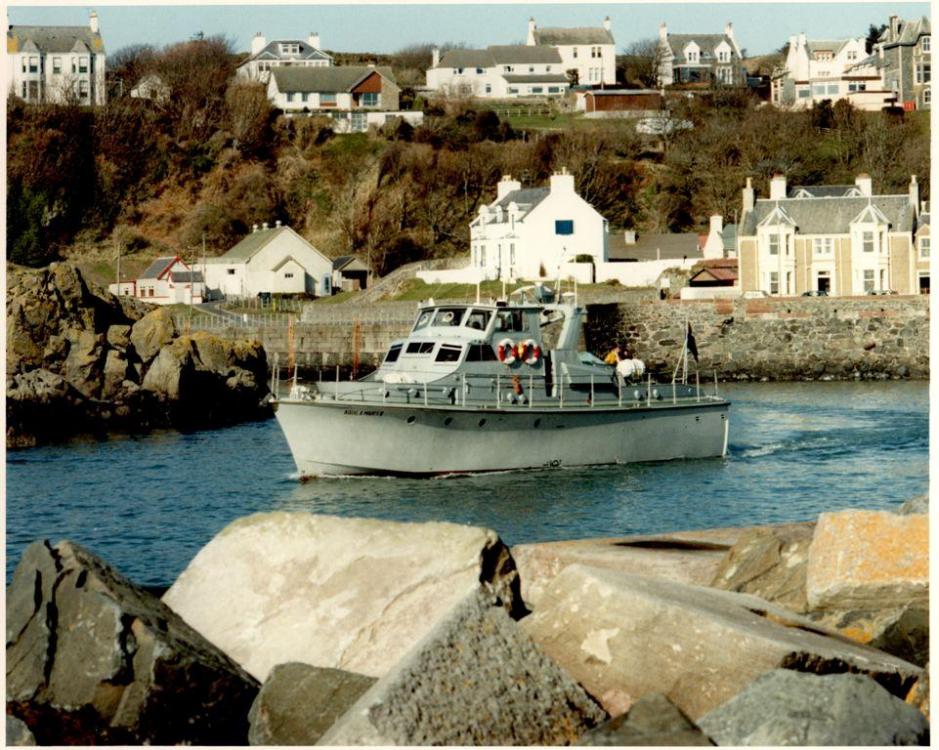

-
It's an indisputable fact that concrete structures can and do fail, and that many houses, commercial buildings and concrete bridges have had to be repaired or even replaced because of this. That's not scaremongering at all, it's just stating a plain fact. I wish I had taken photos of the Cornish Unit PRC house that I lived in around 40 years ago, as they would illustrate the point well (just do a web search, you will find mention of Cornish Unit concrete failures I'm sure, as they were pretty common). There's no difference in the inspection standards for structural timber between construction grading inspection and test and aircraft grading inspection and test. Both use the same techniques. Construction graded and aircraft graded timber will be assessed on the basis of species, density (often inferred from ring count), freedom from knots and shakes and strength. My local sawmill can supply really excellent timber, often locally grown, and every bit of timber I've bought from them has been first rate. Timber from reliable sources like this can't be compared to some of the poor quality stuff that is sold by the DIY sheds, it's like comparing chalk and cheese. The same goes for concrete. Get a good supplier, do the pour with experienced and competent people, at a time when the weather is within curing limits, and the result is likely to be very good. However, if any of those criteria are lacking, then there is a chance that the concrete may prematurely fail.
-
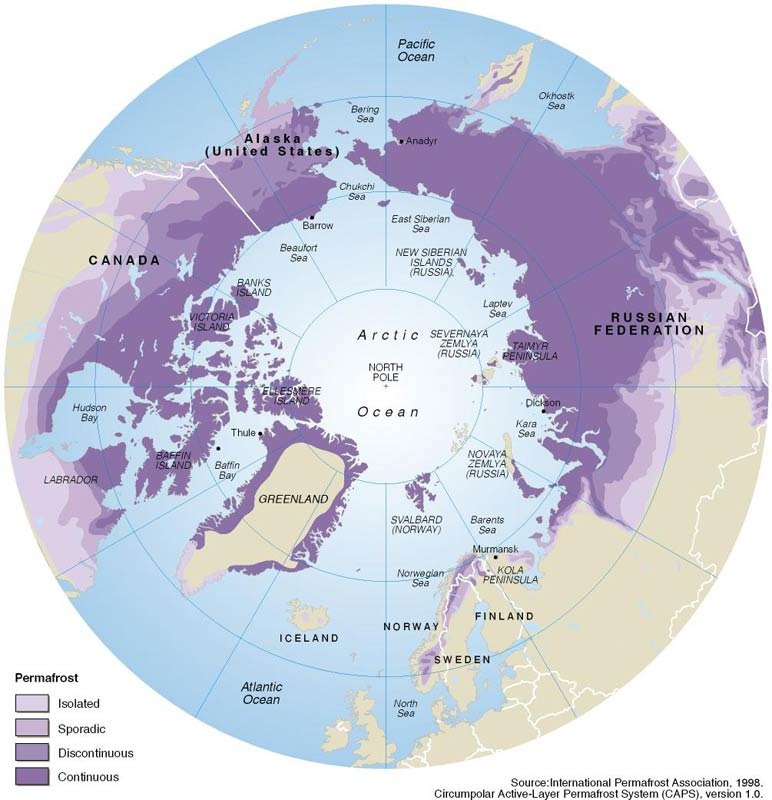
I can tell you. Less than one half of one percent. The majority of the populated areas in Sweden are hundreds of miles away from the high northern permafrost zone.
-
The problem is that I can't find any solid evidence to support the statement that you "can get good concrete - very easy". We have no way of knowing whether the concrete we are buying today is any better than the concrete that has been used to build structures that have been failing over the past few decades. We certainly know more about things like the placement of fabric within reinforced concrete, and more about the need to ensure voids are reduced by vibrating the mix, but the durability of concrete is still highly dependent on the mix being right, the climatic conditions at the time of the pour being within limits and most importantly, the skill of the people doing the pour. Get any of those wrong and there's a chance of premature failure. Also, you definitely can get good wood, there are well-established standards for structural timber. I owned a wooden aeroplane for a few years, that was built in the mid-1990s. That was made from very good timber, timber that, like structural construction timber, had been carefully graded and inspected. The fact that the DIY sheds and some builders merchants tend to sell a lot of really rubbish timber doesn't indicate that all modern timber is rubbish.
-
Look at that map, @scottishjohn, and tell me what percentage of the population of Sweden live inside the permafrost area.
-
You're not actually bothering to read what I write, are you? Did you not note that I wrote (I've added emphasis in the quote to make it more obvious): There is good and bad in all types of construction, no matter what the material. Having experienced living in a concrete house that used to spall off lumps of the stuff whenever the weather got cold, and which was eventually condemned as being structurally unsound (along with several hundred other similar houses on the same estate), I know first hand that poor concrete construction is just as real as poor timber construction. If timber is kept dry then it lasts a very long time indeed, but sadly there have been far too many instances in the last few decades where construction companies have failed to recognise this.
-
You may have missed this sentence from my post: Does that read to you as if I'm doing as you say and advocating that a passive slab is the "only way for all solutions"? I mentioned Germany because it is in Germany that the concept of the passive house first gained prominence, and that is where the Passivhaus Institut is based. As for your observations on permafrost, I suggest you have a look at this: As you can see, you are completely wrong about permafrost existing in any of the major populated areas of Europe, it is confined the the high, northern areas of Norway, Finland and Sweden, not the areas where the majority of the population of northern Scandinavia live at all.

-
Having seen many wooden churches in southern Poland that were around 400 to 500 years old, as well as all the timber framed houses we have here in the UK that are around the same age, plus having lived in a concrete house that was built in the 1950's here (that ended up being demolished because of structural failure), I'm not convinced by that argument. Certainly very good concrete can last for hundreds of years, but we have lots of examples here, from houses through commercial buildings to things like motorway bridges that show that concrete can and does fail after just a few decades. We've also had examples of timber framed houses that have failed prematurely, notably the Barratt Homes fiasco in the 1970's, where they built houses with no understanding of the need to control interstitial condensation, and which rotted out inside a decade. A good timber building can easily last hundreds of years, there are many examples that prove this. Equally a good concrete building can last a very long time, but we have very few examples in the UK of long-lasting concrete houses, or any structure come to that. The Romans developed a form of concrete that we've only recently begun to understand. It doesn't use the same type of cement that we use in modern concrete, and is very different in terms of its longevity, and in particular, it's resistance to water and seawater.
-
Smart Monitoring without a Smart Meter
Jeremy Harris replied to NSS's topic in General Alternative Energy Issues
The Owl systems seem to get reasonable reviews and look to have at least an equal capability to a smart meter, in terms of monitoring: http://www.theowl.com/index.php/products/smart-electricity-monitors/