Jeremy Harris
-
Posts
26430 -
Joined
-
Last visited
-
Days Won
360
Everything posted by Jeremy Harris
-

How much to fit an unvented cylinder
Jeremy Harris replied to Robert Clark's topic in Boilers & Hot Water Tanks
It's roughly a day's work, unlikely to be any more if everything is there. The gotcha might be running the drain pipe, as that may be a bit of work to run in accordance with the regs. -
We hired an architect and he drew plans
Jeremy Harris commented on Thorfun's blog entry in West Sussex Forever Home
The problem we had was that we couldn't meet the 10m from requirement, hence the need to negotiate with the EA and building control. Once that process started we had to confirm everything with the EA, although they were pretty easy to deal with. -
Probably worth comparing the increased capital cost against any saving in running cost through life. Electrically heated towel rails on timers are very cheap to run. We have two, but only use one most of the time. It uses on average about 40 W when it's turned on (allowing for the thermostat cycling it on and off). We have it set to be on for an hour in the morning and an hour in the evening, which seems fine, as it stays warm for around an hour after being turned off, and the towels always seem to dry quickly. The morning timed period is during the E7 off peak period, the evening one is during the peak rate period, so the running cost is slightly under 1p per day. Allowing for three weeks a year when we are away from home, the total annual cost is around £3.25. With a bit of luck, I may live for another 20 years, so if the capital cost, plus running cost, difference for a DHW heated towel rail system was no more than about £65 it might be worth doing. If it was any more than this it probably wouldn't.
-
We hired an architect and he drew plans
Jeremy Harris commented on Thorfun's blog entry in West Sussex Forever Home
Probably worth talking to the EA before going too far. They will have to issue a licence to discharge, and will need some basic information to do that, like assurance that the watercourse used flows all year around (they won't allow discharge to a dry ditch now) and a few other fairly simple requirements. I found the EA easy to deal with, they issued us with a licence to discharge the same day that I applied, after I'd just emailed them answers to all their questions. Building control will have to approve the position of the treatment plant, too, but my experience was that building control here were happy to be subservient to the EA requirements when it came to the proximity to the watercourse aspect in Part H. -
We hired an architect and he drew plans
Jeremy Harris commented on Thorfun's blog entry in West Sussex Forever Home
FWIW, we had to get a special dispensation to place our treatment plant in a similar location, discharging to the stream alongside the lane. We couldn't easily comply with the requirement in Part H for it to be at least 10m away from any habitable building and be 10m away from any watercourse, as there just wasn't enough space on the plot to allow this. I negotiated with building control and the EA, and eventually received an agreement that siting the plant as far away from the house as practical took precedence over siting it at least 10m away from the watercourse it discharges to. Took a bit of negotiation, but things turned out OK in the end. The planners weren't the slightest bit interested in where the plant went, probably because they just viewed it as an issue for building control and the EA. -
A Energy Rated unvented cylinder
Jeremy Harris replied to Robert Clark's topic in Boilers & Hot Water Tanks
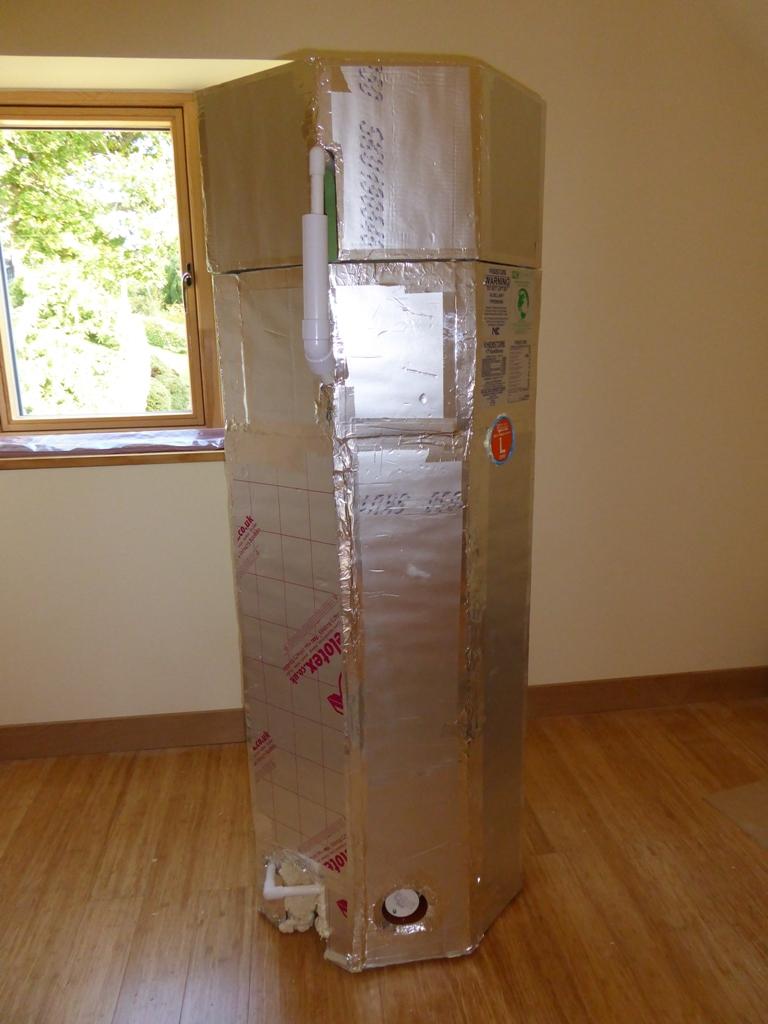
I did pretty much this, I added a layer of foamed on 50mm PIR insulation around our old thermal store. Reduced the heat loss by about 30% or so: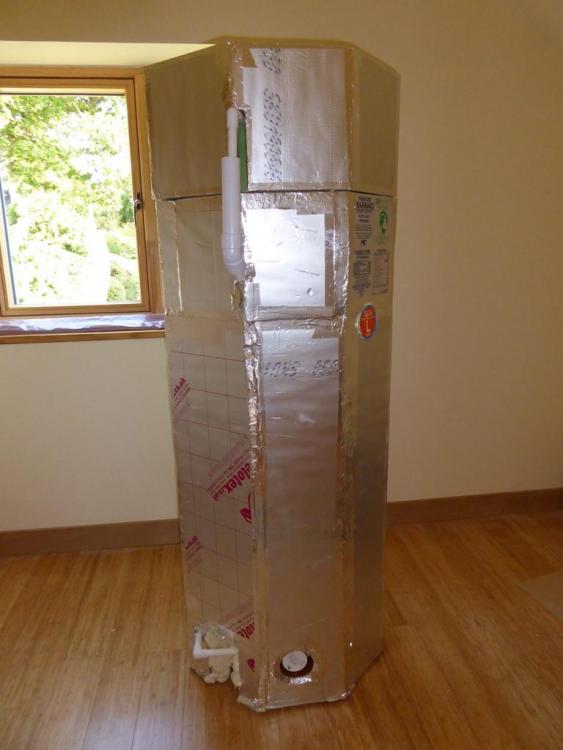
-
A Energy Rated unvented cylinder
Jeremy Harris replied to Robert Clark's topic in Boilers & Hot Water Tanks
Some companies will spray a double thickness insulation layer on, if you request it. I had a thermal store double sprayed to increase the insulation level, but the company wouldn't/couldn't change the energy rating. -
KVM & Network Old & New PC
Jeremy Harris replied to Onoff's topic in Networks, AV, Security & Automation
My memory might be a bit hazy, but I remember having a similar boot problem with a PS2 keyboard PC, that I wanted to run without a mouse, keyboard or monitor. IIRC, the fix was to change a setting in the BIOS, to stop it doing the keyboard check on boot. -
Welcome. When you say you " somehow don't have a waste in our house so a water softener is not an option", how do your wash basins, sink, washing machine etc drain their waste water? There are some pretty good compact softeners around that can usually be pretty easily plumbed into most houses, and will do all that you want (no limescale at all, no marks on shower screens, no build up in kettles or pipes). Phosphate dosing devices, like the Combimate, don't remove the calcium, but they do stop it sticking to surfaces pretty well, so it doesn't form hard scale. They also provide the same sort of benefit as a softener in terms of a reduction in the amount of soap and detergent needed. Sadly there are an awful lot of snake oil devices around, that claim to use some magical technique to change the chemistry of the water, but they all sail pretty close to the wind with their advertising material, and none can be proven to do as they say. There's plenty of discussion earlier in this thread about some of the impossible claims that have been made.
-
No need for a back drop any more, the need for these disappeared a few years ago now, when there was a realisation that foul drain pipes work fine at pretty much any adequate fall. Just run the pipe down so the fall is even from one end to the other and it should be fine.
-
It doesn't take much to cause a fear that lasts a lifetime. One of my very earliest memories is of being out in the garden in a pram, that had a net over the top (used to be common practice years ago). A dog jumped up at the pram, and my mother over-reacted. My memory is mainly of her reaction, but I've always been really nervous around dogs, and I suspect that early encounter may be to blame.
-
I wonder whether we have an instinctive fear of things like wasps and spiders, whether we learn to be frightened of them from others, or whether we learn to be frightened of them by experience? I get the feeling that some fears like this are just instinctive, and perhaps not learned behaviour.
-
Many years ago, I tried this, because I didn't want the hassle of getting the old tiles off, and because I knew I didn't have the skill to patch the wall up so that it would be flat enough to tile onto. The tiles fell off within a couple of weeks, and I ended up with twice as much work and a lot more expense, to put things right. I did learn a lesson though, and another skill. It may be that running a grinder over the tile surface could improve adhesion, but I'm not at all convinced it would work. What I know does work is bonding Multipanel shower board on to tiles that are in good condition. I've done this on a wall where the tiles were really tough to get off. I think this works because the adhesive used bonds well to pretty much any surface, and remains very slightly flexible. I prefer the look and ease of cleaning that Multipanel gives over tiles, too.
-
Anyone used online 3D printing services
Jeremy Harris replied to Gone West's topic in Tools & Equipment
That makes sense. Our volunteer team ran into similar issues with infection control, but I have to say the NHS have put in place a pretty good system for informing and helping people to comply. The technique for disinfection that has been reported as being the most effective on pretty much any material is to heat to 65°C in a dry oven. Most plastics can tolerate this, and there's a study that's looked at the effectiveness of this method and found it comes out ahead of other methods, particularly for potentially porous materials (like FDM prints), where liquid disinfectants may not penetrate all the pores. The dry heat technique also works well for disinfecting single use PPE, if it runs short. It's the only practical technique for disinfecting N95 type masks, as they are made with a high surface charge on the fibres, to enable them to trap fine particles, and wet disinfection destroys this, apparently. -
A video of the action, perhaps?
-
Depends on your site insurance. Ours required the site to be physically secured, with signage etc to try to keep people out. The main issue is probably that you (or your insurer) carries the can in terms of responsibility in the event that someone breaks into the site and injures themselves. Sounds daft, but it seems that this is the way liability works. I remember being amazed at being told that I had to remove the lower ten feet or so of a fixed access ladder up a 100ft antenna mast. I argued that the mast was inside a fenced compound, but the assessor was adamant that we had to fit a removable ladder section, in case someone climbed over the fence, climbed the tower and suffered an injury. Barking mad in my view, but then so is a fair bit of the liability stuff we now have to manage.
-
Anyone used online 3D printing services
Jeremy Harris replied to Gone West's topic in Tools & Equipment
How are these being disinfected? I only ask, because I've read a fair few articles recently about the inherently porous nature of 3D prints, because the layer adhesion is never 100% perfect, means that it's very difficult to guarantee that pre-use disinfection with liquid disinfectants (which is essential before they can be safely used) may not be effective. Part of the spec from the NHS is that the stuff arrives in a sealed bag and is guaranteed to be free from contamination, so there's no risk that someone who's asymptomatic but shedding the virus whilst making these can accidentally transmit infection via these parts. -
Definitely wasps. At this time of year it will almost certainly be an old nest from years gone by, and they rarely, if ever, re-use an old nest. If you do get a nest like this in an enclosed space, it's not generally a good idea to try and tackle it yourself. We had a problem with a big nest at our old house, and I got a chap in to deal with it, and watched how he did it. When we had another a year or two later I made up a remote gadget to spray powder in and kill them, which worked very well. I wrote it up here at the time:
-
The one we have looks like this one: https://www.ebay.co.uk/itm/Automatic-Electronic-Water-Garden-Hose-Watering-Timer-Irrigation-System-Tap-UK/392333041185?hash=item5b58df1e21%3Ag%3A048AAOSwcoFdJGws&LH_BIN=1&LH_ItemCondition=1000 Looks like I was wrong about the batteries, it uses two AA cells.
-
The timer I have runs on four AA cells for about a year, and just fits to an outside tap. It has a digital timer, under a sealed cover, and a clever internal valve that only uses a short pulse of power to turn on or off. IIRC it wasn't very expensive, maybe £15 or so.
-
That's interesting, as we had a glazing unit crack on our Munster Joinery windows, and a fully glazed door that needed adjustment. In our case the internal trim comes off pretty easily to reveal the glazing unit, which has plastic wedges all around holding it in place, plus the same large blobs of silicone. The fitter managed to cut the silicone out OK and commented that he thought ours was unusual in having so much silicone around the glass. All told it was probably no more than an hour's work to change a glazing unit and adjust the door by fitting better "top and toe" wedges.
-
If the tank has an immersion heater then all that's needed is to wire that via one of the diverter boxes that are available. The Apollo Gem is a pretty good one, as it allows a remote sensor to be used, which can be very handy: https://www.apollosolarelectric.co.uk/
-
+1 for an auto-watering setup. Easy to use and needs no attention, other than a periodic check to see if the drippers are still dripping. I used a system with a programmable timer that came on twice a day (early morning and evening) and it works extremely well. The pipes are easy to hide, too, as they are fairly small and being black tend to blend in with the soil.
-
MVHR fire rated terminals
Jeremy Harris replied to Russdl's topic in Mechanical Ventilation with Heat Recovery (MVHR)
When I asked about this I was told that was that there wasn't a requirement for them in a two storey dwelling. I have a feeling there's a thread here somewhere discussing MVHR and fire risk that may have covered this, and also whether or not there needed to be a "fire switch" to turn the MVHR off in the event of fire (to reduce the potential for it to supply fresh air to a fire). I can't seem to find it, though, perhaps it was embedded in the middle of some unrelated thread. -
KVM & Network Old & New PC
Jeremy Harris replied to Onoff's topic in Networks, AV, Security & Automation
I run something similar. I have a perfectly good scanner that only works on an XP machine, as there are no drivers for any newer version of Windows, Linux etc. My copy of AutoCad also only runs on XP (still works fine, though). I've tried a couple of KVM switches without much luck. The problem seems to be the way one of the machines responds to the HDMI being switched; when the monitor "disappears" the graphics processor reverts to some weird mode, and won't switch back to the correct resolution. After hours spent faffing about, including a time when I used two monitors and only used a KVM switch to switch the mouse and keyboard over (a work around for the video resolution problem) I've ended up running the XP machine headless, and connecting to it using Tight VNC. Not perfect, as the screen resolution isn't an exact match for the monitor, plus there's a very slight lag, but it works well enough, and is a lot more reliable than using a KVM switch. All I have running on the XP machine is a handful of programs, no internet browser, no email application, so it should be pretty safe.