Jeremy Harris
-
Posts
26430 -
Joined
-
Last visited
-
Days Won
360
Everything posted by Jeremy Harris
-

Impact of levelling compound (epoxy?) on UFH
Jeremy Harris replied to Dan F's topic in Underfloor Heating
The Salus actuators don't really care too much about flow rate, as they seem to be able to modulate over a pretty wide range. I've found that our UFH works a great deal better with a lower flow temperature than 33°C though. If I ran ours anywhere near that high it would be pretty uncontrollable. We run ours at a flow temperature of about 25°C to 26°C, and have found that this gives an overshoot of maybe 0.5°C. When we ran it at about 28°C the overshoot went up to about 1°C. -
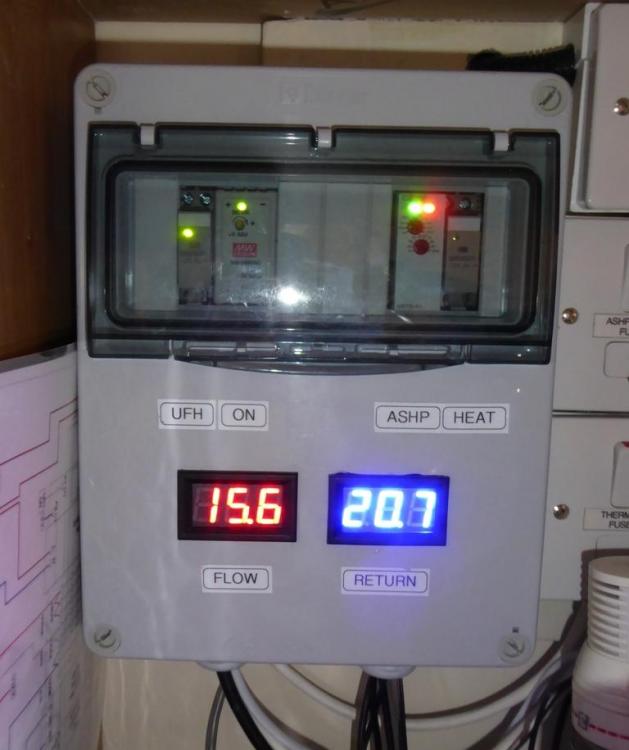
Just taken a photo with the floor cooling running, which shows the flow temperature cooler than the return:
-
Impact of levelling compound (epoxy?) on UFH
Jeremy Harris replied to Dan F's topic in Underfloor Heating
It's the fillers in levelling compounds that dominate in terms of thermal conductivity, I think. Even the epoxy compounds are mainly filler. The response time is key at this time of the year, where we can have sudden changes in outside temperature. Recently we had a long period of warm weather, followed by a few cool days with cold nights (including frost). It's handy to be able to inject a bit of heat after 48 hours or so of cool weather, as the house temperature starts to dip, but only for a short time. We've played with using the warm air system to do this, and it certainly works relatively quickly, but it also heats the whole house (the MVHR isn't zoned) and so the bedroom tends to get warmer than we'd like. -
Impact of levelling compound (epoxy?) on UFH
Jeremy Harris replied to Dan F's topic in Underfloor Heating
Self levelling compound almost certainly has about the same thermal conductivity as concrete or similar materials, so around 1.2 W/m.K. FWIW, we notice zero diference between the side of the house that has bamboo flooring, with some rugs over it, relative to the side of the house that has travertine tiles. In theory the travertine should be a lot more thermally conductive than the bamboo, but in practice the floor surface temperature is always within about 0.1°C, no matter where it's measured. I would personally not like to have pipes at 300mm centres, as I think the response time will really start to suffer. We have ours at 200mm centres, which is OK, but I think the response time might have been better had they been at 150mm centres. -
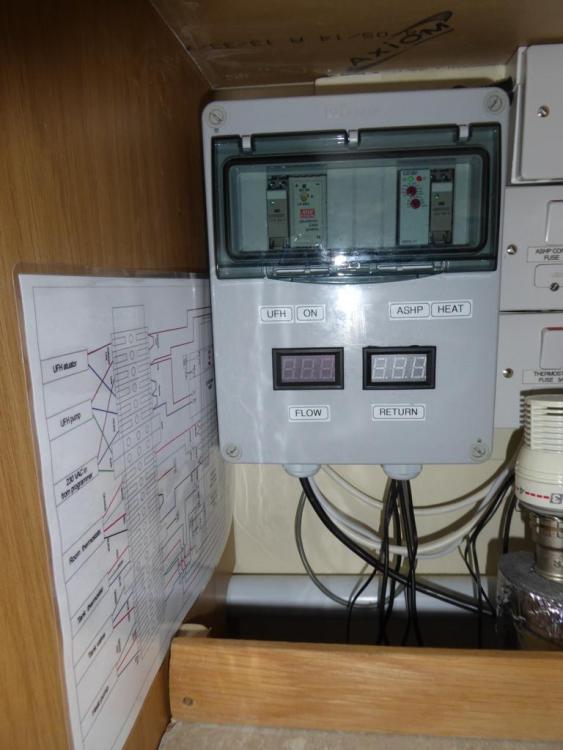
I log the temperatures on the house data logging system, but also have a couple of digital displays on the UFH wiring centre, so can use these to do a quick check:
-
The flow remains the flow, but is cool, rather than warm, so in cooling mode, instead of the return being 4 deg C cooler than the flow, it's 4 deg warmer. I was surprised to find that these actuators worked the same in cooling mode, but I guess it's just a function of them not caring which way around the sensors are clipped on.
-
Luckily they work in exactly the same way in cooling mode as they do in heating mode, as they don't care which was around the sensors are placed. In cooling mode they maintain a 4 deg C differential between flow and return, but the other way around. Typically we'll get around 13 deg C flow and 17 deg C return, for a floor surface temperature of maybe 18 deg C.
-
I used a bunch of PIC microcontrollers, bus powered (as they only need a mA or two each) with each doing some pre-processing of local sensor data, converting it to ASCII and squirting it down a multi-drop serial link that connects all the sensors. There's a PIC in the master box that sends the collated data back out to a local display upstairs (that shows 8 different temperature sensors), drives the display in the hall and also does the data logging. All told there are six microcontrollers around the house all talking to each other to keep things going. The big advantages over something like a Raspberry Pi are the low power (the whole things draws about 1/10th of the power needed to run a Pi) and the cost (PIC microcontrollers cost pennies, rather than pounds).
-
Yes, it's home made. I have a network of sensors around the house that feed data up to a box in the services room, and that puts all the data together, along with the GPS derived date and time (corrected for BST as required) and spits some of it back downstairs to that display in the hall. Perhaps the most used parts of that display are the outside temperature and the date/time, as the clock is always spot on (in essence it's just a repeater for the atomic clocks in the satellites). The data from all the other sensors (mainly temperature at various places, including in the slab, under the slab, water temperatures in pipes and the buffer tank, the ASHP flow temperature, etc) is logged every 6 minutes, so I can go back and see how things are behaving. I have to say that the novelty of analysing all this data wears off after a while, though.
-
I used some proprietary teak deck colour restorer on some stained iroko on my old boat. It seemed to do a pretty good job. As teak and iroko are similar timbers, it might be worth having a look at some of the boat cleaning/restoring stuff, as stains and bleaching on the decks and brightwork on boats is a common problem.
-
FWIW, I believe that many of these rules are just imposed from above, with the people at the sharp end (like planning officers) just having to accept what they've been told. I get the feeling that our local authority has a team of managers who are only there to create arcane and restrictive rules.
-
Must be infuriating. I had started talking to our planning officer just before they introduced the £90 pre-application advice fee here. He replied to the last email sent before that came into force telling me that he was now forbidden from discussing anything more until I'd filled in the form and paid £90. I chose to just submit a full application (as it wasn't much more money) and then continue the discussion with him. At one point he acknowledged that the pre-application fee was causing more people to just submit applications and then enter into lengthy exchanges over details, which was soaking up more of his time than the old process of a few informal 'phone calls. The daft thing is that pre-application advice isn't binding, and is a single shot, whereas submitting an application effectively gives you more than one go. Sometimes I think that the people that make some of these rules really need to take a close look at their likely impact.
-
I remember an old vehicle workshop at Warminster having the old concrete floor levelled and sealed with some sort of epoxy compound. It was tough, but very slightly resilient, self-levelling and also able to fill minor surface imperfections. Looked very impressive when it had been done, and the people working there reckoned it was a lot kinder on their feet. Not sure what it was, but it went on as a layer maybe 3mm to 5mm thick at a guess.
-
Impressed so far! 120kWh this (long) weekend.
Jeremy Harris replied to Benjseb's topic in Photovoltaics (PV)
This Spring has been amazing. Last year our FiT cheque for the January to March quarter was £92, this year our FiT cheque for the same period was £274. I think it's probably been the best first quarter we've seen in the 6 years our system's been running, and we're now up to about 36 MWh total generation. The house has consumed about 19 MWh in that time (not including charging my car). -
Ours uses around 30 W on average, and as it's timed it tends to use a bit under 0.5 kWh/day. Much of this comes from our PV system, so in reality it probably costs maybe 3p or 4p/day to run, if that. It connects to the cold water supply, tee'd off the supply that feeds the tap. I wired it via a time switch and a switch, both located in the cupboard under the sink, with the switch right at the front of that cupboard. The time switch is set to come on early in the morning and switch off in the evening, so the thing only runs when we need boiling water. We use the switch to turn the unit off when we go away. An option I wish I'd got with ours was the larger boiler and thermostatic mixer to supply hot water to the tap. This means there's no need for a hot water supply to the tap and hot water runs very quickly from the hot tap.
-
Itho Hru Eco 4 - help!
Jeremy Harris replied to Amuia's topic in Mechanical Ventilation with Heat Recovery (MVHR)
Welcome. I'd second the above. The filters need to be cleaned/changed at least every six months, sometimes more frequently in areas where air pollution/dust levels may be high. The other thing to check is that the installation has been done correctly. It's not uncommon to find problems with ducting, something another member here found with an installation of about the same vintage as yours. -
Rather importantly, Co. Antrim is in the United Kingdom, a distinction that carries a fair bit of significance. . .
-
I thought you were completely opposed to the idea of good insulation, airtightness, installing MVHR etc, and considered all this energy-saving stuff to be unecessary?
-
Funny old thing, but I delivered another 5 litres of alcohol based home made sanitiser to our local volunteer coordinator this afternoon. Still no official supplies, but we have now received some grant funding from the council to pay for PPE.
-
The volume of our house is about 338m³, and the MVHR (allowing for duct loss) can deliver about 290m³/hour, so at full boost it ventilates at around 0.86 ACH. The relationship between fan speed and flow rate is non-linear, so at speed 2 (about 30% fan speed) the ventilation rate is about 0.35 ACH, and we use this setting pretty much all the time as the background rate.
-
One or two people here have had aluminium sheet bent to shape and powder coated, I'm pretty sure @lizzie did, see this post:
-
I'd be inclined to get some over-cills bent up from aluminium sheet and powder coated to match. That way the cills would properly project out over the cladding and the cut edges would be hidden. Should be a quick and easy thing to fit, as the cills could just be bonded on with Sikaflex. Might need to find some end caps to finish the projecting ends off neatly, and might be best to source those first and have the cill covers bent to match.
-
Yes, it's essential to read the pressure/volume flow rate curve data on the MVHR spec sheet to get this right. Not hard to do, though, as there are a few online calculators for estimating duct flow resistance.
-
More or less, although it's handy to have a bit of spare boost capacity, I think. IIRC our MVHR is currently running at a rate that's about 70% of the background rate given by Part F, which seems to be OK, but there are only two of us in a 130m² house. The same size house with more occupants may well need a bit more ventilation, and my guess is that the Part F rates may be set for a typical mass house builder type house and occupation density.
-
Emersion heater timer
Jeremy Harris replied to Russell griffiths's topic in Electrics - Kitchen & Bathroom
What's on the other side of the PCB? It looks as if it may just be that the PCB track has burned out, if that connection is to a relay contact. Could be something as simple as a dodgy solder joint that's decided to fail, and the black marks are where it's been arcing. A fault like this wouldn't trip an MCB, but would now be picked up by an arc fault detection device (AFDD).