Jeremy Harris
-
Posts
26430 -
Joined
-
Last visited
-
Days Won
360
Everything posted by Jeremy Harris
-

Front garden excavation for drive
Jeremy Harris replied to Margaret dailey's topic in Landscaping, Decking & Patios
There are several systems of interlocking blocks. I looked at using Stepoc, but there are others: https://www.andertonconcrete.co.uk/range/structural/ All MUST have a suitable foundation base, plus drainage, and for a retaining wall with a high surcharge you MUST ensure that there is temporary shoring in place to support the house foundations, as you will need to dig a fair bit further back into the bank in order to allow for the width of the base of the wall, plus the batter angle. Most of the interlocking block companies will include the cost of the structural design and certification in the price for the blocks, or at least the two or three I spoke to would. The only reason we didn't use one of these systems was because of the thickness of the wall at the base, they do take up a lot more room than a vertical retaining wall. -
Front garden excavation for drive
Jeremy Harris replied to Margaret dailey's topic in Landscaping, Decking & Patios
If you're using a builder, please check very carefully that he has a structural engineer available to underwrite the design, as you may need to prove to your insurance company that the retaining wall has been designed and certified in accordance with Eurocode 7/BS 8002. Our retaining wall is a similar size, and our insurers (both of them) needed confirmation of this (although neither asked us for it, the requirement was buried in their terms and conditions). Bear in mind that it's mandatory to have the design and construction done professionally if the wall is over 1.2 metres (just under 4 ft), I believe, or if the retaining wall has any surcharge (which yours does, the mass of the house on the retained ground). It's not difficult to design a wall like this, and an SE won't charge a great deal. Our Se charged us just £350, which considering that the retaining wall cost over £30,000 to build in total, wasn't a lot to pay for peace of mind and ease of getting house insurance. -
Front garden excavation for drive
Jeremy Harris replied to Margaret dailey's topic in Landscaping, Decking & Patios
Absolutely not, there is no way a wall like that would comply with the requirements, and it could easily (almost certainly, I think) invalidate your house insurance. You cannot build a retaining wall that is higher than 1.2 metres (just under 4ft) without it being designed and certified by a structural engineer. The foundation structure alone for a vertical retaining wall that is that high will require sufficient horizontal foundations to withstand the overturning moment from the imposed loads, together with an anti-slip key projecting below the foundation slab. Our structural engineered charged us £350 to design our retaining wall, including drawings and a full specification. Our wall (as in the photo's posted earlier) varies from around 1.4 metres at the lower end to 2.6 metres at the highest end, so at it's highest it is very similar in height to the one you need. This is the SEs design for our wall, it might give you an idea of what is needed: 20130228093748130.pdf 20717.pdf I'd just add that I've had a fair bit of flack from some professionals here, and elsewhere, for suggesting that people do more stuff themselves, and avoid using professionals if they are able to. In the case of a retaining wall, despite being able to design one, there is absolutely no way I would, the risk is just far too great if it fails. -
Front garden excavation for drive
Jeremy Harris replied to Margaret dailey's topic in Landscaping, Decking & Patios
That is going to be a very substantial retaining wall that's needed, it's very close in height to our 2.5 metre maximum height wall, so you can expect the design of a vertical block wall to be very similar to the one shown in the photos I posted earlier, I think. Very definitely not a DIY job at all, unless you have the skill and experience to design and build reinforced concrete structures to Eurocode standards -
Why is so much plumbing stuff such utter rubbish?
Jeremy Harris replied to ProDave's topic in Boilers & Hot Water Tanks
TBH, I'm not sure what they stock, but the chap that runs the place was very helpful when I spoke with him on the 'phone (got a feeling his name may have been Willie). If they don't stock stainless ones, I suspect that what they do stock might be slightly better than you might get from the local plumbers merchant, perhaps, as their main business is selling stuff for private water supplies, where reliability is pretty critical. The other thing is that they are local to you, so probably know what the local water does to stuff. -
Why is so much plumbing stuff such utter rubbish?
Jeremy Harris replied to ProDave's topic in Boilers & Hot Water Tanks
I I've bought from Highland Pumps a couple of times, and found them pretty helpful. They are not far from you, so it might be worth giving them a ring to see if they stock them: https://www.thehighlandpumpcentre.co.uk/ -
Having a planning officer make a site visit is almost unheard of around here. Not sure why, but they rarely seem to bother for small developments. We had a potentially fairly contentious application (the site had a bit of a chequered planning history), and the only two consultees that came out to the site were the conservation officer and the highways officer, both of whom had specific concerns about what we wanted to do. I never actually met our planning officer at all, just spoke to him once on the 'phone and exchanged a dozen or so emails, and that was it.
-
Why is so much plumbing stuff such utter rubbish?
Jeremy Harris replied to ProDave's topic in Boilers & Hot Water Tanks
Looks like weld corrosion from that photo. We had something similar with a small 8 litre pressure vessel, failed in the same location. You can get stainless ones that I'd guess might permanently fix this, and one might be a good option for where you are, as I suspect that the water there might be slightly acidic. Slightly acidic water may well make the corrosion problem worse. I bought one of these stainless steel pressure vessels, and so far (~5 years) it's been fine: https://www.ebay.co.uk/itm/8-litres-1-thread-stainless-steel-pressure-vessel-accumulator-water-tank/174144644679?hash=item288bd46647:g:0pUAAOSw6GJeD0n0 The other advantage of these PVs, is that the bladder can be changed if it fails. -
Front garden excavation for drive
Jeremy Harris replied to Margaret dailey's topic in Landscaping, Decking & Patios
I'll add emphasis to the above. Retaining walls are very serious structures, we had to build a big one when we built our house. Any retaining wall that is more than 1.2 metres high MUST be designed by a structural engineer, or use an approved retaining wall product that has been assessed as being suitable for use in those circumstances. I'd also add that a critical factor will be the surcharge load imposed by the mass of the house - you cannot assume that the "45° rule" will be acceptable without knowing the exact nature of your soil, the surcharge load from the mass of the house and the nature of the house foundations. The latter could be pretty much anything, from almost no foundations (building on corbelled bricks was fairly common in older houses) to a deep trench foundation. The consequences of continuing to dig that bank away without understanding all the above could easily be very serious indeed, especially if we get a period of heavy rain. As an idea of what a proper block retaining wall, that has zero surcharge load (only supports a garden above, not the very much greater mass of a house) looks like, these are photos of ours. It's built from 215mm wide hollow blocks, double thickness at the base, with steel reinforcement bars running through the hollows, which are embedded in RC35 concrete. This wall is 430mm thick at the base, and sits on a foundation that is 500mm thick reinforced concrete, between 1.5 metres and 2 metres wide: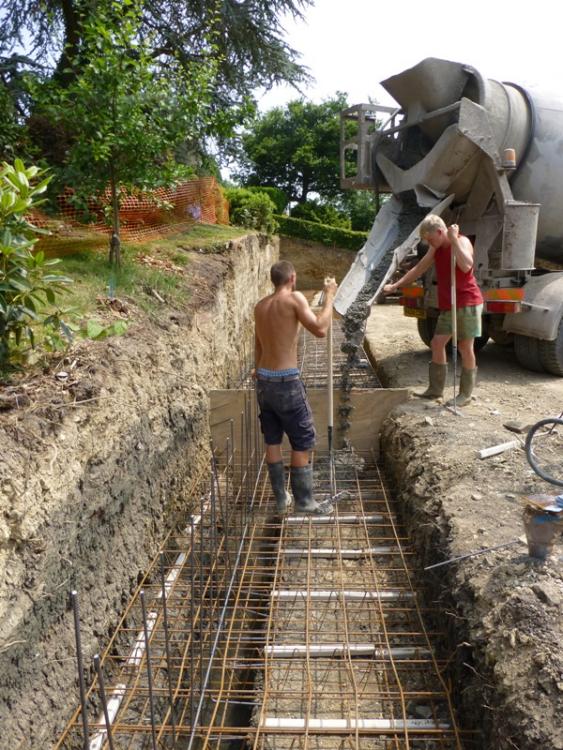
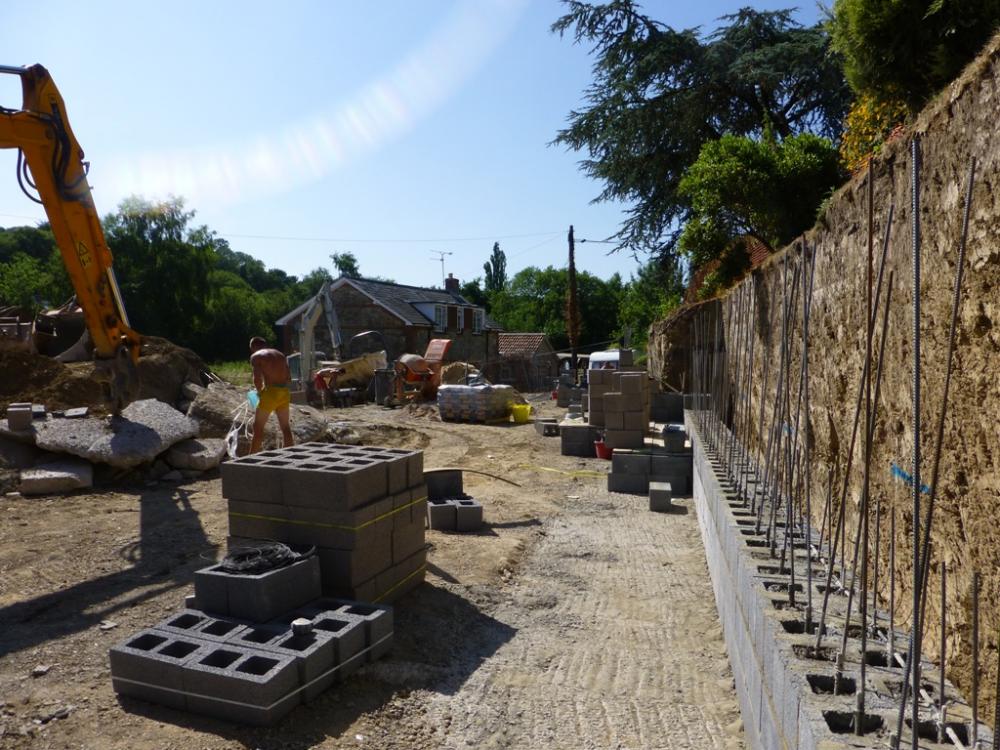
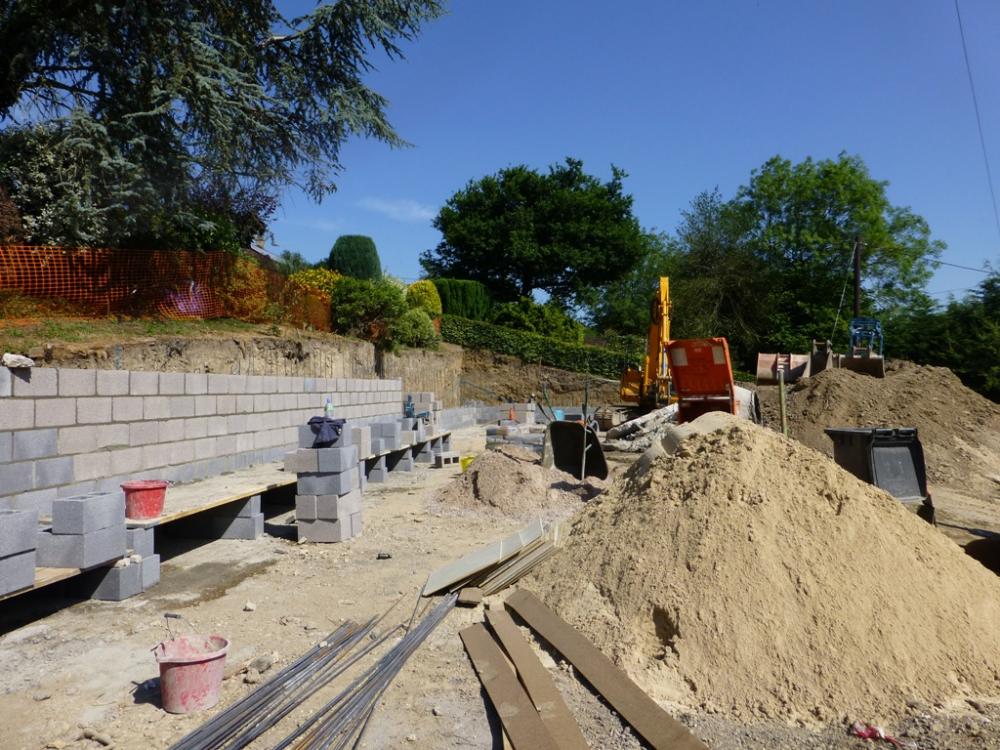
-
Same here, the planners put our notice up (think they put up three in the immediate area). The notices used around here are printed directly on to thin plastic, so not something that could be easily done except with whatever special printer they use, perhaps.
-
I don't think there's much difference between the various insulated slab systems. I had quotes from Kore, Isoquick and Supergrund and all were pretty close in price and spec. We went with Kore only because the company we used for the foundation and house (MBC Timber Frame) offered it in their package, and it seemed to me that having the foundations and house from the same company meant there was one less risk to worry about, as it meant we didn't have to take responsibility for ensuring that all the dimensions, tolerances etc matched. I'd have happily used either the Isoquick or Supergrund systems, as there's nothing much to choose between any of them, IMHO. The main reason we chose an insulated slab like this was to get good thermal performance, as, with the insulated upstand all the way around, that lines up with the insulation in the walls, it virtually eliminates thermal bridging at the foundation to wall junction. It was a bonus that the whole system was very quick to lay, and the house was pretty quick to get to watertight. This speed was a real advantage, as we were building late in the year, during a pretty wet spell, so getting the frame up and watertight so quickly protected the inside of the frame from too much wet weather exposure. The borehole was because the mains water supply was 140m away, up a single track lane, and it would have cost us around £23k to dig up the lane and run a pipe, plus it would have caused major disruption to three or four houses that have drives from that lane, we'd have pretty much cut their access off for a fair time whilst digging up the lane. The borehole, with all the hassle it caused, water treatment kit, etc, was less than half the price, plus we don't have a water bill. In practice we pay around 1/4 the price for water, allowing for the running cost of the pump, treatment stuff, etc, so it's worked out OK.
-
Some photos in this link showing how our insulated raft was laid: http://www.mayfly.eu/2013/10/part-sixteen-fun-and-games-in-the-mud/
-
There are probably a lot more choices around, including some smart solar powered fans with controllers made specifically for greenhouses, like this one (probably expensive though):

-
You're not looking at anything massive to run a ventilation fan, though: http://www.cpssolar.co.uk/Solar-Ventilation Could be stand-alone, with a built-in solar panel, if a 160mm fan will fit OK:
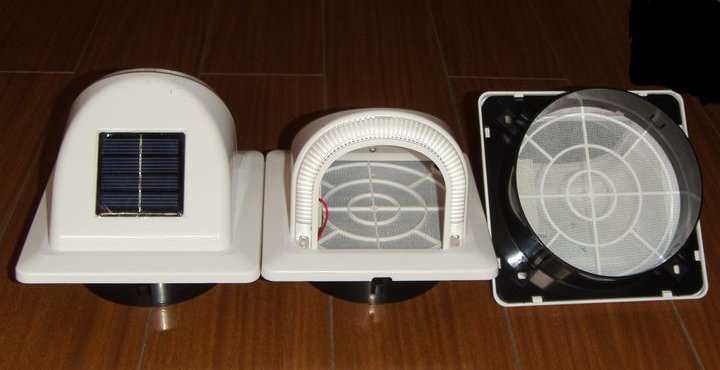
-
Had you thought about just fitting one or more solar panels to directly power fans? That would make for an automatic system, with no maintenance required, as the fan would run whenever the sun was shining, and the more sun the faster the fan would run. Not hard to put a simple system together, using a 12 V DC fan and a suitable small solar panel. As a bonus, the solar panel(s) might also provide a bit of additional shading.
-
I think it just relates to the different way manufacturers label the nominal voltage of lithium ion cells. Most use either 3.6 V per cell or 3.7 V per cell, but a fully charged cell will usually be around 4.1 V to 4.2 V, and a discharged cell can be as low as about 3.2 V to 3.4 V. In practice, most lithium cells seems to sit at around 3.8 V to 4 V per cell when reasonably well charged, so pack voltages are often higher than the nominal voltage on the label.
-
The reality is that the pack voltage is usually something rather different to the label voltage. Just poked a meter on a Makita "18 V" BL1830 pack that hasn't been charged for several months. It read 20.03 V.
-
Makita (and others, I think) do a portable band saw: https://www.makitauk.com/product/dpb180z.html
-
Challenge it, as that's outwith the authority of any PC in England, for sure. All a PC can do is object in the same way as any other consultee. The objections of the PC carry no more, and no less, weight than any other consultee. A PC cannot call an application in to committee, they don't have that authority, but they can ask their local councillor to call it in, as local councillors do have the authority to call in any application. Our local councillor would usually agree to call in an application if the PC asked her to, but she isn't under any obligation to do that. The problem would be proving that a PC has acted outwith its authority, perhaps, although if there was evidence that they had directly requested that an application be called in, and there was no other evidence to support that (like a local authority councillor calling it in, or the number of objections having passed the trigger level for it to go to committee) then the local authority and the PC could be called to account for breaching their powers.
-
My experience suggests that 99% of the time all PC objections are ignored by the planners, anyway. The only way the PC can have any significant impact is if they manage to persuade their local authority councillor to call the application in to committee (PCs don't have that authority). I've seen that happen once, for an application that was bonkers, it was for 2m high steel fencing, with an electric gate in the centre, surrounding a house in the conservation area. The applicant heard of the PC objection, spoke to his agent and told him to withdraw the application, revise it and resubmit it. Turned out that the applicant hadn't actually looked at the original drawings that had been submitted, as they had been drawn up by his tenant, who wanted to turn the house into Fort Knox. The owner thought the application was just to replace a dilapidated wall with a new fence and gate.
-
That pretty much sums up the unofficial (pre-meeting) debate, most were in favour of just letting it go, but one was being officious and trying to make a fuss. TBH, I could see why when I went up there, as it was pretty clear that the original mobile home had been very carefully hidden, surrounded by old sheds that had only recently been knocked down. This was also clear on Google Earth, with older imagery showing that the place had been surrounded by timber sheds until a couple of years or so ago. I reckon the reason that most decided not to raise an objection was because they all knew the former landowner, a local farmer . . .
-
When I was still a parish councillor we had an application for a lawful development certificate under Section 191 of the T&CP Act. Perhaps worth noting that there isn't a requirement to consult on such an application, so in this case it was done pretty much to see if the PC had any local knowledge, I suspect. I drove up to see the place, and it was a mobile home, located off a bridleway, that had been sat on the site of some old farm buildings. Conifers had been planted around three sides of it, making it impossible to see easily. The applicant provided evidence that a dwelling had been on the same site for ~15 years or so, IIRC. My personal view was that the dwelling had almost certainly been deliberately hidden from view, initially by the surrounding old sheds, then by the planted conifers after the sheds had been taken away. Hard to prove, though, and the planning officer gave the applicant the benefit of the doubt. This was only about a year ago, so it shows that, with a bit of cunning, and a fair amount of good fortune, it is possible to get away with "building in the woods". Hellishly risky, though, and it needs the cooperation of the surrounding landowners. In the case above, the chap living in the mobile home had originally been employed by the landowner, then he bought the site where his mobile home was from him, but didn't apply for utility connections in his own name, he piggy backed on the landowners connections, by private agreement. It seems to have been a pretty clever way around getting caught, although I think it was pure good fortune that he didn't get clobbered by the "deliberate hiding an unlawful development" rule.
-
Sadly I think that what you've worked out is pretty true, at least in England. Things can be a bit easier elsewhere, though, for example Wales has allowed some sustainable development like this in the countryside. Have you had a look at this group, for example?: https://lammas.org.uk/en/welcome-to-lammas/ The Lammas group have done pretty well, and been encouraged by the local policy that applies there.
-
As above, ideally the pipes should be full and pressurised when the slab is poured, but we didn't bother with this and everything was OK. You can dry pressure test easily enough, Screwfix do a pretty cheap kit: https://www.screwfix.com/p/monument-dry-pressure-test-kit/72940 but you'll also need a 15mm to 16mm adapter.
-
How much to fit an unvented cylinder
Jeremy Harris replied to Robert Clark's topic in Boilers & Hot Water Tanks
Perhaps £300, for your area? Unlikely to be more than that, I'd have thought. Plumbers around here charge less than that, usually around £250/day, less for larger jobs, perhaps.