Jeremy Harris
-
Posts
26430 -
Joined
-
Last visited
-
Days Won
360
Everything posted by Jeremy Harris
-

Rethinking design in the light of COVID 19
Jeremy Harris replied to ToughButterCup's topic in General Plumbing
Sounds a good idea. Only tip I'd add is to try really hard to make it rodent-proof. I included a storage area above my workshop, boarded out, with an electric hoist to get stuff up and down easily, loft ladder, etc. It's plagued with mice, I must have caught at least a couple of dozen so far. -
MDPE seems to be pretty frost resistant. Never yet seen an MDPE pipe fail from frost damage, even when just run over fields to water troughs. Seen a loose fitting blow off from the expansion of an ice plug once, but that was only because the fitting hadn't been tightened up properly. We have three outdoor taps here, all fed from 25mm MDPE, and none have any frost protection.
-
MVHR cooler product from BPC
Jeremy Harris replied to Pete's topic in Mechanical Ventilation with Heat Recovery (MVHR)
Yes, fitted it myself. Easy enough to do, the hardest part was lifting the outdoor unit up on to a wall bracket, as I needed it to be well above head height at the rear of the house. There's a bit about it in this thread: -
MVHR cooler product from BPC
Jeremy Harris replied to Pete's topic in Mechanical Ventilation with Heat Recovery (MVHR)
FWIW, the split A/C that I installed last year is so close to being silent as to make no difference. We've occasionally run it through the night, and it's barely audible, just a very faint sound that isn't enough to disturb sleep. This wasn't an expensive unit, either, and even the outdoor part is pretty quiet, just a bit of gentle fan noise when it's running flat out. I was surprised at just how quiet this thing is, TBH, as having had A/C systems at work I was expecting it to be a great deal noisier than it is. The unit I fitted is a small Toshiba Mirai, rated at 2.5 kW, and wasn't expensive (cost under £600 for the unit plus the fitting kit). -
Smart Meters...
Jeremy Harris replied to Mulberry View's topic in General Self Build & DIY Discussion
Exactly. Stands to reason that energy suppliers, who are make their profit from selling energy, aren't going to promote something that reduces their profit. They want to be able to reduce their risk exposure on the wholesale market, by passing that price variability on to the consumer. This means they can then operate on a "cost plus" business model, where any change in the wholesale price gets immediately reflected in the price the consumer pays at any instant, with the supplier's profit margin remaining secure. -
Rethinking design in the light of COVID 19
Jeremy Harris replied to ToughButterCup's topic in General Plumbing
Sounds like you need a submarine shower. These have two timed periods, operated by a button. The first gives just enough water to get wet, then shuts off whilst you lather up. The second (and final) press gives just enough water to (very quickly) rinse off. Very common for those not used to them to find they are still covered in soap when the water shuts off, and it can't be restarted, as the thing is designed to save water. -
Both parish councils I've been associated with have dealt with planning applications during normal meetings, only usually takes a few minutes as the comment form doesn't have room for much more than a couple of lines. 90% of applications are for small stuff, like trimming trees, fitting new windows or replacing front fences and gates (being in a conservation area means these often need PP) and many of those applications are just for the PC to note, they can't comment on some of them (tree work, for example). On average, I reckon we probably only had two or three significant planning applications a year, and most of those will have been for things like extensions. The problem that I've encountered with planning officers is inconsistency. One says something and another comes along later and says something completely different. We tried to buy a plot that had outline consent, and the planning officer had changed since that had been granted. When I spoke to the new chap he was opposed in principle to what had already been approved! Hopefully that may have improved in recent years, but I'm not wholly sure it has. Planning committees can be even worse. I sat in on one meeting where the planning officer gave his report, which was a recommendation for refusal (on very good grounds). The chairman and one other member of the planning committee were known to be good friends of the developer's agent, and were clearly very supportive of the application, and they bulldozed the rest of the committee into granting consent, despite it being in clear breach of local planning policy and being against the safety recommendations from the highways and fire officers. The planning officer sat through this with his head in his hands, and at the end asked the chairman for the reason for breaching planning policy, so he could note it. The chairman told him it was his job to go and find a reason to approve the application, not the the planning committees . . .
-
Rethinking design in the light of COVID 19
Jeremy Harris replied to ToughButterCup's topic in General Plumbing
Yes, we had these at work. Push button operated, with a spring and damper that caused the button to slowly pop up after about a minute. -
Smart Meters...
Jeremy Harris replied to Mulberry View's topic in General Self Build & DIY Discussion
Here they still read the meter every year, and even if we had a smart meter the chap reckoned he'd still be here every year to read it. At the same time he reads the generation meter, too, and the requirement to regularly read the generation meter remains even if smart meters are rolled out universally. -
Smart Meters...
Jeremy Harris replied to Mulberry View's topic in General Self Build & DIY Discussion
A year or so ago I had a chat with the SSE meter reader when he came around. I remarked to him that smart meters would put him out of a job, and he replied that it wouldn't, as they were still legally required to manually read smart meters. -
Smart Meters...
Jeremy Harris replied to Mulberry View's topic in General Self Build & DIY Discussion
The visibility of usage has no relevance to smart meters, really, as it's pretty easy for anyone to be able to monitor their energy use so they can adjust their usage pattern to better fit off-peak periods. We got a free energy monitor from one of the energy suppliers years ago, used a wireless current transformer clipped around a meter tail and a small indoor display unit. That was around ten years ago. Our current house has something very similar, and there's a display in the kitchen showing the current usage and whether we're importing or exporting power, so we can switch on things like the dishwasher and washing machine when we're generating. The purpose of smart meters isn't to get people to reduce their energy use, it's to maximise profits for suppliers, by reducing their wholesale purchasing risk and eventually passing that on to consumers in the form of variable tariffs when there is a big enough take up. We're seeing what I strongly believe are "loss leader" variable rate tariffs now, being promoted on the basis of the short periods when the energy price is very low. I've been tracking their prices for a while now, and have found that the periods of low prices are pretty impractical for any demand that needs to run for several hours (like an ASHP running UFH). -
Rethinking design in the light of COVID 19
Jeremy Harris replied to ToughButterCup's topic in General Plumbing
I'm with @SteamyTea on this, in terms of infection control there's no real point in doing stuff like this inside the house. Best to try and keep anything that might be carrying a pathogen outside until it's been disinfected. It's pretty easy to just wipe down a tap handle as you wash your hands if need be, and as a bonus it keeps things looking sparkling at the same time. -
Pretty much, if it's a valid point that's been missed. My experience is that I've never once seen either of the two PCs I've been associated with be able to influence a planning decision. Whenever there has been a refusal, it was always on valid planning grounds, and nothing to do with the PCs bit of paper they sent in. I've certainly seen pretty poor behaviour by parish councillors, ranging from trying to get support for a mates application to trying to get the PC to buy services from their businesses. Most parish councillors do the job because they want to help and improve their local community, but some definitely do it in the hope that they can exert some influence. The daft thing is that parish councils have very little power. They may have a fair bit of responsibility, for things like safety of play ground and equipment, footpaths etc, but their power is negligible, they have to do pretty much everything through the local authority. Can be frustrating at times, as often our local authority seemed to pretty much always give the PC a stiff ignoring.
-
Smart Meters...
Jeremy Harris replied to Mulberry View's topic in General Self Build & DIY Discussion
You need to consider that all important inverse square law effect with distance, though. If you're a metre or so away from the smart meter then the field strength is going to be very low indeed. For some people in flats or semi-detached houses the risk from their neighbours 'phone may well be far greater (could be just the other side of their headboard). Factor in that a smart meter only transmits for a few seconds at a time, unlike a 'phone, that may be transmitting for tens of minutes during a call, or when accessing data, and the risk exposure from the smart meter is extremely small indeed. There are some good reasons for not wanting a smart meter, but the RF risk just isn't one of them. The RF emitted from many other things in the environment, like wifi, remote controls, power line signalling, RF emissions from a multitude of electronic gadgets, LED light drivers, switched mode power supplies, inverter drives in washing machines etc is likely to be comparable in terms of overall exposure. -
Any objection made on valid planning grounds can result in an application being called in. Planning officers should pick this up anyway, as that's their job, and they shouldn't be relying on objectors knowing more about planning law and policy than they do. Here what happens is that if there is an objection on valid planning grounds from the PC, or from member of the public at the meeting, the local authority councillor (who is usually in the audience at PC meetings here) will agree to call the application in. The key thing is that it isn't the Parish Council doing this (they don't have the authority) it's the local authority doing it. I can only recall one PC objection made on valid planning grounds and that application was withdrawn by the applicant before the PC objection made it to the LA, as the planning consultant that had submitted it spotted the error, withdrew the application and resubmitted it with the error corrected. 90% of PC negative observations on planning applications are really just intended as reminders to the planning officer to check details (almost always related to issues like highways safety, drainage, use of materials and appearance etc, in my experience) If someone submits an application that doesn't comply with planning law, or local planning policy, then it doesn't really matter who flags it up, does it? Part of the problem we seem to have with planning is that some people seem able to get away with flouting planning law/policies, leading to others feeling that the system is unfair (me included in that - it can be unfair). The PC shouldn't make an objection that isn't on valid planning grounds, although I know full well that some do, and there have been times when I've heard Parish Councillors make objections in meetings that just aren't valid, they are little different from neighbours in doing that. Usually, the Clerk to the PC will refuse to submit something that isn't valid, though, as a key part of the Clerk's job is to ensure the PC operates within the law. Our Clerk was a stickler for keeping us in line, and would always let us know if what we planned to write on the form wasn't acceptable. I would hope that all Clerks do the same, but would guess that some may not be as on the ball. The Clerk's role is to prevent the "untrained muppets" making fools of themselves, by submitting something that isn't valid.
-
You've been highly critical of PARISH councillors, as in this quote that started all this off (my emphasis): Now it turns out that you didn't mean Parish Councillors at all, so instead of apologising to me (as a former Parish Councillor) for indirectly calling me a twat, you've tried to deflect the debate by pretending that all along you really meant your DISTRICT Councillors, who quite obviously are a much higher tier of local government (legally they are an authority), that run lots of services, including planning. Either you're just trying to stir things up, or, perhaps, you didn't bother to read either of the links I posted earlier and so you're wholly unaware of the very big difference between the different tiers of local government. FWIW, ANY objection on valid planning grounds can result in an application being called in by a local authority, has nothing at all to do with which objector makes it. The usual culprits are internal council departments, like highways etc.
-
You're missing the point, though. You're now talking about District Councils, that have employees, manage and run planning departments etc, not Parish Councils, that can do none of those things. Have a read of the government web page on the way local government works, here: https://www.gov.uk/understand-how-your-council-works From that you'll see that at the bottom of the list there are Parish Councils, that have no authority over planning matters, above them are either a District Council, a Unitary Authority , or a Town Council, that run the local planning department. There's a very big difference between being a Parish Councillor, sitting in a Village Hall for a couple of hours once a month, discussing things like tidying the graveyard, keeping the village tidy, keeping the local footpaths clear and safe, etc, for a few hundred local people, and a District Council/Town Council/Unitary Authority that may employ hundreds of people, run a panning department, refuse collection, road repairs etc.
-
The clue is the name . . They are NOT your Parish Council, they are your Local Authority, a District Council! District Councillors definitely can call in applications to committee, and as the planning committee is made up from District Councillors they do have the authority to decide planning applications. Parish Councils are the next tier down, unpaid volunteers that represent the interests of smaller communities within a District or Unitary Council.
-
I've worked with two different PCs, spent a year or so as a co-opted volunteer on the Neighbourhood Plan committee where we used to live and a stint here as a Parish Councillor. Neither of those PCs had the authority to call in an application, that could only be done by an LA councillor. Parish Councils are legally only allowed to be consultees on planning matters within their Parish, and have no authority to call in an application to the LA Planning Committee. Given that PCs have no representation on planning committees, and are not represented on them, this makes sense. You will find that your PC will be the same, it will not have the authority to call in an application, as the regulations are the same across the whole of England. The Wikipedia entry is accurate, and makes it clear that PCs are only consultees, and have no powers as far as planning is concerned. If yours is breaking the rules, then I suggest you challenge them, perhaps using an FoI request to get evidence first.
-
Good job that I'm no longer a Parish Councillor then, wouldn't want to be considered a twat . . . As @joe90 says, Parish Councillors have very little authority, especially with regard to planning. The opinion of the whole Parish Council only carries the same weight as one neighbour objection, and the PC can't do more than comment during the consultation stage. It always seemed to me that any comment from the PC was given a stiff ignoring by the planners. Pretty much the only thing the PC could do was as @joe90 says, add some local observations. In our case, they were more often supportive, rather than negative.
-
The general guidance as to when an application goes to committee seems to be that one of the following has to happen: 1. The application gets enough objections during the consultation stage to trigger it being called in. 2. The planning officer believes that the application is such that it exceeds his/her delegated authority. 3. One local authority councillor calls the application in (they don't have to give a reason, AFAIK). Parish Councils don't have the authority to call an application in, but they do often have a certain amount of leverage with the local authority councillor, and, at least as far as our PC was concerned, if they asked the LA councillor to she would almost always call an application in. Going to committee can be beneficial sometimes, depending on the nature of the application. Planning committee members rarely know much about planning law or local policies though, so can be swayed by the recommendation from the planning officer. The positive side to this is that the planning officer cannot put anything in that recommendation that isn't supported by planning law or policy, so it can tend to remove some of the subjective stuff. Very much a double edged sword, though, as it can be really difficult to try and predict which way a planning committee might go. One positive aspect is that some planning committees will be acutely aware that if they refuse an application, and it subsequently gets approved at appeal, the LA may have to pay the costs. In these cash-strapped times this may lead to committees being a bit more cautious. FWIW, I don't see how the area of the basement can be a valid planning consideration. I went through chapter and verse with areas with our application, as a previous application had been refused on the grounds that it was too big a footprint. I proved that the key area for planning purposes is not the net internal floor area, but the area of the footprint. The factors that were valid as far as dimensions went were the footprint area and the height and length of the roof ridge. In theory we could have added a basement after gaining consent, as long as it didn't change the external appearance (in practice we couldn't do this easily, because of the water table).
-
Smoke problem from neighbours
Jeremy Harris replied to Savage87's topic in Mechanical Ventilation with Heat Recovery (MVHR)
Just to put our slight problem into perspective, the reason I've not done anything about it yet is that it only happens a handful of times a year. It's not yet enough of a nuisance to have motivated me to get up a ladder and start playing around re-routing the intake with some additional ducting. -
Smoke problem from neighbours
Jeremy Harris replied to Savage87's topic in Mechanical Ventilation with Heat Recovery (MVHR)
We have the same problem at times. My solution is to turn the MVHR off when we smell smoke, but it's far from ideal. In our case the problem arises whenever we have very still air, and seems to be related to the position of our MVHR intake. The position of this intake isn't ideal, as it is high up in a gap between the house and the big retaining wall about 2m behind the house, and I think the smoke somehow gets funnelled into that area somehow. I have noticed that the smell of smoke is a lot less pronounced lower down, so I keep meaning to see if I can find a way to reposition the intake. This isn't at all easy, as it goes out through a wall, just above the first floor, so I've been looking at ways to try and run an external 150mm duct down the rear wall of the house, without it looking too untidy. At the same time, I want to turn the intake around through 90 deg, as I think that may help, and I'd like to add a pre-filter, to help keep the F7 filter in the MVHR a bit cleaner. I've also been looking to see if it would be possible to fit an activated carbon filter at the newly positioned intake, as I'm hopeful that such a filter might help to remove smoke smells. Not 100% sure how to do this, but I have some bags of activated carbon granules, sold for use in filters, and plan to see if I can pour a layer of these over some fine mesh, so that the intake air is pulled through it. Finally, I've also been looking at whether or not it might be practical to use a combined UV-C/ozone lamp in the intake duct. I've no evidence at all that this might reduce the smoke smells, but I do know that ozone is a very powerful oxidiser, that should, in theory, oxides the volatile organic compounds in smoke, but there are other hazards associated with using ozone in the treatment of the air supply into the house. having said that, we have a small ozone generator in our fridge, and that works extremely well, and removes all smells in the fridge, even those from really smelly cheese. -
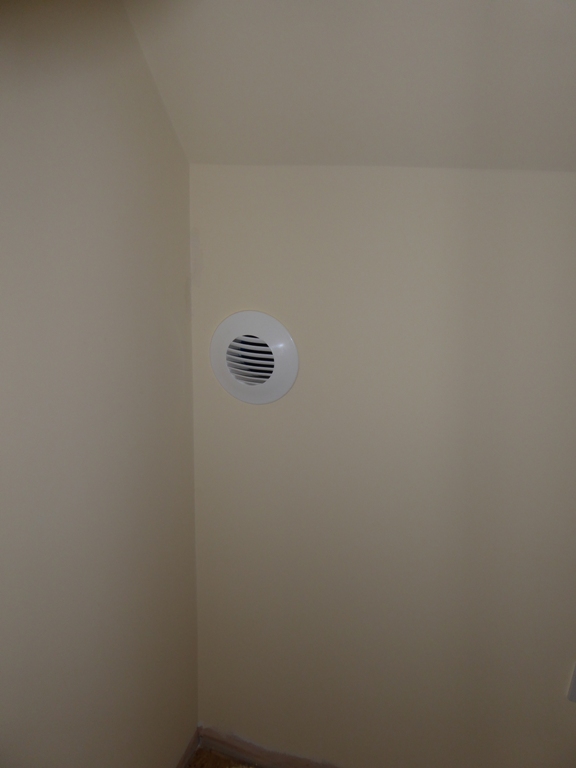
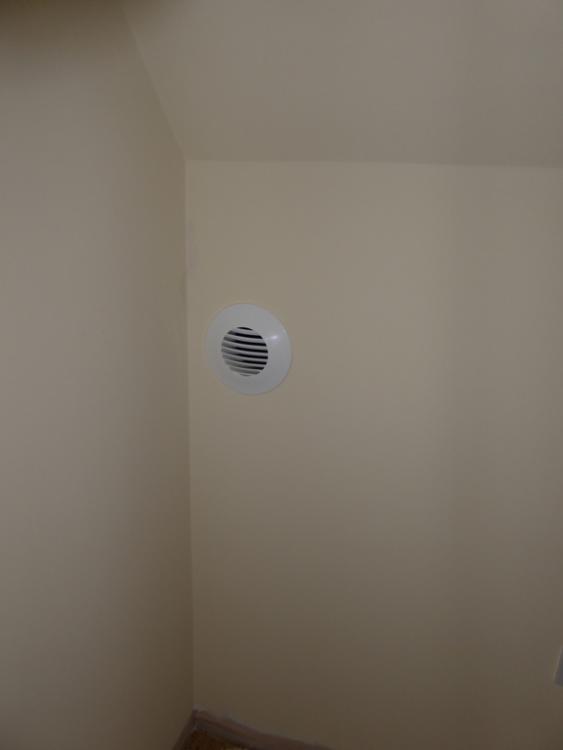
Yes, I fitted low level wall vents in our bedrooms, as we have vaulted ceilings that would have been a pain to run ducts through, as the service void was only 50mm deep and the battens ran the wrong way to feed slimline ducting through. I fed the ducts up through the stud wall from the floor void beneath, with directional terminals so that the air could be directed upwards:
-
Can environmental philosophy and self-build come together?!
Jeremy Harris replied to Jeremy's topic in Introduce Yourself
I agree wholeheartedly. Having deep (400mm in our case) ridge beam hung rafters, made getting both contiguous insulation and VCL very easy, as there's nothing in the way at all. Definitely simplifies things in terms of ease of insulation, better airtightness and minimal thermal bridging, and anything that simplifies the build tends to reduce build cost, as labour is a pretty big chunk of the total cost.