Jeremy Harris
-
Posts
26430 -
Joined
-
Last visited
-
Days Won
360
Everything posted by Jeremy Harris
-
Our PV system provides a fair chunk of our hot water for free, we really only need to boost it from off-peak for around 4 or 5 months of the year. No need for any Legionaires stuff, as it's a sealed system, using a Sunamp thermal battery. The problem I have with charging the Tesla is that it refuses to play nicely with a timed charge point. There's a software glitch with the Model 3 that disables the charge port when the car goes to sleep, so if the charge point starts to advertise power when the car's asleep it refuses to accept it. It's very, very annoying, as the only way around it is to take a massive security risk and allow a third party to have full control of both my car and Tesla account (both use the same security credentials). There's no way that I'm going to do that, not least because Tesla haven't officially released their API to third parties, and giving my Tesla account login and password away to an unauthorised third party seems like madness, just like give a complete stranger the key to the car. Other EVs are fine with charge control via the charge point; the BMW i3 I had would happily start and stop charging, and vary the charge rate, under charge point control, as did the Prius Plug-in I had before that. This made it dead easy to charge the car up largely from excess PV generation for a large part of the year.
-
We have a Sunamp UniQ 9, and it loses around 740 Wh/day, so over 3 days it would lose about 2.22 kWh. The 12 kWh version loses about 810 Wh/day, so would lose about 2.43 kWh over 3 days. The temperature of the initial hot water after 3 days will be pretty much the same as it would be a few hours after charging, as they don't cool down the way a hot water cylinder does, as the heat is stored as a consequence of the phase change of the material inside the thermal battery, very much like a sodium acetate hand warming pad.
-
We built using a closed panel timber frame system. Ignoring the plot-related costs (which were higher than average for us) the house build came in at about £1,380/m² at 2013 to 2018 prices, with me doing almost all the internal fit out (joinery, kitchen, bathrooms etc), the plumbing, heating and ventilation system work. Took a long time, as working on your own can be very slow going at times. The foundation and insulated frame cost, including doors and windows, external cladding and roofing and guttering, came to about £650/m² at 2013/14 prices. From that point onwards I did much of the work, with just an electrician for two weeks, plasterboard and plasterers for two weeks, a floor tiler for two days and a joiner to hang the internal doors and fit the stairs for about a week.
-
I've been tracking Agile and Go for some time now, and so far neither are cheaper for us. E7 is, for us, a slightly better option, with the main reason being that the Tesla will not accept control from a smart charge point (so must use the in-car charge timer) and the ASHP cannot be just ramped up and down to match the price, we need it to run for between 5 and 7 hours overnight in order to heat the slab. We already store heat generated from excess PV generation in a Sunamp, so that delivers around 65% to 70% of our annual hot water needs for free, with the remainder being from an E7 boost (hot water only costs us around £50 or so a year). I've been looking at installing batteries for a few years now, but cannot make the sums add up. We would save so little money that capital investment in the batteries would never be recovered before they died of old age, even with me doing the installation in order to keep the price right down.
-
Easy enough to see how much you might generate using the PVGIS online tool: https://re.jrc.ec.europa.eu/pvg_tools/en/tools.html#PVP It's pretty accurate in my experience; the prediction for us is within a few percent of our actual generation.
-
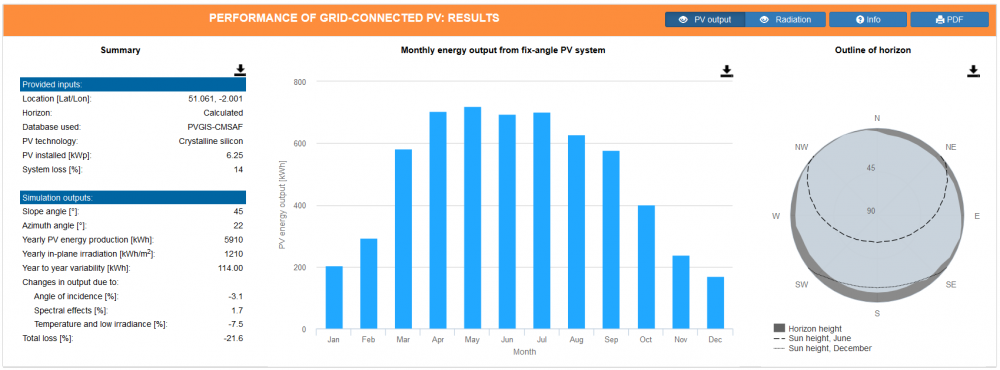
The challenge with getting a house to work easily off-grid is that power generation from PV won't come close to being enough during the time of year when electricity is most needed, so alternative sources, like wind or hydro need to be added, unless the house is to be reliant on a generator from around October to March each year. Storage doesn't help much, as the fundamental problem is that there just isn't enough power available for excess to be stored at times. If installing a generator then it's cheaper to run that to power things directly than to try and store power in a battery pack, because of the losses incurred when both charging and discharging the batteries. We have a fairly large PV array, 6.25 kWp, and our 130m² house only needs a small amount of heating, which is all electric (with a heat pump). The PV contributes nothing at all to the heating in winter, just because we can go for days with very little generation. This graph of the typical output for our PV system across the year illustrates the problem, lots of generation in summer, when we don't really need it, and very little in winter when we do:
-

Temporary heat source for UFH: Willis heaters
Jeremy Harris commented on oranjeboom's blog entry in Kentish RenoExtension
Sorry, missed this! Looks fine to me. -
Yes and no. The problem with these pretty cheap units is that they make no attempt to get rid of the sodium hydroxide. That remains in solution with the hydrochlorous acid. The main issue with that is that hydrochlorous acid is pretty unstable if in a strong alkaline solution, it probably has a half-life of just few days under those conditions. Similar gadgets are available from Chinese sellers on eBay (for a higher price than they were selling for a few weeks ago: https://www.ebay.co.uk/itm/UK-Disinfection-Sterilizing-Hypochlorous-Acid-Water-Making-Machine-Spray-Bottle/153879920799?hash=item23d3f5409f:g:dvcAAOSwJiRef0iH ). What I'd like to do is separate out the reaction vessel from the hypochlorous acid collection vessel if possible, just so what's produced is relatively pure and fairly stable, leaving the sodium hydroxide and any residue from the electrodes behind.
-
Yes, but the area of the electrodes needs to be fairly large, which means using quite a bit more platinum per unit than there is in a catalytic converter. Titanium looks affordable, just over a fiver for enough to make two fairly large electrodes. I'm working on something that may be able to produce about 100ml to 300ml in maybe ten minutes, with a shelf life of maybe two or three weeks. It'll need between 3g and 9g of pure (no anti-caking agents added) salt, and so far it looks like salt is still readily available.
-
It's down to the chemistry, rather than the physical stuff. You start with water (H2O) and salt (NaCl), and when you chuck some energy into this solution, via the electrodes, then you get diatomic hydrogen (H2) liberated from the cathode, diatomic chlorine (Cl2) liberated from the anode and sodium hydroxide (NaOH) in the remaining solution. To make hypochlorous acid, the chlorine needs to be dissolved in pure water. To make it stable, the pH of the water needs to be reduced to about 4. I think that just using acetic acid (vinegar) should do this OK. The mechanical stuff will just be devising an easy way to collect and disperse the hydrogen from the cathode, collect and dissolve the chlorine from the anode into the acidified water solution and coming up with an easy to use, charge and clean reaction vessel, without resorting to lab glassware.
-
From what I've found out so far, the two materials that seem to be best able to survive without corroding and producing unwanted compounds are graphite and titanium. The latter seems to be slightly better, but I may try both. What I'd like to do is come up with something that's fairly easy to make, safe to use and can produce a fairly pure product. The key thing seems to be getting rid of the unwanted hydrogen and sodium hydroxide.
-
One problem that seems looming on the horizon (may already be here) is that some very useful disinfectants may be in short supply, driving up the price. I have a (now diminishing) stock of isopropyl alcohol, for making surface disinfectant and hand sanitiser, but this is now getting to be really hard to buy, and when it is available the price is very high. There's an alternative that is very safe to use, and which can be produced using just water, salt (sodium chloride) and low power electricity, hypochlorous acid. This can be produced using electrolysis, but it needs electrodes that are pretty inert, and ideally also needs a way to separate out the three reaction products, chlorine (which we want to dissolve in water), hydrogen (which needs to be safely vented) and sodium hydroxide (which we don't really want in the end product). There are some (fairly dubious) Chinese made "hypochlorous acid" generators available (for around £20) but they clearly don't make any attempt to remove the sodium hydroxide, and that creates two problems. The first is that sodium hydroxide is caustic, and undesirable in any disinfectant, the second is that it's a strong alkali, so will encourage the premature breakdown of the hypochlorous acid (ideally, the pH needs to be around 4 to give it a reasonable shelf life). The raw materials seems to be fairly easily available, like titanium electrodes. What's needed is an easily made device that can separate out the three products from electrolysis and produce relatively pure hypochlorous acid in solution. This doesn't need to be concentrated, as it's pretty powerful when very diluted. It's been proven to have a strong effect against both bacteria and viruses, and it's safe to use on or around foodstuffs. I've ordered some titanium for the electrodes, and plan to try and make a useful hypochlorous acid over the coming days, making sure that the output from the thing is properly tested, both so I know it's safe and to determine how effective it is. I believe this can be done with easily available test kit, as it seems that hypochlorous acid is already used to disinfect some swimming pools, in preference to using hypochlorite dosing and pH balancing.
-
MVHR is Largely Bogus
Jeremy Harris replied to DavidHughes's topic in Mechanical Ventilation with Heat Recovery (MVHR)
Every self builder makes choices as to what they choose to spend a bit more on, and what they choose to spend a bit less on. Some opt for fairly expensive external finishes, or front doors that cost as much as an MVHR unit, some opt to pay more for a plot because the location is worth it for them. For us it was very much "fabric first", getting a house that needed as little energy to run as possible, so we were prepared to invest more in the basic fabric in order to reduce energy use (and running cost) through life. MVHR was one of those choices made to reduce energy use, but having lived with it for a time we both now think that the energy saving is the least important feature of having MVHR. The air quality is just so much better than any house we've ever lived in that we'd have it even if it didn't reduce the heating bill a bit. That's not something that would have initially driven our decision to install it, though. -
The tiler that laid our 600mm x 400mm honed and filled travertine spent half an hour going around with his laser level to try and find the highest spot, apparently so he could work from there to get the level right. He gave up after faffing around for that time, saying that he couldn't find the highest spot as the whole slab was within a couple of mm of being dead flat. Made his life a lot easier, apparently, although it did mean that I had loads of tile adhesive left over, as he ended up using a lot less than he though he'd need.
-
Same here. I sealed our slab with diluted PVA, made it a great deal easier to sweep up dust, shavings etc. Ours was powerfloated pretty much dead flat, and we have a mix of large format travertine tiles and bonded bamboo flooring (the latter stuck down with Sikabond 95) fixed directly to it.
-
Cable fixings, ceiling new regs.
Jeremy Harris replied to Russell griffiths's topic in Regulations, Training & Qualifications
It's mainly going to be retrofit stuff, I suspect, as it's not hard to put cable runs in through floors where there isn't a risk of the cables dropping before the floor comes down. You can get metal clips to fit inside plastic trunking to hold cables up if the trunking melts. Not sure about cables just laid on top of a plasterboard ceiling, though. My view would be that they need fire resistant support now, mainly because I suspect that water from hoses may bring plasterboard down. -
Cable fixings, ceiling new regs.
Jeremy Harris replied to Russell griffiths's topic in Regulations, Training & Qualifications
The change was introduced after two fire fighters died having got tangled up in wiring that had fallen down within a block of flats, I believe. These regs do apply to domestic installations, wherever there may be a risk of cables falling down from above in a fire. -
Cable fixings, ceiling new regs.
Jeremy Harris replied to Russell griffiths's topic in Regulations, Training & Qualifications
The regs don't specify a specific solution, all they say is this: The ordinary plastic cable clips don't meet this requirement, but metal ones, like these, do: https://www.screwfix.com/p/schneider-electric-thorsman-fire-cable-clips-for-twin-earth-cable-1-2-5mm-silver-100pk/767gv -
Hmm, what to get on with…?
Jeremy Harris replied to Dreadnaught's topic in General Construction Issues
Quick calculation shows that the head loss on a 100m length of 32mm MDPE, that has two check valves, and two ball valves in line will be around 0.16 bar at a flow rate of 20 litres/minute. Not worth worrying about, as a normal shower is usually around have that flow rate. -
Borehole's (particularly Scottish one's)
Jeremy Harris replied to SuperJohnG's topic in General Plumbing
The geology looks similar, so I'd guess there's a good chance that you'd hit water at about the same depth. No problem with any springs draining the aquifer in all probability, as it's almost certainly far deeper than the point where the springs flow from. Doesn't cost a lot for a hydrogeological survey, I think we paid ~£300. Might be well worth it if it comes up with a viable alternative. -
Borehole's (particularly Scottish one's)
Jeremy Harris replied to SuperJohnG's topic in General Plumbing
Not all of them are associated with the A75. There are water boreholes at the smokehouse, and a couple near Carsluith, plus a handful up in Creetown. -
Borehole's (particularly Scottish one's)
Jeremy Harris replied to SuperJohnG's topic in General Plumbing
No, I'm pretty sure they will all be ground investigation holes from when they upgraded that section of the A75 some years ago. It's quite common to see rows of boreholes along main roads that have been improved over the past 30 to 40 years. -
Borehole's (particularly Scottish one's)
Jeremy Harris replied to SuperJohnG's topic in General Plumbing
The BGS website is the most reliable way to find wells/boreholes: http://mapapps.bgs.ac.uk/geologyofbritain/home.html Select the "Borehole Scans" option in the top left and then zoom right in on the map and any that are recorded will show as dots. Clicking on them will give whatever data the BGS holds.
-
I can confirm this, as we switched from ADSL to FTTC a year ago. Only change was for me to install an FTTC capable modem (an FTTC capable combined modem/router is an alternative). Not significantly different from just changing provider in terms of the stuff that needs to be done inside the house.
-
Makita do two versions of their cordless saw with the blade on opposite sides. Only found out when I accidentally bought blades for the wrong version. Not sure why they sell two different sided blades, though, as the only difference between them is the side that has the writing on. To use the "wrong" one you just flip it so the writing faces the saw, instead of facing outwards.