
Nickfromwales
-
Posts
31376 -
Joined
-
Last visited
-
Days Won
345
Everything posted by Nickfromwales
-
Half dozen blank completion certificates would guarantee your safety
-

Full PP or Permitted development ?
Nickfromwales replied to Nickfromwales's topic in Planning Permission
I've been carrying out building work for years . 2 x 4.5m steels and 1 x 4.9m steel going in end of the week. Another day in the office, except I need about 8 guys on site for grunt. . Met Knowles and the gang on the swansea big build about 18 months or so. That was a crazy 9 days ? -
Opinions required please.
Nickfromwales replied to TheMitchells's topic in General Self Build & DIY Discussion
Don't forget you can buy useable baths from 1500mm upwards. Captains baths are usually 1500-1600 long . I would do away with the bath tbh, and accept that a family with small children won't buy. Doesn't sound like that's your target audience anyhoo. Id do everything in my power to put a shower room upstairs, no bigger than needed, and fit ( retain ) a downstairs WC with wash hand basin only. Forget the downstairs shower IMO as no buyers will be expecting two bathrooms in this size house and will deffo not appreciate the lost space / size of the rooms sacrificed to achieve that. Make sure there is good ventilation and only part tile so your buyers can change the colour with different paint. -
Don't forget we have a market place section here mike . Pop any other items in the 'wanted' section, and check there's nothing you need soon on there 'for sale' too .
-
What spaces between flow and return pipes in UFH
Nickfromwales replied to joe90's topic in Underfloor Heating
Don't be sorry ......it pays the bills. . -
Full PP or Permitted development ?
Nickfromwales replied to Nickfromwales's topic in Planning Permission
Results all 'round. Historical regs have been granted as the flats have been existing for over 3 decades. No need for sprinklers, full epc and mega sound proofing, ( and probably more ). Phew. I am, however, fitting insulated PB on the external walls, full filling the 1st floor joist voids with 200mm of acoustic roll, fitting 15mm FR PB to the ceiling, then counter battening perpendicularly and fitting resilient bars. That will then have acoustic ( blue ) PB fitted, so sound deadening should be more than sufficient ( I hope ). As the 2nd floor flat is accessed from the basement rear door, the one which will be the sole means of access for flat A and flat B, there is a requirement for a smoke velux at the head of the staircase. As the top flat has a high ridge height from the upper landing level, I'm unsure as to how best 'make that work'. There is a strong possibility that the client wants to move into the top flat herself and have the attic as the master bedroom, so I'm assuming I can't take the additional ( new to attic ) stairs above the original ones as there would then be no scope for an openable window off the primary means of escape. Getting BCO to call out again next week to get some input and approvals so I can crack on. Basement flat has the original full rear elevation knocked though and supported by steels ( done over 30 years ago ) to extend the rear out. As I thought, the steels are too short and insufficient in size for me to cut and weld onto to extend them, so SE has been out and I get the calcs for the new steels in the morning. £2k later and they'll be fitted. ? Have taken it upon myself to fit steel in the box bedroom so I can take the original fireplace out, thus making the box bedroom a decent bit wider. What difference will a couple more days of smashing and bashing make eh?!? Off tomorrow to buy the steel and get some genie lifts and acrows delivered ready for the tribe to turn up . If you don't hear from me again, we needed more acrows ? -
+ 1 A valuable addition to the forum. . Welcome aboard, hope you don't suffer from sea sickness as it gets a bit choppy here now and then
-
What spaces between flow and return pipes in UFH
Nickfromwales replied to joe90's topic in Underfloor Heating
Bit late to this party as I'm 350mph with work at the mo ? No problem whatsoever going under the walls, just sleeve or insulate it and you'll be fine ( 100mm wall transit would be 300mm of cover. 100 before - 100 under - 100 out the other side ). Loop method is the anti-Christ unless your in spreader plates, so go reverse / inverted whenever possible. -
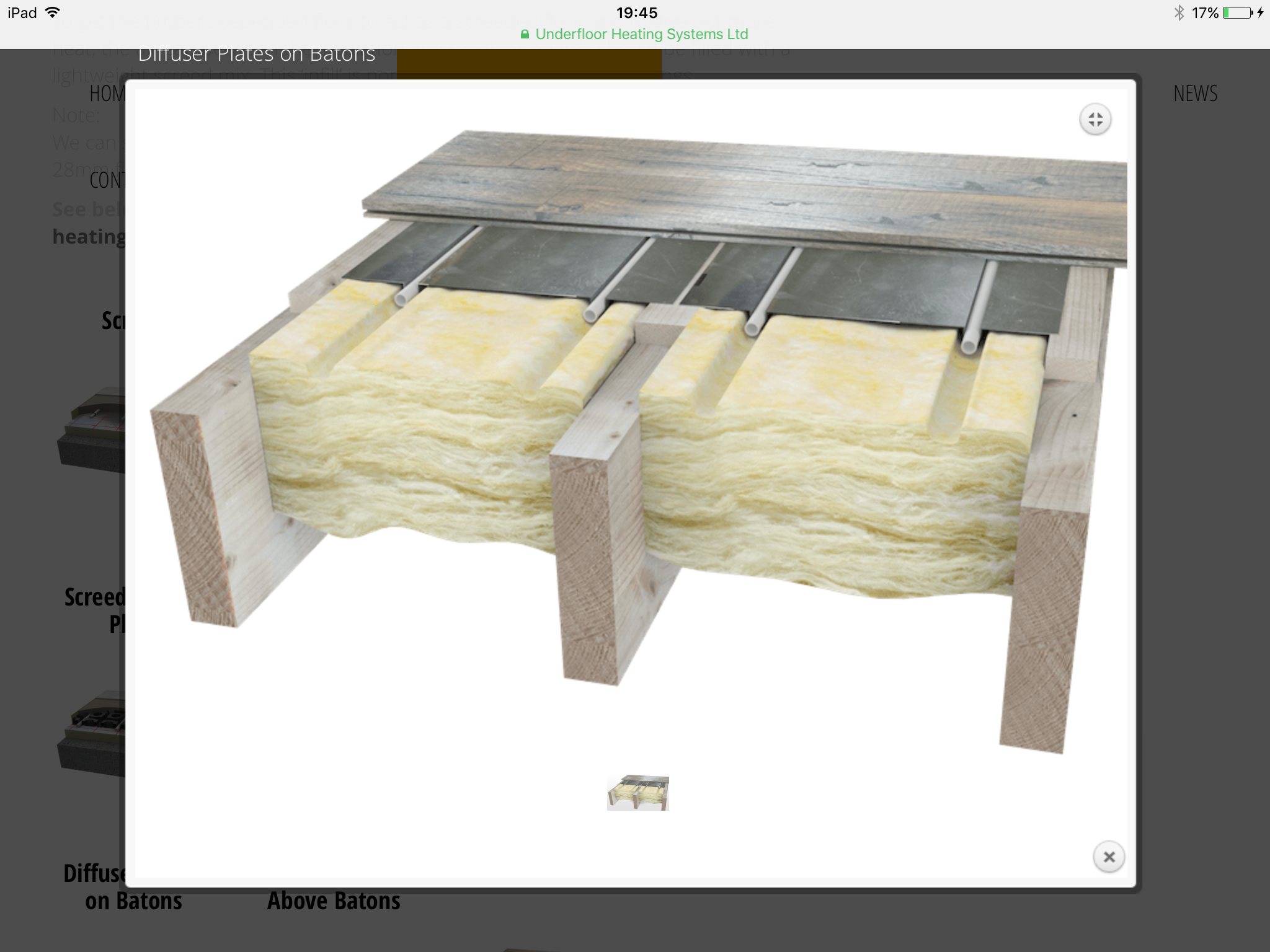
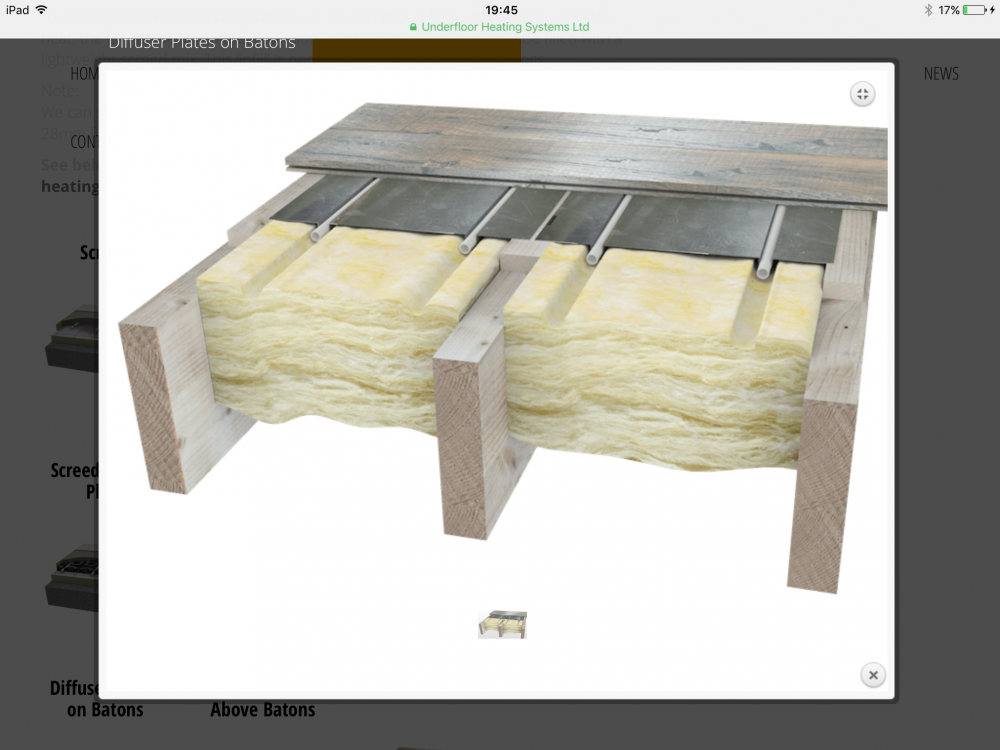
That method is for wooden floor as your finished floor. . The only thing I'd add to that scenario is fitting some fluffy ( Rockwool ) under the plates to make them slightly proud of the finished height. That way, when you fix the wooden floor down you'll be forcing the plates against the fluffy and ensuring good surface contact between the plates and the wooden floor. If you look at Frogeyes pics above you'll see how the plates naturally want to sag so that needs addressing with either method, eg fluffy or staples.
-
This method That allows you to cross the posi joists without cutting into them. Just remove the batten accordingly.
-
Dip under the top rail of the joist. Not ideal, but if you commission ( purge ) properly you should eradicate any air locks / pockets. Once full of water and treated properly with inhibitor ( X100 / similar quality product ) then it should be fine. Air vents ( automatic ) on both of the manifold rails is essential. .
-
With my rubi cutter there is next to no waste. I really struggle to tell which side is factory and which side I just cut. Money well spent . @daiking changing to a pukka blade will help a lot.
-
Warm Water Coming From CWS Tank Overflow Pipe
Nickfromwales replied to Onoff's topic in Boilers & Hot Water Tanks
If your boiler stat was set too high then maybe. The cylinder would only have heated to the set temp of the boiler, so anything above 70oC may have started a bit of excessive expansion plus it would have been sustained so perhaps see if it all settles down now ? -
Duff 3-Way Valve or Hot Water Cylinder?
Nickfromwales replied to Onoff's topic in Boilers & Hot Water Tanks
FYI. My combi continued to produce oodles of hot water during this episode. -
First and foremost, FIT THE UFH FIRST WHENEVER YOU CAN ! Retrofitting from underneath is simply hard work. @Bitpipe was in the same boat as you, but I managed to nudge him into 'doing the right thing' and he put his plates and pipe in as the build went up. MBC lads joined in and helped ( took over iirc ) to lay it and it saved a LOT of grief. The ideal set of events would be to allow for your posi-joists to have an 18mm batten atop, and then plates. The batten is required to allow you to cut the end for the pipe to transverse joist space to joist space as posi-joists can't be cut. Not a problem with regular joists btw. The main thing, either way, is to make sure the plates are fixed up nice and snug. I use an air powered stapler to fix them to the underside of the deck material so the heat transfer ( promoted by surface contact ) is as good as it can get. The only real tip for fitting from underneath is make sure you have a pipe decoiler, make sure you have at least 3 people on it, and don't be in a rush to do it. Pulling in 100m of pipe is a pain, kinking the last 10m piece and having to pull it all out and start again would be soul destroying. . Cut a few short pieces of pipe and get used to the minimum bending radius, ( before the pipe kinks ), by trying to form 180o bends in the sample pieces. That'll give you an insight into how far you can & can't 'push' the pipe.
-
What spaces between flow and return pipes in UFH
Nickfromwales replied to joe90's topic in Underfloor Heating
Simple folks, just insulate every other pipe in the congested areas . 9mm wall armorflex will be ample. -
Duff 3-Way Valve or Hot Water Cylinder?
Nickfromwales replied to Onoff's topic in Boilers & Hot Water Tanks
The only thing missing is a cape ?? -
Yup. Just until you can see it's not got another full revolution left to go. "Plumbers eye" aka "Use the force".
-
Guys just being massively over cautious. . No need to run it imho and I never have. Is your slab concrete with steel mesh or floating screed / other?
-
Put about 25-28 turns of ptfe and turn it into the socket until snug and vertical. End of job. Don't overshoot and back turn it or you'll fack it up.
-
Chip away the internal wall / skim and use a multi tool to cut the sleeve. Screw the tap on and then push the bend fully on.
-
A square plastic trim will have a slight lip after the flat so should help hide the top edge a bit. Remember to keep the adhesive low down so you can fit the trim after.
-
A scribe and snap cutter would be far better tbh. Can you hire one for a day / weekend and just do all cuts in one go, so you have the raw material cut to size then you only need to cut to length ( after you've returned it ). ?
-
Dot and Dab vs adhesive for insulated plasterboard
Nickfromwales replied to AliG's topic in General Construction Issues
All depends if that means a shed load of filling. The bigger the gap the more filling you'll have to do, plus the foam is a bit uncontrolled if it's open to the room. Remember that coving is 80mm or so from lip to internal corner and 30odd mm of that is for the adhesive to land so you've got 50mm to play with. I don't like the plasterer having to start or finish a set that close to where it's visible as they always get a bit of a bell at the top and bottom of the set. ( bless them ). Plasterers also hate the foam as if they catch it with the trowel it gets into the mix and upsets them. The less foam on display the less it needs cutting back and the less loose bits to get in the plaster. Also, sometimes on a retrofit I've had to get the walls on prior to the ceilings going up, just to get things on and drying if we can't get the ceiling a up for any reason, so the foam option really does help out there. Yes, but there are dabbers, and then there are guys who have seen it done and have a go Prudence, and attention to detail are your friend, but a guy getting paid on meterage will always want to compromise that for a buck I've found. When the dab has gone off the boards won't move one bit, if dabbed properly. I use high expansion foam at frequent intervals to ensure the gaps are filled. LE foam hardly expands at all so I don't recommend it for this tbh. Just don't go mad with it. -
Recommendation of a plumber in Antrim/Ballymena area?
Nickfromwales replied to JamieM's topic in Ireland
Oh, and if you find a good plumber I'm happy to speak with them if there are any aspects of the remit they're unsure about.