

Nickfromwales
-
Posts
31376 -
Joined
-
Last visited
-
Days Won
345
Everything posted by Nickfromwales
-

Bath Surround / Boxing In, and concealed pipework
Nickfromwales replied to Onoff's topic in Bathrooms, Ensuites & Wetrooms
+/- 2mm worrying you ?!? Given the shape of the room at the start you should be patting yourself on the back mate -
He's right. There is no way an oil boiler should be servicing the UFH directly, even more so with it connected directly to the heat exchanger and no means of bypass. In the boiler manufacturers installation instructions ( MI's ) it'll specifically mention designing the system to reduce / eliminate short cycling. This can be done with a LLH or small buffer tank, I'd go for the buffer myself as a LLH will typically have much smaller volume which would give less result vs cost to do. The heating all comes off the buffer, 3 sets of tappings ( boiler in and 2 x UFH out ) and the dhw still comes direct from the boiler via the motorised zone valve.
-
Bath Surround / Boxing In, and concealed pipework
Nickfromwales replied to Onoff's topic in Bathrooms, Ensuites & Wetrooms
In fairness, that's looking like one well engineered, meticulously executed bathroom. . Très bein, Rodney. -
A mobile welder will gas a couple of letterboxes in for you in no time at all. Just check with SE to see if they need to be plated over afterwards to maintain integrity. ?
-
Help.... query shower top entry waste
Nickfromwales replied to Alexphd1's topic in Bathrooms, Ensuites & Wetrooms
I'd favour push fit EVERY day of the week. As long as the pipe is supported then there is really no need to solvent weld imo. I've had more trouble from solvent welded joints on 110mm than I ever have with push fit. Glue can go brittle and if the two mating surfaces aren't prepped and cleaned properly then the joint will fail. Also, you'll really be buggered if you ever need to move or alter it afterwards. Silicone lube it up and push fit all the way. -
Help.... query shower top entry waste
Nickfromwales replied to Alexphd1's topic in Bathrooms, Ensuites & Wetrooms
Can you post a link to the one you've chosen? I think it'll more likely be push fit tbh. -
?
-
My mate did that. Just bought a 1400x1800 piece of smoked, tempered glass, and a chrome wall channel. Looked the bollocks. He asked me to manage the transition from downstairs to upstairs and supply a few pairs of hands. As he was a friend in need I naturally said no chance . I knew him well enough to know he'd have made me buy it if we broke it.
-
The Dewalt multi tool is a lovely bit of kit. I really dislike the on off switch position on the makita, and the Dewalt one is variable speed on the trigger too so a real contender. Fwiw, the new Dewalt stuff has me SERIOUSLY tempted, with just the price tag on the new 54 volt stuff keeping me well away. ?
-
I'm 80%+ makita, and they're great, but you'll be hard pushed to match the Fein IMHO. If it's a daily driver, go with another Fein, but if it's occasional then the makita is an excellent choice. Don't buy an early model or you'll be stuck with the tool change for the blades, the newer one is tool-free. For eg
-
Which one was it ?
-
Is it a system boiler ( with integral pump ) ? And are there any gate valves on the flow and return to the cylinder ?
-
Bath Surround / Boxing In, and concealed pipework
Nickfromwales replied to Onoff's topic in Bathrooms, Ensuites & Wetrooms
I foooishly assumed that was a given, so yes, NEVER put chrome pipe into ANY speedfit fitting. . Good shout Peter . -
Bath Surround / Boxing In, and concealed pipework
Nickfromwales replied to Onoff's topic in Bathrooms, Ensuites & Wetrooms
They're only ever going to be at =/< 2 bar so I'd not panic too much about 2 compression joints behind the rad, I've done it hundreds of times converting copper to chrome via compression bends or couplers. Ive had more immediate failures with soldered joints than compression tbh. Famous last words -
Id say inside .
-
Bath Surround / Boxing In, and concealed pipework
Nickfromwales replied to Onoff's topic in Bathrooms, Ensuites & Wetrooms
Bingo -
Bath Surround / Boxing In, and concealed pipework
Nickfromwales replied to Onoff's topic in Bathrooms, Ensuites & Wetrooms
Nope. Quick search found this , Thats about as good as it gets, but with the added bonus of the compression side being able to accept chromed 15mm pipe, so the exposed stuff can be nice and shiny to match the 'radiator'. Then straight into these ??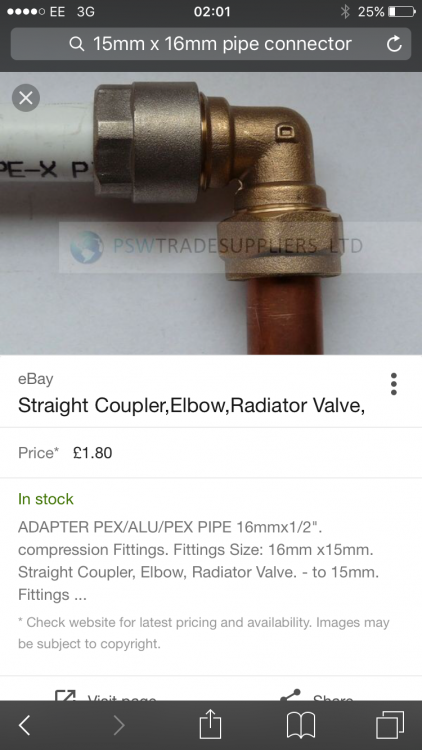
-
Attic cold water tank - anti-freeze measures?
Nickfromwales replied to readiescards's topic in General Plumbing
? -
+1
-
Does he mean a slab, covered in insulation and then the pipes and screed ? I understand that you sound happy with your change in direction, but I can assure you that there would be absolutely no degradation caused by the pump running. The pipes and concrete set as one, and therefore there cannot be ANY movement. Movement is required to caused abrasion, so that type of fault / leak simply wouldn't occur IMHO. I believe he has given you a bum steer there, and I've also fitted this stuff for years, AND been responsible for screeding it. The only difference between me and your chap is I have zero stories to tell about leaking / damaged / burst Ufh pipes, howsoever caused . I know which one I'd listen to. .
-
At Loggerheads With UFH Supplier Over Design Layout
Nickfromwales replied to slidersx200's topic in Underfloor Heating
Very disappointing that they failed to respond positively. Byron needs to get a new UFH designer, as, witnessed by myself, this was far below any acceptable standard. There was better available for free . I promoted them for their supply only services, and technical support ( in-house ), but as far as their design services go ( outsourced ) the writing is unfortunately on the wall. -
Attic cold water tank - anti-freeze measures?
Nickfromwales replied to readiescards's topic in General Plumbing
@readiescards Buy a pressure gauge and fit a non return ( double check ) valve to it. Connect that to your outside tap and leave on for 48 hours. That will capture the peak STATIC pressure available and is critical survey info to ascertain your best cold mains solution. 1 2 3 Test and report back. -
Attic cold water tank - anti-freeze measures?
Nickfromwales replied to readiescards's topic in General Plumbing
That's a hell of a hosepipe -
Is this not a neighbour issue ?
-
+1 on those electri saver units. I fit them when we do uvc's with a 20a switch paralleled as a master override .

