

Nickfromwales
-
Posts
31390 -
Joined
-
Last visited
-
Days Won
346
Everything posted by Nickfromwales
-

What valve needed for UFH cooling
Nickfromwales replied to tanneja's topic in Air Source Heat Pumps (ASHP)
DIY for me, up to the point of gas and F certification etc. This lot for around £750 a unit ( supply only ) isn’t bad, but cheaper makes can be had. I’m seriously tempted by this. Link Due to the limited combined outputs of the multi unit splits, I think I’ll end up with 2x Link covering 2x units in workshop and office and then the rest doing the 3x 1st floor bedrooms and 1x attic bedroom. I can then point the max outputs at the biggest / most problematic spaces. The controls can be set up to allow one indoor unit to demand more of the outdoor units power to make sure that that particular space has sufficient cooling. Pipe kits and gassing need to be priced on top, and even with me buying and running all the lines and power etc ( also don’t forget about the condensation drains from each indoor unit to a suitable drain ) I expect to spend another £600-£800 on top of those prices. Hiding pipes and cables will be down to how much labour money you throw at the project. -
Plasterboard required for plant rooms?
Nickfromwales replied to Hilldes's topic in Plastering & Rendering
You can get horizontal UVC’s if that helps? -
Shower control valves and toilet help
Nickfromwales replied to Vijay's topic in Bathrooms, Ensuites & Wetrooms
Like I said, talking complete and utter bollocks. Email them a link to @Onoff’s video. -
Shower control valves and toilet help
Nickfromwales replied to Vijay's topic in Bathrooms, Ensuites & Wetrooms
It from his ‘personal shower’ collections…… Please don’t ask any questions about arse hair removal devices……. -
Plasterboard required for plant rooms?
Nickfromwales replied to Hilldes's topic in Plastering & Rendering
Yup. They do get crazy very quickly! -
What valve needed for UFH cooling
Nickfromwales replied to tanneja's topic in Air Source Heat Pumps (ASHP)
Combi for DHW. ASHP for cooling and heating with cheap low grade heat. Combi for heating for the depths of winter. Hybrid ASHP’s can have either gas or oil burners to do exactly this. Controls will be the difficult part. Personally I would fit the 4 splits upstairs to purge unwanted heat and see what effect that has on the overall overheat issue. Nothing beats air-con in bedrooms afaic, ( I’m looking at a 5 split system for my own house atm ). I think it would leave things manageable with the splits absorbing and exporting excess ambient heat from the upper floors vs it just stagnating. Note: the 4 and 5 way splits operate with intelligent load shifting, and only allow full potential to one problem area. The remaining units have to share the residual kW power rating so some rooms suffer the lower output. Basically you cannot exceed the output of the main unit. Eg you may have a 12kW outdoor unit and 4x 3.6kW cooling capable units but they’ll never all achieve full potential. -
fitting vertical column radiators
Nickfromwales replied to gaz_moose's topic in Central Heating (Radiators)
These vertical rads have quite a bit of weight to them, before filling with water. If you can cut out where the cupboard is and offer a couple of 200x200mm 18mm plywood squares and then fix the upper rad brackets through the plasterboard and into the ply that would then take all the weight and give a solid fixing. The lower fixings are usually either just bump stops or another 2 of the same brackets as you have up top. They are less important if you’ve got a good purchase up top, and can be done with some Gripits -
UFH manifold cabinet - any point?
Nickfromwales replied to MortarThePoint's topic in Underfloor Heating
I’ll be fitting 2 of these on my current project where I’m fitting 2x manifolds, one above the other, in the back of a general use cupboard in an utility room. The plastic flow gauges and capillary wire for the thermostatic probes are easily damaged, so if anything is routinely taken in / out then there is merit in protecting them imho. Can be done with 2 bits of 50x50 and a removable panel of MDF. -
Plasterboard required for plant rooms?
Nickfromwales replied to Hilldes's topic in Plastering & Rendering
BCO gets the final say, as always, but if doing this for your own peace of mind the go to town. Foam to fill gaps, cut back shy, then tape + acrylic FR mastic on top for maximum integrity. Smoke detection in plant spaces should be mandatory. BRegs are more worried about air admittance on a foul stack ? -
Shower control valves and toilet help
Nickfromwales replied to Vijay's topic in Bathrooms, Ensuites & Wetrooms
Yup. And if either the head or the spray need to be tamed, which I don’t think will be necessary, you can just fit a suitable 3rd party flow restrictor. Link -
Shower control valves and toilet help
Nickfromwales replied to Vijay's topic in Bathrooms, Ensuites & Wetrooms
@Vijay The person you spoke to is talking out of their arse. That valve will deffo control flow. I’ll put money on it. -
Plasterboard required for plant rooms?
Nickfromwales replied to Hilldes's topic in Plastering & Rendering
https://www.labc.co.uk/sites/default/files/labcpd0715_techg_firefoam_0.pdf Fire foam is combustible -
Plasterboard required for plant rooms?
Nickfromwales replied to Hilldes's topic in Plastering & Rendering
Arresting the spread of fire from open flames is the consideration here. If it were a multi storey dwelling or adverse scenario requiring fire intervention then your BCO would have already stated so. Have you actually asked your BCO ? Our opinions here are worthless btw. That person is signing your build off not any of us If you don’t have any mandatory stipulation(s) then just consider risk vs mitigation, and focus on the salvage of the fabric of the property, eg if a fire started there.Buying a FR plasterboard is £10 more than a regular one. Why skimp?!? Fill gaps with intumescent acrylic caulk not FR foam as that has far better integrity. FR foam is for very small gaps only. On every single one of my full M&E installations, early prevention ( detection and intervention ) via deployment of optical, ionisation, multi-sensor and heat detectors in every habitable and plant space is standard practice. Each type of detector is selected to suit the space. Finding a fire before it’s become involved is the number one focus of the owner, and prevention of the spread of flames and cold smoke is the focus for means of egress and escape, eg the preservation of those routes of escape ( for 30 or 60 mins whichever is applicable ). Talk to your BCO. -
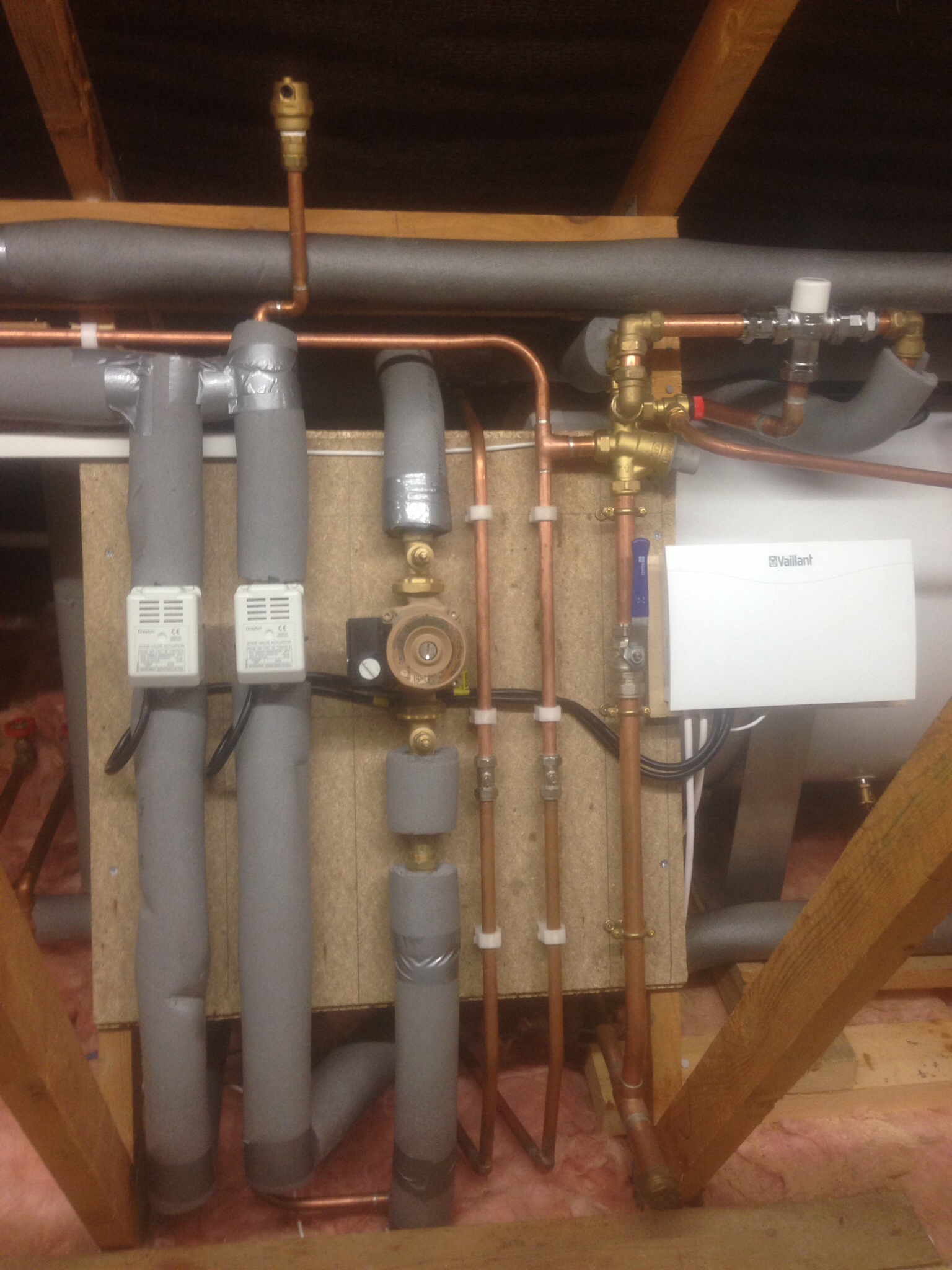
Tundish needs to be with the UVC for G3 compliance. Control group within 500mm of the UVC. It’s all in the MI’s of the UVC so do you have a copy?
-
The copper fitting above the tundish appears to be a 22x22x15 centre tee, taking another output. That’s probably the 6bar PRedV off the control group, but we need a LOT more pics and info before you have a pop at this guy. Nowhere near enough info to interject atm sorry. Water main by electricity supply is perfectly fine. No issues there. If this is a new UVC install, then we need to know if every mixer tap / mixer shower / bath mixer etc, basically anything monoblock receiving hot and cold into the same body, has been supplied with a balanced cold feed from the control group. Lots to ask and see before answering any further.
-
Shower control valves and toilet help
Nickfromwales replied to Vijay's topic in Bathrooms, Ensuites & Wetrooms
Either/or most prob, but it may have a middle position doing 50/50. Would you really need both on at the same time ? Starting to think a digital mixer is your only choice here. Deeper pockets will get you this; https://www.ebay.co.uk/itm/Kohler-K-2971-KS-NA-HiFlow-Rite-Temp-Pressure-Balancing-Valve-one-size-/174780823037?mkcid=16&mkevt=1&_trksid=p2349624.m46890.l6249&mkrid=711-127632-2357-0 You’ll also need this; https://www.homeloft.uk/products/kohler-kt53214cp-refinia-valve-trim-with-pushbutton-diverter-valve-not-included-polished-chrome Nice single lever, integral user set high temp ( anti scald ) arrest, and a simple push button for diverting from head to hose. Thats as good as it gets me thinks. You’ll need to sniff out a UK supplier to get accurate prices, but Kohler is very good stuff, up there with HansGrohe and spares and after sales will be ongoing. You can buy a service / overhaul kit now and be right for 15-20 years of trouble free motoring. Good luck. Sounds like you need it. ? -
Shower control valves and toilet help
Nickfromwales replied to Vijay's topic in Bathrooms, Ensuites & Wetrooms
This might tick the boxes. Link Large simple single lever, multi function plus a reasonably useable driver for switching between hose and head. That will probably be a 2 click flow rate, medium and fast ( as you pull the lever out it will click into position one then you keep pulling for position two ). You’d have to confirm that, but that is a signature setup for the higher end manufacturers. Swing left to right for temp. Send this to a complimenting diverter valve for head / hose. Downside is, you’d have to feed the hot side via a TMV as I don’t think these are thermostatic. Upside is, zero risk of accidental scalding as you will have already capped the max hot temp input eg an inadvertent move of the lever to the hot side would not give hotter than say 38oC ( or whatever you set the TMV to ). Upside 2, this is bombproof and future proof. -
Shower control valves and toilet help
Nickfromwales replied to Vijay's topic in Bathrooms, Ensuites & Wetrooms
Ah yes, Hudson sorry. Long day(s). They look the same as a Bristan I fitted so brain just hit autopilot as it does occasionally ? -
Shower control valves and toilet help
Nickfromwales replied to Vijay's topic in Bathrooms, Ensuites & Wetrooms
If this needs to be fit for purpose then this could be a plan. Set this concealed into the wall. Infirm friendly and thermostatic with good flow control. Then pipe in the wall to one of these types of one in two out stand alone diverter valves ( choose one that matches the shower valve as best as possible ) and then pipe from the two outlets of that to the head and the handset. That’s your lot mate. After that, proper disability recognised units are just single output to a hose and spray for assisted bathing eg no dual setup. -
Shower control valves and toilet help
Nickfromwales replied to Vijay's topic in Bathrooms, Ensuites & Wetrooms
Yup. That’s reasonably easy to turn. @Onoff, can you provide some feedback as to how much effort the valve needs to turn the two flow valves plz? The centre control is temp so basically set n forget. -
Underfloor heating manifold how it works?
Nickfromwales replied to Martysmarty's topic in Underfloor Heating
Not on a boiler > single loop UFH setup. Deffo not a healthy arrangement for the boiler. The manufacturers installation guides often state that short cycling should be mitigated against by design. You need a 50L buffer in series with the flow, between the zone valve and the UFH manifold, and a 22mm gate valve ( NOT a bypass valve ) fitted across the flow and return connections where they supply the manifold. I use the 50L version and works a treat. These are very well insulated and wall mounted. Just connect the boiler flow ( after the ZV ) to one upper tapping, and and then UFH flow to the diagonally opposite lower tapping. Blank the two other tappings off. That will give you sufficient energy buffering to not have the boiler ever running under duress. -
Shower control valves and toilet help
Nickfromwales replied to Vijay's topic in Bathrooms, Ensuites & Wetrooms
Ok. It’s only a SEQUENTIAL valve that gives you cold flow at 100% which you then keep rotating to get the heat through until happy and showering. The majority of other thermostatic mixers will have a lever valve which pulls towards you for 0-100% flow rates, and swings left to right for temp control. Vado is excellent stuff for the money btw. I’ve fitted loads of the stuff and never had a single issue. The Bristan valve that @onoff linked and used is very good for the money, and easy to use. Great flow rates etc. Heap enough to buy one for spares. Same tor the WC seats, just buy 2 for spares and get on with your life -
Yup. These folks pay ‘staff’ to manage the stuff they can’t be bothered with, like sucking up crap from the pool bottom. This guy would regularly be using the pool in the arse end of the summer through to September and beyond. Big party throwers, and lots of creams laying around to ‘cure various issues with the nether regions’s’ ??
-
Underfloor heating manifold how it works?
Nickfromwales replied to Martysmarty's topic in Underfloor Heating
If you can only have the UFH on when the rads are on, it would help massively. If not, you’ll need a buffer tank for sure. -
I put two gas boilers in for an outside pool ( uncovered!!! ) and the guy said he would just “live with the £5-6k gas bill p/a………..” That was about 6/7 years ago. I strongly advised 15kW of ST on the roof ( 2x 7.5kW system split E&W ) but he said he would think about it but wasn’t overly bothered. Said gas was just a button push so a simple solution. Wtf.


