


Dreadnaught
-
Posts
1819 -
Joined
-
Last visited
-
Days Won
5
Everything posted by Dreadnaught
-
My soil survey was done by a company Peterborough. Let me know if you'd like their details.
-
I'd like it please.
-
Earlier this year I used a specialist contractor from Suffolk for my reinforced concrete raft foundation if that's any help. Message me if you'd like the details.
-
I thought this was spot on: – Person 1: Why do we build houses like this? [Picture below] Person 2: Can’t resist taking a shot to see if I can do it in 5 tweets or fewer (as follows) … Tweet 1 1066 - William I establishes a system of land ownership that gives incredible political & economic power to landowners, giving land incredible ? value. Tweet 2 1948-1961- We regulate development but still end up allowing landowners to capture most increases in land value, even though that land value is created by everyone. Tweet 3 1970s-2000s This creates a biz model: 1. buy up potential development land. 2. wait / negotiate for LAs to award planning permission. 3. capture the sudden ⬆️ in land value by ? cheapest (facsimiles of) homes & n’hoods you are allowed to, then sell to the mortgage industry. Tweet 4 2000- Successive policies put ever-increasing pressure on LPAs to award planning permission, compromising on quality in order to prioritise quantity. Meanwhile the land value capture industry is also heavily subsidised because Gov believes we rely on it. Tweet 5 2020s Side-effect: we all end up living in the financial assets left behind by this industry. Even though they were never really designed to be successful places to live (I.e good social, economic or environmental infrastructure). That wasn’t their purpose. – From here:
-
That's what I found too with IdealCombi, so I am going to install myself (with a bit of friendly help) and use the Illbruck system. I only have six windows.
-
 Yes, I have seen the same with my timber frame. My foundation raft is complete and so the site is in a stable state to sit and wait. I have told my timber frame company to only buy materials at sensible prices and that I will be willing to wait. Who knows how long I will have to wait.
 -
Choice Timberframe specialist
Dreadnaught replied to Balraj Appadu's topic in Surveyors & Architects
I considered Olof at ADF (great service from him) but ended up using East-Anglian firms for (i) supply, (ii) engineering, and (iii) installation of my 26x screw piles (3x companies who regularly work together). One of the easiest parts of my build so far. Happy to provide an intro if of interest. -
Partitions: Timbers studs Vs Metal C studs
Dreadnaught replied to MortarThePoint's topic in General Construction Issues
If anyone is interested in MF partition walls, flipping through the GypWall White Book may well open your eyes. I like that you can choose a wall build-up based, for example, on sound absorbency vs thickness. https://www.british-gypsum.com/literature/white-book/partitions Of course you don't need to buy the components from British Gypsum. They are standard and commoditised. -
Partitions: Timbers studs Vs Metal C studs
Dreadnaught replied to MortarThePoint's topic in General Construction Issues
This is 60/72 but you get the idea…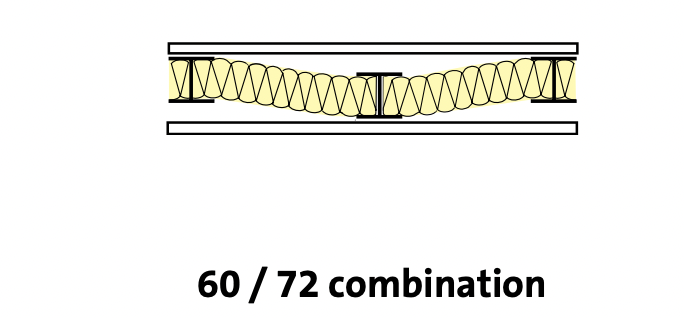
-
My costs (125 m² insulated raft): Groundworks: £15,100 Utilities connections off site: £10,000 Screw piles (x26): £12,500 including design, supply & installation. Insulated raft foundation: £35,000.
-
They only one I read is Passive House+ magazine: https://passivehouseplus.co.uk. When they review a house, they give a list at the end of all the suppliers, which is useful.
-
Recommended reading material?
Dreadnaught replied to Irish Rover's topic in General Construction Issues
The Passivhaus Handbook by Jae Cotterell. I read it cover-to-over and found it very useful. -
On the subject of SVPs, there needs to be adequate provision for ventilation of the foul drain among you and your neighbours. That does not mean every house needs an SVP. I looked at my neighbours and spotted other SVPs so told BC that I didn't need one. BC accepted it. I will just have AAVs.
-
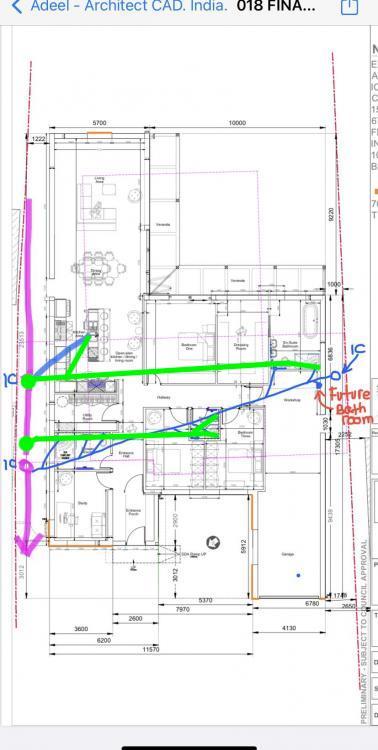
This (in green) is the sort of thing I had in mind. All WCs on main runs. Stick a rodding eye at the end of the long run if it exceeds the max length of a run according to BC. You don't need to angle your runs at 45º. You can approach the IC at 90º and have a short bend right next to the IC to hit the socket (bends are allowed so long as they are right next to the IC). And note that, while bends are best avoided in general, bends of <30º are generally allowed away from the IC in long runs if they are required.
-
Interesting. I am unsure about having the WCs on branches. I would be tempted to find a way to have them on the main runs. Perhaps have two main runs branching from the purple IC. Just an idea. My only definite comment is that you could consider just a rodding eye at the end of the run rather than a full IC if you wanted. (I am not an expert but I did design (and install) my own drainage system for my current build, which has been signed off and inspected by building control.)
-
Getting ready for the big start!
Dreadnaught commented on Thorfun's blog entry in West Sussex Forever Home
sadly I don't think you will find one. Sufficient to say that it is a kiosk made from a palette-as-a-base with flimsy OSB walls, door and roof. Despite it being plumbed in to the sewer, having a fetching window with a view (no glass), and a bucket conveniently filled with water for flushing, the consensus from certain visitors thus far has not been complimentary. -
Confused by Triple Glazing Justification
Dreadnaught replied to MortarThePoint's topic in Windows & Glazing
Heat loss through frames is often greater than through the glass. Manufacturers who make triple-glazed windows probably care more about frames than those that only make double-glazed ones. Buy good frames. -
@Visti has a Brink model I believe. I heard he was happy with it. Remember that the Brink units are also branded as Ubiflux Vigor too.
-
(@Nick Laslett, I might have about 8m of the 32mm insulated twin pipe spare on my site if you're interested. I'll measure the off-cut next time I'm there.)
-
What does that mean please?
-
What SAP information to submit to BC
Dreadnaught replied to Moonshine's topic in Building Regulations
Same here. I just sent them the whole report. -
Suspect that's a minimum. Or rather a maximum that their lifetime-aging-system will allow them to estimate. 30-years will see me out. And it will probably be an easy-ish job to replace it when the times comes.
-
I too am considering using Ubbiflex B3 for covering my insulation at the bottom. I have the samples of grey and black (tempted by the black). I am puzzling over fixings. @ToughButterCup, how did you attach yours to your EPS? Regarding stopping vermin, I am thinking of putting a narrow layer of MOT-style stone right next to the house and up against the Ubbiflex. I assume the buggers won't chew or burrow through stone. Then backfill with soil for my flower beds.
-
I paid £22 per panel delivered, with free clips. Cambridge.
-
Windows....which company did you choose and why?
Dreadnaught replied to Tom's Barn's topic in Windows & Glazing
@GaryM, looks great! Installed by IdealCombi's official installers or DIY?

