


Dreadnaught
-
Posts
1819 -
Joined
-
Last visited
-
Days Won
5
Everything posted by Dreadnaught
-
 Good point about privacy. Matter/Thread is being designed to accommodate Apple's greater focus on privacy that is inherent with Apple HomeKit. More details here if you're interested (scroll down to the "Home" section): https://www.apple.com/ca/privacy/features/. In regard of their prioritisation of privacy, all companies are not the same.
 -
Another perspective is the wider market of commercial building automation. None of the consumer systems currently available are suitable for large buildings. A major focus of Matter (and therefore Thread) is for it to be a system suitable for building automation and control. Companies that specialise in building automation and control such as Siemens, Schneider Electric, Assa Abloy, Lagrand, even Lutron, are all taking central roles with Thread. Oh and here is a full list of the participants in the Matter Standard as of today (and more a joining constantly): ADT Security Services Green Energy Options Piaro Afero Inc Grundfos Plume Design Alarm.com Amazon Apple Inc ARM Ltd ARRIS Solutions Inc Assa Abloy AB ATLANTIC Group Atmosic Axis Communications Ayla Networks BEGA Gantenbrink-Leuchten KG BELIMO Automation AG Belkin International Inc BOE Technology Group Co Ltd Bouffalo Lab BrightAI BRK Brands Buffalo Inc Bureau Veritas Consumer Products Services Busch-Jaeger Elektro Cable Television Laboratories CAME SpA Card Access Engineering LLC Chameleon Technology UK Ltd Charter Communications China Electronics Standardization Institute Comcast Cable Communications Management Connectivity Standards Alliance Control4 Coway Crestron Cypress Semiconductor Corp Danfoss A S Datek Smart Home AS DEKRA Delta Dore Delta Electronics Deutsche Telekom AG Develco Products Digi International DigiCert Inc digitalSTROM AG D-Link Corporation dormakaba Holding AG DSP Group DSR Corporation DT&C Co., Ltd. Easee Eaton ecobee EDF RD EDMI Ltd Eglo Leuchten GmbH Element Materials Technology Ltd Eltako GmbH Emerson Commercial Residential Solutions EnOcean GmbH Espressif Systems Essence Group E-surfing Smart Home Technology Eurofins Digital Testing Eve Systems Exegin Technologies Ltd Facebook Inc Fortune Brands Global Plumbing Group Future Home AS Futurewei Technologies Gardena GmbH GE Current – A Daintree Company GEWISS SpA Google LLC grandcentrix GmbH Granite River Labs Guangzhou Elite Education Technology Co Ltd Hager Controls SAS Haier Hangzhou Sky Lighting Co Ltd HDC I-Controls Honor Device Company Limited Huawei Technologies Co Ltd IKEA of Sweden Infineon Technologies innovation matters iot GmbH Inspur Software Technology Co Ltd Insta GmbH iRobot iThinx GmbH Itron Inc Jasco Products Company JiangXi Innotech Technology Johnson Controls Inc Kee Tat Manufactory Holding Limited Kirale Technologies SL Kroger Co Kwikset Landis Gyr AG Latchable Inc LEDVANCE LLC Leedarson Lighting Co Ltd LEGRAND Lennox International Level Home Inc Leviton Manufacturing Company LG Electronics Liberty Global B V LIFX Logitech Lumi United Technology Co Ltd Lutron Electronics Mastercard MediaTek Inc Microchip Technology Midea Group Miele-Cie KG Mill International Mitsubishi Electric Mitsubishi Electric US MMB Networks Morse Micro mui Lab Inc Nanjing IOT Sensor Technology Nanoleaf National Technical Systems Netatmo Niko nv Ningbo Sunpu Ningbo Suntech Lighting Technology Co Ltd NodOn Nordic Semiconductor ASA Nortek Control NquiringMinds Ltd NXP Semiconductors Netherlands BV ON Semiconductor OPPO Orange SA Origin Wireless Inc Osram Sylvania Inc Otodo Panasonic Corporation Panasonic Marketing Europe GmbH Panasonic North America PanKore Integrated Circuit Technology Co Ltd Perspecta Labs POLYNHOME Powerley Procter and Gamble PROFALUX Proxy Inc Qingdao Yeelink Information Technology Co Limited Qorvo Qualcomm Remotec Technology Ltd Resideo Technologies Robert Bosch GmbH Robert Bosch Smart Home GmbH ROCA SANITARIO SA Ruckus Wireless Sagemcom SAS Salto Systems Samsung Electronics Co Ltd Savant Company Schlage Lock Company LLC Schneider Electric Sectigo Ltd Secure Meters UK Ltd Sengled Co Ltd Sercomm Corporation Shanghai MXCHIP Information Technology Co Ltd Shenzhen CoolKit Shenzhen Heiman Technology Co Ltd Shenzhen Orvibo Technology Co Ltd Shortcut Labs AB Siemens Industry Inc Siemens Schweiz AG Signify Netherlands B V Silicon Labs SimpliSafe SITERWELL Electronics SmartThings SoftAtHome Somfy STMicroelectronics SAS Synaptics System Level Solutions Inc TCL TeLink Micro LLC Tesla Texas Instruments TietoEVRY TP-Link Corporation Limited Trane Technologies TUV Rheinland of North America Tuya Global Incorporated Ubilogix ubisys technologies GmbH Underwriters Laboratories Universal Electronics Velux AS Viessmann Elektronik GmbH Vimar SpA Vivint Smart Home vivo Mobile Communication Co Ltd Whirlpool Corporation WS Audiology Denmark AS Wyde Labs Wyze Labs Inc X-HEMISTRY Inc Xiaomi Communications Xylem Inc Yandex LLC Yo Labs Inc Zehnder Group Vaux Andigny Zhejiang Future Lighting Zuma Array Ltd Zumtobel Group AG Z-Wave Europe GmbH Zyax AB
-
While it is encouraging to see all the big consumer companies supporting Matter and Thread, such as Apple, Google, Amazon, Samsung and IKEA. What is arguably more important is the support by the semiconductor manufacturers. All the little companies buy their semiconductor modules off-the-shelf for their systems. When those off-the-shelf modules move over then the whole industry will follow. Semiconductor manufacturers such as Silicon Labs, Texas Instruments, NXP, Nordic Semiconductor, Qualcomm are all backing Thread.
-
Yes, it will. Nanoleaf has announced full support for Matter. https://www.androidheadlines.com/2021/05/nanoleaf-becomes-the-latest-brand-to-support-the-matter-smart-home-standard.html
-
I use the Home App and I find it to be fine. I think that all of the home-automation apps are criticised and the adage that "you-can't-please-all-of-the-people…" applies. The Home app's functionality will be extended in time but it can already do everything that you mentioned in your original post, especially if you are comfortable using the Apple Shortcuts app as welll for some more advanced automations. Keep in mind that: (i) the best home automation shouldn't need human intervention but be programmatic; e.g. blinds that rise at sunrise, or rise when the brightness of sunshine exceeds X; or using motion sensors in rooms; and (ii) in addition to using the Home app, you can control your home using Siri from a Homepod, iPhone, iPad, Mac or Apple Watch, or button, or from Control Centre on any of those devices (and all work well in my experience). (And Siri is now much better than it used to be.).
-
For blinds, Somfy of France is a board member of the Matter (and Thread, where their CTO is a Director of the organisation) and they manufacture devices for both curtains and blinds. None using Matter have been launched yet but it would be reasonable to expect them next year. Their products seem to be modular and all it will take is a Matter-compatible module to be launched. I will be using them for automating my curtains throughout my new house. https://www.somfy.co.uk
-
Thread is one of the technologies (along with Wifi, and Bluetooth but only for initial connection) that will be used in the forthcoming Matter standard that is being sponsored by all the large manufacturers, including Apple, and which officially launches next year. I shall be centering my home automtation system on Matter (and thus Thread too). https://buildwithmatter.com (The alliance behind thread grew from the Zigbee alliance, which renamed itself the connectivity standards alliance).
-
Wire through wall for weather-compensation sensor
Dreadnaught replied to Dreadnaught's topic in Air Source Heat Pumps (ASHP)
Yes that is what I guessed. As a fan of simplicity, I hoped that abandoning zones would make the plumbing simpler. It seems it might. Although there seems to be a consensus that no zones might be going too far. By the way, what is Ambisense? Are they just smart radiator valves? Do you use them with radiators or with UFH? -
Wire through wall for weather-compensation sensor
Dreadnaught replied to Dreadnaught's topic in Air Source Heat Pumps (ASHP)
Good point. Another similar eventuality is solar gain from the sun, especially in the late afternoon. Presumably that cannot be predicted by weather compensation, which I guess relies on temperature forecasting. Going back to @Nickfromwales point about the heating system having a long time constant (because of the mass of the concrete slab), my response to your point is that there is nothing much you can do about the overheating, even with zones, as any intervention will only have a appreciable affect some hours later. I can imagine that the only remedy is to anticipate that forthcoming big-party-of 20-people in the morning before and just turn the whole heating system off in advance. Equally, might the ASHP controller flip the system in to reverse cooling mode when it detects overheating. I don't know. Regarding solar gain, it was (long missed) @Jeremy Harris who highlighted the benefit of running the circulating water through the UFH pipes without a heat source, to redistribute the heat around the house. Thoughts? -
Wire through wall for weather-compensation sensor
Dreadnaught replied to Dreadnaught's topic in Air Source Heat Pumps (ASHP)
Thanks for sharing your insight @ProDave. But in your case but without multiple heating zones, without multiple thermostats, and without automatic valves on your UFH manifold linked to a wiring centre, wouldn't you instead manually dial back the flow rate on those loops that supply the zones that heat-up the quickest. Once manually balanced like that, all your zones would reach the target temperature at approximately the same time. No over heating. Simpler system. A one-off exercise to set it up. In practice would that work? Am I misguided? -
Wire through wall for weather-compensation sensor
Dreadnaught replied to Dreadnaught's topic in Air Source Heat Pumps (ASHP)
Thanks @J1mbo. Your experience of living with the system is very helpful and encouraging. That's interesting. In my case, that the coldest room in the house will be the Utility Room. We have laid the UFH so that the supply runs that traverse under the Utility Room are insulated. The Utility Room will only receive heating from the (depleted) UFH pipes that return from the large main Living / Dining / Kitchen area. Mine will be a pretty well-insulated and airtight house with MVHR so I expect that all rooms within the thermal envelope will be similar in temperature. Would the Utility Room be a good location for the Vaillant controller? It was actually where I was planning to put it anyway, to hide all such gubbins. -
Wire through wall for weather-compensation sensor
Dreadnaught replied to Dreadnaught's topic in Air Source Heat Pumps (ASHP)
I'm even hopeful that the above approach might simplify the plumbing by removing the need for the usual hydraulic decoupling between the ASHP and the UFH manifold with a low-loss header or similar. I assume some form or expansion vessel would be needed. But perhaps that is all. I would certainly aim to need neither a wiring centre nor wiring for multiple thermostats. (As you can tell, my plumbing knowledge is near nil.) For DHW* I am still toying between a Sunamp** heated by off-peak electricity and thus completely separate from space-heating. Or having a more conventional unvented cylinder matched to the ASHP, such as Vaillant's own UniTower all-in-one, and therefore linked in with space-heating too. If I chose the Sunamp route, I am slightly concerned that the ASHP would stand idle for about half the year, when neither space heating nor cooling is needed. My fear is that idle appliances aren't happy appliances. * DHW: domestic hot water. ** probably a Sunamp eHW 9. -
Wire through wall for weather-compensation sensor
Dreadnaught replied to Dreadnaught's topic in Air Source Heat Pumps (ASHP)
Thanks @ProDave. My own instincts on this broad subject, and based on my reading around the subject, is to have a relatively small ASHP. Set it to run at a low temperature and almost constantly. And allow it to adjust the temperature using its own controller, which I can tweak the curves for a while as @J1mbo said, but with the aim that eventually it will be "set-and-forget". Oh, and not to bother with any heating zones or indeed any automatic actuators on the manifold at all. The relative room temperatures can be tweaked as needed by manually turning the manifold knobs on a set-and-forget basis. And have but a single thermostat in the living room (the one in the image above). Oh, I also plan to have electric UFH mats in the bathrooms so the floor feels toasty-on-ones'-tootsies in the winter. And this can operate as auxiliary heating if needed in the coldest depths of winter. If even that proves insufficient, a dimplex or two should suffice in a severe cold snap. (And use the ASHP to cool the house in the heights of summer too.) Keep it really simple and aim for set-and-forget. Am I nuts? -
Wire through wall for weather-compensation sensor
Dreadnaught replied to Dreadnaught's topic in Air Source Heat Pumps (ASHP)
Yes, I would be happy to tinker over weeks or months. What is the alternative? I wonder how else one could attempt to put the right amount of energy in to the house over a 24h period to maintain the temperature at an approximately constant level while the weather varies? I think @TerryE has a custom computer algorithm to do it linked to a weather forecast. But that's the only alternative I can recall. -
Wire through wall for weather-compensation sensor
Dreadnaught replied to Dreadnaught's topic in Air Source Heat Pumps (ASHP)
I don't have any details about the weather compensation, other than: "sensoCOMFORT comes with an outdoor sensor which provides an understanding of the thermal behaviour in and around the property and adjusts the flow temperatures to ensure optimal efficiency". Oh, and it has a pretty LCD screen so it so it must be good.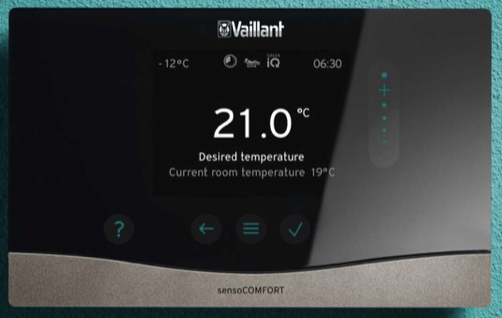
-
Wire through wall for weather-compensation sensor
Dreadnaught replied to Dreadnaught's topic in Air Source Heat Pumps (ASHP)
Good point. Perhaps it will be as effective as having separate heating zones within the house. But as a standard feature of the "SensoCOMFORT" ASHP controller (don't you love those marketing names), I suppose it can't do any harm. -
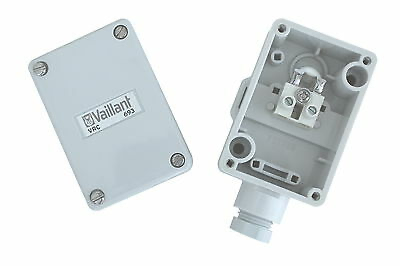
Next I will be putting on the external cladding of my timber frame (Cedral Lap planks). Beforehand I am looking at all the penetrations through the exterior wall. One penetration is the wire for the ASHP controller's weather-compensation sensor (see image below of the sensor). The manual says "Connection wire is 2 x 0.75 mm²".Google says this is "2192Y" wire, which seems to be a common type cheaply available from Screwfix, etc. Should I … just buy a roll of that wire? install it through the wall with a loop outside and a longer loop inside? Should I use a cover plate (see below in orange)? Or instead just slope the penetration downwards and back fill with silicon? This is my first bit of "wiring" so would appreciate any advice and suggestions.
-
Ah thanks @shuff27, that's helpful to know.
-
By the way, I intend to put a in-line pre-filter box on the intake like this. This will be a coarse filter so as not to add too much resistance to the air flow. And which will catch errant flies and so on. WIth the new duct runs, this could now be in the neighbouring Utility Room: more easily accessible for filter changes. I am a bit cornered about condensation forming, on the inside in summer and outside in winter. I may look to have a tray underneath to catch any condensation.
-
I have a question about how high to drill the the holes. Back on site, I had another careful look at the position of the holes. I realised that I cannot drill through the span of a posi-joist as I planned. This because I would be cutting through the top of the wall cassette, so hitting the horizontal I-beam that is its cap. This means that I will instead lower the holes beneath the ceiling of the plant room, which will make the drilling easier anyhow. (This in turn means that, to achieve my desired separation between intake and exhaust (of 1.5 m) that I will run the intake duct through the stud wall in to the neighbouring Utility Room.) My new question: I have high ceilings, 2.8 m. Now that the holes are below the ceiling, how low can they go? Could be at 2 m height? Could they be even lower? Or is higher better?
-
The pozijoist is touching the wall. Ingenious! Thank you to everyone once again for more ideas. I'm back on site on Saturday and I will be up on my step ladder again for another look… and think.
-
I checked them with a tape measure so all looks well. Good point. It is foam mass-flow ductwork so I think it should be OK. It should absorb any vibration. And, too, the joist in question only serves a utility room and the main bathroom, fortunately not a bedroom.
-
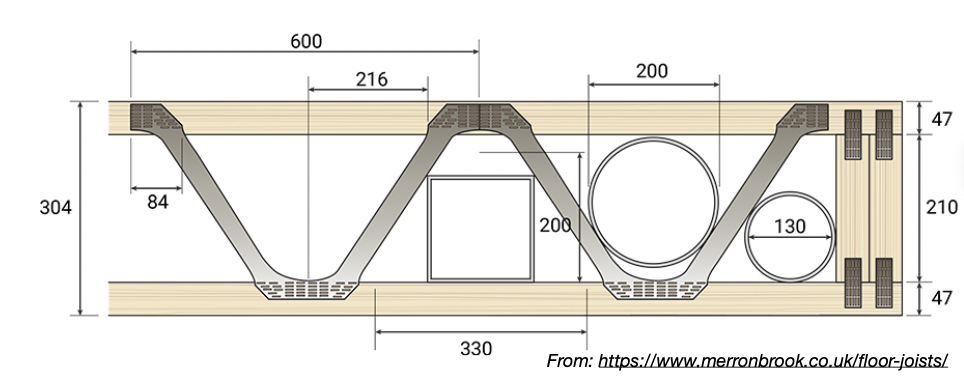
Good suggestions. Thanks all! One problem. For the inside holes I will be cutting through the span of a posi-joist, which is positioned against the wall. I don't think there will be enough space for a jigsaw. The posi-joist is 304mmm, so a 200mm howl will only just fit, as follows:
-
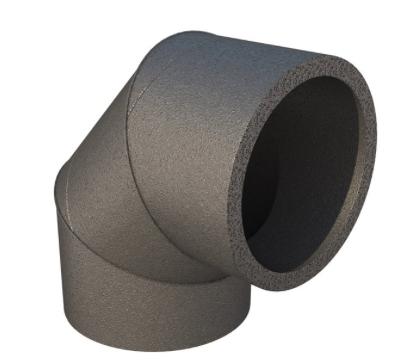
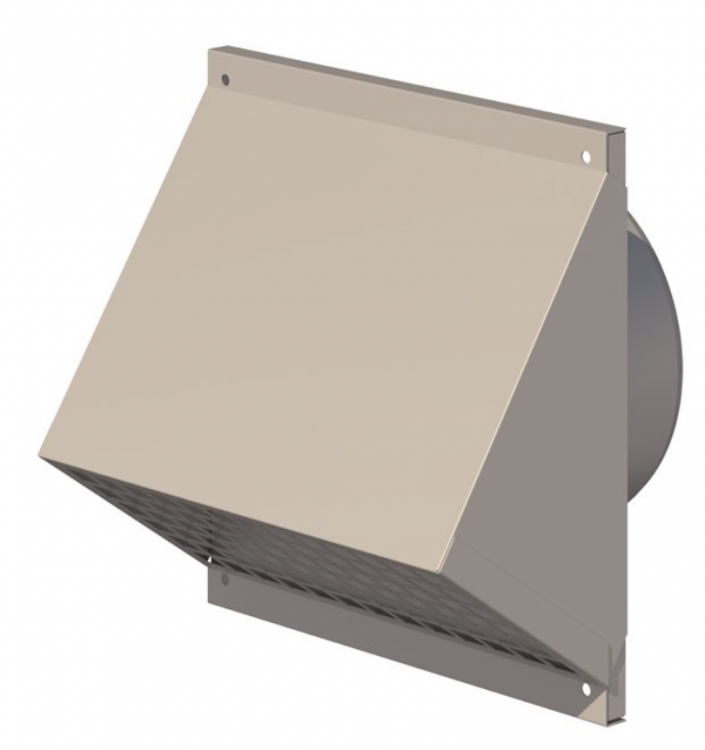
How do I go about drilling holes in my exterior walls for MVHR ducts (2x) to atmosphere? What tools should I use? How should I do it? Guidance, suggestions & tips most welcome! External walls (closed cassettes) OSB, 12.5mm, Smartply Propassiv – inside Empty cavity 240mm, to be later filled with blown-cellulose insulation. Studs every 600mm. Magply, 9mm – outside House warp: Tyvek Firecurb Ducts (2x) Ubbink 160mm (internal diameter) insulated ductwork External diameter: 192mm External cladding (not yet installed): Cedral lap planks (190mm, 30mm overlap), over treated battens. External wall terminals (x2):
-
Oh, and I positioned the MVHR unit as far away from the bedrooms as I could, even taking the precaution of placing it on the far wall of the plant room. In a well-insulated house, which is airtight and triple-glazed, and which therefore tend to be whisper quiet inside, even small sounds become noticeable, sounds that would normally blend into the background of a normal house.


