
ProDave
-
Posts
30688 -
Joined
-
Last visited
-
Days Won
424
Everything posted by ProDave
-
We have I joists downstairs (there are no services under the floor) and posi joists upstairs as there are plenty of services. Both are very good and solid. I believe the posi joists cost more.
-
One got into our house when I was fitting a velux window and left it unsealed for over a day (we had previously heard it on the roof between the roof tiles and sarking board) After about 2 weeks of the cat not getting it, and it fully exploring all the service voids and scratching about just about anywhere you could mention, I put poison down for it. It has gone now, but no smell at all. It can't have got out, it will have died somewhere but no smell.
-
EICR testing for rental property
ProDave replied to joe90's topic in Regulations, Training & Qualifications
Strictly the smoke alarm is not a failure on the EICR. If the sparky has "failed" the EICR for no hard wired smoke alarms then he is WRONG. However hard wired smoke alarms is a separate requirement for rental properties. Only just coming into force in England, but has been a requirement for Scotland for some time. There is a lot of discussion on the electricians forum as they are trying to bring in a different competent persons scheme for doing EICR's over and above any others. A non 18th edition CU as noted is a C3 at most so NOT a failure. There is no such thing as a failure, it is either Satisfactory, or not satisfactory. and to be not satisfactory it has to have 1 or more C2 or C1 faults. -
Oil Prices nearly 30% Down
ProDave replied to Ferdinand's topic in General Self Build & DIY Discussion
Heating oil price on a firm downward slope https://www.boilerjuice.com/heating-oil-prices/ -
Ah, so a power cut and then back on, may have powered it up in the wrong order then.
-
The first thing I would try, is find the consumer unit, identify the power feed to it. Turn it off wait a few minutes and turn it back on, i.e. re boot it.
-
We have an ASHP so I will answer the "concerns" The ASHP needs to be sized to match the building, if done right it will work properly. A well insulated house will not cool down quickly and only needs a low heat input. So it does NOT need to heat up quickly. I estimate if the heating in our house broke down it would be 24 hours before you even noticed. Yes the HP only heats heating OR hot water. Again if it takes an hour to heat the HW tank you WILL NOT notice that the space heating has gone off for an hour. We live in the Highlands where -10 is common most winters. The ASHP carries on working. There is no doubt heating a HW tank takes longer so you would just fit a larger tank. They are no more noisy than an oil boiler. But the noise is outside the house. Most people are happy to have an oil boiler roaring inside their house, so a similar level of noise outside is not going to bother anyone. An ASHP works best at a low temperature so ideally suited to under floor heating or over sized low temperature radiators. The electricity grid is getting lower carbon all the time as we move away from fossil fuel generation.
-
FCU = Fused connection Unit. SFCU = Switched, Fused Connection Unit. If the towel rail is too close to a bath or shower it's normal to just have a Flex Outlet Plate in the bathroom and a switch outside the bathroom to control it.
-
Most that I see are lath and plaster on the inside (with no insulation between that and the stone) From what I hear "plaster on the hard" was only done by poor people.
-
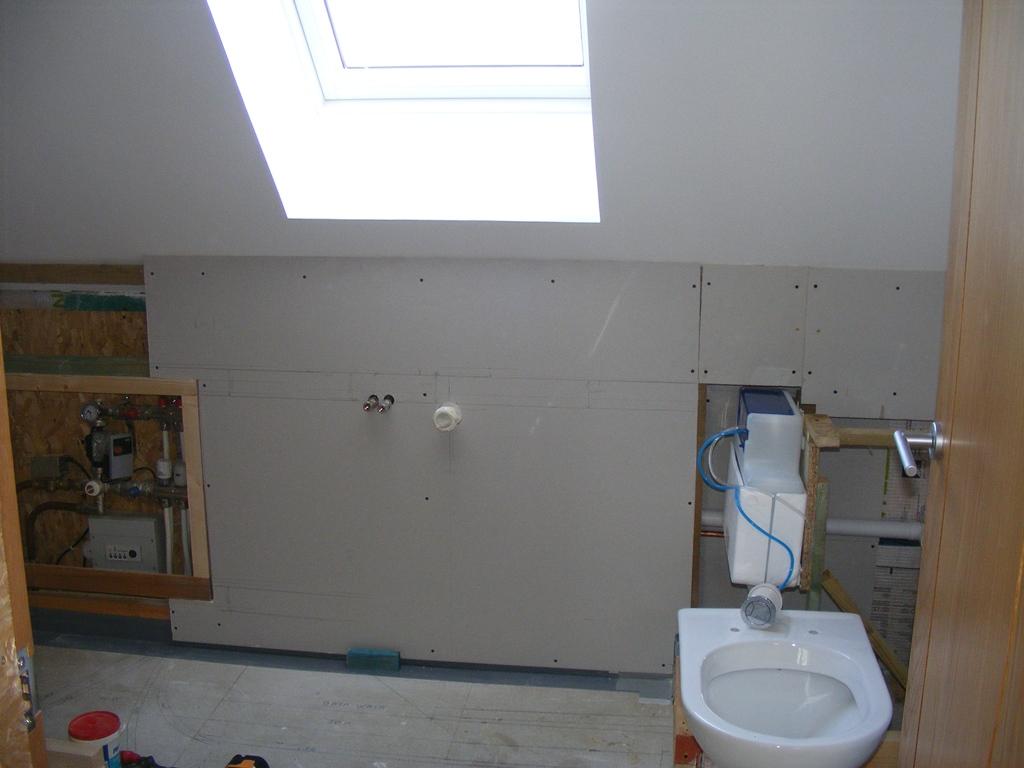
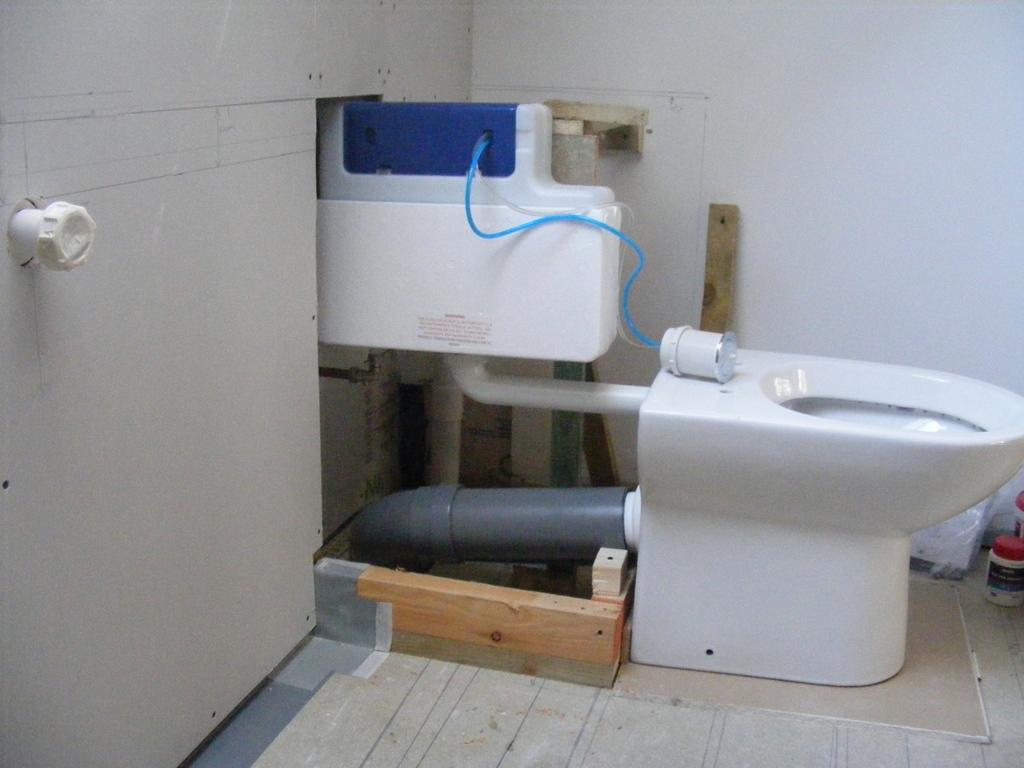
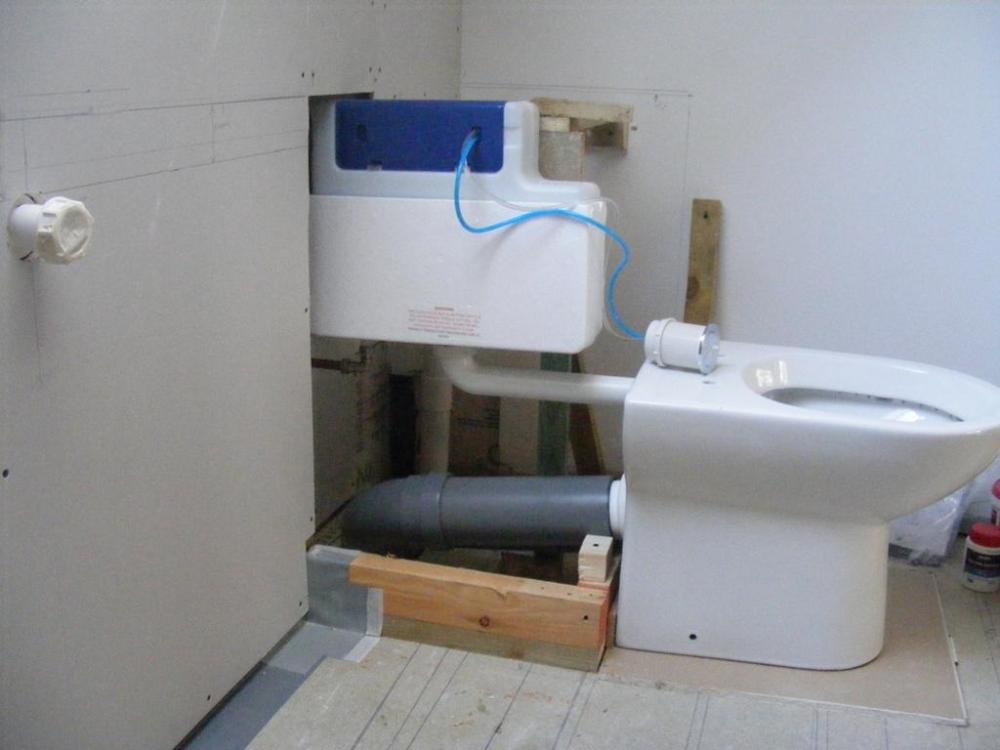
Yes of course. I just put it there to test the plumbing would work. It is currently sat on an offcut of plasterboard to simulate the additional height it will be raised by the time the floor is tiled. I am trying to get the worktop height as low as possible due to having a countertop basin. I have set the cistern as low as I can, i.e. the top part of the flush pipe is shortened to it's limit. So the underside of the worktop will be about 10mm above the top of the cistern just allowing room to remove the access hatch. will be using a thin worktop to keep the top surface of the worktop as low as possible. I would have liked it slightly lower but that would mean seeking out a cistern that took up less space.
-
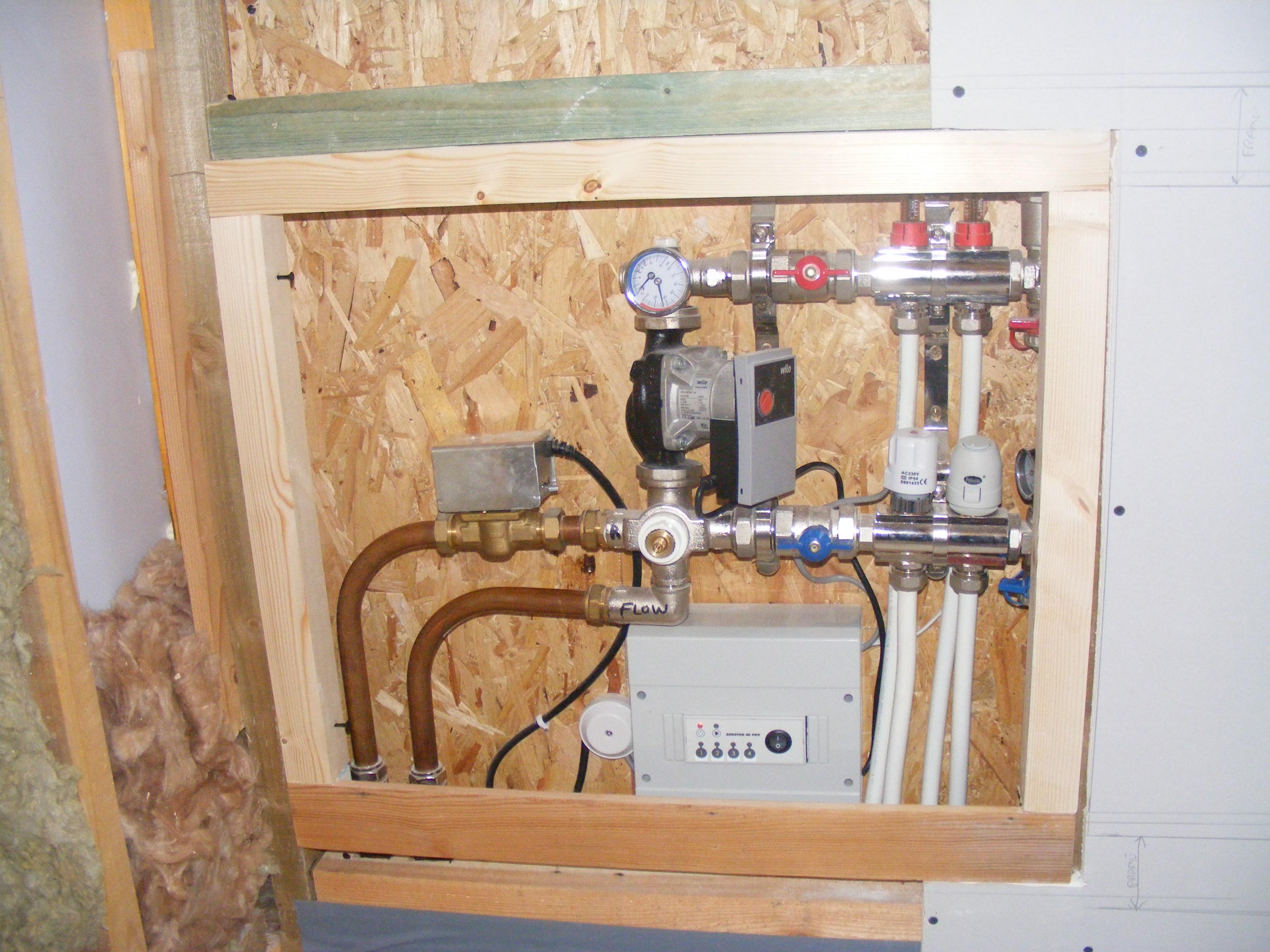
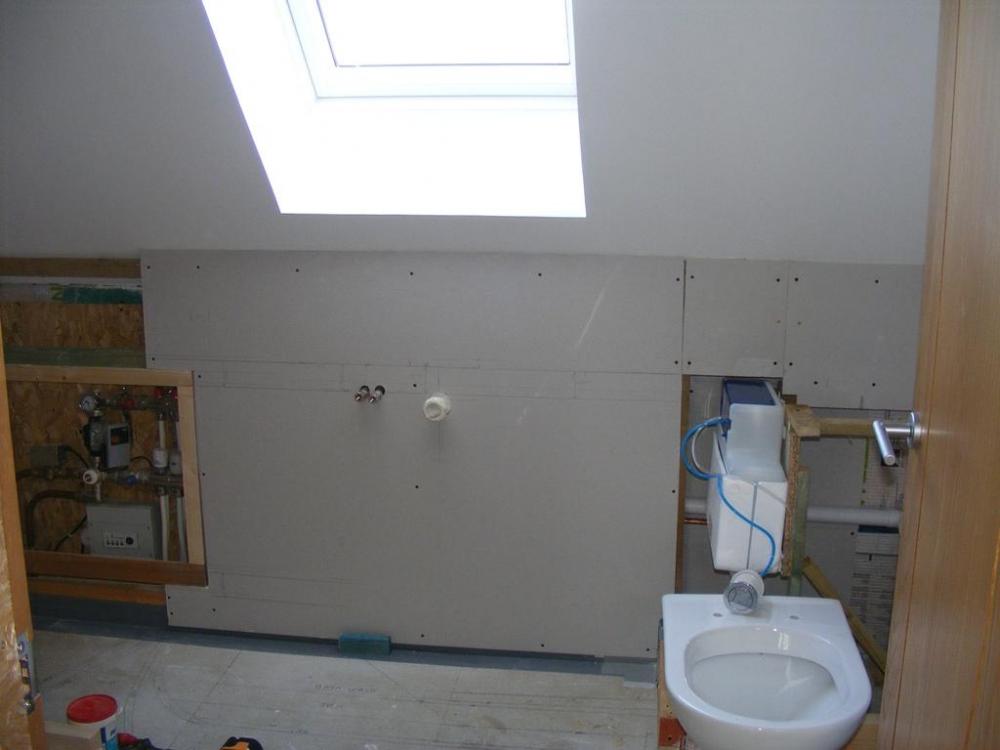
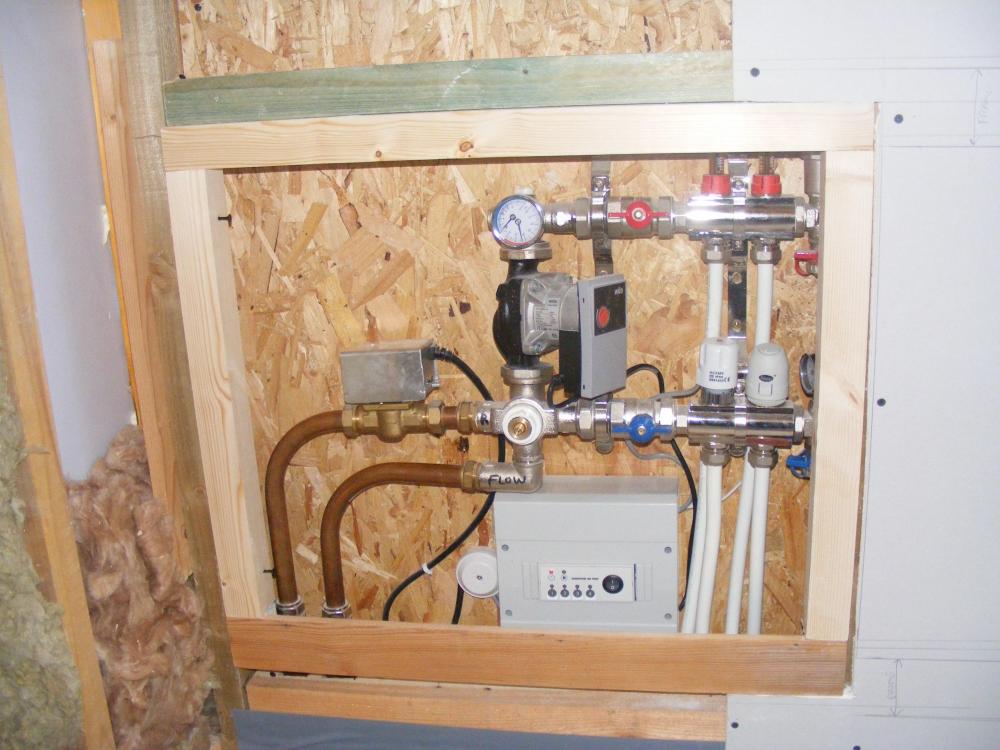
So when I had the plasterboard just tacked to the wall, and the base unit in place, I marked the exact locations where the basin waste and tap feeds needed to come out. I then drilled the holes, marked those through to the wall behind, removed the plasterboard and did the plumbing for the basin. This is the access left for the UFH manifold. By turning the pump round a bit I have kept the depth needed to a minimum. this will be covered by a trap door in the left of the base unit. The WC cistern is mounted sideways and will be accessed through a trap door in the right hand end of the base unit. the front panel (behind the WC pan) will be solid. So now it's time to scrub up the floor and apply the tanking membrane ready for the floor tiling.
-
But WHY do they think you need to be a "registered heat pump engineer" to fit them? Yes you need an F gas ticket to gas a split system. So fit a monoblock heat pump and you only need an electrician and a plumber. Or is this more UK "lets bury the problem in extra paperwork" nonsense?
-
Strictly speaking that holds the light bulb, and the "light socket" is free floating and plugs onto the back of the bulb. Why are you having trouble finding those?
-
But two 100mm layers of 100mm Frametherm 35 would go in there nicely.
-
It pays to have ALL the parts, basin AND trap, them do a mock up of exactly where they will go.
-
I am not sure what you mean by a "downlight socket" That is not a term in common use. You normally buy a downlight as a complete assembly with the bezel any brackets it needs and a connector to go on the lamp, and a termination box to joun the lighting wiring to the flying tails of the lamp holder. Which bit are you trying to buy on it's own? You can certainly buy replacement GU10 and MR16 lamp holders on their own, which is a good thing because the MR16 lamp holders in particular are a rubbish design. They are not really capable of taking the higher current required of a 12V Halogen lamp and burn out with regular monotony. One of the reasons I dislike 12V lighting. In contrast the GU10 lamp holders are very good, and I really think it is time we scrapped the BC and ES light fittings (which are dangerous things) and used the GU10 base for "ordinary" lamps.
-
If you went up to say 300mm I beam studs you could fit more of a cheaper / easier to fit insulation like Frametherm 35 and have a better decrement delay. No mention in your description of an air tightness / vapour barrier or a service void for cables? That sort of detail will improve the build probably more than increasing the insulation.
-
I am doing this right now in my own en-suite. I have built the unit that the basin will go on, so with that stood in place and the basin on it with the trap fitted, trap at mid point of it's height adjustment, I marked on the wall exactly where the waste pipe needs to exit. Then I fitted the waste pipe to a coupling that sticks half way out of the wall to join the tail pipe from the trap into and plasterboard the wall. I will take some pictures later and update my en-suite thread.
-
Depends what you mean by "small" "Small" to most people would mean about 1kW which is not going to add much charge to your car at all. 10kW is probably more like what you need and they are not cheap. You also need to be in an exposed location with few local obstructions to get the best out of them. At some time I will play with a small turbine but I know our site is far from ideal so I am not expecting much.
-
I put together a 4kWp system for £1500 including panels, inverter and mounting frame for ground mount. I seem to be self using about £250 worth of electricity per year so should get payback in 6 years. That might improve as I have some shading issues. I cut 2 trees down over the winter so I will see if that improves things this summer. It took a LOT of shopping around to get everything at rock bottom price.
-
I don't like the design of that one little bit. I would have expected there to be some form of gutter around the perimeter of that, with that able to drain somewhere safe, to give a safe exit for any water that does make it past the seals. No doubt they will remove the glass, re seal everything and put it back, and then all will be well. Until next time...... When it is off, make sure every single fixing screw hole is well sealed, that will be where it is getting into the building. And since the framework does look to be larger than the upstand, I would talk to them about the idea of drilling safe weep holes to allow any seepage out onto the roof.
- 48 comments
-
- 4
-

-

-
- roof
- rooflights
- (and 2 more)
-
Like most things, ebay https://www.ebay.co.uk/sch/i.html?_from=R40&_nkw=compriband&_sacat=0&_sop=15
-
If it's a developer house then you can almost guarantee the most important thing, the insulation levels and air tightness will not be as good as they could be, so right from the start you have that disadvantage. That would be where I would direct my questions.
-
New member, renovating a stone croft house!
ProDave replied to MMeNDtal's topic in Introduce Yourself
Not quite. Outside to in: Stone wall gap 100mm (or more) frame filled with insulation air tight membrane taped at all joints 25mm battens following frame studs to create a service void for cables etc Plasterboard. That will give you an air tight structure I doubt insulating outside will stop all the damp, this house will have no foundations as such and no damp proof course. -
Working on 1L of LPG = 6.9kWh and your consumption of about 20 litres per day means you have a heat use of about 138kWh per day. That is a lot. Lets say the heat into the house is 80% of that allowing for boiler efficiency that's 110kWh of heat into the building per day. Lets assume the heating is on for 12 hours of the day to achieve that, that's 9kW of heat for those 12 hours. So you would probably be looking at a 12kW ASHP to run that. Working on a rough COP of 3.5 for the ASHP to give you that 110kWh of heat, it would consume 31kWh of electricity and at 14p per kWh would cost about £4.34 So very roughly an ASHP would halve your heating costs.