ProDave
-
Posts
30862 -
Joined
-
Last visited
-
Days Won
427
Everything posted by ProDave
-
What is the breakdown between window price and fitting price?
-
I saw one just last week where when you opened the top drawer, it was in fact two narrow drawers with a gap in between for the basin trap to hang down into.
-
My stance would be "there is no wayleave, here is my notice to remove your equipment" then start negotiating that you might just consider giving them a wayleave if you convert it to an underground cable running around the perimiter of your plot well away from where you want to build the house.
-
Might it be an idea to do a test with an electric heater? So turn off the ASHP and plug in an electric convection heater of a known power output and put it in one room at a time and measure how long it takes to heat that room to the desired temperature. That will finally give you a measure of total power needed to heat the house. At the moment barely warm radiators are not proving anything, other than the ASHP is for some reason struggling to get them hot. When the installers were back last week, did you actually ask why are all the radiators not hot?
-
My guess is all the manufacturers of this type of insulation will be re branding and re launching following Grenfell.
-
Sizing up 6k Solar PV, am I on the right track?
ProDave replied to magutosh's topic in Photovoltaics (PV)
How about splitting the system. 3.68kW grid tied just plain and simple. The rest completely off grid charging a battery system. Obviously the loads that drives are all on a separate off grid electrical system but could feed your EV chargers and other high loads. You would need a changeover switch to power up the off grid circuits from the grid in the event of prolonged poor sunlight and running out of power. If you are talking of a 14kWp off grid system it might be worthwhile, but you would have to cost it properly to make sure your "free" electricity is not costing you more than what you can import. -
As everyone else says, get a set of 1M long SDS bits. Done it loads of times. If the wall is rubble in the middle get a sleeve ready and an assistant to push the sleeve in from the other side as you withdraw the drill. 25mm drill and a bit of 22mm copper is a perfect sleeve for 15mm.
-
Raising ground to the old level
ProDave replied to Bored Shopper's topic in Landscaping, Decking & Patios
The level shifts you are talking about I would not worry about PD or not, I would just do it. Te the garage, take the retaining wall alongside the garage with a gap so you are not piling soil against the garage wall. If you have building rubble that will need disposing of so get rid of that first and then determine final levels by what is needed to use up the soil. -
Bad Airtightness Test Result
ProDave replied to AliG's topic in Mechanical Ventilation with Heat Recovery (MVHR)
Until just over a week ago I would have recommended Octopus. But they have just put the prices on my variable tariff up by over 10%. I have not heard anything in the news to say wholesale electricity prices have risen 10% lately. And the only fixed tariffs they offer are no different to their variable tariff. So sad to say time for that battle of switching suppliers. A task I hate because all I want is the different electricity supppliers listed in order of pence per kWh but nothing is that simple on the comparison websites who pull the dirty tricks you mention. -
Showerwall - Arghhhhh
ProDave replied to canalsiderenovation's topic in Bathrooms, Ensuites & Wetrooms
What size are the panels? On my Multipanel I chose the ones without the t&g join so you use a joining strip which is a bit more forgiving, but they are 1200mm wide panels so unless you have a massive shower you won't have a join in the shower area. A lot of the t&g type I have seen seem to come in narrower panels so you have more joins and even if the join is perfect you still see a discontinuity of pattern. -
IVT Ecolane ASHP - any owners out there?
ProDave replied to readiescards's topic in Air Source Heat Pumps (ASHP)
I had a high pressure fault when I comissioned a GSHP for someone and speaking to the manufacturer, he explained it as low water flow, not taking the heat away from the HP quick enough so certain parts inside get too hot and the pressure gets too high. You mentioned slowing down your pump speed, I would start by increasing that again. -
It happens in Australia. North of Brisbane on the Bruce Highway is a sales yard where you can go and buy a second hand timber Queenslander type house and they will transport it and re erect it. These were never built to be portable but they literally cut them in half and stick some girders under them and transport them on low loaders. I saw a tv program about it, they have to travel at night with a police escort as abnormal loads.
-
I have declined from answering as I don't have a clue about some made up unit. I strongly suspect "Energy integral" bears little relationship to the true meaning of Integral in mathematics. Differentiation will give you the rate of change of a parameter. Integral gives you the sum over time. All I can remember is "integration by parts" was one of the most difficult areas of maths that I found difficult to understand.
-
Give an example of the context of it's use
-
Wobbly light or a visit to Specsavers
ProDave replied to Pocster's topic in Boilers & Hot Water Tanks
It just takes a multimeter to check the continuity of the element, typically in the region of 19 ohms for a good one. So if there is no off peak, why the 2 feeds and only one on a timer? Perhaps a bit of understanding of what you have got and check it matches what you need? -
A caravan can only be single storey so even if portable, a 2 storey home would not be possible under the caravan regs and would have to be a proper building with building regs.
-
Wobbly light or a visit to Specsavers
ProDave replied to Pocster's topic in Boilers & Hot Water Tanks
I suspect you have TWO problems: Off peak heater has failed some time ago, but has gone unnoticed until now that the TOP immersion (or the timer) has failed. Or possibly vice versa. Either way an electrician, armed with a spare immersion element or 2 should sort it. -
It does not say anywhere that a "caravan" has to be made off site. It can be constructed in it's final position if you want to. The only stipulation is it must be capable of being moved, so it must be built in such a way it won't all just fall apart if you try moving it. It has been tested and proven that lifting it onto a low loader with a crane is a valid means of moving it. so it boils down to the "chassis" must be stiff enough that you can somehow move it.
-
Wobbly light or a visit to Specsavers
ProDave replied to Pocster's topic in Boilers & Hot Water Tanks
The neon lights are notoriously unreliable and often fail, often because of the appallingly bad way they are connected inside the switch, so no light does not automatically mean no power. the only sure way is to take it off and measure the voltage at the output. But hold on, what is going on there? Top switch I would expect to be daytime boost, but it connects to a timer, so are you giving the tank a daytime boost regardless of whether it needs one or not? And the bottom switch I would expect to be off peak and would not expect any power to it in the daytime, but it has power, and why does it connect to a junction box going to multiple places not just straight to it's immersion heater element? -
Sizing up 6k Solar PV, am I on the right track?
ProDave replied to magutosh's topic in Photovoltaics (PV)
The only issues I have heard of with PV and house sales are "rent a roof" schemes, and concerns over the roof integrity. You will have neither of these issues. -
Sizing up 6k Solar PV, am I on the right track?
ProDave replied to magutosh's topic in Photovoltaics (PV)
If it is an on, or in roof system then you might have issues from a grumpy buyers solicitor about roof loading etc. But that is usually an issue with retro fit systems to old houses not designed for solar pv on their roofs. Yours is a new house with the PV fitted at the time of build and the PV will be there when BC issue the completion certificate so I cannot see an issue at sale time, just refer them to the BC completion and state no alterations have been done since then. Out of interest what is the MCS installer quoting to install panels that you supply? Any competent electrician should be able to connect them. That is where you need to be looking for quotes. How about the electrician that will be wiring the house? -
It will be a while before I fight this battle (still fighting others) but I will let you know the outcome.
-
Sizing up 6k Solar PV, am I on the right track?
ProDave replied to magutosh's topic in Photovoltaics (PV)
I don't want to sound like a part pooper, but there is no way a 6kWp solar PV system is going to provide all your energy needs. It will make a dent in your bills but do not kid yourself you will be anywhere near self sufficient. Absolutely no point in MCS. Just you or your roofer fit the panels and get any competent electrician to connect them. The DNO notification thing is not just a case of being "lazy" Up to an output of 3.68kW you can fit the panels and notify the DNO and they have no choice but accept it. Above that you have to get prior permission from the DNO and they might or might not make a charge for network upgrades. I asked the question of SSE where we are and I never got as far as requesting a quote as they made it clear there would be a charge. Solar PV without any FIT payments is marginally viable if you just have to buy the kit and connect it. If there was an additional DNO upgrade charge, that would almost certainly imho make in not worthwhile, which is why I stuck at 3.68kW -
what shall we do with existing roof conversion
ProDave replied to nina's topic in Lofts, Dormers & Loft Conversions
Do you feel inclined to post some pictures so we might get an idea what complies or not? The major things are Structure. BC will probably want the structure exposed so they can see if it is adequate and possibly structural engineers calculations. Insulation: Proof the walls and roof are insulated to required standards. Windows and fire escapes, a window will need to be a maximum height from the floor and a minimum opening to be used as a fire exit. Stairs will need to comply with normal stair rules of width, steepness and headroom. Fire doors if it is a loft conversion of a 2 storey property making it now 3 storeys. -
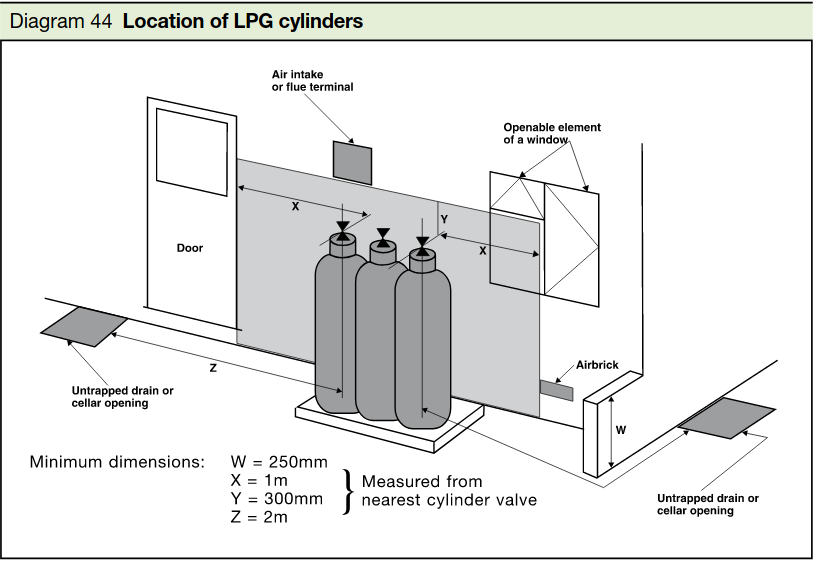
Perfect Not only does it show a non opening window, it also males it clear the distances are measured from the gas valve on the cylinder, not the top of the handle. So I suspect I would be okay even if my windows opened. So I will proceed on that basis that I now have a pretty picture to show BC when they object and grounds to argue it.