

ProDave
-
Posts
30862 -
Joined
-
Last visited
-
Days Won
427
Everything posted by ProDave
-
To test the seal of those 2 bolts, place the cistern on a stand of some sort away from the pan, and fill it with water from a bucket and see if they drip. If the don't then it will be the donut leaking.
-
Most of us on here have bought normal second hand ones, probably mostly recognised Japanese makes, then sold them for not a lot less than we bought them for. The Chinese one, bought new, would be guaranteed to lose a lot.
-

Attaching some wood straps to wall - which fasteners?
ProDave replied to NeilScotland's topic in Decorating
I would stick them. "Stick likes sh*t" would be my choice. You will need to hold them in place while it sets, tape will probably be all you need. ALL my skirtings and architrave are fixed like this, no nail holes. -
Our utility has the washing machine and that infernal towel fluffing machine aka Tumble Dryer. It also was the WC (not everyone likes that idea) It also has space for a "pulley" one of those clothes drying things that drops down from the ceiling so not everything has to go in the TD. That has it's own alcove so you can still walk through the room when it's full. Yes walk through as it is also the access to the garage. Oh and there is room for the ironing board to love there ready for use without having to fold it away every time. So yes a big utility room is good. Oh and it has a bit of space earmarked for a shower, a Scottish BR requirement.
-
Developers don't like deviating from a standard spec. If you informed them before first fix the additional cost should be trivial, but they seem to just milk you instead. I have retro fitted additional stuff to a new build after they have moved in for less than the builders wanted.
-
Yes like everything else they have to be "accessible" so no putting them up high or low down. you would have to check what the BR say in England it will be with all the other accessibility stuff. P.S my earlier comments, I missed the post where this jumped from fitting it in a low loft to now putting it in the utility room.
-
Should these valves stop my hot water?
ProDave replied to Harry Wood's topic in Boilers & Hot Water Tanks
I think the red handle in the top right picture might be the one, if the pipe from the bottom of it carries on down and then into the bottom of the cylinder. the bottom left one I think goes to the heat input coil so is part of the central heating system not the hot water supply. It is not unknown for gate valves to fail, particularly if they have been over tightened so it's entirely possible the valve is not shutting off. If all else fails, go into the loft and tie up the ballcock then run the hot tap until you have drained the header tank dry. -
The expansion vessel can go next to the tank so no extra height needed. But you do need a little bit of space above as the hot comes out of the top of the cylinder so you need room for an elbow and a bit of pipe plus insulation so say another 100mm?
-
Why is that? I don't speak from experience, but I can't see how a magnetic latch is different to a normal latch? It surely uses the same square shaft and you turn the square shaft to open it, and the latch is not going to know or care if you are turning the square shaft with a handle or a knob. so who says you cannot use a knob with a magnetic catch and WHY?
-
Isn't that stud wall going for the bigger shower, so what's the point in doing the floor yet?
-
UFH some zones not so hot/possible not working
ProDave replied to Adam2's topic in Underfloor Heating
That is correct behaviour. With the actuators off, all loops will be at full flow, set by adjusting the flow meters. An actuator pushes down on the pin to stop the flow. When it is energised it releases that pressure to allow the water to flow. If all zones flow okay with the actuators removed, there are no blockages. So if a zone is not opening when energised the actuator head has probably failed. They are easy to get and can be had for mot much more than £10 each. -
12V DC lights will draw 20 times the current of the same power 240V light. Add to that DC is not self quenching in the same way ac is, so there will be a lot more arcing when you break a dc load with a switch. And more volt drop because of the higher current so dimming due to volt drop may be much more noticable.
-
Potentially yes, though you would have to do some pretty stupid things wrong to make them so.
-
But you CAN do the output plumbing, plumb the heat source and motorised valve and controls, route the cold water supply up to the tank, install the D2 drain pipe then get your friendly plumber to make the final connections, test and commission it and sign the paperwork for not a lot of cost because you have done the donkey work. But you do need to first find such a plumber that is happy for you to do some of the work.
-
What I find strange is plumbers in particular seem scared of them. I was talking to one only yesterday and he regards it as black magic and does not want to touch them. What is even more bizarre is a few years back I wired the new build of a local plumber. I suggested we install the ASHP between us, but no he would not touch it and got a local renewable energy company to fit it.
-
Partial removal of party hedge and erection of 6ft fence
ProDave replied to Melissa's topic in Introduce Yourself
So the house owner has been pragmatic and put his new fence clearly on his side of the boundary leaving the hedge in place as the boundary marker. -
Search the reputable merchants. You could always look on ebay, but that is a bit of a lottery and is becoming imho more of a dodgy place to buy stuff.
-
Crosswater shower tray installation in U shape space
ProDave replied to Ash Gall's topic in Bathrooms, Ensuites & Wetrooms
I will admit to doing the same but with a proper waterproof sealant, Stixall i think was the one. You don't actually need much, usually only a small area of the shower tray touches the floor. Measure and mark out what bits actually touch the floor. 17 years later no movement no leaks. -
You have actually not lifted them very much. Ours was jacked up so the wheels were only just off the ground and that defined the height. you don't look to be much more than 6" higher than that. One observation, your first jacking point should be under the axle, you jack that up first and then get support under the axle and get it level across the van, everything else works out from that. It seems you have no support under the axle with your first support in front of it? Apart from anything else this first support point only needs a very low stack of blocks and so is very stable. Then there should be marks on the chassis showing the approved support points and those should be where your blocks go, on mine it is supported by a total of 12 pillars including the 2 under the axle. Then as already mentioned some ground anchors and strap it down and it is going nowhere.
-
The No 1 question has to be do you need to replace your boiler? If it's working fine I would probably not bother. then you have to look at the heating needs of your house and see if an ASHP will really work and what alterations you might need to make it work, e.g if you have normal radiators throughout then they will not work with an ASHP so major changes needed. An ASHP whould be a serious consideration for a new installation where it can be properly designed, but I am afraid a lot of retro fit systems are poorly designed and give disappointing performance.
-
Partial removal of party hedge and erection of 6ft fence
ProDave replied to Melissa's topic in Introduce Yourself
Yes. Or are you arguing that the wall should be the boundary? -
MVHR ducting concealment
ProDave replied to islandboy's topic in Mechanical Ventilation with Heat Recovery (MVHR)
When I did ours, I found it was important to lay them in a careful order to prevent pipes crossing over and keep them neat and tidy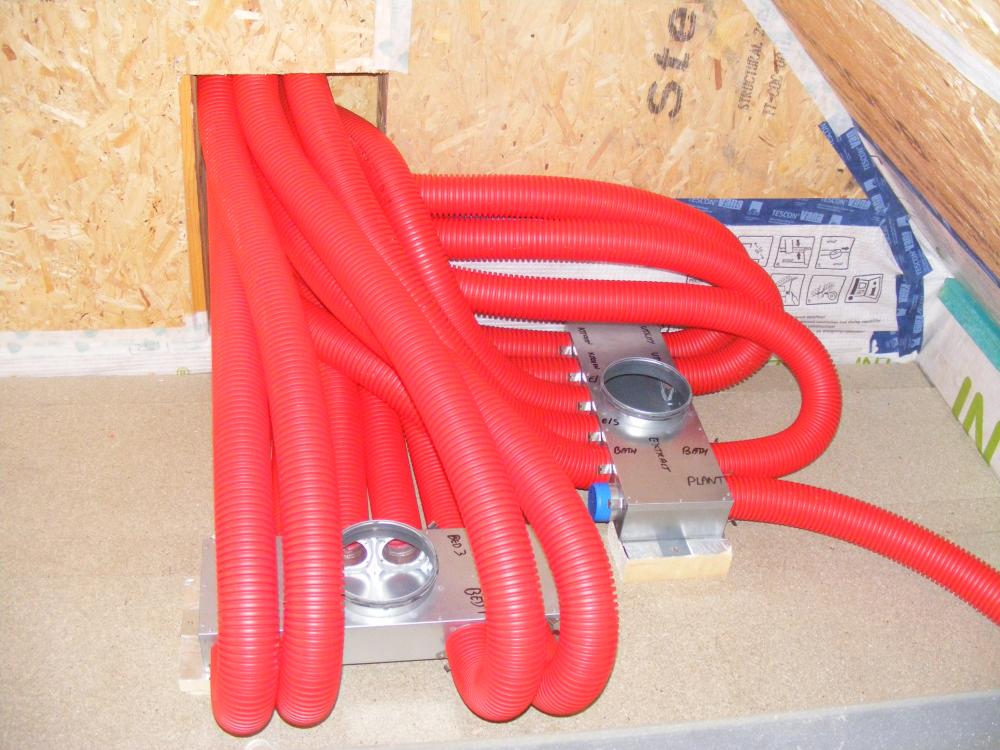
-
Unless you want to move it, what is the point? A waste of a nice trailer that is never going to move.
-
Partial removal of party hedge and erection of 6ft fence
ProDave replied to Melissa's topic in Introduce Yourself
I have given my answer. a 2M high fence in that position is permitted development and I believe they have correctly measured the height from the ground level it sits on. I also believe all they have done is trimmed the hedge that was trespassing on their property back to allow them to put the fence there. You seem to be looking for a dispute with your neighbour? -
As the tank is heating, the water gets stirred around by convection, so it will heat the whole tank to the required temperature. The problem is as you draw water off, the water remains stratified and all that happens is the hot water moves up and cold comes in at the bottom to replace it. It is not until the hot / cold transition reaches the thermostat that it calls for heat. fitting the lower thermostat pocket at say 1/5 up the tank might be better?