


Gus Potter
-
Posts
2155 -
Joined
-
Last visited
-
Days Won
26
Everything posted by Gus Potter
-
Russell. You beat me to it by seconds.
-
Hello Charteris. That's one of the reasons I joined BH too as folk are helpful, you can make a daft post and not get pelted for it. It's also a great place to learn stuff. Could you do a wrap around single storey extension, you may have thought about this already. Keep the walls 1.0m off the boundary say. With a wrap around single storey you can vault the ceilings etc, bring light in from the roof.. loads of options. Then you get to play with a layout and kitchen design. It may be that you are looking for something of higher quality rather than just a lot of extra floor space? But, if you do this wrap around you can cut off car access to the rear if you want to put a garage up in the back garden. It can be trade off. Do you just need extra bedrooms or do you want to create a great living space all on ground level? Sometimes getting knocked back to start with can actually be of benefit as it really makes you think about what you need and want. This can allow you to spend more efficiently. All the best with the project.
-
Just a thought but if you got a drainage contractor in with a mole (makes a hole say for a cable / duct) under a road then you could maybe make an argument this way? Avoids trenching the ground and cutting all the roots. In principle this may work. To start with aim to keep the mole deep in maybe low nutriant soil so you reduce the risk of damaging the primary roots. In practice.. I'll leave that up to your imagination. If you don't want to imagine then get in a pro Arboriculturist who may be able to look at the soil, refine the general guidance on the extent of a root protection zone and keep you on the right side of the regs. If you hit an obstruction using the mole then you can hand dig to clear it and.. while hand digging you make sure you don't cut the roots.
-
Hi Craig and Iceverge and all. Thanks for posting, great stuff for me to see how folk innovate, approach design. Can I ask what sofware are you using to model the window reveals? Is it a small package (spread sheet) for just heat flow or are you using part of a big expensive Finite Element package like Abacus?
-
Iceverge, I hope I have not put you off but I think that you could better spend money on making sure you get a good quality of build. By all means use your calculations as a target but the key will be the quality of the workmanship and attention to detail. For example if you put up a timber kit that is soaking wet, then fill between the studs with PIR insulation. Leave it a few months and you'll find gaps between the studs and the insutaltion as the timber has shrunk. You'll also find that the PIR you thought was fitted tightly is moving about a bit. It now acts as a duvet with your leg out the side of the bed! If you can get a handle on this type of behavoir and seal things up, look after the quality of the build and material then you can get a cracking job without resorting to more expensive materials.
-
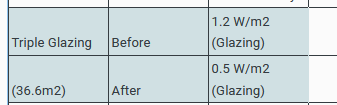
Hiya Iceverge. That is some impressive figures. I have copied a bit of your table below. I,m not sure if I am right or wrong here but.. as a designer over the years I have found that the window market is a bit worse than the second hand car market. That's just me! You may achieve these values with a very big area of glass and thus the exposed perimeter area of a frame is not that significant, you can see this effect when you look up the insultation required for a floor slab .. Kingspan / Cellotex ask you to calculate the area vs the perimeter.. and this principle in some ways applies to glass and the surrounding frame. Now, with modern argon filled units say the heat loss through the window frame can have a significant impact on the performance. When chosing windows you need to consider this. But it's hard to compare like for like as for a manufacturer to test every combination of window size is very expensive. While I think your figure looks good for the glass only, one needs to have an appreciation of what these figures mean in practice and how you can best apply them to your design. @craigI think Craig may be able to expand on practicalities of this in terms of the detailing round the frame, exposing the frame externally less to the cold air. There is much more to this than just looking at the U value of the glass.
-
Thank you Craig. I'm more structures orientated, know a little about the principles of glass design but now know more. Thanks again Craig. Every day is a school day.
-
Has anyone seen some info on the net re tripple glazing regarding the life span of the sealed units (8 years?). There is some suggestion that the middle pane is in it's own greenhouse and subject to high temperature and higher thermal movement. Thus a tripple glazed unit is more prone to failure. We know they are more expensive, heavy to design for. It may be that you need tripple glazing to get you over the line for BC purposes but if this is your forever home then is this a cause for concern? How much will it cost you to replace them (tripple glazed) at a later date? @craig "Windows and doors are integral to the thermal envelope and airtight layer. Without them, you just have a big hole in the wall(s) and airtight layer. " Yes Craig is bang on. Craig is taking a hollistic view. No point in putting in a Rolls Royce window if you neglect the detail around the window and let drafts fly about where they should not be.
-
Hello SiBoyle. Interesting stuff. I have clicked on the download link but only get the results for rotary borehole 2. Can see the void. The void shown in the pdf doc I can down load may be localised. Mods.. Is this a tech failure at my end not being able to download all 11 pdf's? SiBoyle. To get a more comprehensive response on BH you can identify the site and post all the info you have. It's up to you but if you feel ok actually identifying your site, assuming the deal is done then BH folk will chip in. I'm not Columbo but when a grouting contractor offers a fixed price then they probably have a good idea that they are not going to loose money on the job. I can see that the site is named on the RBH record as "The Old Coop" The Coop are not daft and have to my knowledge employed competant SE advisors... you may not need to grout at all.. just gather evidence and off the back of that make an engineering judgement.. After all, both the grouting contractor and an SE will cover you insurance wise.. with a good bit of fine print in the policy. But.. the differance could be a fair bit? The grouting contractor will let you sort out the rest on your own. The SE will take a holistic view and consider the foundation cost and options too, strip / raft etc SiBoyle "and what foundations are suitable following this? Just a raft or trench?" that comes later. The first thing to do is to dig (excuse the pun) deeper and look at all the info, go back to basics.. desk top study of the site and surroundings..look at the surrounding buildings say and see if they are moving about.. Can you see signs of movement. Bell pits were often dug in clusters... long and fascinating story. Start to form a view of what could be under the ground. It sounds like a lot of work but the cost of this research can suddenly save you a pile of money.
-
Small, efficient SIPS build in Midlothian
Gus Potter replied to catrionag's topic in Introduce Yourself
Hiya Catrionag Midlothian is a big place, and yes expensive for land. Are you down the Falla end, Borthwick or closer to Pencuik/Newton Grange. If your are near a mining area then be thorough in your due dilligence, especially if it looks anything like a gap site. You can start to check the mining areas here. Have a look yourself in case the solicitor makes and error. https://mapapps2.bgs.ac.uk/coalauthority/home.html Once you nail this then you have a load of choices about how you form the structure. If down say Falla way, borders end then then you could go for a " site built kit" by a local joiner, make the walls a little thicker, a few mm and save on the uplift on a small "SIPS type kit". Control the quality of work to get air tight..? Much will depend on how much hands on you want you have. You'll find pretty much everything you need to know and get lots of help from folk that really know their stuff here on BH. All the best. -
Thanks MarckC for the confidence. Maybe, but it's touch and go! Russell. Yes I think you are right to be cautious here with the budget. Also Gav " I personally think you are easily 50% under, your prices are very sporty for a 4 story building.." That's a new expression for me, I like "sporty" pricing concept! Pro Dave nails it too. If you can introduce some columns then you can make the cantilever problem go away and bring the cost down. PeterW.. yes even up north here I would be looking at 2.0 - 2.5K per sqm as this looks like it deserves some attention to quality detail. But JJD1 says it's a constrained site so yes 3.0k /sq m given the possible foundation / building stability costs. JJD1. A design like this could be stunning once you start to develop it up. You could do some great looking slick detail with the structure and really make a statement. It's a good SE challenge to do something like this on a tight budget. JJD1 ..It looks like you or your designer has considered the exposed slanting roof members over the terrace which would act as "cables". In some ways you have something like an asymmetric cabled stayed bridge concept here, but with less onerous loadings. It may well be that at London property prices this could be viable? JJD1 can you post some elevations and a site plan?
-
Oh Peter you have put me on the spot. Having a look at the section. Structurally big cantilever, more span than available back weight. That bit that is over hanging is much more than the main width of the four storey part. For all, think of it like a swing.. pivoted just to the right of the door. If all the building is the same weight it will probably want to tip over under it's own weight. But.. Peter. Could you Architecturally make the left hand side of the section heavy.. do this in brick / block, make the over hanging cantilever zinc external say.. not masonry.. say on a steel stud work, use a wriggly tin slab on the four storey bit.. you'll need a good floor thickness anyway for fire regs.. now you have ballast for the cantilever... for all, you now add a big weight to the short end of the swing so it won't fall over. It may be that you need to add a good mass to the left wall ( Trombe wall possibilty? ) using masonry..you will need a good bit though. The side elevation looks good.. not too many openings. This leads me to thinking about a simple steel braced frame that fabricators churn out every day.. easy to insulate and get priced up.. simple steel connections and so on. A simple design that you can easily attract tenders.. cost effective.. go for simple stupid. But in some ways this is good economic design... best to spend the money on Architectural features than heavy steels /piles you hide? One key would be to nail down the construction sequence so the thing does not fall down when you are putting it up. Provide enough back weight at all times so you go you don't need too design the left side piles as tension piles. Fine for a major client as tension piles ( still cost a bit more) are fine on occasion but as a self builder keep it simple / stupid and you'll get more tender options. I think it's just doable engineering wise for a domestic client at London prices, but.. they need to invest early to get a buildable design that leads the contractor by the hand. Do this and they may well get this in on or below budget. It's a must to get the Architect and SE working together from day one and in short order bring on board a trusted contactor who undestands the stability issues. That's my first go at this! and please excuse the spelling and grammer.
-
Hello Old kettle. I'll have a stab at this. You are correct in that a raft spreads the load, we have a gut feel for this, I think you are on the right track Old Kettle. Also as a general spec I think you are on the right lines give or take a bit. As a bit of background and starting from the most common. I touch on couple of points which I hope helps discussion. I see you mention a value of 3.0m depth for a strip found. This can be (the 3.0m is a clue for me) more related to building near trees, It's two different issues? See NHBC link below. Three metres, this is where you often get a big depth of a strip found when near trees as the roots play havoc with the soil moisture content in some types of ground (certain type of clay soils will shrink and swell for example by a few inches), the roots also grow larger, if you have a leaky drain, they will follow the nutriants you provide and grow accordingly! You can see the effect this has when you are out for a walk.. pavements near trees are often lifted up by the roots.. nature at work. https://nhbc-standards.co.uk/4-foundations/4-2-building-near-trees/ You may have silty gound, a thin layer of peat, maybe filled ground and so on. Here the SE will judge that it is cheeper to dig down to something solid, trench fill and build on top. That too can give a deep strip found depth, but often not 3.0m unless you have wide span ground beams and poor gound. Normally a strip found where there is no tree influence will be some 1.0 / 1.2 m to 0.45 m below ground level to the underside of formation. You can also find good info on this on the NHBC website, a legacy of their previous research. Old Kettle. I can see / hope / helps as it seems you are interested in this. Imagine you have strip found in a field on it's own. It loads the ground but as you go down in depth you have the weight of the soil above. This soil each side as you go down in depth acts to confine the pressure, hence when you look at the shear stress profile in the soil it's like a bulb shape, not the 45 - 60 deg principle you may see from a say lintel loading. But for a raft, or closely spaced piles the bulbs start to interact so the depth of the overall bulb goes further down, as each bulb interacts.. That is why rafts need a deeper depth of investigation which is not often discussed on BH. As an aside.. There are plenty of keen gardeners here on BH, who know that tree roots often don't go that deep. I have seen many cases like Old Kettle mentions of 3.0m.. but many designs follow the standard warranty provider safe / conservative standard guidance that is also adopted by BC as a fall back / standard position. Arboriculturists may not be the flavour from time to time on BH.. but a word with them on root depth could save you a fortune, and then a word in your SE's ear off the back of that? Old Kettle. I hope that I have covered some your points but have the odd doubt.The technical aspect of foundation design and how that interfaces with the super structure is not yet been fully explored on BH.
-
Hi LSB. If you are DIY then experiment with the fixings and what you have to work with.. this is they key. If they fail then you have wasted your money. Make a mockup and see what it "feels" like (when you are screwing the fixings) and how you do the ingoes to the windows etc" . Make sure you get the right fixing, when they are long you are almost fixing "blind" if you are not used to doing it. Maybe go for a higher fixing density.. reduces the U value but best to be safe. Remember that that you may be fixing into old brick / hitting uneven / weak / weathered mortar joints that have a lower capacity than what the manufacturer declares in their spec. Go for the least complex fixing you can and put plenty in!
-
Hello old Kettle. I'm not sure how to link properly but have copied a post I made below that may help. Technically when you design a strip found you have a bulb of pressure on the ground below that is not that big.. width and depth, hence why you see folk often getting lower depths of dig for strip founds and a typical SE price less than £1000.00. But rafts.. ICF (insulated rafts) behave in a different way.. the bulb of pressure extends much deeper than for a strip found, roughly you need to dig deeper. But not always when you are say extending or adding something near an existing dwelling. Oh, can anyone tell me how I reference a post I made a while ago?
-
Half finished project up for sale in Hastings
Gus Potter replied to Water's topic in General Self Build & DIY Discussion
Interesting stuff and great to read the knowledgeable comments. I wonder if they just ran out of cash or if they hit a fundamental issue with the ground and thus the labour cost broke the bank, hand dig? Also the photos are wide angled, when you count the bricks it's not that big but seems to breach the PD guidance? Someone will buy it though. -
Yes off on the wrong track. Thanks again Daiking.
-
Off on the wrong track! Thanks Daiking.
-
From the SE side it would be wise to look at how the SIPS panels are held down and get this nutted out. A lot of folk have a gut feel that the wind won't lift the house up and this does not happen..often.. However, the big elephant in the room is that lot's of new houses have big wide doors and openings. Here you have less walls.. they are more like columns so they want to over turn as the wind blows on the side of the house. To stop this effect you often need to rely on the holding down straps to stop each panel overturning. To stop over turning you need "ballast".. something heavy to anchor to and you also need to find a fixing method. The super structure providers often say.. holding down system is for the SE, SE says it's for the super structure (kit) designer. No one wants to take responsibilty (someone should do for competant design.. it's in the statutory CDM regulations) for the fixings / straps etc as this requires design time and coodination.. that comes at a cost which is not spelled out to self builders and the like. I would ask some of the SIPS suppliers for options on how the panels are restrained against overturning. Check the SE design to see what uplifts are occuring at the panels and so on as this will impact on how you are developing up your design. All the best.
-
Hello Syne. Your nautical approach will appeal to some of the members on BH. It's a good analogy and good questions. I simplify, but if you think about the ground as layers of a cake. Each layer (if clay say, not rock ) moves - expands and contracts by different amounts depending on the moisture content. Each layer of soil also compresses by different amounts depending on how much load you put on it. You can be technical here and try and account for the different layers of soil and found the ICF at a different depth. You could maybe analyse this using an advanced soil model.. academic research.. But in reality the layers of soil are not generally level as this is nature. Any model would be just that. By different depths I mean say plus 300 mm (not a few mm) as this is the point where you could start to excavate too much near the existing founds? A way of simplying this is to found things at roughly the same depth. A clay soil as it shinks and swells will easily lift a house up and down. Syne .. yes your right about the ground. If the clay (say) swells and the house stayed at the same level then this would mean that the founds are sinking into the soil? If you are on rock or chalk then it's different, I have assumed clay here. Now, if you found the ICF raft at the same level as the old house each will move roughly up and down at the same rate at this level (datum). What you are doing here is making educated assumptions. This is the first part. Next (second part) is to look at the ICF material. Often you see a spec for IFC as being able to carry say 150 kPa at 10% compression. That's about 15 tonnes per sq metre. Sounds like plenty, but the insulation is elastic. If you have a thickness of ICF of say 300 mm then to carry this amount of load then the ICF would need to compress by 10% of 300mm = 30 mm..that causes an issues for say a floor slab, the windows and doors won't open, you'll get cracking that will overstress the other parts of the structure. One reason being is that some parts of the ICF will be more heavily loaded than others and move differentially. What we do here is to manage the loads on the ICF down to about say 40 Kpa as a starting point. Now the 30mm compression at 150 kPa is (40/ 150) * 0.1 * 300 = 8.0mm.. this is more on the ball park.. a timber kit can shrink this amount easily for example. The 8.0mm is very rough as there are other factors that are too lengthy to explore for now. Put the two parts back together. If you load up the floors on the old house, say get a heavy fall of snow, the walls are solid, go all the way to the founds, thus the old house does not move (compress) down that much over the eaves to foundation level. It's a solid old house. The extension walls subject to the same load won't compress that much but the IFC will compress.. by say the 8.0mm under full loading. In summary with a bit of good detailing you can account for the ICF movement between the old and the new which is doable, but founding at different depths (bottom of ICF ~ = to bottom of old found depth) can introduce other issues. A good way of looking at this is to say.. well the old house shows no signs of distress, let's not found something at a different depth, more, let's found something at the same depth, try and avoid heavy point loads on the soil, especially near the old founds and see if we can develop a design along these lines that will account for the different behavoir of the ICF insulation and the old walls of the house. Hope this helps.
-
Hi Keiko909 From memory and a bit of background. I said five years ago but it's probably a bit more than that, but less than ten. I was designing a lot of cold formed steel portal sheds over the UK for the companies that sell these sheds on the mass market. A couple of them had a sideline business where they were buying containers and turning them into business units, one had got a lot of them and turned into a kind of eco B & B hotel. We stacked them up to I think three storeys.. can be done SE wise but it was a lot of work and I'm not sure they made any real money out of it. In terms of the technical spec you have a metal box. Metal is waterproof so this is your vapour barrier. One way of doing it is to put the insulation on the outside so the steel box is on the warm side. If you spend time on BH and ask questions you'll get a lot of help from the folk here that really know their stuff. One thing I learnt when I was doing this is that the container market is even worse than the second and car market. But when I was involved it turned out that there are a lot of brand new containers that come from China that have a one way trip thus not been in slaty air for too long. They never go back.. but the steel is a bit "crap". However you also find that some of them are lined out in high value timber, sometimes protected species not good.. what do you do? Another thing I learnt was that at the time it was cheeper to put stuff in a container and cart from China than to the UK than from Dover to Glasgow! I don't think this economic has changed much? I've seen this done but maybe starting point is what you need to pay for the box and what is left inside it? Hope this helps.
-
Steel RSJ to Oak Purlins..how to join on 100m bearing?
Gus Potter replied to TimG's topic in RSJs, Lintels & Steelwork
Yes, not easy to source and anything reclaimed at that length and virgin timber requires a bit more thought, may be a bit more bashed about than you want. I would consider the over cladding once you have got all the dusty and wet trades out the way. You may have an oak stair which will have a more "Engineered" look? In the UK we tend to initially think about "solid timber" beams, stairs and so on. In the US and Canada they often rough stuff out then over clad in a higher quality timber. Over cladding can often simplify the structural issues so you get to spend more on the things you see? -
Interesting stuff. About five years ago I worked on designs for container conversion with a couple of companies that were doing this in the South of England. You can probably find some of their stuff on the net. All the best. It can be done no doubt so look forward to your posts.
-
Float the idea to the builder that you may engage the same QS to maintain a watching brief on the "design and build" contract they offer you. I have seen this many times before and the contract offered is often not fair, equitable and reasonable unless they are at least sticking to a recognised standard contract adopted by the industry. Make no mistake a good experienced QS or other professional is worth their weight in gold. A few well chosen words of advice can save you later... They may (QS) even give this advice for free. I do if able!
-
Well done to you Andy. For all there is a lot to what Andy is doing. ICF etc, sounds like there is a big opening in the front. Although it's done under PD what Andy is doing can add a lot of value to the property.. if it is done right. Imagine it's just an extension not connected to the house. It's also a great way of cutting your teeth which can give you confidence to tackle larger projects if you fancy it. Andy.. sounds like you know what you want so maybe no real need for an "Architect" per say. Many of these "garden buildings" now have a big open front on the high side with bifolds or sliding doors. What you now have is something akin to an open sided, often mono pitched farm shed with a set of doors on the high front elevation. What is required here is to make sure that when the wind blows the building does not fall to the side in the plane of the doors. Here what you often do is to make the side walls, roof and the back wall are stiff. You can try this at home with a cardboard box. Cut out one long side, tape it up along the seams, down to a table and push it along the plane of the doors. You'll see it wants to rotate so if you brace the "gable" it works. For the technically minded this often called a complimentary shear effect. To square this circle the SE will work out the wind load and put bracing or use the panel stiffness on the gables, back wall and roof to show that it works. You'll need to make sure the building is fixed down to something heavy as it also wants to lift up in places. Andy if you can get all the data on the panels, slab and put this into a document. The more info you give the SE the less they need to guess and so on. Also, get the details on how the panels are connected together. No point in having the panel data without the info on how they can interact and connect together. It's a big learning curve to become competant to prove this calculation wise but there are SE's that will do small jobs for enthusiastic beginners so don't loose heart when searching them out. If you do the donkey work on gathering the info then you may get a cracking reasonable price from an SE. One last thing I have observed is that sliding doors need some kind of space above so the roof / lintel over can deflect down. This is a traditional deflection head detail. But I was talking to some fitters of bifold doors the other day and they want to pack the head of the doors tight to stop the mechnism at the top coming loose?

