


Gus Potter
-
Posts
2383 -
Joined
-
Last visited
-
Days Won
34
Everything posted by Gus Potter
-
And Great points, power to the elbow! The thing drew my attention to the stability was the aspect ratio of the structure. Height to windward length. In other words it is quite tall compared to it's footprint. There is also glass areas that would require some careful movement control not just in terms of vertical deflections but also horizontal deflections. Doing this in timber could be challenging when designing the connections to say the least! These types of TF connections need a lot of space which could destroy the Architectural intent. If you look at the the walls facing the wind in the east / west direction there are not many in the "right place" of a decent length (without some fancy modifications) to resist the wind loading in this direction. Now if we were to make the building footprint larger in the east / west direction but no taller it would be more "squat" when considering the east / west wind and probably have more internal walls we could use to brace. This would then concur with the order of your analysis. I agree that steel is not best suited to angles and curves.. in the round my feeling is that it is worth a close look at a steel frame on this project just to make sure you have not missed an opportunity. Beware modular timber suppliers quotng "excluding all steels". great advice from @saveasteading
-
@saveasteading You have hit the nail on the head here. You can use them as as part of the "treatment train" for water run off and pollution manangement as per the SUDS requirements. In lay terms. Green roofs can hold the water for a while during heavy rainfall and then release it slowly into the eventual water course.. helps mitigate flooding. Water evaporates too (when it stops raining locally) and so on so less ends up down steam.=adding to the flood volume. Also, during dry weather air pollutants settle and get trapped on the growing matter. If you have tin roof and a dry summer you get all sort's on the roof from bird droppings to particles from car exhausts. If you get a short sharp shower of rain this all ends up quickly in the river which probably has a low flow so the concentration of pollutant is high and it kills the fish for example. Green roofs can get you over the line for your permissions to build but saveasteading is right .. if you don't look after the roof, like you wash your windows or water your house plants it's all a load of.. guano / smoke and mirrors.
-
Hello Pipedream. Wow! No wonder you're happy! At first glance it may be worth looking carefully at whether this may be best build as a complete steel frame. The elephant in the room here is the global sideways stability of the building. On the ground floor you have a lot of glass, the building is U shaped, three storeys.. it will pick up a fair bit of wind load. I would get an SE to mull this over before you progress any further. Make sure you get the stability nutted out as you don't at first glance have enough walls in the right place to achieve it without some complex bracing systems and associated foundations to "ballast" it. This means money and a fair bit of it too! The above is not gloom and doom. You may find this is the most cost effective way. Steel is really versatile. For example you could look at a mixture of hot rolled steel beams ( the big I sections say) and cold rolled floor joists and roof members. They are often Cee shaped (zed shape on the roof) and thin walled.. just the same as you see in B&Q holding the cladding or an industrial mezzanine floor. Oh and you will probably easily carry any extra wieght of a green roof to boot. It requires a different approach (mind set) to the detailing in places.. cold bridging, insulation and fire protection but it's all doable. Cantilevers can often be more easily dealt with using steel, section depths are less and this allows you to more easily avoid "chunky" details and encourages more slender details for visual appearance. Really what you do is design an "industrial building" as the skeleton and over clad. The steel frame is just a meccano set, quick to erect. Also, many of the weather proofing details are already developed, you have less issues with shrinkage cf masonry and timber.. plenty positives. If you wish post more drawings. A good thing to do is put gridlines on the drawings if you can as it allows folk see at a glance how things line up between floors. Al the best with what looks like a great house.
-
Andy. No wonder this is causing grief. Here is a suggestion. Mull this over even if just to rule this idea out. It seems like you are getting run ragged. The following suggestion is based on tactics used to deal with say a home warranty provider who is using the fine print to avoid addressing the issues. Take a step back first. Get yourself a "street wise" Stuctural Enginneer. Get them to site for a day.. yes a day and expect to fork out £800.00 -1200 quid. Seems a lot but the SE will spend a few hours thinking time after they have left site.. not that bad. The SE will look to see where the frame is non compliant..and everything else that they can see or even if they "get a smell" they will look at that too. Once an SE is instructed to examine everything..it means anything else that may count as a contributing factor.. they do.. no prisoners! For example the SE will look at all the nail edge distances, plumbing of the frame, the roof trusses, the load paths and how this missalignment of the dormer may be changing the load paths and if the supporting walls are still ok. The ground levels, how the kit is sitting on the founds.. odd stuff that may not seem directly related to the issue.. damp proof membranes, vapour barriers.. tile batten spacing.. the lot! The reason for this is that all these other bit's an bobs contribute to what SE's call "robustness" and this forms part of the design codes. Also, if the say trusses are not sitting where they should be then questions get asked, for example are the connections still ok.. again are the tile batten spacings still compliant with the tile specifications.. it's a big can of worms to defend! Make no mistake if you are an SE and you are instructed to survey a timber frame.. well that is what you do! You don't muck about! The secret here is that once you find a non compliance that impacts on the structural safety of the building you have them over a barrel. What you then say is.. hey you may be quoting me the fine print but you have supplied / erected an unsafe structure. This cuts to the chase as if your SE say's it's not safe they have to do whatever it takes to fix it.. if it goes to court.. the SE stands up and says..they provided an unsafe structure and by that time the HSE will have been notified also, so too they will be chasing them. What I can say is that once you nail them on the structural side they are often keen to negotiate. The next step is up to you. You can try and negotiate a settlement yourself or you can instruct your SE to "have a chat" with your TF supplier. The SE will not "do a deal" on your behalf in terms of the fabric as professionaly they can't compromise on safety. The SE at this point acts as an independant person. To explain. An SE has a duty to public safety, you may sell the house but the liability rests with the SE long after you have gone. However, by acting independantly they will often use some back channels to reach encourage settlement that is equitable. They may for example say to the TF supplier.. well if you don't play ball with me I'm going to recommend to my Client that we get a QS of like mind to me.. no prisoners.. and the bill is going to go up. My Client just wants it sorted and quickly..they are not seeking to punish you but if you keep digging in they may take a different view! These are thing an advisor can say but you as a Client may not be so able to do. Andy. Quite often trusses may not be "quite where they should be" Not all of the trusses will be fully loaded so sometimes you only need to remediate a few, maybe one or two so it's not often a case of the whole lot needs to be taken down. The key here is to find the big stick to bring them to the table and quickly. The above is one possible way of achieving this. Ideally.. resolve it quickly, settle and not spend time trying to get your money after you have moved in. The moving in should be fun and if you have this hanging over your head it kind of spoils it? Lastly the supplier will also be expected to pay any SE fees you have incurred.
-
New Member from Cork Ireland building ICF House
Gus Potter replied to Blynchy's topic in Introduce Yourself
Jack. "It will never be commercial while I or any of the other people currently involved with the site are running it." Delighted to read this. Is there any merit in letting folk know what you need in funds + moral support + members own time to keep BH sustained? Yes BH have gone Ltd but I can understand what might drive that.. If you look back on the history of BH it seems to me like it started with a few enthusiasts all wanting to share knowledge. It caught on in a pretty big way. These founder members have put in a huge amount of work. I think to myself.. how is this to be sustained in the long term. It would be a sad loss if this body of knowledge and annecdotal evidence of folk building / renovating etc their own homes was to be lost. It is in fact a historical record! It would also be a disservice, not least, to some of the founder members that have been lost or just moved on if BH were to fall. Jack.. yes the advice on BH must have saved folk a fortune at times.. so 5% is a good ask! .. you won't get that quality of advice elsewhere for free. I ask.. how may we help? -
20mm scalping instead of Type 1
Gus Potter replied to dangti6's topic in Landscaping, Decking & Patios
@saveasteading Thanks for the "like".. I wrote it for you as I like the word "shifty" Just kidding. Gus -
Mods.. I'm fairly new to BH, joined mid 2020. The resource seems to be expanding exponentially. This knowledge base is astounding. I think it is been so successful as you have stuck to the not for profit model. What are the plans for the future? How much more donations do you need to keep this running? How are you finding the time to run this site? saveasteading. Well articulated.
-
20mm scalping instead of Type 1
Gus Potter replied to dangti6's topic in Landscaping, Decking & Patios
"Do you mean that a shifty supplier might have mixed nasty stuff in?" I do. "Otherwise, in what way have times changed?" Well I mentioned "happy days" Back then folk were not that daft, as are folk here are not too. In the happy days if someone had mixed broken asbestos sheets, fag packets, big lumps of bitumen, dead fish into the road planings, you will, even as a lay person be able to see it and say "hang on". But one thing that can be hidden is this. Generally modern bitumen planings are fairly benign. But up until the mid 1980's coal tar was used in roads and that contains a potential nasty mix of carcinogens that are more mobile. In other words they can leach more easily into your plot and start to contaminate your land. Now, when they are planing an old road they may take off the modern top layer (bitumen based), and a bit more.. the bit with the coal tar. So the top planings go to recycling, the last load (with the coal tar content) goes to you cheep. Back in the "happy days" we had little idea or knowledge about hydrocarbon pollution. "Have even used it under floor slabs, with BCO approval." Yes we did! For me if you have bought a plot or doing up you house why risk introducing an additional pollutant? -
Yes at times. I do have a blog slot on BH but have neglected. Jeremy Harris, the mods et al have set a high bench mark! I joined BH as; it's not commercial, I find the folk here refreshing, there is humour, serious stuff where folk really need somewhere to turn to for help, great innovators.. the list goes on. I learn something new each time I look about on BH, it's a two way street for me and I enjoy being here. If there is interest from BH members in the structural side then I would give it a go and also post stuff on the blog bit so that it is all in the one place..but then it could start to loose the terms of reference of BH. In other words BH folk want to know about their own house / project and get a response to their own posts rather than read some generic stuff? I think this is the life blood of BH and why it works so well. Also, it's the Mods et al.. without their dedication, this site would not be what it is. Another thing is you have some real pro's on BH that have specialist skills. They may not post regularly, then in spurts, but the quality is exceptional. @SteamyTea "I would find it useful and save me having to find my copy of:"Why-Buildings-Fall-Down-Structures" For all. What about sticking to BH and finding out "what makes buildings stay UP"
-
20mm scalping instead of Type 1
Gus Potter replied to dangti6's topic in Landscaping, Decking & Patios
If it's a public pedestrian path be careful as the Highway Dept may not accept as scalpings often don't comply with the plasticity requirements. Happy days when you could get road planings to do your drive to your new house or fill in a hole. Was great stuff. Times have changed. Think twice before you take up an an offer from a "road squad" who are doing a job "round the corner" and are offering a few loads of road planings for a few quid. It's not so much the bitumen content but the other contaminants that go with it! Do you really want this material on your property and the potential liability that comes with it. -
Lime Mortar on New Build
Gus Potter replied to BadgerBadger's topic in Bricklaying, Blockwork & Mortar
Interesting stuff. "Our key driver is aesthetics." It's about 20 years ago that this cropped up for me the last time. We were talking about using concrete blockwork and brickwork in lime mortar to avoid having to introduce movement joints. Standard UK spec is say joints in concrete blockwork at 6.0 centres / brickwork at 9.0 m centres. We looked at lime mortar and as it was mostly concrete block decided not to take the plunge and spec it, knees got a bit wobbly! Fine on old stonework..but! But BadgerBadger.. hey, hand made bricks. There is a massive attraction here as you are maintaining the ethos. I commend you for that. Concrete blocks pretty much shrink over time and that's it. But clay bricks are arguably more lively and natural". They expand a fair bit in the heat, swell / shrink as the humidity changes and just move a bit as they age and weather. I'm not sure how this may stack up for you but if you have say a feature elevation of a decent length and going for the real deal with hand made bricks with a traditional clay mix then much will depend on you own personal desire. However, if you have a fair expanse of brickwork having a movement joint visible kind of defeats the purpose? And that drives you towards a soft flexible lime mortar which could do some 12 - 15m run? that much? without a joint or return corner to relieve the stresses? The other thing is whether you have a timber frame on the inside or are using a cavity masonry wall. If you're doing this then the regs on venting TF cavities could be a "damper" but with cavity masonry construction maybe easier to deal with? There is no doubt that it will cost you more but if you are going to do, it do it right and enjoy. Some folk buy paintings others build walls and get to see them every time they get home and walk in the front door. I would make sure that you don't get hung up on some building regs that require you to put in say plastic cavity vents. Solum vents would be ok as you could really go to town and get authentic reclaimed vents! Now I've just spent all your money! -
Hi Tank. This is kind of for all and I can see it's a shed. I'm assuming that you are talking about a concrete lintel. There are two generic types. One is a non composite lintel. This acts just like a steel beam which is often designed to carry all the load on it's own. The other type of lintel is called a composite lintel. These lintels have a declared capacity based on the fact that they have brickwork that is laid directly on top of the lintel and forms a bond with the top of the lintel. In other words the brickwork is "stuck" to the top of the lintel and thus the lintel and the brickwork form a quasi arch.. work together to carry the load.. hence the term composite. Again, for all if you stick in a cavity tray you create a slip plane so destroy the composite action. Tank.. Based on your rafter size it looks like the lintel is not carrying a lot of load. If you have a non composite lintel then reducing the courses above should be ok.
-
Hello kiwibloke. "How does building construction type ( brick, block work, timber frame etc) affect the foundation cost?" Not that much on standard strip foundations. To provide some context. A typical two storey house with well propotioned load bearing internal wall loads a strip found by about 40 - 50 kN/m, a bit less if TF. That is about 4 -5 tonnes per metre run of found. A common allowable soil bearing capacity, say a consolidated clay (not soft clays) is 100kN/m^2 .. 10 tonnes per square metre. Thus a 600mm wide strip found can carry 100 kN * 0.6 = 60 kN per metre run = 6 tonnes per meter run so gas in the tank there.. Practically you often need a 600mm wide found to fit the wall on anyway and to give the brickie / ground worker a bit of tolerance. "My second question is what dominates the foundation cost, is it the ground geology or the building construction type?" For most domestic stuff it's the "geology" that tends to govern. Type of generic soil type ; sands / clays/ rock, chalks filled ground. Next you drive down; water levels, proximity of trees, ground gas potential and so on. "For the sake of argument If I am free to choose the geology and construction type what would be the best geology and construction type to minimise foundation cost?" Kiwi.. is this the Xmas wish list? Worked on a job a few years back. Top soil about 250/ 350mm thick from memory, great top soil all saved for the garden. A sub soil, clay / sand firm but easily dug and this was used to regrade the landscape. Then about three feet down (900mm) fractured weathered rock. This rock had not seem the light of day since the last mini ice age. Although fractured was great to support a house found. The site was slightly sloping and the rock was sufficiently fractured that we got good soakaway results for the septic tank and rain water run off. We excavated out the big hole for the septic tank with a JCB 3CX. We just carried on digging out the fractured rock here an there and used this as sub base for all the drive / hard standings.. saved a fortune. That was nearly perfect! Aye Conor you were lucky there! For all. If you are new to building a house think twice before you do your investigation with a mini digger. Also, if you have say one house under your belt.. well pride comes before a fall if you think you are suddenly a ground expert. It's often false economy. For a standard house set of trial pitting budget on something like a JCB 3CX for a day with a good driver. Get the SE to attend on the same day. Let the SE and the driver work together, stand back and just watch! you'll be amazed at what they can find and deduce! Make them tea and provide some buns and they will often include you in the process. It can be a day well spent and you can look back knowing that you have a good understanding of why your house "stays up". Take a standard strip found at say 900mm deep. To do a proper job you want to dig down some 2.7m or until refusal to be sure. If you hit something solid with a mini digger at say 1.5 m how do you know it is not a boulder! a mini digger is like taking a knife to a gun fight! A mini digger just does not have the "poke" and you end up disturbing the soil so much that the SE is left up with mince. What can often happen here is that you end up with an over designed found which will cost you a lot more than the extra expense of getting the right machine. "grabbing a handful of soil" Yes at times it may appear so. But there is a little more to it than that. I wonder.. you often pay your lawyer / solicitor a good fee without quibble, but balk when you need to pay say an Architect / Professional Contractor, Heating Engineer / Electrician for advice that will save you loads of money! Even though they are still all insured to the same if not a higher level!
-
Basement floor construction with finite depth
Gus Potter replied to GlanMenai's topic in Foundations
Hello GlanMenai. You're off to a good start with your questions and research. Hope this helps a bit. To progress.. it's a good time to seek some professional advice. This could be from an experienced Architect (basements) or a specialist basement contractor if you have some contacts. Most often an SE is the best place to start as you'll need them anyway at some point so best to get them in early. I'm assuming you have an idea of what you want to achieve layout wise so this is more of a "structural" undertaking as you have a defined footprint. Most SE's say follow a process which is akin to this... 1/ Introduction.. meet.. discuss what you want to achieve, your "soft requirements".. warmth, light , bathrooms (this is to get a handle on drainage) and so on. You may want to create a lighwell outside to introduce natural light into a basement and this will involve making a hole in the outside wall 2/ Walk round the outside and examine the condition of the visible structure.. looking for and at; the topgraphy of the site (sloping or flattish), cracking, settlement, walls out of plumb, type of construction.. long list. 3/ Examine the roof layout and condition.. chimney locations and other features that could be heavy or become potentially unstable if some movement occurs when messing about forming the basement. Understand where the roof loads appear to be supported from the outside. 4/ Next go inside and up into the attic. Look at how the roof is formed and if the loads are evenly spread or are there for example large purlins transferring load to the walls in certain locations. Look for movement where the roof timbers join together. Often this can give an indication of how a building has settled over time as you can see how the joints may have separated / cracked over time. You compare what you can see inside with what you have seen outside. 5/ I'll assume the building is two storeys. Go to the first floor and determine which walls are the spine walls..usually brick. These are the walls that help tie the outside walls together, help resist the wind loading pushing the building sideways and maybe provide a bit of stability to walls containing chimney flues that need a "bit of extra help" to stop them moving sideways. It's also important to look for walls that may have been removed to enable a change in layout of the first floor. If the original layout has changed this is material as you may have lost a bit of stablity and tying for example. 6/ Go down to the ground floor and do the same. Here you often find that folk have been widening out openings in walls, putting in beams and this introduces point loadings which were not there when the house was built. All the time looking for signs of movement and "odd stuff" 7/ Lastly look under the ground floor. Look at in particular the areas where you think there may be point loading (that is why you start at the top and work down) examine the condition of; the mortar / the bonding of the masonry/ the quality of the original workmanship. 8/ There are are few expert plumbers and sparks on BH who know not to knock out large holes in the underbuilding..but often you find that a "cowboy" has smashed large holes in the underbuilding with a club hammer. In some cases you can see that the building is starting to protest but has not got to the point where this is visible in the living space. But one more "knock".. what then? 9/ Lastlyish examine the solum. Is it earth and what is it made up of? Can you see evidence of water rising, lots of salt deposits, signs of flooding.. again it's a long list. Now you have done your "Columbo" bit .. digest. GlanMenai.. you have gathered some info on the founds, well done. The next stage say for the SE is to have a look at the soil. Soil types are a massive subject so I'll leave out info on all the different types, already in this post folk are alluding to this and there is plenty on BH about clay / chalks / rock an so on and how they behave in different ways. To cut to the chase the SE will probably already know what generic soil type is likely prevelant in your area. A thing they will always be keen to determine is what the ground water conditions might be. This is fundamental to making head way as water can have a big impact on the capacity of some types of soil to resist load, remain structurally stable during construction (sometimes called stand up time and water management) when you are forming a basement (doing the work) and after completion. Clearly you need to know where the water goes as this will drive the design of the water proofing / drainage. Remember that insulation floats so you need to make sure you don't create a boat.. your floor could lift! Once you have gathered the above info you can then get to the exciting bit where you can explore the different insulation options, UF heating solutions and how much depth you need to fit it all in. It's stating the obvious but the deeper you go the more risk you run in certain types of ground. On the other hand there are some types of ground where you can pretty much dig to you hearts content.. within reason. Lastly, even if you are just intending to dig no lower than the level of the existing founds please get your proposals checked out. What you can do is remove what we call the "surcharge" which is the weight of the soil above foundation formation level. This apparently small weight can have a significant effect on the founds if removed, especially on old buildings that may have been mucked about with. Also, you can change the way the water drains under the house and in some cases this can result in unwanted movement. If you follow this process you should get a good understanding of how your house works and this could open up other avenues to explore that you may have not yet thought of! You may also save some money! All the best with the project. -
It all look questionable. It looks like the columns and yet to be cast horizontal transfer beam are supposed to stop the extension swaying sideways. The right hand column has the rebar protruding.. as though you are going to make a rigid connection to the "lintel" The rebar sticking out the top of the column on the left is short and won't work to form this rigid type connection if the columns and "lintel" are to behave like a portal frame. It may be that it has been designed so that the columns act as vertical cantilevers with the lintel just "resting" on top. In this case you will need some pretty "beafy" founds. I would get your SE out pronto to have a look.
-
Pasquil Roof Trusses from Chorley
Gus Potter replied to jack1962's topic in General Self Build & DIY Discussion
Hello Jack. Yes they will be working to something along lines of the Canadian / American codes. I appreciate your incredulity ...why not just provide you with the info and allow you, the customer to take an informed view? There can be many reasons for them not adopting this approach. One might be that the rep is not allowed to step outwith their brief. Their job (the rep) is to sell. The production manager and the folk that are doing the SE stuff in the background all have their positions to protect. That is part of modern coporate life, the greasy pole. It is not good for the "team" if the rep gives you the technical spec that say drops the production manager in the..custard. -
Pasquil Roof Trusses from Chorley
Gus Potter replied to jack1962's topic in General Self Build & DIY Discussion
Difficult times. If you have a simple roof although say loaded with attic rooms it might be worth looking at a traditional cut roof. Here you can use some simple steels or purlins at attic floor level to relieve some of the load. Much will depend on your circumstances but it's doable. Prefabricated trusses are generally made from a high grade timber TR26 and I have heard the big developers have "hoovered" it up. With a traditional roof you can go for a C16 or C24 timber that is maybe more "easily" available.. some weeks it is, some not, but at least you have time hopefully on your side and the reassurance that you have the material and that it belongs to you. The main thing is that you can spend time getting all your timber to site, store it carefully and then hopefully this will allow you to manage your progamme as you are less reliant on say cranes, delivery times of trusses and so on? Yes, it's not the most efficient way maybe, but in the round it may be worth a look even if to rule it out as an option. -
What Resin To Use For Resin Anchors
Gus Potter replied to Johnny Jekyll's topic in Building Materials
Conor. I'm left handed so went to check my spelling.. kindling.. these are the small sticks you use to light the stove say. Kidding is just friendly banter.. -
Pasquil Roof Trusses from Chorley
Gus Potter replied to jack1962's topic in General Self Build & DIY Discussion
Jack, you're making headway. Yes, It comes as no surprise to me that they have a "confidentaility" concern. I would not pelt the rep at this stage.. oh and if you are the rep reading this it's not something that you may be expected to know in great detail unless you have been designing and selling trusses for a long time. Jack you may wish to do the following. Write back in laymans terms and state that you bought the trusses from them as they are a CE approved fabricator (which I believe they state they hold) as you wished to be assured you were buying a quality and quality controlled product that complied with the Scottish Building Regulations.. You may wish to also say that it is your understanding their roof trusses are CE approved (look at the data badge for the CE mark) in the same way that structural steel must be supplied by a fabricator holding the CE mark as it is a legal statutory UK requirement, not least to ensure public safety. Make them an offer. Either come up with the technical information or you may contact trading standards, the HSE or the company that have oversight on their product approval. Be friendly but firm. Say you will be happy to maintain confidentiality as you just want to resolve the situation. Also say that you may or may not get your own SE to review the information they provide depending on whether they engage in a responsible manner. Make no mistake here. When it comes to structural safety it is a serious matter. A failure on their part to properly engage with you can have serious financial consequences for them coupled with a loss of reputation. You may also wish to mention that due to say the "shot through nails" that you have a concern that this may have weakend the timber locally and that you are also seeking to have these concerns addressed. Point out that you have lost "confidence" rightly or wrongly as the rep has back tracked on their "gap" 10mm now 1.5mm. Make no mistake here. When it comes to structural safety it is a serious matter. -
What Resin To Use For Resin Anchors
Gus Potter replied to Johnny Jekyll's topic in Building Materials
It's a thing you can recycle.. to light the fire with when the kindling has run out or the pages when there is no toilet roll. Just kidding. -
Pasquil Roof Trusses from Chorley
Gus Potter replied to jack1962's topic in General Self Build & DIY Discussion
Hello Jack. Yes there are tolerances..to some extent.. but it's a long topic. If you are not familiar with the in's and out's of truss manufacturing then one easy way is to turn the argument around when the rep comes and make them do the work. Yes they may be quoting the Eurocodes to you as they know it's not common bed time reading.. What you have here can be called a "lack of fit" in other words, there is a gap. When working in tension say the toothed nail connector is pulled tight.. often fine with a moderate lack of fit but when in compression.. a closer examination is required. Ask your rep to provide you with their test results / or SE sign off that demonstrates the gap you see is acceptable. Also ask them to provide you with the specific code clauses that deal with lack of fit. Explain you want to resolve this so it would be helpful if everyone is using the same hymn sheet and referring to the same clauses. If they can provide above info and show it is ok.. well should be ok? The gap is not horrendous so you may find all is ok. It's hard to give a definitive answer as much of truss connection design is by testing so each nail plate behaves in a different way. They are not keen to provide info as in some ways they are giving away their family silver.. testing and development costs a fortune. No, not really with modern software. The funny angle come from the fact that you are working to datums and this can throw up the funny angles on fabricated trusses. remember we are using computers to design and produce the data files for the machines that cut the timber.. it's not like a cut roof where you have a joiner with a set square. That said I would always aim to use standard pitches and so on as the slater / tiler and joiner still need to loose form the valleys, soffits and so on. Uddingston.. down the road from me so familiar with the factory to some extent. The gable ladders are still "hand build" where as the trusses are set on a "jig" on a very "sofisticated" bit of kit. Yes best to put work on hold until resolved if you can. -
What Resin To Use For Resin Anchors
Gus Potter replied to Johnny Jekyll's topic in Building Materials
Bit of fun on using up extra resin anchors. Setting up part of the kitchen. The shelf is the top off an old oak sideboard. Will put a false base on it with some lighting to shine down on kitchen worktop and hide the rod /galv band ect. Rods are left over M12's that was used for anchoring structural stuff. Wall is 52.5 mm insulated plasterboard with 30mm of fire protection behind so 80mm of soft stuff. Holes below are test holes to find the studs. Drilled through the lot and about 40mm into the timber studs behind.. they (studs) can take this hole in this case structurally wise. Was going to put some resin in but thought let's try it by just putting a double lock nut on the end of the rod so I can turn the rod with a spanner.. and see if it the shelf will hold a bit of weight by just self tapping /threading it into the timber. It does so far! There is a little flex in it but not putting loads of books etc on the the shelf.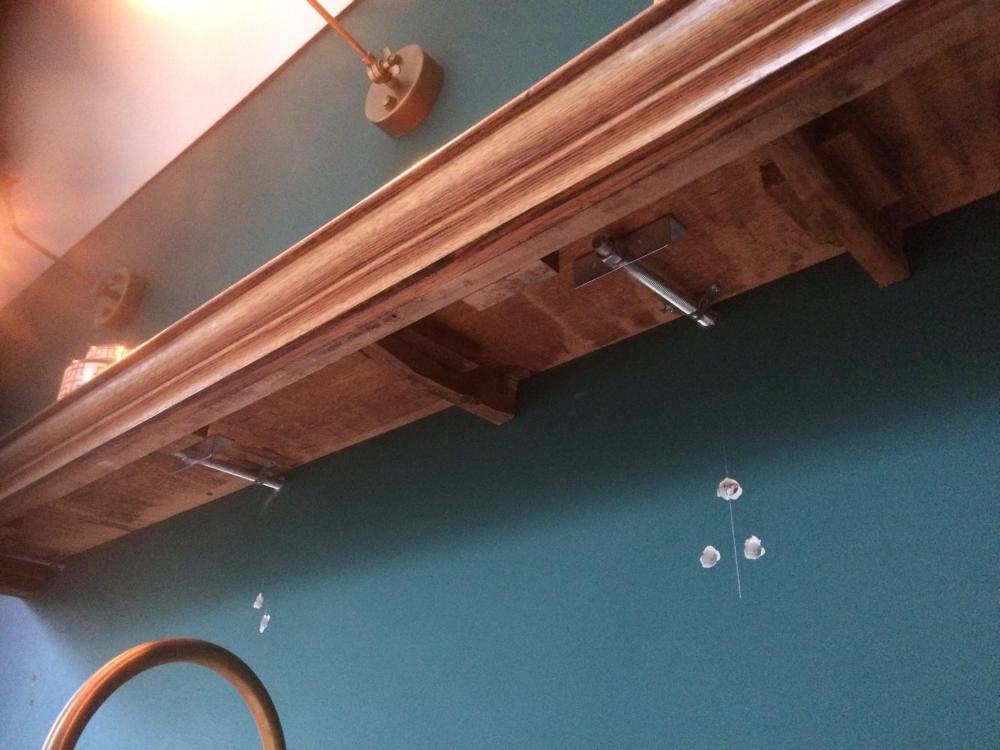

-
What Resin To Use For Resin Anchors
Gus Potter replied to Johnny Jekyll's topic in Building Materials
If you swap the bolts for rods cut to length on site just check what grade of bolt the SE has speced.. this could be 5.6 or say 8.8 grade. You can buy rod online say that is certified as being a particular grade. To avoid any hassle later on get a receipt that shows the grade of rod. If in any doubt get an 8.8 grade rod and nut to match as this usually covers all domestic applications. Some of the rods you get from DIY suppliers don't always have the grade specified and thus can appeal to the wallet at first glance. If you have rod left over this can come in useful to fix, for example floating shelves. -
How much can I safely store in my loft?
Gus Potter replied to vcps2021's topic in General Structural Issues
Yes looks like on the same page. The 25 kg per square metre your SE mentioned is shown in the "Ceiling Tie loads screen" shot as "Imposed load (loft storage) 250 N/m^2. Off this you deduct flooring weight to arrive at the figure of ~ 10 kg per square metre. -
Hiya Caroline P. Knocking out wall in flats is quite a subject. It's a great topic and not just relevant to folk with a "portfolio". I hope the following helps. If there is interest I'll make a post on the in's and outs of taking down walls in old stone built flats if you are say a first time buyer. For now Caroline.. The devil is in the detail, you say you have a "management company". That changes the game as if you are managing property, then you become an experienced client under the CDM regulations, it's difficult to argue with the HSE that you are just a domestic home owner. The law differs quite a lot. The next thing is, do you own the whole block or just all or part of the ground floor. Lastly, does the building connect to other buildings, say like tenements or a row of flats in a terrace. Now if you are taking out load bearing walls on a ground floor flat then the SE is going to ask: 1/ Who owns the other flats, or is the block in single ownership. 2/ Is the block connected to another block, do I need to take into account the stability of say a whole terrace of flats or is it a stand alone block. 3/ How do I discharge my statutory duty to public safety by ensuring that from conceptual design to completion and beyond (in service) the design and build is controlled and supervised. 4/ Can I be sure that I am working with a competant team who recognise that there has to be an element of the budget (5-10 % yes folks it's that much! ) set aside for health and safety as required by the statutory CDM regulations. Is there provision for contingency should we need to take action if something untoward happens. Who is authorised to take immediate action should something happen that is unexpected. 5/ The SE will want to know that the builder / contractor has not just public liability insurance but also full contracts works insurance. If they don't have this then the SE's PI insurance provider will run a mile, they will ask... Why is the SE working with builders that don't have a proven track record and industry standard insurance? Why should we take all the risk as the SE's insurers. It's worth while researching this as it could save you a pile of cash and also let you sleep at night knowing you are being safe, not inviting BC to serve you a notice and so on. Caroline, the above sounds a bit rough but that's kind of how things pan out. If this is more than a one off then your Dad and Husband probably need to get some proper contractors insurance, other than that they may be better off just doing the finishing work.



