PeterW
-
Posts
18480 -
Joined
-
Days Won
207
Everything posted by PeterW
-
So this is a “depends” answer ..!! Wood will insulate and be thicker - you could use engineered wood but that would be 14mm thick on the assumption that you float it over a backer board system of around 15mm. That leaves 60mm for PIR which isn’t enough. Tile would need a similar - if not slightly thicker - panel system and more rigid. Ideally onto a screed but you don’t have the thickness for a minimum 50mm liquid screed, plus 10mm tile and adhesive. That’s going to be probably 55mm insulation at best LVT (depending on brand) ideally goes onto a screed system, so 5mm for LVT and then 50mm screed is leaving you with 45mm insulation which isn’t enough. You say about “cold floor” but only tiles really feel cold underfoot. You could do something like LVT on 6mm ply on 22mm T&G and float it all on 60mm of PIR. It won’t feel warm but neither will it feel cold. To be honest if you’re going to the hassle of ripping out walls then I would be taking out the floor too. 100mm concrete isn’t that thick and assuming it’s not got loads of rebar in it a decent jigger breaker will take it out no problem. You’ll be left with 130mm for insulation with a 50mm flow screed over the top, a perfectly flat new floor and UFH too, with no compromises.
-
That's not correct - Heat loss is increased by the temperature but you will need to put more heat into the building anyway to heat the room so the floor temperature will become irrelevant and your losses will be near identical. What is your plan for the floor finish for the new room as that will affect the options.
-
Ok - So could you “drop” your plans so the building sits below the roofline slightly ..?? It would mean no disturbance to the roof and therefore you should be fine. Lots of ways to skin this cat but to be honest a fully built extension with no planning approved in 5 months is going to be a serious challenge anyway !
-
That’s not balanced. There is a way to test it but explaining it is a challenge ..!! You need to work out which rad gets hot “first” by opening all the lock shield valves and then you go back and reduce the flows. Start by listing out all the rads and where they are please.
-
 Looking at your layout you seem to be combining the lounge, dining and kitchen along with part of the hall into a single room ..? You’ve then gone for a front extension (that will need planning permission AFAIK) and then really not gained much in space. The engineering cost of putting in the steelwork needed for the combination of those rooms would be phenomenal as you have removed both spine walls, and then added the complexity of a 9m opening across the back. At a quick fag packet calculation, the steels in the back of the house alone will be 533x210x122 so weigh over a tonne each, and the spine will be similar. Without knowing the joist layout, I expect you may have to remove the floors potentially or will at least end up with 200mm drops in to the rooms where the current walls are from the ceilings which will look a mess. Not knowing where you are in the U.K., that structural work alone could be £40-60k. That’s before you have made any other changes to the building. I would be putting a full width back extension at 3.5m deep across the whole building and getting that to do the work of your current lounge diner layout. Then rework the other rooms, you have space to use part of the garage and still retain some for storage.
 -
The workshop has a rad in it..??? So this sounds like they aren’t balanced at all, and the ones in line in front aren’t getting the heat. Do you know the order in which the rads are plumbed..??
-
Does your scheme alter the roof in any way ..? There are ways of ensuring bats remain undisturbed and as long as you’re not affecting their entry and exit routes then your scheme should be fine. the downside is you can’t do anything until you have permission and you could find this will take until the middle of the year.
-
You have to use GRP or steam proof panels for the walls as anything else will have issues. These guys do some nice stuff - saw them at one of the shows.
-
@LSB Our farm tracks used to be MoT1 until the top of the hill and then they were concrete bays at 8” thick laid 10ft wide by 8ft long... so that would be fine ..!! Not a “driveway” by any stretch of the imagination and that’s classic council crap tbh .. I would do as @TonyT said and top scrape it and put MOT1 down and then let it grow over. Hundreds of farm tracks like that across the U.K.
-
Depends what you are looking for and how much you are prepared to pay. Is this a new build ..?? search for M&E Consultant or M&E contractor and you should be able to find one.
-
Ensuring vaulted ceiling won't get hidden condensation
PeterW replied to Jilly's topic in Ventilation
Ok so you can get round this. What sort of tiles have you got @Jilly..? Prior to ridge venting the simplest way was to use tile vents - you’ll need to replace a tile every 3m or so in the top 3 rows of tiles. It’s easy done - they push up the tile above to allow access to any fixing and then swap the tile for a vent. They are made to match the tiles. Alternative if you have a planning issue or non standard tile is to use lead vents - lovely looking but eye watering expensive if they are non standard sizes. These are the vents - about 3 times the price of plastic but lovely to look at ..!! https://www.justlead.co.uk/product/roof-void-vent/- 35 replies
-
- 3
-

-

-
- vaulted ceiling
- ventilation
- (and 2 more)
-
Can’t use it for that. You need to use a proper breather membrane and a vapour barrier below the insulation.
-
Running out of hot water
PeterW replied to canalsiderenovation's topic in Air Source Heat Pumps (ASHP)
It’s in the conduit going into the left hand port. -
That is a significant flow temperature and not needed in a decently insulated properly. It is also above the maximum flow temperature of a couple of thin screws products. 35-37°C is fine and you will get a return of around 28-30°c when balanced which on a heat pump will be pretty close to max CoP. I’ve seen a couple of your posts that refer to commercial standards and residential is usually slightly cooler as the overshoot can be more pronounced.
-
Errr ... poor blockwork and pointing will show up under render, and your plasterer will hate you if he’s got to stop up a load of gaps or clean off snots. You will find better places to save money - if you did it over 4 months where a bickie would take a month, your cost of finance could far outweigh the “saving” you have made.
-
Black UPVC Quadrant or small profile ..? Can’t see the exact dimensions but should be able to get something
-
WC / Shower Room on Ground Floor vs Building Regs
PeterW replied to BartW's topic in New House & Self Build Design
If it was me the top floor would be master suite with the terrace - gym seems a waste ..! -
Shouldn’t that say @pocster will be along with his plans for his HA Laser show .. as he’s still tiling his floor .. and he will be doing it some time in May...
-
Wetroom shower tray formers and vertical outlet trap options
PeterW replied to cwr's topic in Bathrooms, Ensuites & Wetrooms
Assuming you want to tile, the McAlpine one comes in a tile version here https://mcalpineplumbing.com/wet-room-products/tiles-gratings-accessories-and-conversion-kits/fgt150-sv-110-150mm-square-stainless-steel-tile-internal-non-return-valve-push-fit-outlet need to get the tanking perfect though -
@Russdl If you’re using in the corner then just bed the profile itself into a bead of CT1 and it will seal the corner for you too
-
The connector I linked is IP65. It’s all 12v anyway so perfectly safe and all I did was a smear of clear CT1 over the joint on that one and on the ends (they push in) and a quick bead across the top of the profile when installed as the cover snaps in tightly.
-
GRP if it’s behind a parapet as they can hold snow as well as water and ice and snow are more damaging. You can get a decent fall on it (1:40) and it won’t have any issues for decades.
-
No it’s fine - it will be standard twin and earth - the sparky may need to solder the wires unless there is a neat place to hide a connector. They sell a connector to do it but if you look carefully there are solder pads all the way down the strip you can attach to. This is the proper connector - they aren’t expensive but a little bulky. Without seeing where it’s going it’s difficult to see if you can get the connector hidden. I use this supplier now for all the LED Stuff I need as it’s really good quality and zero interference from the transformers. It’s not the cheapest but it is very good.
-
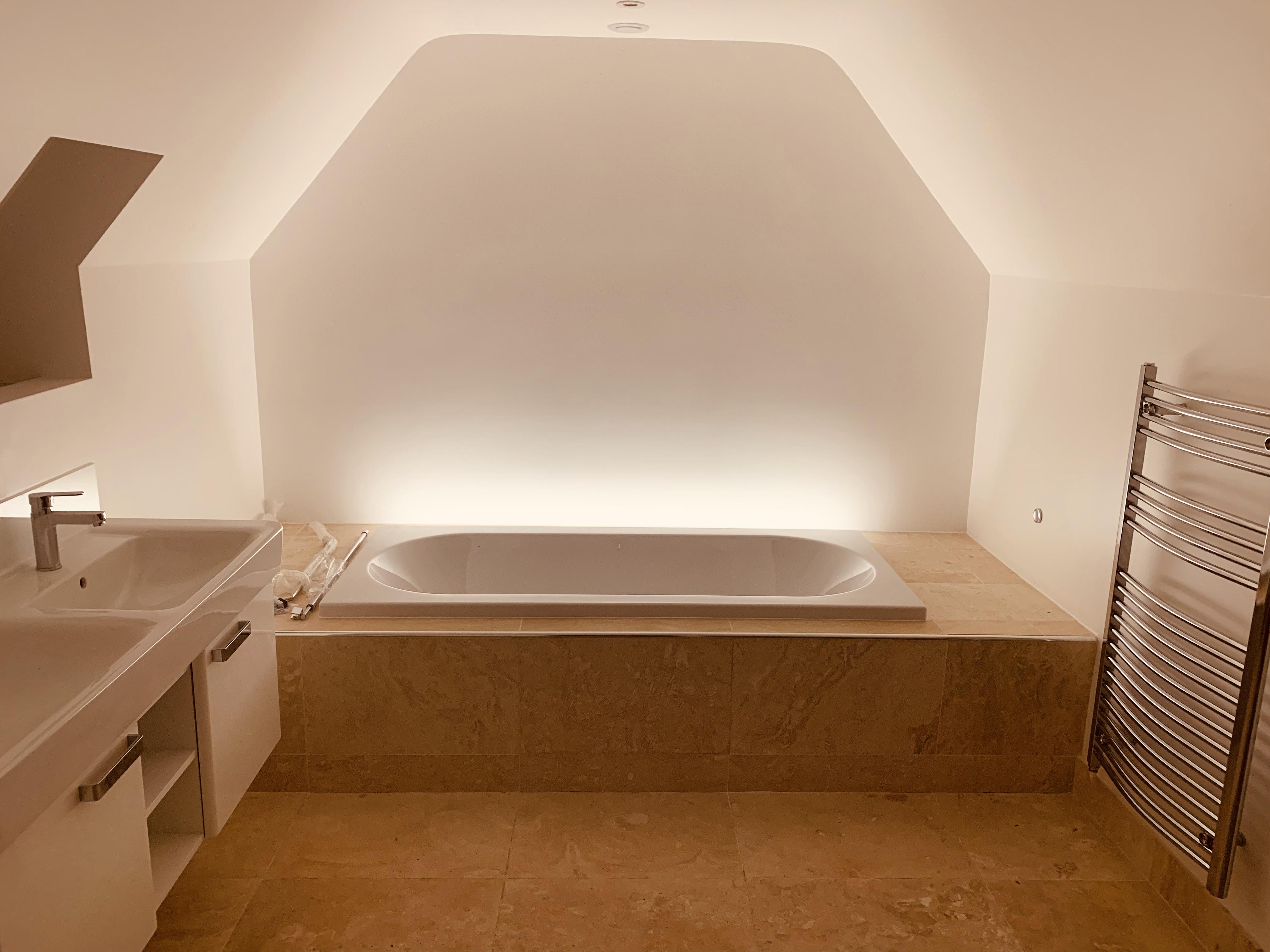
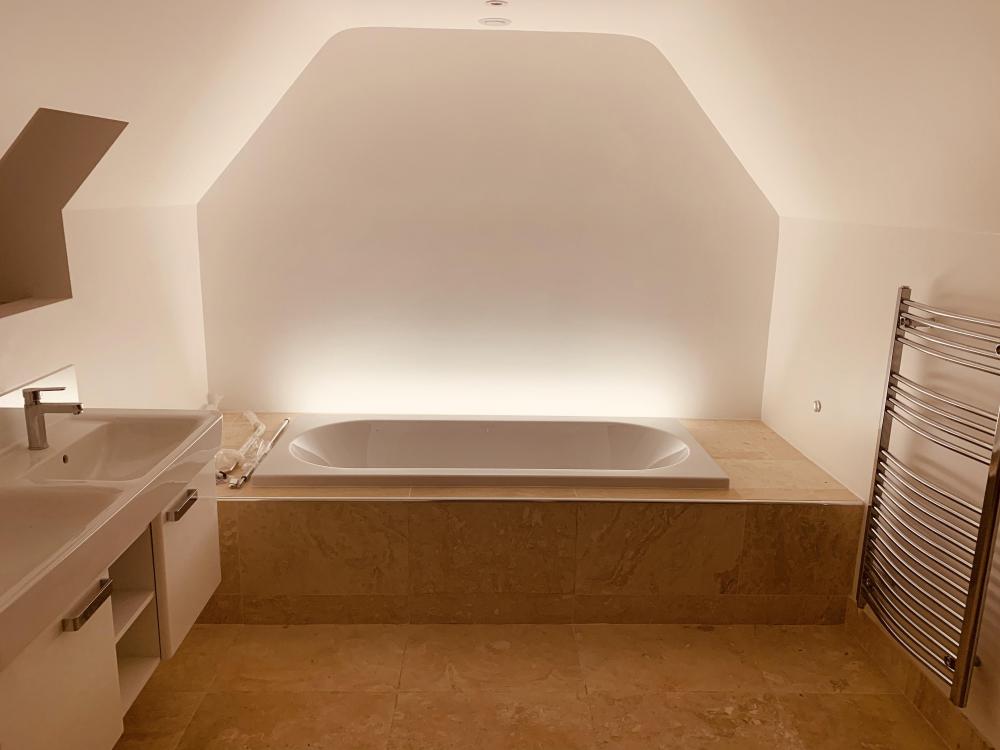
OK so why not use a profile and strip ..? You can buy IP65 self adhesive strip and you can get some really nice profile - I used a quarter round behind a bath to cast a glow up a wall and it was dead easy. You need to “hide” the transformer somehow but not difficult. Or it can go in the attic and just use the grey T&E for 12v to the strip Profiles here https://www.ledspace.co.uk/collections/corner-led-profiles/products/flat-corner-led-profile IP65 strip https://www.ledspace.co.uk/products/tradestrip-60-12v-led-strip-warm-white-splashproof
-
@JFDIY this worries me as if that fails it fails hot, so your boiler will dump 55-65°C water into the floor ... that’s about as bad as it can get, and it’s another reason I don’t like Nu-Heat (other than their ridiculous pricing ..!!)