


A_L
-
Posts
652 -
Joined
-
Last visited
-
Days Won
1
Everything posted by A_L
-
EPC for RHI with incomplete build
A_L replied to oranjeboom's topic in Energy Efficient & Sustainable Design Concepts
Since it is an existing house I think an assessment could be done on the basis of electric instantaneous heating. However the heating system does not affect the total heat demand, which is dependent on the heat losses. IIRC if the EPC has recommendations the heat demand figure for the RHI payment will be based on the heat demand with the recommendations implemented. If you have <= 150mm loft insulation then 270mm will be recommended and if no CWI this will be recommended, if <80mm jacket on DHW cylinder then improvement also recommended. There may be other relevant recommendations. -
Phase Change Blocks to Protect Freezers
A_L replied to Ferdinand's topic in Energy Efficient & Sustainable Design Concepts
The phase change will occur at a temperature lower than the fridge uses so will not store/release energy.- 18 replies
-
- 1
-

-
- cold storage accumulator
- phase change
- (and 1 more)
-
Focal correction for mid distance work onsite.
A_L replied to epsilonGreedy's topic in General Self Build & DIY Discussion
I have astigmatism and I am significantly short sighted. I have been told that I am not suitable for varifocals/bifocals. I have a pair of glasses where one lens (the right) is for reading and the other for long distance. Seems to work O.K. for me. -
another possibility https://www.worldweatheronline.com/ainstable-weather-averages/cumbria/gb.aspx
-
Strictly speaking a 24kW boiler will use 24kWh every hour it is on, it is unusual for a electric boiler to modulate as its efficiency is unaffected by the on/off ratio. I do not how big you thermal store is (300l?) but it will only store about 10kWh of usable energy for the radiators and the boiler will tend to fire every time cool water from the radiators returns to the thermal store as its entry will be immediately below the heating elements and the sensor which controls them. The size of your electricity bill is relatively unaffected by the 24kW immersion as your heat loss from the tank will be a relatively minor 3kWh per day or so and this will provide background heat in the house anyway. The size of the bill is ultimately determined by the whole house heatloss and the mean average temperature you maintain.
-
If your 3.3m2 coil is stainless steel I think it would only require a temperature drop of around 3°C across it to transfer 5kW
-
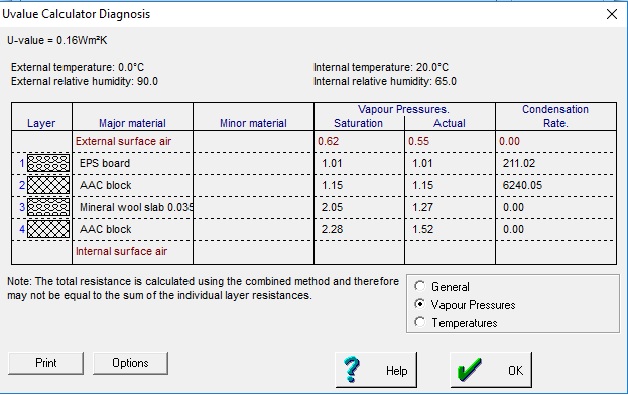
FWIW the old BS5250 (Glaser) method suggests you do need a VCL, or at least a vapour check layer. you might want to play with - http://www.builddesk.co.uk/software/builddesk-u/condensation-risk/ https://www.u-wert.net/u-wert-rechner/?&lang=en

-
http://www.microgenerationcertification.org/consumers/product-search?product_type_id=6770 Note the SCOP varies with the flow temperature which is installation dependent. 'F2040' in Keyword field of search
-
Design SAP and sunamp
A_L replied to vivienz's topic in Energy Efficient & Sustainable Design Concepts
Please don't. A fail at the 'as built' stage could be costly and inconvenient to correct. -
Design SAP and sunamp
A_L replied to vivienz's topic in Energy Efficient & Sustainable Design Concepts
I would ask Sunamp for a solution as they are bound to have had this problem already. Instantaneous DHW would give a better result than reality as there would be no allowance for storage and distribution loss. What fuel is used for the instantaneous DHW? What are the TER and DER values?- 18 replies
-
- 1
-
-
- heat storage
- design sap
- (and 5 more)
-
Design SAP and sunamp
A_L replied to vivienz's topic in Energy Efficient & Sustainable Design Concepts
As long as its good enough to look like its going to pass when it gets to the 'as built' stage it honestly does not actually matter too much unless you are motivated to get a good result. I am not familiar with current full SAP software but it is likely that he has ignored the Sunamp as there probably is no way to enter such a new system in the software. How has he actually entered your DHW? The thermal bridges will be conservative default values which will hopefully significantly over estimate the energy use or they are 'approved details' with already defined values. -
Given the sarking board there should be an air gap. Assuming rafters at 400mm centres 200 + 82.5 ha U approx. 0.093, 200 + 60 has U approx. 0.106. A difference of 0.01 in U value has an energy implication of about 0.5kWh/m2.yr
-
A U value of 0.13Wm2.K could be achieved (just) with 130mm of Celotex
-
If your 163m2 floor is anywhere near square it would only take 50mm of Celotex to get down to 0.28W/m2.K
-
Non setting mastic or sometimes expanding tape. Could use 100/150mm wide strip of DPM polythene fixed with ORCON F to both floor and wall.
-
With good air tightness, approaching PH levels 2-2.5kW of heat input should maintain temperature to very low levels (-10°C). The immersion will be the majority (not backup) heat source for six months at least for DHW. With total December PV production averaging perhaps 3.6kWh/day, DHW PV will be minimal.
-
Trussed rafters, warm roof
A_L replied to Russell griffiths's topic in General Self Build & DIY Discussion
Tongue and grooved 18mm OSB should be reasonably airtight on its own, could always put silicone in the groove. Maybe this is a case for an airtight breather membrane outside the OSB so that you only have a problem if the air-tightness layer comes 'in-board' (at around the gutter level) Maybe a case for fully adhered membrane https://www.proctorgroup.com/air-barriers https://www.dorken.com/en/our-products/products/residential/delta-vent-sa.php -
Trussed rafters, warm roof
A_L replied to Russell griffiths's topic in General Self Build & DIY Discussion
This depends on your idea of a 'warm' roof. Mine is that there is a continuous layer of a substantial proportion of the total insulation above the trusses to reduce the temperature differential across the trusses and have them and everything below the insulation at near internal temperatures. Obviously this not the construction you want. If by a 'warm' roof you mean everything below the trusses at substantially the internal temperature then leaving a 50mm air gap on the topside of the insulation, running up to a ridge vent, or sometimes by fully filling the truss depth with insulation and using a suitable breather membrane below the roof covering. A VCL below the trusses would be necessary and I would put at least some insulation below the trusses to reduce thermal bridging through them. -
@bissoejosh, do you have a BBA cert for pumped cellulose?
-
The only downside is likely to be a decrease in the 'decrement delay', or the ability to reduce/delay sun heat transferring through the structure and possibly causing overheating in summer. If the façade is of brick or dense block this would reduce/eliminate the risk. I am assuming that you have a cavity construction. If a lightweight 'solid' construction with render the risk would be increased. I have frequently encountered brick/cavity/timber frame walls incorrectly filled with eps beads (it invalidates the usual CIGA guarantee) but never experienced any technical failure so I would not expect any problems where you retain a void cavity.
-
Long planks under the feet of the scaffold/ladders will be enough.
-
Previous thread on similar topic - https://forum.buildhub.org.uk/topic/4553-corner-window-insulation/?tab=comments#comment-72824
-
Beware the power consumption of motion sensors, could easily be 10W, that is a lot of LED light.
-
If the PIR has a foil face put this uppermost. If practical put the supro underneath the PIR with adhesive or similar. Avoids multiple punctures from OSB fixings. PIR, especially foil faced has significant vapour resistance and acts as its own vapour check so would not bother with VCL if you do not already have it.
-
hello and welcome, In regards the GSHP as a rule of thumb you will need 50m2 of land per kW of heat pump output. An alternative to insulating the whole floor is to insulate down the external walls to the top of the footings. Even without any underfloor insulation 100mm eps edge insulation to 0.67m could get you to about 0.6W/m2.K
