


A_L
-
Posts
652 -
Joined
-
Last visited
-
Days Won
1
Everything posted by A_L
-
Creating Visual Block before Planning App
A_L replied to Ferdinand's topic in Landscaping, Decking & Patios
2 - To get a reasonable screen to 2m in three years you are going to require at least 4x1.5m plants per metre at a cost comparable to your boarded fence. 3 - There are none that will do the job as quickly/cheaply 4 - Remember these are deciduous and there is not much solidity for many years 5 - To long (10yrs?) unless planting full almost full sized plants at considerable cost Plant the slow grower on the outside and reclaim ground when you remove the leylandii (Possibly sell them on ) -
'Raw' asbestos is a fibrous material, not something encased in a matrix and formed into a sheet! Obviously cannot say for certain what the matrix is.
-
- Would there be any significance in the fact that the maximum allowable under PH is U=0.15?.
-
OCDEA - On Construction Domestic Energy Assessor. The person who did your initial assessment will be able to advise on the effect of the fuel change.
-
Yes there is a PEA, predicted energy assessment and an final 'As built' SAP. One of the major hurdles is to get your CO2 emission (DER or Dwelling Emission Rate) below a target emission rate (TER). The TER is based on natural gas which has a CO2 rate (g/kWh) of about 40% that of electricity. So it would be very easy to fail this. You need to get your OCDEA to assess this ASAP.
-
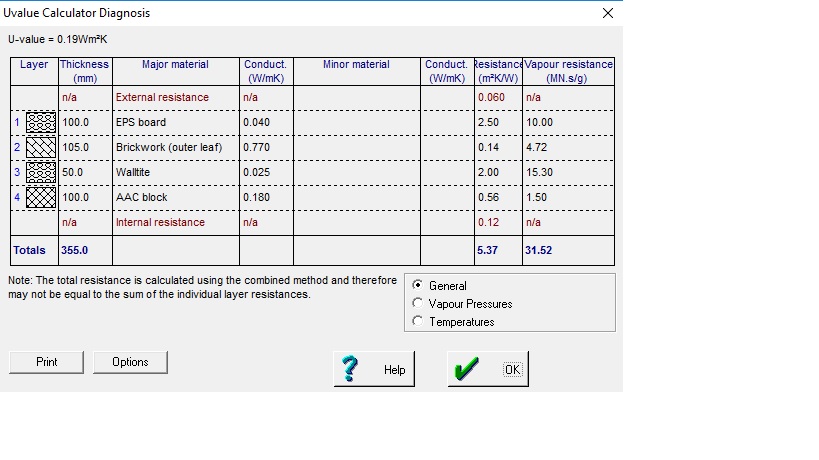
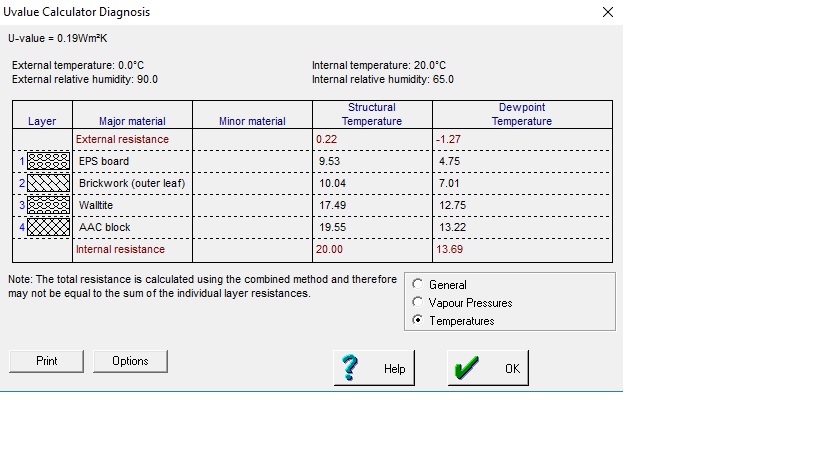
@PeterW The software operates to BS5250 1989 and BS6229, it is no longer publicly available but was state of the art till about 2007 (NHER Evaluator). Here are a couple more outputs for the same build-up.
-
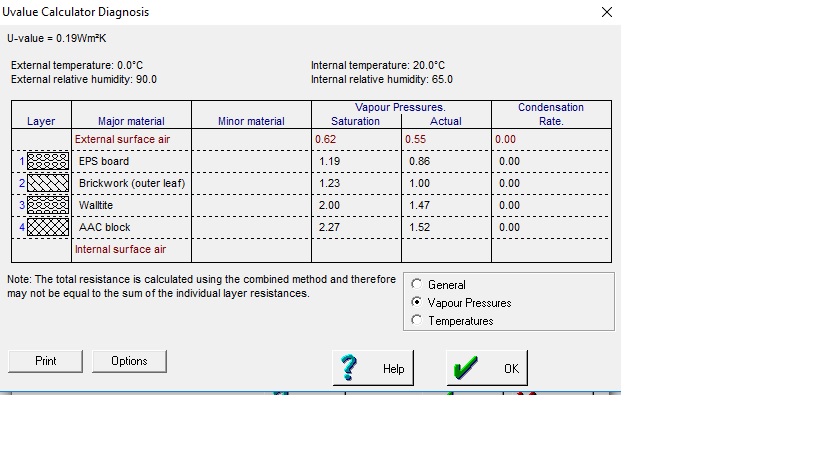
Yes, here is a condensation analysis. Since dense concrete block does not produce interstitial condensation with a filled cavity I assumed that the OP would be referring to AAC block (lambda 0.18W/m.K) which does, after all these have been around for a very long time
-
If visually acceptable airbricks top and bottom would do The people who supply Icenyne usually have access to a closed cell polyurethane as well. Walltite, a spray applied closed cell polyurethane has a vapour resistance sufficiently high (306 Mn.s/g.m.) that interstitial condensation would not occur. There are a small number of companies that use polyurethane for cavity wall insulation, it is usually used where wall ties have failed as it sticks the two leafs together. Interstitial condensation happens in this case for two reasons, 1) the lightweight block is sufficiently thermally resistive to significantly lower the temperature of the brick outer leaf. 2) polystyrene has a significant vapour resistance, typically 100Mn.s./g.m that it causes the water vapour to 'dam up' on its warm side in the outer masonry leaf, in comparison with high density fibre batts at <10Mn.s/g.m These two effects combine to push the vapour pressure above the saturated vapour pressure for the location, causing condensation. Without a cavity venting solution, which really just increases the temperature of the outer masonry layer 150mm of EWI will lower the temperature and increase the vapour pressure in in the outer masonry leaf causing even more condensation
-
Ventilating the cavity to the outside would obviously completely negate the EWI, if you could ventilate to the heated space it would solve the problem at about a 10% loss of thermal resistance for the whole wall. If the cavity fill is a low vapour resistance material, such as any fibrous/cellular insulation and the EWI is polystyrene there is an interstitial condensation risk in the outer masonry layer. If you could change the EWI to dense fibreglass/mineral wool batts then the reduced vapour resistance should eliminate the condensation risk (assumes render reasonably vapour open).
-
Bring on the Hydro Power :-0
A_L replied to Lesgrandepotato's topic in General Self Build & DIY Discussion
- at a reasonable 50% efficiency you've probably got about 250W - assumes 10l/s flow, 5m head - formula, .............flow(l/s) * head(m) * 9.81 (gravity) * 0.5 (efficiency of generator) = Output (Watts) -
You are not going to get significantly better energy recovery efficiency, perhaps 2% in class leaders but the Specific Fan Power (SFP) is perhaps 50% higher than the best. http://www.ncm-pcdb.org.uk/sap/pcdbsearch.jsp?pid=34 Also what ach@50Pa has the assessor assumed?
-
What's my likely epc value now?
A_L replied to Lesgrandepotato's topic in Energy Efficient & Sustainable Design Concepts
Since 53 is a 'high' E my guess is a 'C' at least half way up its range. -
A few questions about vapour permeability etc
A_L replied to Crofter's topic in General Construction Issues
In this case , yes. However this is only so because the OSB is sufficiently vapour resistant to restrict the rate at which vapour passes through to reach the cold side. If the OSB had only been 9mm thick it would not. In other words it is the build-up as a whole which works, not an individual element. -
A few questions about vapour permeability etc
A_L replied to Crofter's topic in General Construction Issues
If it is possible for you to move the OSB to the warmside of the I-beams (as @ProDave has done) you would not even need a VCL (I would probably still fit one anyway) This corresponds with the approach suggested by @JSHarris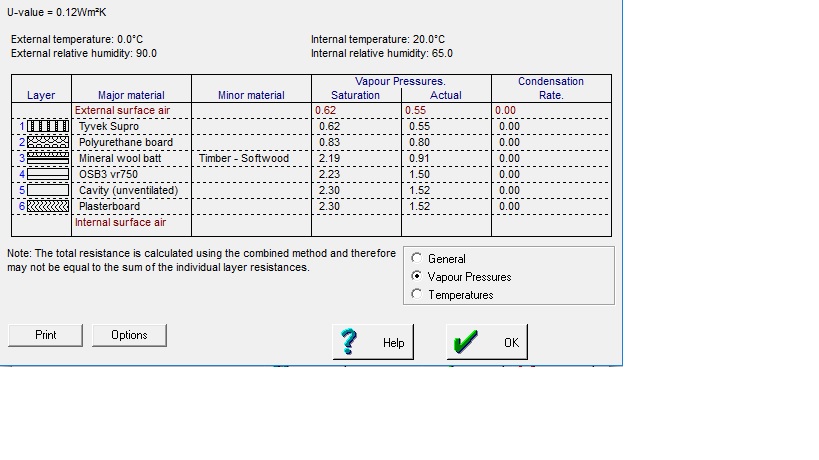
-
A few questions about vapour permeability etc
A_L replied to Crofter's topic in General Construction Issues
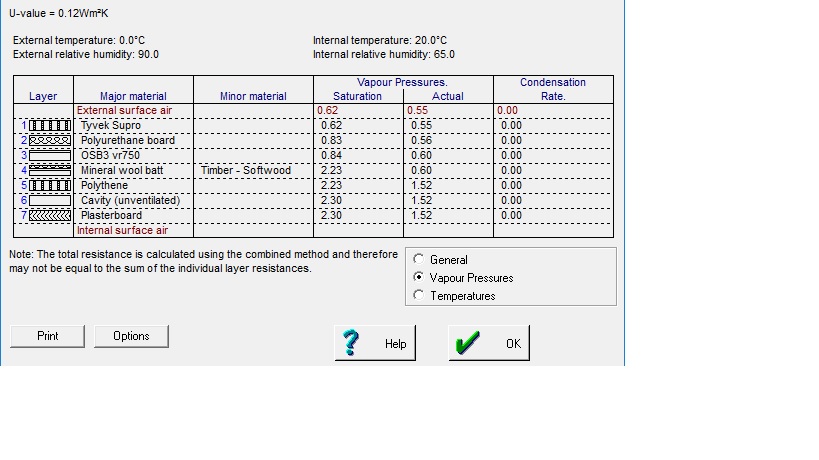
Hello @MikeSharp01, sorry for the slow reply, went out after replying to Crofter, came back late and was too tired to assemble this reply, unfortunately things are now going to get a little complex and perhaps a little indecisive. First here is the BBA cert for Norbord OSB3 which may be what you have http://www.bbacerts.co.uk/CertificateFiles/38/3857PS1i1.pdf Here is a useful document that will on page 4 enable you to convert the various units that are used in vapour resistance/condensation analysis http://builddesk.co.uk/wp-content/uploads/2013/01/vapourResistances.pdf I have approximated your build-up as follows Note the high vapour resistance off the polythene VCL Based on this build-up here is a condensation risk analysis The model, which operates to BS5250 1989 and BS6229 and suggests that there will be no interstitial condensation under the given conditions. If the vapour resistance of the VCL layer was reduced to about 40Mn.s/g it suggests condensation may start to occur at the OSB layer. Here is a publically available tool to model condensation risk, which works to BS5250 2002 http://www.builddesk.co.uk/software/builddesk-u/condensation-risk/ a 30 day free trial version is available. Just make sure the external/internal temps and humidity you use are realistic In summary 1) Your build-up as described appears to have no problem with interstitial condensation. 2) If the VCL was degraded sufficiently a risk could arise, it does not 'fail-safe' 3) If your build-up is exactly as you describe it seems to me that VCL is vulnerable.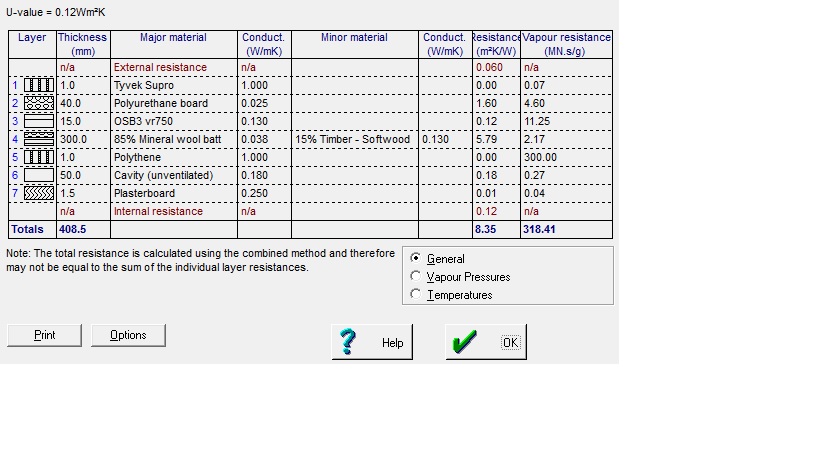
-
A few questions about vapour permeability etc
A_L replied to Crofter's topic in General Construction Issues
Corrugated steel O.K., use approx. 50mm battens attached to vertical studs to provide rain-screen type construction with generous gaps top and bottom to provide solar assisted ventilation! The battens would also secure a vapour open and preferably airtight breather membrane which should hold the underlying semi rigid insulation batts in place without further sheathing. Try to avoid OSB sheathing on the outside, as some are quite vapour resistant, this is the riskiest option with regard to interstitial condensation. Cement bonded particle board, MgO board, have low vapour resistances, panelvent dhf if you can get it and even plywood are other possibilities with lower vapour resistances than OSB. I would only use woodfibre if you think reducing the thermal bridging of the studs is important. Do not use PIR/PUR on the cold side of the insulation as you are right, they have significant vapour resistances The Kingspan roof sheets in principle have an insulation of sufficient vapour resistance to prevent sufficient water vapour getting to the cold side, i.e. under the vapour impermeable metal sheet, that condensation does not occur. This not something I am entirely happy about. -
FWIW IMHO, 1) Stud upgrade, worth it, even if small additional costs elsewhere. 2) Slab upgrade, worth it, even more if UFH. 3) Roof upgrade, probably not.
-
Help me out of these holes, please!
A_L replied to ToughButterCup's topic in Insulated Concrete Formwork (ICF)
- or add a nut, weld, use spanner etc...? -
the full quote:- 'Homes would have “high thermal mass” so they do not lose heat easily from https://www.theguardian.com/tv-and-radio/2017/sep/04/grand-designs-presenter-kevin-mccloud-seeks-to-raise-50m-to-build-600-homes-a-year bad if it was the reporter, if it really was K.McCloud then.......
-
Thermal Solar Panel V LPG Boiler To Heat Water Costings
A_L replied to s2sap's topic in Boilers & Hot Water Tanks
The average you will generate is 17kWh per day, on a perfect day in U.K. a 4kWp PV system can generate in excess of 28kWh You will, unless you pay for an export meter, be on a 50% 'deemed export' and receive 4p for half your generation regardless, even if you do not export any at all During the heating season after appliance and DHW heating the amount left over will be insignificant -
If the immersion heater is side-entry low down in the tank then no. I however it is a top-entry then there are some complications. If you actually mean the heating element of the immersion heater then they do not heat the water below their lowest point well and obviously the volume heated will be less with a shorter one. If you really do mean the thermostat then the shorter one will switch off when the water higher up reaches the set point leaving the water below it less warm due to stratification, although this effect may be small if the water heated is turbulent and mixes to some extent.
-
Thermal Solar Panel V LPG Boiler To Heat Water Costings
A_L replied to s2sap's topic in Boilers & Hot Water Tanks
The latest version of perhaps the most respected simulator http://re.jrc.ec.europa.eu/pvg_tools/en/tools.html#PVP -
It means you can get 3x as much renewables as well, you will be able to export at least 3.68kW per phase.
-
Thermal Solar Panel V LPG Boiler To Heat Water Costings
A_L replied to s2sap's topic in Boilers & Hot Water Tanks
'Fraid so Steamy...........Basically you forgot to multiply by 4.2, also 0.00027 would be better It takes 15.95kWh (not 4.125) to raise 250l of water by 55°C, 0.25*1.16*55 = 15.95 The boiler may be 90% efficient but I bet the efficiency of transferring the fuel energy to the tap is 70% or less so have to allow a factor here To get anywhere near this I think you would need at least 7.5m2 of ST and two days storage capacity -
It claims to have an aluminium heat exchanger. Other units of this type have a ceramic heat exchanger so that heat transferred at a particular location along the length of the heat exchanger does not move along it to cooler areas too readily. This allows a temperature gradient along the heat exchanger which allows you to heat the incoming air. So given the high thermal conductivity of aluminium I would want to know a lot more about how it is supposed to work. More expensive versions of this idea often have pairs of ventilators which communicate with each other and are set to 'blow' and 'suck' at the same time and then swap over, maintaining balance It is a generally good idea but more expensive than centralised MVHR for a whole house


