


A_L
-
Posts
652 -
Joined
-
Last visited
-
Days Won
1
Everything posted by A_L
-
The short answer is no, but with much of the house buried in ground it should be possible. The joists of the first storey floor and ceiling are likely to major contributors to air leakage if they penetrate the inner leaf of the cavity wall, taping membrane to them is a laborious and finicky job, with the roof off there may be opportunities to place membrane advantageously. All Kingspan will have to have taped joins. If modifying window reveals, adding insulation to reduce thermal bridging, it should be possible to tape windows to reveals.
-
When you mention insulation give the type, it makes a lot of difference to the thermal qualities and as Mike has mentioned other characteristics. You do not mention insulation of the attic ceiling, insulating to U=0.15 is a must. The solid walls, have they any insulation? particularly those which presumably are only partially embedded in the hillside? 50mm of insulation is not enough for the exposed wall, 100mm of insulation of conductivity (k/lambda) less than 0.03 would be better. What direction is the window and single/double/triple glazed? The ground floor should be O.K. with UFH in screed as long as window at least double glazed. As for the attic, if only for occasional bedroom use consider radiators on a separate zone here if you are not using a heat pump for CH. As regards MVHR you need to get total uncontrolled ventilation below about 3m3/m2(external area)/hr to benefit. As explained by Temp above carpet acts as an insulator but you can increase the flow temperature as long as the surface temp does not exceed 27/28°C. It gets cold quickly because there is little storage of heat in a lightweight floor. It does not affect the fuel bill which is determined by heat losses.
-
How to make a dual fuel towel radiator work?
A_L replied to Mr Punter's topic in Central Heating (Radiators)
Why not just close one valve? This assumes this is not a 'bypass' radiator. Water expands by about 3.5% over the range 20°C/70°C https://www.engineeringtoolbox.com/volumetric-temperature-expansion-d_315.html Edit - forget this 'idea' Or leave enough air in radiator to absorb this without significant pressure increase, assuming this does not affect thermosyphon/circulation within radiator. -
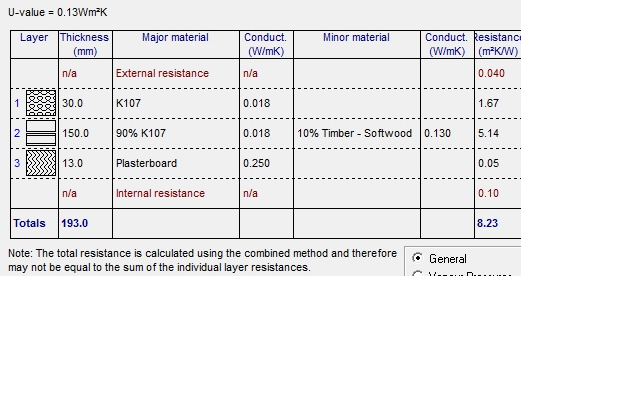
I think they are a bit optimistic, even with a 10% timber fraction (38mm@400mm centres) I get 0.13
-
All Electric House & DEAP (SAP-UK)
A_L replied to mike2016's topic in Energy Efficient & Sustainable Design Concepts
Not totally familiar with Irish regs but I think they are substantially similar to U.K. On that basis it would be difficult to get an all electric house to have a Dwelling Emission Rate below the Target Emission Rate if no help from a heat pump and insulation levels around building regs values. It should be possible with PH levels of insulation/infiltration however. -
hello and welcome, I think @pdf27 was thinking along these lines but is now going for knockdown and rebuild, maybe he will be along shortly. https://forum.buildhub.org.uk/topic/4184-in-a-bit-of-a-dilemma/?tab=comments#comment-66331
-
here is a BBA cert for a very similar Pavatex Diffutherm system bba-certificate-for-nbt-timber-frame-rendered.pdf
-
UFH in slab or screed, eps or pir insulation?
A_L replied to Tin Soldier's topic in Underfloor Heating
Just remember you need a VCL above and below PIR http://blog.celotex.co.uk/technical/what-celotex-insulation-can-be-used-in-floor-applications/ -
Yes - see Ed Davies post about eight posts ago. https://forum.buildhub.org.uk/topic/7017-can-you-have-too-much-pv/?tab=comments#comment-119234
-
New build - heat and energy considerations
A_L replied to Tyke2's topic in New House & Self Build Design
@Ed DaviesNo references, but 70°C is the usually quoted output temperature, its about the highest flow temperature where the return can be expected to cause 'condensing' in the boiler. Relative to 70°C outputs at 30°C/13.5%, 40°C/32.1%, 50°C/53.0%, 60°C/75.8% for rooms at 20°C and 'ordinary' radiators -
I think you should look at air to air heat pumps (air conditioners) with multiple outlets in the large space, particularly if this is a non-winter holiday home. You will get high COPs, If you can point the PV SW & SE production will coincide with consumption. There are dedicated air to water heat pumps for hot water production. e.g. http://www.ariston.com/ww/Air_sourced_water_heaters or this type https://www.ebay.at/itm/Trinkwasserwarmepumpe-Trinkwasser-Warmepumpe-Trinkwasserwarmepumpen/221497987856
-
Roof insulation. Internal,external
A_L replied to Russell griffiths's topic in General Self Build & DIY Discussion
@Russell griffiths , what is described as a 'breather membrane' in the diagram on page 7 is actually described in section 4.2 (page 4) as a 'vapour control layer' ! This and the relatively high vapour resistance of the OSB immediately below it means that there is a significant risk of condensation and a flow of air is needed to remove it. With insect proof ventilation at gutter and ridge and a air flow at right angles to the insulation I do not think there is to much of a problem, low air velocity. -
Total energy consumption per m2 per annum
A_L replied to NSS's topic in Energy Efficient & Sustainable Design Concepts
@ProDave , can you estimate how much of that is DHW? -
Vapour Barrier or no Vapour Barrier
A_L replied to teddy_amok's topic in Lofts, Dormers & Loft Conversions
I would say you need to increase the ventilation in the loft. This would prevent condensation on the timbers. On the ceiling the place to put a VCL on the warm side of the lath. Foil backed plaster board would be the sort of thing, although with enough ventilation you shouldn't need a VCL although it will help with air tightness On the walls you really need IWI, if the insulation has reasonable vapour resistance, e.g. PIR/PUR/XPS you should not need a VCL but again it could help with air tightness. Simply laying insulation on the skeilings is not airtight enough, either IWI like the walss or remove lath and plaster and re-do. Tie the airtightness features of ceiling, skeilings and walls together. -
Roof insulation. Internal,external
A_L replied to Russell griffiths's topic in General Self Build & DIY Discussion
Now that you have said it is some sort of metal sheet roof I wood say that a ventilation gap on the cold side is essential. Well ventilated a VCL is a backup which I would install but is possibly not necessary. The boards in option two will have a higher vapour resistance than the between joist fill and will be les likely to need a VCL than option one where the rockwool batts will have a nominally higher vapour resistance than the joist fill but still a very low value. In option one the rockwool batts are not strong enough to take the external roof and you would require battens fixed to the joists to carry it. Here is the BBA cert for a metal sheet roof, it has a ventilation gap and an optional VCL, page 7. BBA Certificate for Colorcoat Urban Roof panel.pdf -
Laminated glass will be etched BS EN 14449, toughened BS EN 12150
-
@curlewhouse , on the assumption this is a PIR product you should have a dpm above AND below it as there is a possibility of hydrolysis (breakdown into its constituent chemicals) in permanently damp conditions http://blog.celotex.co.uk/technical/what-celotex-insulation-can-be-used-in-floor-applications/
-
Most panels are around 1.0m x 1.6m, at 285w per panel with 20mm between panels you need about 6m2 per kWp output. You cannot have panels higher than ridge line and for the usual fixings you stay about 0.5 m away from other edges, although fixings are available to go right up to the edge (wind uplift problem). @Russell griffiths 1kWp will yield about 900kWh/year but do not expect any significant output when you need the heat pump for space heating. Maximum production will be 7-8kWh/kWp/day in May/June. Dec/Jan might average 0.8-1.0kWh/kWp/day with frequent zero days
-
@Square Feet , this a reference to the 'Approved Certifiers of Design' referred to in your first post which applies in Scotland. They come in two versions, 'Building Structures' and 'Energy'. As competent persons (well maybe?) their work does not have to be checked by BC at building warrant stage and a small discount is available. http://www.certificationregister.co.uk/
-
@newhome , your DNO, Scottish Power, is likely to want you to have 3-phase supply for heat pumps of 14kW and up
-
@sam , Yes and No in that order.
- 29 replies
-
- 1
-

-
- u value
- insulation
- (and 1 more)
-
Basically I agree with AliG, rolled out loft insulation gives cheapest thermal resistance performance. If the rodent problem could be eliminated then loosefill cellulose with its greater decrement delay is only about 7-8% dearer on a performance basis. https://www.insulationsuperstore.co.uk/product/thermofloc-loose-fill-cellulose-insulation-12kg-bag.html
-
@PAR1969, contact Home Energy Scotland on 0808 808 2282 (The Energy saving trust by another name). They should know the companies active in your area. Maybe even have grants/loans available if appropriate.
-
@jamieled, Anytime you can draw a heat-loss path, in these cases down and out through the floor slab and back up to the external air, that does not pass through a dedicated insulation material you are likely to have a significant thermal bridge. It can be mitigated but will always be present to some degree.
-
The lambda value of the Glapor is given as 0.078 so a lot of a relatively expensive insulant is going to be required. The thermal bridging of the examples given will be relatively high.
