Ian
-
Posts
751 -
Joined
-
Last visited
-
Days Won
3
Everything posted by Ian
-
I’ve used something similar designing Lidl stores: Porotherm https://wienerberger.co.uk/porotherm
-
Re ventilation of rain screen cladding on framed buildings, the guidance in BS5250:2011 is that you have at least 500sq.mm of ventilation to the outside per linear metre of wall.
-
Specifying our roof; cement board and OSB3
Ian replied to ToughButterCup's topic in Roofing, Tiling & Slating
@recoveringacademic just a few thoughts about your roof spec: - unless your house is very close to the boundary with one of your neighbours there’s no requirement in the Building Regs for you to have a fire resistant roof (just think of all those flat roofs finished in bitumen felt!) - if you’ve decided for personal reasons that you want the roof to be fire resistant then a more practical solution would be to ditch the OSB and the cement board and replace them both with a single layer of metal roofing sheet. The cheapest wriggly steel roof sheet you can find will do as you won’t be able to see it. It will need battens under and counterbattening over etc to provide an air gap to prevent condensation forming on the u/s. The cedar shakes can go on top to hide the metal. -
Specifying our roof; cement board and OSB3
Ian replied to ToughButterCup's topic in Roofing, Tiling & Slating
If you want the cement board layer to act as a fire barrier then, yes, any gaps will need sealing with a fire rated material. -
M spec ramp to the rear door but not the front?
Ian replied to epsilonGreedy's topic in Building Regulations
@epsilonGreedy there’s provision in the Regs for the situation you’ve described so it shouldn’t be a problem however I’d recommend discussing it with your BCO first. -
@Jamie998 toughened or laminated both comply with requirements for safety glass in the building regs. For security glass the police tend to recommend laminated glass as it is a little more difficult to break through. As an architect I specify toughened laminated (2 panes of toughened laminated together) for critical safety locations such as glass balustrades in busy shopping centres or in overhead glass applications. If a single sheet of toughened glass breaks it falls out completely whereas 2 sheets laminated together will hold in place if 1 is broken. Toughened glass is also best specified as heat soaked to avoid potential spontaneous breakages due to nickel sulphide inclusions.
-
Protect your Fence Posts with a Postsaver
Ian commented on Ferdinand's blog entry in God is in the Details
I put in 150 meters of fencing and got the machined timber posts from a local N Wales supplier called Clifford Jones. The ones I bought are from their 'Platinum Plus' range and have an anticipated 25 year lifespan (with a guarantee for what its worth). The posts are kiln dried and pressure treated. They also incise the posts to get the treatment further into the wood. Their next grade up involves sleeving the timbers similar to @Ferdinandand they quote a 35 year expected life. -
They are there to provide resistance against horizontal loads (eg wind loads). Without them the building would collapse like a pack of cards.
-
@vivienz we used them and they were excellent to deal with and the worktops were great too!
-
@Visti Given that you won't be building the mezzanine now the main design issue that you need to look at in order to future proof the design is Part B of the Building Regs (Fire Escape). This is the relevant extract from Part B for England:
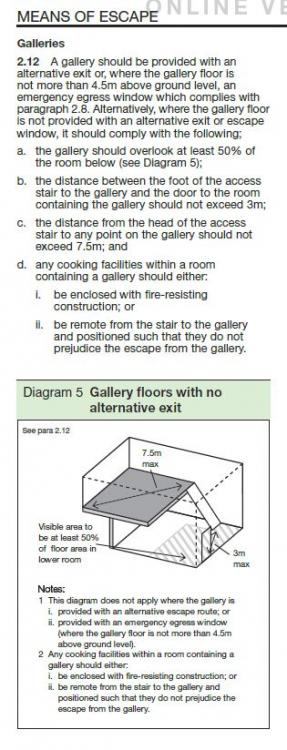
-
England & Wales are treated the same way. I don’t know about Scotland or N Ireland.
-
Sorry but that’s not correct. We bought all our external works materials such as garden fencing and driveway materials after the date of our completion certificate and we were able to claim the Vat back successfully on them with the rest of the claim.
-
Actually the deadline for submission of your Vat reclaim is 3 months from the date of your completion certificate
-
@lizzie The short answer is to simply ask your inspector what he needs from you in order to sign it off - on my own build all he asked for was the 3 items you've mentioned + they did a final visit to check that we had actually finished. IMHO it's pointless spending hours of your time getting items of information together that the inspector may not need. Ian
-
@recoveringacademic The general rule is that site helmets should be replaced if they have been damaged in any way and in terms of lifespan it's usually recommended to replace them every 5 years. The risk of something dropping from above will be very low if you're working on your own - I'm with @JSHarris and I'd wear whatever is most comfortable.
-
@StructuralEngineer The diameter requirement of 32mm - 50mm on that diagram from part K is like that because some people have trouble gripping a handrail which is narrower than that. Building Inspectors will usually accept the handrail recessed into a hollow in the wall if space is tight.
-
Air-tightness and wall plates (rim joists)
Ian replied to ToughButterCup's topic in Roofing, Tiling & Slating
@recoveringacademic The main commercial alternative is using joist caps but they are more expensive and not as good: https://www.wickes.co.uk/Wickes-Safety-Fast-Joint-Cap-SFJC305-50/p/215030 -
Air-tightness and wall plates (rim joists)
Ian replied to ToughButterCup's topic in Roofing, Tiling & Slating
@recoveringacademic I think the idea originally came from Tony Cowling as the "Tony Tray": http://tonyshouse.readinguk.org/tony.htm -
What utilities are nearby or under my land?
Ian replied to MikeR's topic in General Self Build & DIY Discussion
Don't forget to also check mining records. Over the years I've worked on quite a few sites which had either vertical shafts or horizontal tunnels under the site which affected the way that the site was developed. For some sites, eg ones in built up areas, its also worth checking old OS maps in your local library. I had one site in St Helens where checks showed an underground culverted river that crossed a corner of the site. -
Part K is simply the Approved Document and is not the actual Building Regs which means that you may be able to negotiate something different from Part K if you can convince your Building Inspector. If we are just looking at the wording in Part K then there's nothing to prevent you from using a handrail that is different to the thicknesses shown in diagram 1.13 as that diagram is for "buildings other than dwellings". I would however disagree with you when you say that that the first two steps need no handrail as I don't think paragraph 1.37 provisions should be read in that way. I think paragraph 1.37 means that if you only have a flight of 2 risers or less then you don't need a handrail. Any flight with 3 risers or more then the whole flight needs handrails.
-
@Ralph I'd agree wholeheartedly with those who have suggested taking a fabric first approach and using Jeremy's heat loss calculator to explore options. I'd also suggest with regards to heating systems that it's worth trying to keep things as simple as possible. The main thing I'd like to add with regard to insulation is that there's little point in adding a lot of extra insulation and better windows to go beyond the minimum requirements of the Building Regs if you don't also aim for very good airtightness with MVHR. At typical minimum Building Regs standards, heat losses from a naturally ventilated building will typically amount to about half of your total heat losses IE you'll be losing roughly 50% of heat through the walls, roof, floor and windows and 50% from draughts.
-
BC appointed and questions I had not anticipated.
Ian replied to MikeSharp01's topic in Building Regulations
The bit of the Approved Document B that you will need to read is Sections 8 & 9 (page 41 onwards) link: -
@Ed_MK if you don’t get any recommendations from the forum you could try the Milton Keynes branch office of an Approved Inspector called Assent Building Control. I’ve worked a lot with the guy that runs their Cheshire office who Is excellent but I have no direct experience with any of their other offices so can’t say how good they are. Address: Regus House Fairborne Drive Atterbury Milton Keynes MK10 9RG [Edit. Make sure you tell them how far you got with the LABC appointment paperwork and the fact that you haven’t paid them anything yet. The appointment process of an Approved Inspector is strictly governed and there are rules they have to follow]
- 36 replies
-
- 1
-

-
- planning permission
- planning conditions
- (and 2 more)
-
@Ed_MK if you would like to see if it’s not too late to switch you will need to discuss your situation in detail with an Approved Inspector as there are certain technical requirements in their appointment which need to be met however from what you’ve said you should be okay. I’d start by asking if there’s anyone else on the forum who is building in your area of the country who could make a recommendation.
-
@Russell griffiths the main difference between a ground bearing concrete floor slab and a b&b floor is one of thermal efficiency. In winter the temperature below a ground bearing slab will be a lot warmer than the air that will be circulating below a b&b floor